Not a repost! I decided to rewrite some chapters of “The Decade Volcanoes and Us” as I put them up on Patreon. This was one of them (and yes, a third edition to include rewrites will be out).
This Decade Volcano listing isn’t a single fire mountain with a hyphenated name — it’s a double entry composed of two active Siberian volcanoes located side by side and, unfortunately, also close to Kamchatka’s largest population centers.
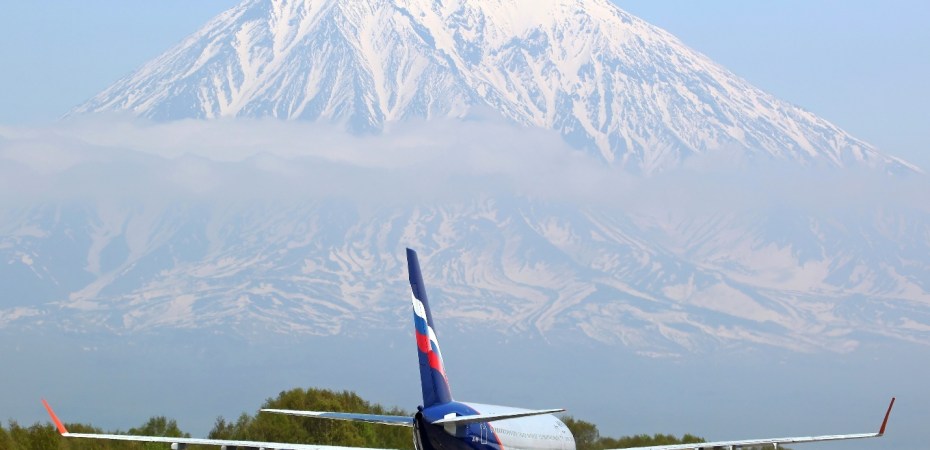
In the above image by Alexander Mishin via Wikimedia (CC BY-SA 3.0), you’re looking at Koryaksky as seen from Yelizovo International Airport, Kamchatka, Russian Federation.
Yes, it’s that close to the airport.
Air traffic concerns aside, even volcanologists, including Bushenkova et al., Koulakov et al. (source of the quotation below), and Taran et al. in the reference list, comment on Koryaksky’s “almost ideal shape.”
However, the ruggedly handsome fire cone is present today only because Koryaksky hasn’t blown itself apart or fallen down lately. It tends to do both repeatedly as geologic time goes by.
Avachinsky, next door to Koryaksky, is much more popular with climbers but nevertheless it’s a frequently active and occasionally very explosive stratovolcano in its own right.
Avachinsky drew international volcanologists’ attention with a surprise eruption of lava in 1991 during the International Decade (MTU; Viccaro et al.), while the Soviet Union was disintegrating.
If you checked out that climbing video, the weird-looking grill-like stuff in Avachinsky’s summit crater is a lava dome that formed as the 1991 eruption ended.
Active volcanoes are changeful places. Earlier in the twentieth century, sometimes it was possible (though risky) to climb down a hundred feet or more into Avachinsky’s crater! (Taran et al.; Viccaro et al.)
(Just for the record, as long as we’re looking at climbing videos, some people are willing to tackle Koryaksky, but it is much more of a challenge.)
In both videos, you can see just how close Avachinsky and Koryaksky are to each other and to the port city of Petropavlosk-Kamchatsky on Avacha Bay as well as a number of smaller local communities.
Let’s check out one last video, this time from the city’s point of view.
The “home volcanoes,” as local residents call them, own the background in this video/photo gallery from 2019 on Petropavlosk-Kamchatsky, one of Russia’s oldest cities and home to almost a quarter million people.
I don’t speak Russian, but it’s an intensely beautiful landscape.
However, evidence of hazard sits out in plain sight: all of that rugged topography in and around the city is debris from Avachinsky’s great sector collapses some thirty thousand years ago!
Temperamental gatekeepers
Both of these Decade Volcanoes contribute to Kamchatka’s reputation as “the Land of Stone Torches.”
Much of Kamchatka is wilderness, studded with a multiplicity of active subduction-zone volcanoes. In times of global peace, it has drawn many international visitors as well as researchers in a variety of fields.
But no one can drive there.
Kamchatka, nine time zones east of Moscow, is remote — a peninsula jutting off northeastern Eurasia, its shores washed by the northwestern Pacific Ocean.
To get there, visitors must travel via ship or plane to the urban hub at Yelizovo and Petropavlosk-Kamchatsky — waaay down on the southern tip of the peninsula — and then take all-terrain vehicles and/or aircraft north into wonderland.
At this international gateway stand Avachinsky and Koryaksky, ready to shut it all down with another big event like those that have occurred at each volcano in the past.
How big?
The port of Petropavlosk and the Yelizovo International Airport both are built upon thick Avachinsky mudflows and debris field deposits.
A late Pleistocene landslide scars Koryaksky’s south-southeastern flank (Ponomareva et al., 2006), and more recently in geological terms, lahars (mudflows) from the volcano have reached Avacha Bay. (GVP)
On the human time scale, thankfully, these volcanoes have been better behaved.
Koryaksky had a VEI 2 eruption in 2008-2009 and a VEI 3 in 1956; Avachinsky’s latest blasts have been a VEI 1 in 2001, VEI 2 in 1991, and a VEI 4 in 1945. (GVP; Kamchatkaland 2022c)
Let’s take a quick look at each volcano separately.
What is Avachinsky?
It is a stratovolcano all right, but in many online images Avachinsky — unlike its picture-perfect companion, Koryaksky — appears to be all over the place.
Scars from its complex, violent past are visible everywhere except on the young central cone, which is periodically resurfaced with fresh lava.
For instance:
- There used to be an Old Avachinsky. Possibly it was a pointy stratovolcano like Koryaksky until it had some Mount Rainier-style sector collapses (flank+summit), 30-40 thousand years ago; two of these have been identified thus far, including the one that underlies Petropavlosk-Kamchatky. (Ponomareva et al., 2006)
- Positioned in front of the 2-1/2-mile-wide horseshoe-shaped crater left by those collapses and later eruptive blasts is the huge Monastyr block — a 0.5-cubic-mile chunk of Old Avachinsky rock that slipped away at some point during the catastrophes (Ponomareva et al., 2006) but didn’t get very far because of its size.
Also cluttering up the landscape here — to the right if you stand facing Monastyr and the crater — is what remains of yet a third volcano. It’s called Kozelsky.
It formed around the same time as Koryaksky and Avachinsky. After a huge explosion long ago, Kozelsky now is either dormant or extinct, depending on which source you consult. (Bushenkova et al.; Kamchatkaland, 2022a; Koulakov et al.; Krasheninnikov and Portnyagin)
Avachinsky had a four-thousand-year-long run of big blasts, starting around eight thousand years ago. Some of these were among the largest post-ice age eruptions known in Kamchatka. (Ponomareva et al., 2007, Table 3)
It then eased off a bit, having more numerous but somewhat weaker eruptions, and then the currently active Avachinsky Young Cone began to grow.
The Young Cone alternates between clusters of frequent explosive or effusive (lava flow) eruptions (most recently, in 1737-1827 and again in 1926-1945) and quieter spells with fewer, less productive eruptions, like the one in 1991. (Ponomareva et al., 2007; Viccaro et al.)
Sommas
“Young Cone” — does that remind you of Gran Cono? (This is the Italian name for the Decade Volcano we know as Mount Vesuvius.)
Volcanologists, whose trained eyes can quickly sort key geologic features out of what’s just pretty scenery to the rest of us, call Avachinsky a “typical Vesuvius-Somma structure.” (Koulakov et al.; MTU; Taran et al., including quote; Viccaro et al.)
In each case there is a central conical vent (Young Cone/Gran Cono), partially surrounded by the horseshoe-shaped remains of an older volcano that either slipped away or was blown off (or both).
At Vesuvius, that earlier volcano was named Somma.
Because research at the Somma-Vesuvius Volcanic Complex (SVVC) in the 19th century and early 20th century helped volcanology develop into a full-fledged scientific discipline, field researchers who identify similar volcanic features outside Italy still label such horseshoe-shaped features “sommas.”
Although important geological differences exist between Mount Vesuvius and Avachinsky’s Young Cone (MTU), we still have, in southern Kamchatka, a recently active, explosive cone sitting in a somma, perhaps not quite as close to Petropavlosk and environs as Vesuvius is to downtown Naples, but too close to people, nevertheless.
And that isn’t the only dangerous volcano here.
What is Koryaksky?
Everybody’s idea of what a stratovolcano should look like, Koryaksky is probably the same age as Avachinsky, going back to the middle Pleistocene (Viccaro et al.; Kamchatkaland, 2022), but it is somewhat more laidback.
Like Avachinsky, Koryaksky can have either explosive or effusive (lava flow) eruptions.
However, its explosive eruptions — at least those known to have happened since the last ice age ended — haven’t been as intense as Avachinsky’s. (GVP)
Koryaksky’s largest known eruptions were extensive prehistoric lava flows from the summit and flanks. These still blanket parts of the volcano’s western and southwestern slopes. (GVP)
Aware of the threat to people and infrastructure, Russian volcanologists have been keeping an eye on both volcanoes since at least the mid-twentieth century, trying to learn as much as possible about each of them. (Koulakov et al.; Taran et al.)
During the International Decade, more details about the overall history of Koryaksky and Avachinsky, came to light. Today, even more is known about these hazardous “home volcanoes.”
The Decade Volcano program
Avachinsky’s brief, relatively low-intensity eruption in 1991 offered geoscientists a chance to study that volcano’s activity with modern tools for the very first time. (Viccaro et al.)
In light of the hazards to population centers, as well as the potentially explosive nature of these two fire mountains, both Avachinsky and Koryaksky were listed as Decade Volcanoes in 1996. (Koulakov et al.)
In 1999, IAVCEI (International Association of Volcanology and Chemistry of the Earth’s Interior — the group that, among other things, selected Decade Volcanoes) announced that researchers at Avachinsky/Koryaksky had:
- Identified at least 112 eruptions that had occurred at Avachinsky/Koryaksky over the last 8,000 years, occurring in two stages.
- Estimated the volumes and column heights of larger events.
It was a beginning.
Work continued after the International Decade ended, and in 2020 Krasheninnikov and Portnyagin reported on detailed fieldwork of volcanic deposits laid down over the last 13,500 years.
They showed that:
- Avachinsky has had more than 150 explosive eruptions, some of them VEI 5.
- Koryaksky has had about sixty eruptions. Most of these occurred during the first few thousand years after the ice age, in periods when Avachinsky was quiet.
- Kozelsky — remember that one? — had two eruptions during those early millennia, too. (So it’s active then, at least according to these researchers.)
In the meantime, both volcanoes continue to fume and quiver, and their fumarole temperatures are rising. (Koulakov et al.)
One or the other is likely to erupt again during our lifetime.
This time around, though, activity at either Avachinsky or Koryaksky is much less likely to catch people by surprise.
Stats
Location:
- Avachinsky: 53.256° N, 158.836° E.
- Koryaksky: 53.321° N, 158.712° E.
Avachinsky’s GVP Volcano Number is 300100; Koryaksky’s is 300090.
Nearby Population:
Per the Global Volcanism Program website data for Avachinsky and Koryaksky, respectively:
- Within 5 km (3 miles): 0; 0.
- Within 10 km (6 miles): 0; 13.
- Within 30 km (19 miles)
- Within 100 km (62 miles): 270,205; 257,322.
: 180,016; 142,050.
Current Status:
Both are quiet, Aviation Code Green, as of February 14, 2025.
Biggest recorded event:
Written human records here only go back to the seventeenth century.
Avachinsky’s most recent VEI 4 eruption was in 1945, but its most damaging VEI 4 event may have been in 1827, when widespread ashfall ruined crops and drove game animals away. (Bazanova et al.)
As mentioned above, the geologic record shows some VEI 5 eruptions at Avachinsky in the BC era. (GVP)
Koryaksky’s largest known historical explosive eruptions would be those VEI 3 eruptions in 1956 and 1779.
The big eruptions that covered much of Koryaksky’s flanks with lava are largest known eruptions in terms of volume, but since lava flows aren’t considered explosive, they are classed as VEI 0.
Monitoring:
Russia’s Kamchatka Volcano Emergency Response Team (KVERT) has websites in English for Koryaksky and Avachinsky.
Here are webcams for
Koryaksky and Avachinsky.
All active Kamchatkan volcanoes sit under international air traffic lanes between North America and eastern Eurasia. The Tokyo Volcanic Ash Center (VAAC) keeps an eye out for ash clouds here.
Sources:
- Bazanova, L. I.; Brytseva, O. A.; Melekestev, I. V.; and Puzankov, M. I. 2001. Potential dangers from eruptions of Avachin volcano, in ” Geodynamics and Volcanism of the Kurilo-Kamchatsky acute water system.” IVGIG TWO RAS, Petropavlovsk-Kamchatsky, 2001, 428c.; UDC 551.21
- Bushenkova, N.; Koulakov, I.; Senyukov, S.; Gordeev, E. I.; and others. 2019. Tomographic images of magma chambers beneath the Avacha and Koryaksky volcanoes in Kamchatka. Journal of Geophysical Research: Solid Earth, 124(9): 9694-9713.
- Global Volcanism Program (GVP), 2009. Report on Koryaksky (Russia) (Wunderman, R., ed.). Bulletin of the Global Volcanism Network, 34:3. Smithsonian Institution. https://doi.org/10.5479/si.GVP.BGVN200903-300090. https://volcano.si.edu/showreport.cfm?doi=10.5479/si.GVP.BGVN200903-300090 Last accessed May 30, 2020.
- ___, 2010. Report on Avachinsky (Russia) (Wunderman, R., ed.). Bulletin of the Global Volcanism Network, 35:8. Smithsonian Institution. https://doi.org/10.5479/si.GVP.BGVN201008-300100.
- Kamchatka Volcanoes. n.d. Koriaksky. http://www.kscnet.ru/ivs/volcanoes/holocene/main/textpage/koriaksky.htm Last accessed May 30, 2020.
- ___. n.d. Avachinsky. http://www.kscnet.ru/ivs/volcanoes/holocene/main/main.htm Last accessed May 30, 2020.
- Kamchatkaland. 2022. Avachinsky. https://kamchatkaland.com/note/avachinsky-volcano. Last accessed February 14, 2025.
- ___. 2022a. Kozelsky. Last accessed December 5, 2022.
- ___. 2022b. Koryak. Last accessed December 6, 2022.
- Kiryukhin, A.; Lavrushin, V.; Kiryukhin, P.; and Voronin, P.
2017. Geofluid Systems of Koryaksky‐Avachinsky Volcanoes (Kamchatka, Russia). Geofluids, 2017(1), 4279652. - Koulakov, I.; Jaxybulatov, K.; Shapiro, N. M.; Abkadyrov, I.; and othersDeev. 2014. Asymmetric caldera-related structures in the area of the Avacha group of volcanoes in Kamchatka as revealed by ambient noise tomography and deep seismic sounding. Journal of Volcanology and Geothermal Research, 285, 36-46.
- Krasheninnikov, S. P.; Bazanova, L. I.; Ponomareva, V. V.; and Portnyagin, M. V. 2020. Detailed tephrochronology and composition of major Holocene eruptions from Avachinsky, Kozelsky, and Koryaksky volcanoes in Kamchatka. Journal of Volcanology and Geothermal Research, 408, 107088.
- Michigan Technological University (MTU): 1996. Avachinsky Decade Volcano: The 1945 and 1991 eruptions.
https://www.geo.mtu.edu/volcanoes/boris/mirror/mirrored_html/AVACHINSKY.html - Newhall, C. 1996. IAVCEI/International Council of Scientific Union’s Decade Volcano projects: Reducing volcanic disaster. status report. US Geological Survey, Washington, DC. Retrieved from https://web.archive.org/web/20041115133227/http://www.iavcei.org/decade.htm
- ___. 1999. IAVCEI’s Primary IDNDR Project: Decade Volcanoes. IAVCEI News 1999. 2:8-9. https://tinyurl.com/ycxtsu4h (PDF)
- Ponomareva, V. V.; Melekestsev, I. V.; and Dirksen, O. V. 2006. Sector collapses and large landslides on Late Pleistocene–Holocene volcanoes in Kamchatka, Russia. Journal of Volcanology and Geothermal Research, 158(1-2): 117-138.
- Ponomareva, V. V.; Churikova, T.; Melekestsev, I. V.; Braitseva, O. A.; and others. 2007. Late Pleistocene-Holocene volcanism on the Kamchatka peninsula, northwest Pacific region. https://scholar.googleusercontent.com/scholar?q=cache:bZAJ7mmQ2GsJ:scholar.google.com/+Ponomareva,+late+pleistocene+holocene&hl=en&as_sdt=0,38
- Viccaro, M.; Giuffrida, M.; Nicotra, E.; and Ozerov, A. Y. 2012. Magma storage, ascent and recharge history prior to the 1991 eruption at Avachinsky Volcano, Kamchatka, Russia: Inferences on the plumbing system geometry. Lithos, 140: 11-24.
- Wikipedia. 2020. Koryaksky. https://en.m.wikipedia.org/wiki/Koryaksky Last accessed May 30, 2020.
- ___. 2020. Avachinsky. https://en.m.wikipedia.org/wiki/Avachinsky. Last accessed May 30, 2020.
- Wikipedia (Russian, via Google Translate). 2020. Avachinskaya Group/Kamchatka Volcanoes. https://ru.m.wikipedia.org/wiki/Вулканы_Камчатки#Авачинско-Корякская_группа Last accessed May 30, 2020.
- ___. 2019. Avachinskaya Volcano. https://ru.m.wikipedia.org/wiki/Авачинская_Сопка Last accessed May 30, 2020.
- ___. 2020. Petropavlosk-Kamchatsky. https://ru.m.wikipedia.org/wiki/Петропавловск-Камчатский Last accessed May 30, 2020.
 Flight To Wonder