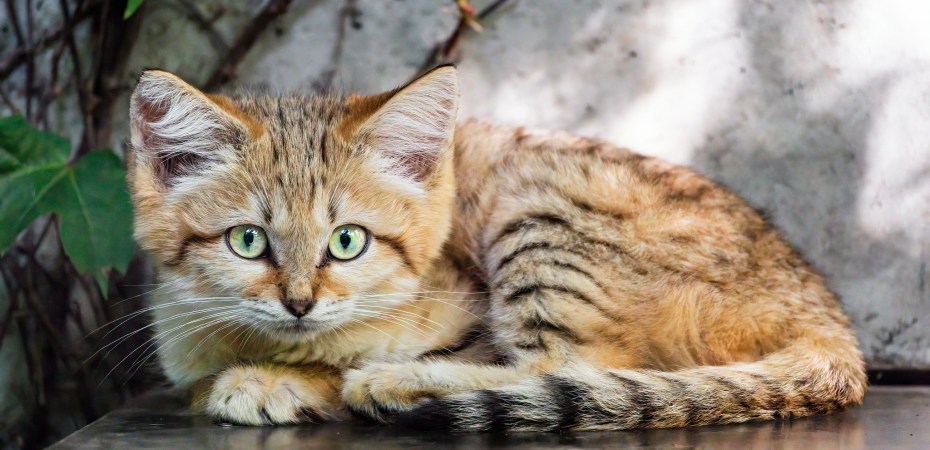
Africa’s most famous desert is the Sahara, and in the Sahara (as well as in some of the region’s other deserts) lives a cat.
❤🐈❤🐈❤
Such a small, well-camouflaged kitty is hard to see in such a big desert, let alone record, so most online videos are of captives.
For more information about little Felis margarita, here’s an excerpt of the sand cat chapter in one of my eBooks:
This is the only cat that lives almost exclusively in the desert. That said, you won’t find it in a shifting dune field without vegetation (even though Russians call this feline “barchan kot”: the dune cat).
There must be a little greenery around to feed and shelter both predator and prey.
The sand cat’s scientific name is Felis margarita. French naturalist Victor Loche gave it this name to honor General Jean Auguste Margueritte, who led Loche’s nineteenth-century expedition through the Algerian Sahara.
Lineage:
Domestic cat/Felis.
Outstanding Features:
- Doesn’t retract claws while walking. This probably gives the cat some traction on sand, although it dulls all claws except the dewclaw, which is located a little way up on the leg and never touches the ground.
- A very good digger, and not just because its prey lives underground. Sand cats also make burrows, or take over abandoned ones, and are seldom seen above ground during the heat of the day. That’s why Saharan nomads call this “the cat that digs holes.”
- Physically adapted to desert climate extremes. Long black/brown fur completely covers the sole of each paw, insulating those sensitive feet from sand that can be up to 58 degrees Celsius (136 degrees Fahrenheit) in daytime. Also, the sand cat’s thick fur coat keeps it warm at night, when temperatures can drop below freezing.
- Very specialized auditory structures, compared to other small cats.
Those big ears and associated internal structures are necessary because sound travels differently in dry desert air.
The only two felines that come close to the sand cat’s ability to detect low frequency sounds made by prey that’s underground or moving very quietly are Africa’s black-footed cat and Asia’s Pallas cat (also known as Manul), which also live in arid country. Kitchener et al. report that sand cats hear sounds up to a quarter-mile farther off than house cats do.
Data: This information is from the Cat Specialist Group, except where noted.
- Weight: 3 to 8 pounds.
- Height at the shoulder: 9 to 14 inches. (Wikipedia)
- Body length: 15 to 20 inches.
- Tail length: 9 to 12 inches.
- Coat: Pale yellow-tan, medium-length fur with white on the cat’s face and underparts, as well as a few dark markings that vary among individuals. In northern parts of the sand cat’s range, the winter coat is very thick and long, making the animal appear much larger than it really is. All sand cats have a banded tail that’s tipped in dark fur. The openings of their huge ears are filled with white fur, perhaps to protect against sandstorms. (Cat Specialist Group; Heptner and Sludskii)
- Vocals: These shy hunters are rarely seen, let alone heard, in the wild.
Hemmer et al. describe the sand cat’s voice as raucous and note that, just like the jungle cat, sand cats sometimes “bark” like a small dog.
Sand cats also make a short, explosive little “tch!” sound known as the sand cat spit…
In this 13-year-old video, Canyon does that sand cat spit at around the 3:10 mark:
Sand cats are small, but they definitely are tough enough to survive in one of the harshest environments on Earth!
Featured image: Tambako the Jaguar, CC BY-SA-ND 2.0
 Flight To Wonder