- Global Volcanism Program page
- Japan Meteorological Agency (JMA) Mount Kirishima status page (Japanese)
- KYT live cam (Japanese):
- JMA’s Kirishima City updates (Japanese)
- Tokyo VAAC
advisories page - Japan Geological Survey
page (Japanese) on the eruption. - Kirishima City live cam list (Japanese)
This actually ties in with the ongoing VEI 8 post series on individual caldera volcanoes because of location — this volcanic complex is in the Kagoshima Graben (mentioned with Kikai) and it sits in between Aira and the next supervolcano on the list (and last one in Japan), Mount Aso.
Also, it has had activity recently, per the Global Volcanism Program:
The Japan Meteorological Agency (JMA) reported increasing unrest at Shinmoedake (“Shinmoe peak,” a stratovolcano of the Kirishimayama volcano group). The Global Navigation Satellite System (GNSS) indicated minor inflation starting in November 2023. The number of earthquakes with epicenters beneath Shinmoedake had been increasing since late October 2023; during 1-11 December 2024 the seismic network detected 284 earthquakes. At 1100 on 12 December the Alert Level was raised to 2 (on a 5-level scale) and the public was warned to stay 2 km away from Shinmoedake Crater. Sulfur dioxide emissions were below detectable limits on 3 and 9 December.
There are other reasons to look at Kirishimaya more closely — including but not limited to (Japanese) the cultural connection mentioned in the book review post — but, barring major changes, that must wait until the VEI 8 series is completed.
For now, here are some fireworks from Shinmoedake in Kirishimaya in 2018:
Original post and repost — 2019: Here’s a slightly revised post from 2018 about a complex set of Japanese volcanoes! Fortunately, they have been quiet now for over a year.
For most of us, the words “Japan” and “volcano” summon up an image of Mt. Fuji, near Tokyo. But this country has many more volcanoes, some of them not as simple in appearance as Fuji-san.
Take Mount Kirishima, for instance. It is a study in contrasts.
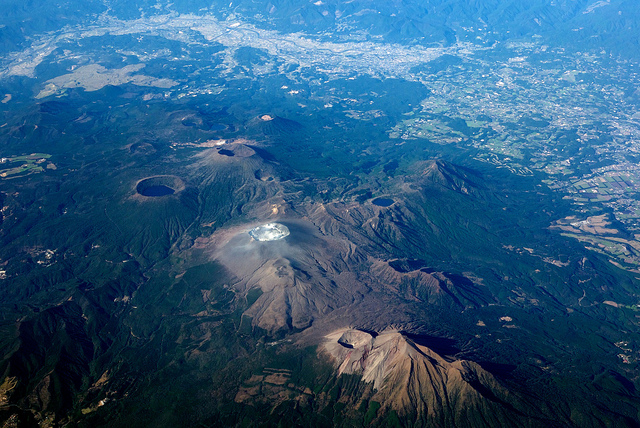
On the one hand, Kirishima frequently erupts; on the other, it’s a great place for a walk through the park.
The park
Here is someone’s video of a walk up three volcanoes in the area; the first two–Takachiho (crowned with a legendary spear, per Wikipedia) and Karakuni–are part of the Kirishima center; the last one, beautiful Kaimon, belongs to the Ata caldera underneath Kagoshima Bay.
That certainly looks peaceful. Volcanoes sculpt some of the most beautiful landscapes in the world.
But as you can see, a lot of people live near Mount Kirishima — a frequently active volcanic center.
A violent history
Starting some 600,000 years ago, huge caldera-forming eruptions began here, at the head of Kagoshima Bay on the island of Kyushu. Ever since then, volcanic events have been explosive in nature (not showing much runny “Hawaiian-style” lava).
About 330,000 years ago the style changed to building stratovolcanoes instead of big holes in the ground (which is what a caldera is, basically). Ever since, this complex volcano has built more than 25 relatively small peaks and cones. Two vents have been active recently: Shinmoedake and Ioyama.
This 2018 gives basic information for the Ioyama (or Mount Io) eruption. Both of these volcanoes have kept a fairly low profile since their 2018 activity. (Of note, Moto-Shirane volcano is not part of the Kirishimayama group; the nearby violent eruption referred to in this video was that of Shinmoedake.)
Although this hasn’t happened recently, magma occasionally interacts with ground water in the Kirishima volcanic group, forming a maar with the resulting steam-driven eruption.
This volcanic group is slowly becoming more active and its magma rate is increasing. Volcanologists are watching Kirishimayama closely to better understand how it works so they can most accurately predict its future course.
It’s not easy for an English-speaking layperson to understand Japan’s volcano monitoring system, but I have found online a web page for the Kirishima Volcano Observatory.
Also, the current Japan Meteorological Agency alert page in English (yes, JMA monitors geological hazards, too) does not list any Kirishimayama group volcanoes.
Updates:
Dec. 4, 2025, 6:02 a.m., Pacific: I am updating all these posts. Here is the most recent JMA update, via Google Translate:
Announced by the Fukuoka Regional Meteorological Observatory and Kagoshima Regional Meteorological Observatory at 16:00 on November 28, 2025
We would like to inform you of the activity status of Mt. Shinmoe from November 21st to 3:00 PM on the 28th. Within approximately 2 km of the Shinmoe-dake crater, please be on the lookout for large volcanic rocks that may be scattered in a ballistic trajectory due to the eruption.
Volcanic activity status
No eruptions have been observed at the Shinmoe-dake crater since September 8th.
Surveillance camera observations showed that smoke from the Shinmoe-dake crater rose up to 600m above the crater rim. Fumes from fissures on the western slope of Shinmoe-dake rose up to 100m.
Volcanic earthquakes with epicenters directly below the Shinmoe-dake crater were frequent until early November, but have been decreasing since mid-November. No volcanic tremors have been observed.
Continuous GNSS observations have shown slight extension on some baselines between Mount Kirishima since around March 2025, which is thought to indicate expansion deep within Mount Kirishima, but this has stagnated since early July.
Volcanic activity at Shinmoe-dake continues to be elevated, and there is a possibility of further eruptions…
August 27, 2025, 2:29 p.m., Pacific: Shinmoedake had a moderate explosion, with plume to 5500 meters. At last look, JMA’s alert level is unchanged — this doesn’t seem to be a self-sustaining eruption.
【新燃岳で噴火】
6月下旬から断続的な噴火が続いている火山 霧島山・新燃岳では、今日8月28日(木)4時53分に噴火が発生し、噴煙は火口縁上5500mに上がりました。
噴煙は上空の弱い風に流され南西方向に流れるとみられます。鹿児島県を中心に火山灰の降灰に注意してください。https://t.co/mYbOX8sAVH pic.twitter.com/LwMsO9RjMv— ウェザーニュース (@wni_jp) August 27, 2025
https://platform.twitter.com/widgets.js
August 16, 2025, 3:37 a.m., Pacific: Per JMA updates, intermittent activity at Shinmoedake continues. The alert level is still 3.
Dr. Imura recently flew over the crater:
8/14午後、南東側火口列の部分が大きな火口になっていました。斜め噴火して火砕流を出した2018溶岩縁の火口と赤火口は、独立して噴気を上げていました。8/10の噴火は大きく成長した火口から起こったのでしょう。FNN取材機から。 pic.twitter.com/ZObsr9cEG2
— Ryusuke IMURA (@tigers_1964) August 16, 2025
https://platform.twitter.com/widgets.js
X translation: “On the afternoon of 8/14, the southeastern crater row had formed a large crater. The 2018 lava rim crater and the red crater, which had erupted diagonally and produced pyroclastic flows, were independently emitting volcanic gases. The eruption on 8/10 likely originated from the significantly enlarged crater. From the FNN reporting aircraft.”
August 11, 2025, 8:26 a.m., Pacific: Intermittent low-level activity continues at Shinmoedake, with a bit of a burst yesterday and today.
Here’s an excerpt, Google-translated, from today’s JMA update covering August 8-11:
…The eruption, which began yesterday (the 10th) at 5:23 AM, appears to have ceased today (the 11th) at 1:34 AM. During the continuous eruptions, smoke rose to a maximum height of more than 3,000 meters above the crater rim.
A field survey conducted yesterday at the base of the mountain revealed high emissions of volcanic gas (sulfur dioxide) at 2,800 tons per day (compared to 500 tons on the 6th).
Volcanic earthquakes with epicenters directly below the Shinmoe-dake crater have been fluctuating since late October 2024, and have remained extremely frequent during this period. Volcanic tremors associated with the eruption have occurred.
Tiltmeters around Shinmoe-dake have not shown any significant changes that would indicate underground expansion of the volcano.
Continuous GNSS observations have shown slight extension along some baselines on either side of Mount Kirishima since around March 2025, which is thought to indicate expansion deep within Mount Kirishima, but this has stagnated since early July…
I’m glad it wasn’t worse because the prefecture has been hit with landslides, road washouts, flooding, and water/power outages this past week from heavy rains.
August 1, 2025, 6:28 a.m., Pacific: There isn’t any major change, although JMA does note in its update today that volcanic earthquakes centered under Shinmoedake have been very frequent over recent days.
Tokyo VAAC has been and continues to issue many advisories. In addition, like everyone else they must be very happy to see the eruption again, thanks to the disappearance of volcano-hiding weather clouds that have obscured things for weeks.
新燃岳、久しぶりに見えた。火口内南東部からもくもく上げているが白い。火山灰の量は多くない。風は西へ。
(今日、韓国岳登山者からの写真報告を期待します) pic.twitter.com/Tek8SrWiPi— 早川由紀夫 (@HayakawaYukio) August 1, 2025
https://platform.twitter.com/widgets.js
July 22, 2025, 6:14 a.m., Pacific: Visibility through the Kirishima City cams remains poor, but Tokyo VAAC continues to post advisories about what sound like low-level events.
JMA continues to note that no expansion is measured at Shinmoedake but it does continue deep within the Kirishima complex (“Mount Kirishima”).
Per Google Translation of this article (link should autotranslate):
On June 22, Shinmoe-dake in the Kirishima Mountains erupted for the first time in seven years. Since then, eruptions have been on and off repeatedly.
According to the Kagoshima Regional Meteorological Observatory, Shinmoe-dake has erupted 20 times in the past month.
The maximum amount of smoke reached about 5,000 meters above the crater, and on busy days, 4,000 tons of volcanic gas was observed being released per day.Associate Professor Ryusuke Imura of Kagoshima University, who has surveyed Shinmoe-dake from the air four times since June 22, points out that the changes in the crater’s crater indicate that volcanic activity is active…
July 10, 2025, 12:31 a.m., Pacific: There are no changes noted in updates other than the fact that JMA did not mention the possibility of pyroclastic flows in today’s update.
Earlier updates had noted that flows out to as much as 2 km were possible.
The topic of pyroclastic flows at Kirishima/Shinmoedake has become controversial — and that’s not good when an explosive volcano is erupting in the midst of about 4 million people.
I only know what I’ve read on X (via X translation) by Drs. Hayakawa and Imura, but that’s plenty to go on as both volcanologists are very concerned about pyroclastic flows and believe that mitigation measures should be taken before one reaches inhabited areas.
Dr. Imura got into a public controversy with the local meteorological office over a relatively small cloud a few days ago that spilled over the crater rim and sat there for a while.
He called it a pyroclastic flow even though the local office said it wasn’t going fast enough for one.
This layperson thought it most resembled an electrically charged cloud that Frank Perret described at Vesuvius in 1906. Unlike that one, though, this Shinmoedake cloud did seem to show small coingnimbrite plumes at some of its leading edges in the one cam video I saw of it, which would make that a pyroclastic flow although more views from different angles would have been preferable.
Dr. Hayakawa is as dogmatic as one would expect of an expert who has documented a million years’ worth of tephra in Japan: there have been multiple pyroclastic flows, he says, and the situation is serious.
It is that, for sure, especially with the newly reported detection of fresh magma in Shinmoedake’s ash.
Some say that this is good news because it means that the volcano is degassing and crystallizing its magma — this happens at many quiet volcanoes, of course, but this layperson has not ever understood the process to apply at an actively erupting one.
Fresh magma at shallow levels is probably on the move, and therefore crystallization cannot be the dominant process…at least not until the movement stops and the magma begins to freeze in place.
I don’t know what to think.
Volcanologists should speak publicly with one voice, which Dr. Imura and Dr. Hayakawa are not doing with JMA. At the same time, I’m having Godzilla Minus One Captain Akitsu flashbacks as I contemplate JMA updates, in part while being influenced by Hayakawa and Imura.
July 8, 2025, 6:47 a.m., Pacific: Per browser translation of this story, “…At a press conference on the 8th, the Japan Meteorological Agency revealed that the amount of new magmatic material is increasing, based on the results of an analysis of volcanic ash falling from the eruption…”
July 8, 2025, 5:09 a.m., Pacific: Activity was reported to be less yesterday, but per the YouTube autotranslation of this local news video, Shinmoedake had a stronger eruption this morning, though not as strong as its most intense emissions during this activity phase ongoing since late June:
July 5, 2025, 9:21 p.m., Pacific: About four hours ago, on the other side of the caldera, Sakurajima had a vulcanian blast. It still has an impressive though relatively small ash cloud present.
On cam, Shinmoedake appears to be having less intense activity at the moment.
It’s an interesting situation.
Also, Dr. Imura mentioned this yesterday but I missed it until he retweeted this very visual shot of the two fissures in Shinmoedake’s crater, recorded during one of its more intense periods:
2018溶岩の火口中央部にある窪みは見えてる。新燃岳山頂火口の中に北東から中央に向かう200mの割れ目火口列と、山頂火口の南東縁内側に沿って割れ目火口列ができてる。 https://t.co/Mb2T3qiudY
— Ryusuke IMURA (@tigers_1964) July 6, 2025
https://platform.twitter.com/widgets.js
Edit: I don’t know whether this is significant, but Dr. Hayakawa tweeted that it looks on seismograms as though something happened around 9 o’clock (local time).
9時台にいろいろあったみたい。画像は未入手。
・高千穂河原地震上下
・湯之野苦心 pic.twitter.com/fjjxyYQQ4O— 早川由紀夫 (@HayakawaYukio) July 6, 2025
https://platform.twitter.com/widgets.js
He is focusing on Shinmoedake, but if I’ve got the time zone conversions right, that was around the time that Sakurajima exploded (“business as usual,” Dr. Imura called it).
Is it significant? (I didn’t have the nerve to ask either of those two volcanologists during this crisis at Kirishimayama.)
July 5, 2025, 5:03 a.m., Pacific: Surprisingly, there’s no update from JMA yet.
What was a relatively small plume on the southern fissure is now quite vigorous looking on cam, though it is still low and still “bends in the wind” somewhat (but not as much as it did earlier today).
Nevertheless, I see that Dr. Hayakawa has just tweeted that “now is the time to use this map”:
この地図を使うのは、いま。 pic.twitter.com/60HTnKA1tO
— 早川由紀夫 (@HayakawaYukio) July 5, 2025
https://platform.twitter.com/widgets.js
He also has cheery comments on things like the silent way that pyroclastic flows move and ash columns rise (it’s shortly after 9 p.m. over there and getting dark) and “without wisdom there can be no fear.”
Hazard maps are most effective when followed before the crisis arrives, and comparatively little is lost by following them even if the crisis ultimately doesn’t arrive or is less intense upon arrival than expected.
As per yesterday’s update, JMA notes a 3-km exclusion zone and mentions that small pyroclastic flows could run out as far as 2 km.
I wonder if the volcano has read this update. Hopefully a new one won’t be needed overnight.
X translation: “Hmm.”
うーん。 pic.twitter.com/3fL1F74J8J
— Ryusuke IMURA (@tigers_1964) July 5, 2025
https://platform.twitter.com/widgets.js
July 4, 2025, 10:14 p.m., Pacific: There have been no dramatic changes yet. JMA update won’t be out for a few more hours, but of the two knowledgeable people I am following closely now for news — Dr. Ryusuke Imura, of Kagoshima University, and Dr. Yukio Hayakawa (not the actor’s son), a retired volcanologist who has studied and recorded a million years’ worth of tephra in Japan (an amazing accomplishment!) —
- Dr. Imura notes that the eruptive plume is now rising from the southern end of the fissure, while the northern end, which was active earlier, now emits a white cloud.
- Dr. Hayakawa tweeted this model of the fissure, based on cam views, about two hours ago:
御鉢火口南縁カメラから韓国岳の南西斜面を見通すと、新燃岳火口内の噴火割れ目はウサギの耳の真下まで届いてないように見える。 pic.twitter.com/2nJGrtDtG2
— 早川由紀夫 (@HayakawaYukio) July 5, 2025
All around on my X explorations are comments on how unusually dry and powdery Shinmoedake’s current ash is.
It does contain some dark minerals, per the Geological Survey of Japan (GSJ) report, but I guess not very much.
According to the GSJ and also Dr. Hayakawa, Shinmoedake is now clearing out old lavas from 2011 and 2018.
Imura suggests the driving force at present might be steam (phreatic eruption). Hayakawa prefers not to use that term and for now seems to keep open the possibilities for whatever is powering the eruption.
At the moment, the eruption is nowhere near plinian-style, but it also appears to be nowhere near closing.
[Layperson speculation] The “elephant in the room” is Aira Caldera. Unlike Sakurajima, the Kirishimayama Complex does not sit on Aira’s rim. It borders another, and I think extinct, caldera just north of Aira. (There are calderas all over the Kagoshima Graben.)
Geophysical studies suggest that the complex, unlike Sakurajima, has its own plumbing system.
Nevertheless, while researching the Aira post I came across some papers proposing a possible Aira contribution to some Kirishima eruptions.
How widely that’s accepted, I don’t know.
I didn’t follow that up because it wasn’t topic related, and just now the point is too arcane to revisit, but that, combined with Sakurajima’s recent expansion followed by almost total quiescence ever since, has me wondering about potential underground pressure field interactions, if not actual magmatic links, among all three active volcanoes.
Here’s why it matters in practical terms.
For a while now, Aira has been expanded to the level it was at just before Sakurajima’s Taisho VEI 4 in 1914.
Unlike its situation at the turn of the 20th century, though, Sakurajima has had a relatively open conduit now for many decades.
I wonder if, because of mantle magma resupply, Aira now “wants” to put on another Taisho-style eruption — NOT a supereruption, which is a whole ‘nother thing with probably very different precursors — but it can’t build up enough pressure for one at leaky Sakurajima and now, somehow, might be putting the squeeze on Kirishimayama instead.
Whether any proposed magmatic connections exist or are close to existence might be what determines whether this Shinmoedake eruption escalates or fizzles out.
If it escalates — a big “if” — millions of people could be affected locally and, if the winds are right, perhaps all the way up to the Tokyo area.
I hope Shinmoedake settles down soon, Sakurajima doesn’t go off, either, and that Aira just says to itself, “Fine. I’ll just let it sit and save it all up for another “big one” tens of thousands of years from now.”
[/Layperson speculation]
July 4, 2025, 2:00 a.m., Pacific: Dr. Imura confirms that a crater has opened outside the summit crater rim. The drone image in the retweeted post was taken shortly after the ash emission intensified yesterday.
火口縁の外に火口が開いているのを確認しました。 https://t.co/0oCjAHpYNk
— Ryusuke IMURA (@tigers_1964) July 4, 2025
https://platform.twitter.com/widgets.js
JMA is keeping the alert at Level 3.
July 4, 2025, Pacific: Per this story (autotranslated), the ash column might be widening. They quote the JMA but I don’t yet see a July 4 update up yet.
July 2, 2025, 6:53 a.m., Pacific: Here is an excerpt from JMA’s update today, via browser translation:
Volcanic activity status
Eruptive activity continues at the Shinmoedake crater.
The eruption observed by surveillance cameras from 10:25 on June 27th is still continuing as of 15:00 today (2nd). From 11:43 today, the amount of volcanic smoke associated with the eruption temporarily increased, and the volcanic smoke rose to a maximum of 2,800 meters above the crater rim. On the inclinometers around Mt. Shinmoedake, very slight changes were observed due to this eruption, indicating contraction near Mt. Shinmoedake.
During a field survey conducted yesterday (1st), ash fall was confirmed in Kirishima City, Kagoshima Prefecture, and Ebino City, Miyazaki Prefecture. In some parts of Makizono-cho, Kirishima City, we noticed so much ash falling that the white lines on the roads were no longer visible…
Someone recorded this time lapse of Shinmoedake’s fissure eruption plume today from a JMA cam, and Dr. Imura reposted it, noting (per X translation) that it seems to use most of the crack when a lot of material comes out.
たくさん出る時に割れ目全体を使っているようです。 https://t.co/uo05gfsXl9
— Ryusuke IMURA (@tigers_1964) July 2, 2025
https://platform.twitter.com/widgets.js
June 27, 2025, 5:33 a.m., Pacific: Tweeted about two hours ago by a knowledgeable person in the area:
新燃岳の6/27 12:40の様子。KTS(鹿児島テレビ)取材機から。
山頂火口の中で割れ目噴火してた。
山頂火口中心から時計の1:30の短針の方向。
インパクトクレーターはなかった。
新しい積灰の上に小さな泥流の跡。土砂噴出が火口縁を越えたようにも見える。 pic.twitter.com/JK8UvgZwt0— Ryusuke IMURA (@tigers_1964) June 27, 2025
https://platform.twitter.com/widgets.js
X translation: “The state of Shinmoedake on 6/27 at 12:40. From KTS (Kagoshima Television) coverage aircraft.
A fissure eruption was occurring within the summit crater. In the direction of the 1:30 hour hand from the center of the summit crater.
No impact crater was present.
Traces of a small mudflow on top of fresh ash. It also appears that debris ejection surpassed the crater rim.”
June 25, 2025, 9:15 p.m., Pacific: Shinmoedake apparently erupted five to six hours ago, per JMA’s update, but clouds hide the mountain.
Google translation:
June 26, 2025, 9:05 AM, Fukuoka Regional Meteorological Observatory and Kagoshima Regional Meteorological Observatory
Today (26th), at around 7:58 AM, Takaharu Town Hall in Miyazaki Prefecture reported that ash had fallen.
Volcanic activity status
Today (26th), at around 7:58 AM, Takaharu Town Hall in Miyazaki Prefecture reported that ash had fallen.
It appears that an eruption has occurred at Shinmoe-dake. Due to clouds, the surveillance cameras installed by the Japan Meteorological Agency are unable to see the smoke or the situation around the Shinmoe-dake crater.
No air vibrations thought to be associated with an eruption have been observed.
The number of volcanic earthquakes in the previous 24 hours has been high, exceeding 300.
Disaster prevention precautions, etc.
Large volcanic rocks may fly in a ballistic trajectory up to approximately 3 km from the Shinmoedake crater, and pyroclastic flows may reach up to approximately 2 km. Therefore, please be on alert within approximately 3 km of the Shinmoedake crater.
On the downwind side, be careful as not only volcanic ash but also small volcanic rocks may be carried by the wind and fall far away.
As in 2011, be careful as there is a risk of window glass breaking due to the large air vibrations caused by the explosion.
Follow the instructions of local authorities and do not enter risky areas…
Weather News has more information (autotranslated).
June 25, 2025, 4:50 a.m., Pacific: Good news, per this news story (autotranslated):
Experts analyzed the volcanic ash that fell during the eruption of Shinmoe-dake in the Kirishima Mountains on the 22nd and found that it contained almost no material related to new magma.
While experts said it was likely a “steam eruption,” they also pointed out that it is necessary to keep a close eye on future developments…
However, the JMA Kirishima updates describe some ground deformation (from a deep source, if this layperson understands the text correctly), and volcanic gas emission, while reduced, is still faitly high.
June 23, 2025, 6:19 a.m., Pacific: Shinmoedake has been restless lately, and a few hours ago they reportedly (Japanese) raised the alert to 3 (on a five-point scale where evacuations of vulnerable groups begin at 4 — this volcano is rather remote and I think that ash is the main hazard, as it proved in 2018 and 2011).
Featured image: Image by Kanenori from Pixabay
Sources:
Global Volcanism Program. 2018. Kirishimayama.
Nagaoka, S., & Okuno, M. 2011. Tephrochronology and eruptive history of Kirishima volcano in southern Japan. Quaternary International, 246(1-2): 260-269.
 Flight To Wonder
[…] 27 update: JMA says today that Ioyama is still having low-level activity, and that Kirishimayama is inflating a bit, possibly indicating magma flowing into the […]