This post is a mixed and bittersweet bag.
First, happy stuff:
Everyone needs to unwind now and then, and I do so by hanging out at a waterhole in Namibia’s Etosha National Park — via a live cam.
The viewing takes a little getting used to because dramatic things seldom happen. The animals either take a LONG drink or else stand around, staring mindlessly at nothing in particular, but with patience it can be very relaxing.
The wildlife, when present, moves at their natural pace, which usually is not fast, and that’s contagious. 🙂
Once relaxed, the wonder of it all begins for this viewer.
Etosha has many waterholes.
I don’t know how many have cams.
Okaukuejo, my hangout, is where I (and hundreds of other virtual safari goers) watched three lionesses try to trap a smallish but adult black rhino one night.
At least that’s what it looked like. The lionesses had been relaxing at one end of the waterhole for quite some time when the rhino came to drink at the other end. The cats hadn’t seemed to be hunting, but suddenly there were only two lionesses — the other had melted away into the night.
Her two companions then got up and played the sort of “catch me if you can” game with that rhino that you’ll see in the video below being played by cubs with an infant black rhino.
Only the two lionesses were leading that small adult rhino away from the water as they danced back and forth in front of it.
I figured Lioness #3 was out there, getting set to pounce, and maybe the rhino realized this, too, because it stopped about halfway out to the dark edge of the floodlight’s circle and refused to go any farther.
The lionesses soon gave it up and disappeared and the thirsty rhino went back to the water.
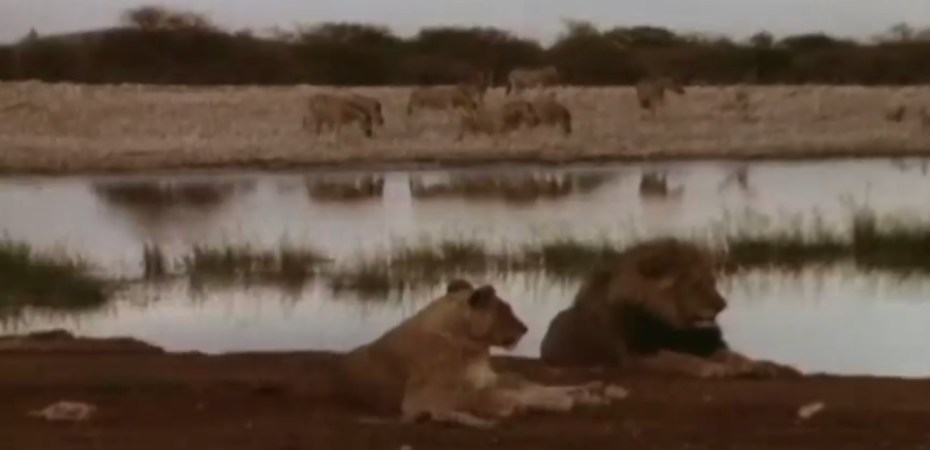
Just one of those things you might see at an African wildlife cam, if you wait long enough, but because of it I decided to share this 1981 documentary about a pride at Ombika waterhole, about twelve miles away.
I agree with the New York Times review that, even now, four decades later, it’s “…about as good a wildlife documentary as you will see on television and almost certainly a better film about lions than you are likely to see again. It tell us everything we wanted to know about lions except, perhaps, how dangerous they are to people. Blame this on the film makers’ enthusiasm for their subject…” and probably the people that have given it 8 million views on YouTube also agree with that assessment.
The video puts you right into a pride that’s stable enough and is so well off that most of the horrible things that can happen in the wild when life is hard don’t occur (on camera anyway, though the film makers don’t gloss over kills and the bloody eating, or the life-ending injury to the cubs’ mother).
So that’s nice (but see More Information below video for the sad ending in real life).
You will know lions better once you watch it (or rewatch it, if one of those 8 million views was yours):
More information:
This is sad, and there is also a dilemma.
- According to the PDF research paper available for download as one of the options here, the Ombika lion pride moved out of the park and began to prey on livestock. In 1985, farmers killed them all. Persecution arising from such predation in unprotected areas, as well as other human-lion conflicts (lion attacks, mostly), is a major reason why African lions are endangered.
This news makes that video’s ending so poignant.
- Over the last twenty-eight years, according to this source (which I haven’t heard of before), lion numbers in Namibia have gone from about 20 to 150. It sounds like conservation efforts have helped, but the conflict still exists.
- The Etosha Lion Project.
What is a solution that’s fair to both lions and people?
🦁❤🦁❤🦁
Back to happy stuff.
At one point in the documentary above, they talk about how the cats drink.
Here is a video from last month, from the people who operate the live cam, showing a leopard drinking and adding in some jaw action for some reason.
This one also records what they say is the first-ever sighting of a caracal here.
I hope they eventually add some lion videos to their list of special sightings!
More information:
A commercial source came up in a search, and few others did, so I’m using it but know nothing about the company or its expertise.
- There are almost 12,000 leopards in Namibia, according to this source.
- Predators of Etosha (same source).
- One c😎l leopard.
Some lagniappe:
Meanwhile, on the feliform/canine front and at another waterhole cam operated by the same people, it’s anyone’s guess what this brown hyena did to tick off those two jackals:
 Flight To Wonder