For a change of pace this feline Friday, let’s explore a delightful fact that I brought up in my first cat-related eBook: the Vikings loved domestic cats!
So do some of their descendants.
Iceland’s national news service RUV gave extensive coverage to the disappearance and recovery last month of Reykjavik’s beloved Diego, who has many, many admirers (autotranslated).
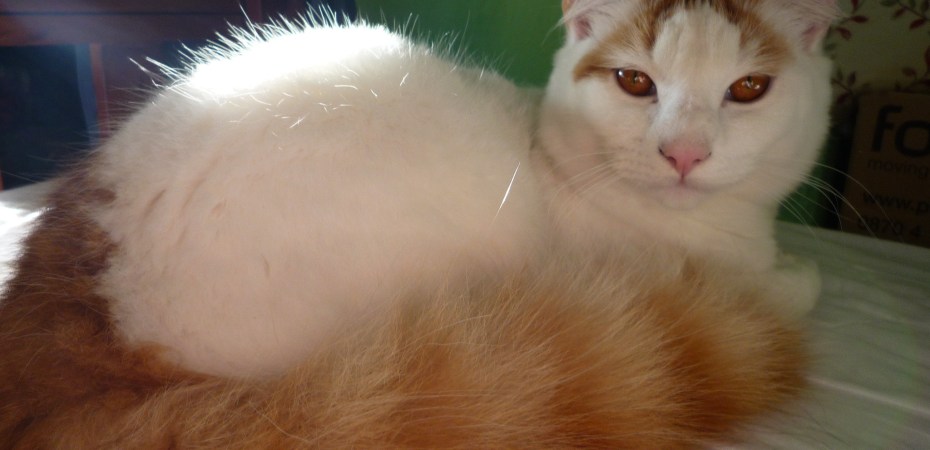
Diego, however, is a gray-and-white semi-longhair, whereas the early Vikings apparently liked orange cats, as well as white ones. (Todd)
This coat color mutation possibly originated in the Middle East, but for hundreds of years cats with orange or orange/white fur also have been common in lands associated with the Vikings, including northern and western Scotland, the Faroe Islands, and perhaps Iceland. (Todd)
Did Vikings carry them there?
That hasn’t been definitely established yet but, believe it or not, there is a connection.
Orange and white
While recent studies leave it as an open question, some sources referenced at the end of this post do suggest that the orange cat coat mutation started out in the Middle East.
The look is now also embodied in a fancy cat breed — the Turkish Van:
There is no mention of Vikings in that video, but they’re probably part of the story.
Their origins are unclear, but these warrior-traders might have been a collection of people with varied backgrounds who thrived between roughly 750 and 1066 AD.
Scandinavia was their base, but it’s helpful to think of “Viking” not so much as an ethnicity as a way of life.
Vikings were fierce warriors, but they were also businessmen, explorers, and colonizers.
They built a trading network wide enough to transport North African coins into central Sweden, Central Asian leather goods into Iceland, and Scandinavian brooches over the Ural Mountains.
In Eastern Europe, where they were known as Varangians, Vikings had an 1800-mile-long (3000 km) river route from the Baltic Sea near modern Stockholm to Constantinople, which (aha!) is in the general region where orange and white cats might first have become widespread.
Vikings did trade in cats, probably tabby cats since that coat pattern is the one usually shown on cats in later European illustrated prints.
There likely were some pets, but the bottom line was what mattered. Cats and cat pelts were profitable.
The business brought in especially good money between roughly 850 and 1050 AD, when the furrier business was booming in several Viking-era towns.
Perhaps the unusual solid and bright fur colors of orange and/or white on the Middle Eastern cats made those fortunate felines an exception to the tabby pelt trade?
What did cats mean to the Vikings?
Most archaeological cat finds are from foreign sites, especially in England and Ireland.
In Scandinavia, cat remains show up in:
- Elite settings. There’s usually little to no evidence showing how they got there. Expensive pets? Grave gifts? Magical talismans?
- Sacrificial sites. At Uppsala, for example, the Vikings held important rituals every nine years. Archaeologists have found human bones there as well as at least seven different animals, including cats.
- Some urban areas. Birka, for instance, seems to have had a sizable cat population while fewer cats have been found in Hedeby, even though that was a major trading hub.
Given the rarity of archaeological cat finds, it’s surprising how common cats were in Viking art.
For instance, they were the typical “gripping beasts” in the Borre style that artists used during the 9th and 10th centuries.

Casiopeia, CC BY-SA, in this article on Viking art. Note the gripping beast’s cat-like triangular face, though paws seem to be doing something inside the frame on this brooch.
In this artwork, a ribbon-like feline head and body form the border around a complex geometrical design, while the beast’s four paws grasp the edges tightly, holding everything together.
The popularity of this dreamy abstraction leads Prehal (see source list) to suggest that domestic cats, particularly white ones, might have been very important in Norse magic and rituals.
White cat fur apparently was associated with seiðr, the Norse magic that women practiced. And in shamanistic religions, animals frequently serve as guides to the spirit world.
Legend has it that Freyja, who traveled in a cart drawn by two big tomcats, taught her husband Odin seiðr.

The idea of a love goddess riding in a cat chariot has inspired a lot of online artwork, but there don’t seem to be any useable Viking-era depictions, so here is a cat decoration on a Viking ship displayed in Oslo. (Image: A. Davey, CC BY-NC-ND 2.0)
Freyja was both a fertility goddess and in charge of a warrior heaven called Folkvang, which was separate from but equal to Odin’s Valhalla.
No one knows what the entry criteria were for Folkvang and Valhalla, but Freyja and her husband somehow went halvsies on the spirits of fallen Viking warriors.
And that’s where we’ll have to leave this fascinating story about Vikings and their cats, until more discoveries are made.
Let’s hold on to the thought that, somewhere just beyond our ken, a veritable rainbow of cats is chasing unkillable mice around and under tables that are loaded with hearty food and drink while hordes of happy warriors in Folkvang and Valhalla cheer them on.
Lagniappe:
Things can be pretty nice on Earth, too.
Featured image: Chris, CC BY-SA 2.0
Sources:
Besides the cat chronology sources:
Aberth, J. 2012. An Environmental History of the Middle Ages: the Crucible of Nature. Routledge. Retrieved from
https://books.google.com/books?id=7a28UnCLPIIC&lpg=PA265&dq=haithabu%2C%20skeletal%20remains%20of%20cats&pg=PA174#v=onepage&q&f=false. (Preview only)
Adams, S. 2018. Lindisfarne raid. https://www.britannica.com/event/Lindisfarne-Raid Accessed September 7, 2018.
Cox, D. M. 2002. Explaining Viking Expansion. Doctoral dissertation, West Virginia University Libraries. http://www.academia.edu/
download/31949475/cox_viking.pdf
Fairnell, E. H. 2003. The utilisation of fur-bearing animals in the British Isles: a zooarchaeological hunt for data. University of York MSc
thesis. Retrieved from http://www.fairnell.co.uk/content/documents/eva-fairnell-msc-thesis.pdf Accessed April 2, 2018.
Hatting, T. 2012. Cats from Viking Age Odense. Journal of Danish Archaeology, 9(1): 179-193.
Hedeager, L. 2008. Scandinavia before the Viking Age, in The Viking World, 35-46. Routledge Handbook. https://www.routledgehandbooks.com/doi/10.4324/9780203412770.ch1
Ottoni, C.; Van Neer, W.; De Cupere, B.; Daligault, J.; and others. 2017. The palaeogenetics of cat dispersal in the ancient world. Nature Ecology and Evolution, 1: 0139.
Overton, N. J. 2016. More than skin deep: Reconsidering isolated remains of ‘fur-bearing species’ in the British and European Mesolithic. (Abstract only) Cambridge Archaeological Journal, 26(4): 561-578.
Piltz, E. 1996. “Varangian Companies for Long Distance Trade,” Byzantium and Islam in Scandinavia: Acts of a Symposium at Uppsala
University, June 15-16, 1996, ed. Elisabeth Piltz. http://faculty.uml.edu/ethan_spanier/Teaching/documents/CP22aVarangian.pdf
Prehal, B. 2011. Freyja’s cats: Perspectives on recent Viking Age finds in Ϸegjandadalur North Iceland. Hunter College MA thesis.
http://www.nabohome.org/postgraduates/theses/bp/BrendaPrehalThesis.pdf&ved=2ahUKEwiz68q1tJraAhXhj1QKHUaaDkIQFjARegQIARAB&usg=AOvVaw3AKyj74QeP0msepnjqDeHC.
Sindbæk, S. M. 2007. The small world of the Vikings: networks in early medieval communication and exchange. Norwegian Archaeological Review, 40(1), 59-74.
Underwood, E. 2018. Viking cat skeletons reveal a surprising growth in the size of felines over time. https://www.sciencemag.org/news/
2018/12/viking-cat-skeletons-reveal-surprising-growth-size-felines-over-time Last accessed December 27, 2018.
Wikipedia. 2017. Prehistoric Sweden. https://en.wikipedia.org/wiki/Prehistoric_Sweden Last accessed September 7, 2018.
___. 2018. Vikings. https://en.wikipedia.org/wiki/Vikings Last accessed September 7, 2018.
___. 2018. Viking art. https://en.wikipedia.org/wiki/Viking_art Last accessed September 7, 2018.
 Flight To Wonder