
Status: As of latest update, Yellow, not erupting.
Pedro Carrilho/Shutterstock
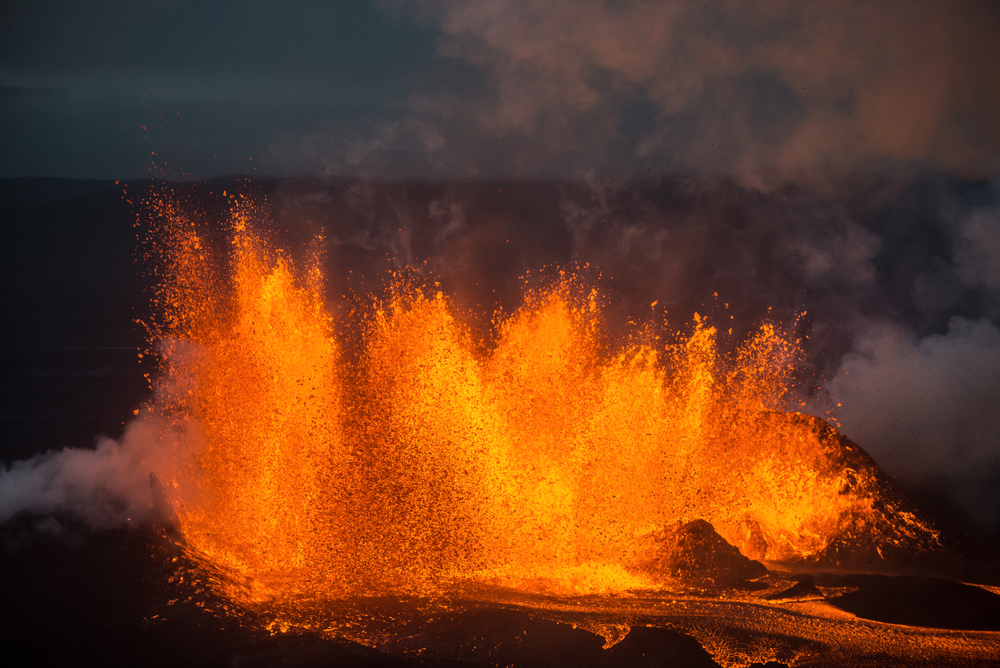
That lava fountain image is from the spectacular 2014-2015 eruption on Bardarbunga’s Holuhraun fissure system.
Another of its fissure swarms, Veidivotn, is famous for hosting the voluminous Thjorsa flood lava eruption about 8,000 years ago.
Bardarbunga demands respect.
What is Bardarbunga?
Like many Icelandic volcanoes, ice-bound Bardabunga is a structural combination of caldera and associated fissure swarms, some of which (like Holuhraun) extend beyond the glacier.
For all the details, check out its Catalogue of Icelandic Volcanoes entry.
Bardarbunga’s caldera collapsed after the 2014-2015 eruption and it went quiet for a while. Now it stirs again.
Today Icelandic Met Office specialists noted that (Google translation) “at 01:49 an earthquake occurred in the SA flank of the Bárðarbunga caldera. Initial calculations give a magnitude of M3.6. Earthquakes of this magnitude are not uncommon in that area. The earthquake was not felt.”
Bardarbunga is waking up.
Links
Icelandic Met Office (IMO):
- Updates
- VONAs (Volcano Observatory Notice to Aviation)
- Bardarbunga-Holuhraun 2014-2015 eruption
- IMO’s Bardarbunga information and monitoring page.
Global Volcanism Program page
London VAAC advisories page.
Iceland Monitor category page.
Updates
December 3, 2025, 11:41 a.m., Pacific: I’m updating posts for the new “Restless Volcanoes” post. Since the GVP report in January 2025, Bardarbunga has had a few strong temblors, so let’s go with unofficial but knowledgeable Jon Frimann’s post from a little over a month ago about the last big shake thus far.
March 19, 2025, 1:53 p.m., Pacific: IMO geoscientists note a M2.9 quake this morning at Bardarbunga, followed shortly by a M4.2 — and then, quiet.

There are no other changes so far, but the volcano keeps inflating per unreviewed data at the IMO monitoring page, linked above.
February 22, 2025, 3:44 p.m., Pacific: The current geoscientist note at IMO:
At 21:04 tonight, an earthquake of magnitude 5.2 occurred in the northern caldera of Bárðarbunga. More than 20 aftershocks have been recorded, the largest of which is 3.1. There are no signs of seismic unrest. There have been no reports that the earthquake has been detected.
Written by geoscientist on duty Feb 22 22:39
Jon Frimann did a post about this ongoing strong quake swarm, too.
I have been meaning to update this post but more urgent events and my writing projects kept me away — it’s only an academic concern, after all.
However, two academic sources — Haraldur Sigurdsson for the University of Iceland’s Web of Science page (Icelandic) and the UI Southern Volcanoes group in a Facebook post — have, respectively, recently brought up Bardarbunga’s Thjorsa flood lava eruption 8,000 years ago and two other large-volume effusive eruptions in the last 2,000 years.
(Katla is in this overproducer’s club, too, with the Eldgja flood lava eruption in the 900s, shortly after settlement and the only known eruption outside its caldera, and so is Grimsvotn, with the Skafta Fires, or Laki as we foreigners call it, in 1783).
A flood lava eruption is small and — key feature — limited in duration compared to large igneous province eruptions like the Columbia River or Deccan flood basalts that can go on for millions of years.
But a flood lava eruption in Iceland is bigger than what we’re used to seeing. See the book “Island on Fire” or some research papers like this to get an idea of what the Skafta Fires were like firsthand.
As Dr. Sigurdsson wrote, the Thjorsa flood lava eruption through Bardarbunga’s Veidivotn fissure system — bigger than either Eldgja or Laki — is considered to have been a result of pressure release as big glaciers melted and the last ice age ended.
Many of Iceland’s spectacular lava shields and other volcanic features were formed then and never AFAIK have shown signs of activity since.
Bardarbunga, near the hotspot, continued on but at “normal” levels, though with bigger output in 800 AD and the 1400s, per the Southern Volcanoes group. In 2014-2015 it had an eruption at Holuhraun that was 1/10 the volume of Laki/Skafta Fires.
During that effusive eruption Bardarbunga’s caldera collapsed as the melt below it flowed out — to be expected.
And then Bardarbunga should have slept for many decades. When it had some 5-pointers last year, Jon Frimann quite reasonably noted that the next eruption probably would take 50 years or so to come on.
And here we are now and he is noting that magma might be trying to reach the surface.
And two highly respected academic sources recently saw fit to mention Bardarbunga’s occasionally high output in public venues — to be clear, without drawing any linkages to the current activity at restless Bardarbunga.
I am not drawing any linkages, either, and just consider it a heads-up that I wanted to pass along. Let’s just keep one eye on Bardarbunga and remember:
- If it doesn’t go off, all well and good, and as it should be only ten years after such a voluminous eruption.
- If it does go off, it likely will be with a “normal”-sized or even small (for Bardarbunga) eruption.
- It is a member of the overproducers’club.
- As volcanologists say in general, even the volcano doesn’t yet know what it will do.
January 28, 8:06 p.m., Pacific: I missed this January 18th post from Jon Frimann about the dike intrusion.
Things overall remain stable at the moment.
January 16, 2025, 6:31 p.m., Pacific: They have lowered the Aviation Code back to Green as no more swarms have occurred, which is terrific, but I will leave this pinned a while longer, just in case.
January 14, 2025, 6 p.m., Pacific: Per IMO (autotranslated):
• A powerful earthquake swarm in Bárðarbunga began this morning. The largest earthquake was M5.1.
• About 130 earthquakes have been recorded since this morning. The most powerful earthquake swarm since 2014, when the Holuhraun volcano erupted.
14.1.2025Updated January 14 at 4:30 PM
After 9 am this morning, the intensity of the tremors decreased significantly.
It is unclear whether the surge is fading or will pick up again.
The aviation color code for Bárðarbunga remains yellow.
The volcano is unusually large and there are many scenarios for possible development.
The development of seismic activity will be closely monitored.
After 9 am this morning, the intensity of the earthquake swarm in Bárðarbunga decreased significantly and few earthquakes have been recorded since then. The intensity of the earthquake swarm was considerable. Despite the reduced activity, earthquakes are still being recorded, and further developments will be closely monitored.
The earthquake swarm began just after 6 am this morning and peaked at 8:05 am when the largest earthquake, measuring M5.1, was recorded. In addition, 17 earthquakes above M3 have been recorded, of which two were at or above M4.
Earthquakes will be reviewed and there may be changes in recorded earthquakes and their magnitude. The aviation color code remains yellow, indicating increased activity compared to normal conditions and uncertainty about the development.
Progress unclear
Despite the reduced activity, it is not possible to say whether the swarm is fading. Many scenarios are possible for the development of earthquakes in the area. The development of seismic activity in Bárðarbunga and possible volcanic eruptions will be closely monitored. Further information will be published as new data is received.
December 14, 2024, 5:42 p.m., Pacific: There are no major changes, but the Iceland Monitor published an overview article and low-level seismicity occasional occurs.
December 8, 2024, 11:55 a.m., Pacific: Well, that didn’t take long. There has been another 5-pointer, and geophysicist Pall Einarsson talks about it in this mbl.is article (autotranslated).
Featured image:
 Flight To Wonder