The last blogging here on this very active Hawaiian volcano goes back to 2018 and its huge Lower East Rift Zone eruption.
Since then, lava has returned to the summit —
— and more recently, there have been some small eruptions in and outside the summit crater, the last one very briefly in September.
Kilauea is not erupting just now, but there are sporadic magma intrusions. See update further down: Kilauea is erupting.
So I want to pass along a link to the Hawaiian Volcano Observatory’s Kilauea page because of their recent assessment of possible outcomes of these intrusions.
We are likely to hear from Kilauea over the next year, hopefully just with more small and scenic lava flows.
Updates
January 16, 2026, 9:26:a.m., Pacific: Per the USGS:
USGS Volcano Notice – DOI-USGS-HVO-2026-01-15T06:34:34+00:00 Back
HAWAIIAN VOLCANO OBSERVATORY INFORMATION STATEMENT
U.S. Geological Survey
Wednesday, January 14, 2026, 10:05 PM HST (Thursday, January 15, 2026, 08:05 UTC)KILAUEA (VNUM #332010)
19°25’16” N 155°17’13” W, Summit Elevation 4091 ft (1247 m)
Current Volcano Alert Level: WATCH
Current Aviation Color Code: ORANGEOn Wednesday, January 14 at 7:35 p.m. HST, a swarm of earthquakes began beneath Halemaʻumaʻu crater at the summit of Kīlauea. Elevated seismic activity gradually died down in frequency of occurrence and intensity, over the course of 40 minutes. Locations of these earthquakes are spread broadly beneath east side of Halemaʻumaʻu crater and the south caldera. All of the detected earthquakes have been less than magnitude-2, with most being magnitude-1 or smaller.
This is the third small swarm of earthquakes beneath Halemaʻumaʻu crater since the end of episode 40. The first swarm began at 12:40 a.m. HST and lasted for 30 minutes on Tuesday, January 13. It was followed the next day by a second swarm around 9:10 a.m. HST, and lasted less than 30 minutes on Wednesday morning, January 14. The first and second swarms both had magnitude ranges similar to the third. Most of the earthquakes seem to be occurring around the shallow Halemaʻumaʻu magma chamber, some 1.5 to 4 km beneath the surface.
Most of the earthquakes are volcano-tectonic earthquakes that accompany crack opening due to magmatic pressure. Elevated seismic activity of these intensities have not been seen at the summit since the start of the eruption in December 2024. A small swarm did precede a new fissure opening in the wall of the Halemaʻumaʻu crater just to the south of the vents, at the start of episode 30. It is yet to be determined if these swarms after episode 40 will have an impact on lava-fountaining activity at the surface.
Volcanic systems remain a complex balance of magmatic pressure and strength of the surrounding rocks. If the rocks weaken, one possible outcome is injection of a magma into a fracture creating a dike. If the magma breaches the surface a new vent might be created shifting the focus of the eruption. Historically, episodic fountain eruptions can cease when the magma supply is diverted in this manner.
Currently all of the activity remains beneath Kīlauea caldera and there is no observable evidence that magma is migrating away from this area. Both the east and the southwest rift zones remain quiet at this time.
The USGS Hawaiian Volcano Observatory will continue to closely track changes in seismic activity and monitor Hawaiian volcanoes for any changes.
USGS-HVO Interactive Earthquake Map of Hawaiʻi: https://www.usgs.gov/observatories/hawaiian-volcano-observatory/earthquakes
Short updates may be posted on the HVO webpage as necessary HVO – Observatory Messages | U.S. Geological SurveyMore Information:
Kīlauea activity summary also available by phone: (808) 967-8862
Kīlauea webcam images: https://www.usgs.gov/volcanoes/kilauea/webcams
Kīlauea photos/video: https://www.usgs.gov/volcanoes/kilauea/photo-video-chronology
Kīlauea lava-flow maps: https://www.usgs.gov/volcanoes/kilauea/maps
Kīlauea FAQs: https://www.usgs.gov/volcanoes/kilauea/faqsThe Hawaiian Volcano Observatory is one of five volcano observatories within the U.S. Geological Survey and is responsible for monitoring volcanoes and earthquakes in Hawaiʻi and American Samoa.
CONTACT INFORMATION:
askHVO@usgs.gov
Subscribe to these messages: https://volcanoes.usgs.gov/vns2/
Summary of volcanic hazards from eruptions: https://www.usgs.gov/observatories/hvo/hazards
Recent earthquakes in Hawaiʻi (map and list): https://www.usgs.gov/observatories/hvo
Explanation of Volcano Alert Levels and Aviation Color Codes: https://www.usgs.gov/programs/VHP/volcanic-alert-levels-characterize-conditions-us-volcanoes
December 12, 2025, 8:48 a.m., Pacific: I’m updating all these posts. Kilauea has been very active this year, slowly filling its summit caldera via fountaining episodes — an ongoing process.
Following it would have been nearly full-time work here for me. Fortunately, the Hawaiian Volcano Observatory has us all covered.
I’m glad that they don’t hold a grudge against Madam Pele for her destruction of one of their live cams:
March 13, 225, 8:10 p.m., Pacific: Here’s geologist Shawn Willsey on the most recent (and brief) fountaining event:
March 8, 2025, 8:45 p.m., Pacific: I’d like to take a chopper flight like this! 😍
Lava from #Kilauea's episode 12, which ended on March 5, covered about two-thirds of Halemaʻumaʻu. Ooze-outs along the margin of the flow decreased yesterday & are inactive today (Mar 7). New episode possible in next 4-6 days. pic.twitter.com/PD5sO66vQi
— USGS Volcanoes🌋 (@USGSVolcanoes) March 7, 2025
https://platform.twitter.com/widgets.js
February 20, 2025, 11:44 p.m., Pacific: Kilauea’s activity is not threatening, but I shouldn’t have overlooked these updates.
Madam Pele has done her fire dance ten times now, and the USGS has an in-depth Facebook post on it. 😎
December 27, 2024, 4:48 a.m., Pacific: Round Three has begun, per USGS Volcanoes on Facebook (that post also summarizes the whole eruption thus far).
No new updates are on the main HVO Kilauea page yet, but they’ll certainly go into details on it with today’s update around midday, Hawaii time.
December 25, 2024, 6:30 p.m., Pacific: Aaaand Round Two has ended — glad I got that viewing in this mrning!
What do you think? Will there be a Round 3?
HAWAIIAN VOLCANO OBSERVATORY STATUS REPORT
U.S. Geological Survey
Wednesday, December 25, 2024, 11:27 AM HST (Wednesday, December 25, 2024, 21:27 UTC)KILAUEA (VNUM #332010)
19°25’16” N 155°17’13” W, Summit Elevation 4091 ft (1247 m)
Current Volcano Alert Level: WATCH
Current Aviation Color Code: ORANGEActivity Summary: Episode 2 of the summit eruption of Kīlauea paused just before 11:00 a.m. on Christmas Day.
The vigorous fountaining from vents in the southwest corner of Halemaʻmaʻu crater rapidly died down over a few minutes just before 11:00 a.m. (see Kīlauea Daily Update for more information). Lava began draining back into the vent at 11:00 a.m. at the nearly the same time that summit tiltmeters began recording a change from deflation to inflation. Seismic tremor also decreased markedly at the same time. The pattern was similar but more abrupt than the onset of the pause on Monday, December 23, that occurred between 3 and 4 p.m.
Episode 2 lasted a little over 24 hours, which is about twice the duration of the first eruptive episode. Prior summit eruptions have lasted days to weeks and there is a high probability that this eruption will resume if the summit repressurizes over the coming days.
HVO continues to closely monitor Kīlauea and will issue an eruption update tomorrow morning unless there are significant changes overnight…
Given the volume and the gassiness, not to mention all the signs of magma movement underground in recent weeks to months, I think a Round 3 is likely, but not inevitable.
There are packets of magma on the move, obviously, and perhaps small sills at very shallow depths are venting, but apparently a conduit from one of the big reservoirs up to the surface, either in the summit caldera or along the south summit outside Kaluapele somewhere, has not yet opened up.
Or possibly the larger reservoirs just aren’t quite pressurized enough yet. There is, I’ve read, a complex balance between the plumbing systems of Mauna Loa, Kilauea, and the newest one, which used to be called Loihi, offshore, which has a ways to go yet before breaching the waves
Or could it be an interrupted supply at depth?
Lots of possible explanations can be proposed for a big hotspot volcano like Kilauea.
December 25, 2024, 4:26 a.m., Pacific: Kilauea’s fountains are a warming sight, this chilly, damp Christmas morn.

That’s the Two Pineapples’ version of the USGS feed from V1 cam — complete with a “Merry Christmas” (thanks, Madam Pele!) and the occasional superimposed images of Santa and/or red and green balls sailing around above the growing lava lake.
That lake looks especially impressive tonight on the USGS thermal cam:

Remember: This isn’t Halemaumau any more. It’s the much larger Kaluapele Caldera now (check out the various summit cams in daylight to get a sense of its hugeness) — this ongoing eruption almost covered the whole thing during that tremendous gush at first, and now again during Round Two.
HVO might provide numbers during one of its daily updates, but just eyeballing it, this eruption sure has volume as well as “oomph” in the form of gases powering those fountains hundreds of feet into the air.
Good! Maybe the magma moving around inside the great fire mountain has found a path it likes and will continue to give us, once again, an active lava lake at Kilauea’s summit.
Not so good is the six-figure outpouring of SO2 in HVO estimates. It won’t affect climate because it isn’t reaching the stratosphere, but it can and, given the right weather conditions, probably will occasionally affect local residents with vog (volcanic smog).
On the plus side: volcano tourism! That’s another good reason to hope this continues.
December 24, 2024, 3:22 p.m., Pacific: Round Two has begun, per HVO. The summit repressurized, forcing out some of the old lava that drained back in yesterday, and then new gassy lava made fountaining start again around 11 a.m. local time.
The text at that link changes with each new update, so here is today’s text:
HAWAIIAN VOLCANO OBSERVATORY DAILY UPDATE
U.S. Geological Survey
Tuesday, December 24, 2024, 11:48 AM HST (Tuesday, December 24, 2024, 21:48 UTC)KILAUEA (VNUM #332010)
19°25’16” N 155°17’13” W, Summit Elevation 4091 ft (1247 m)
Current Volcano Alert Level: WATCH
Current Aviation Color Code: ORANGEActivity Summary: The eruption at Kīlauea volcano that began yesterday, December 23, slowed starting around 3 p.m. HST yesterday. The eruption paused through the night and reactivated at several of the vents along the southwest of Halema‘uma‘u crater floor. Eruptive activity remains confined to Halemaʻumaʻu and the downdropped block within the caldera and may fluctuate in vigor over the coming days. No unusual activity has been noted along Kīlauea’s East Rift Zone or Southwest Rift Zone.
Summit Instrumental Observations: Seismicity at the summit over the last 24 hours has been low with approximately 8 earthquakes, all below magnitude-2.0. At the onset of the eruption yesterday morning, seismic tremor was high. However, around 3 p.m. yesterday, seismic tremor began to decrease, and currently there is low to moderate tremor related to vent activity. Immediately after the summit eruption commenced, summit tilt meters recorded rapid to moderate deflation until late afternoon. Around 3 p.m. yesterday, Kīlauea’s summit began slowly inflating. Based on ground instruments, the SO2 emissions were estimated to be over 100,000 tonnes per day during the initial stages of the eruption and dropped to about half of that by mid-day yesterday before the pause. The infrasound array picked up a clear signal from the summit around 10 a.m. this morning corresponding to low-level fountaining. A data problem last night resulted in images from Halemaʻumaʻu crater being displayed on a Nāpau Crater camera site. There is no eruptive activity in Nāpau Crater, and the camera has been temporarily taken offline for maintenance.
Summit Eruption Observations: Webcam images indicate that the new eruption started within Kaluapele (the summit caldera) in Hawai‘i Volcanoes National Park at 2:20 a.m. HST on December 23. The main eruptive vent is located on the southwest side of Halemaʻumaʻu crater. By mid-day yesterday, lava flows had erupted across Halema‘uma‘u crater floor and overflowed onto the down-dropped block area to the east. Lava flows covered 650 acres (1 square mile or 2.6 square kilometers), which is about one quarter of the entire caldera floor of Kaluapele. Large glowing bombs, pumice, and Peleʻs hair were deposited downwind of Halemaʻumaʻu during the peak of the eruption. Fountaining decreased abruptly at 3:30 p.m. yesterday and had ceased by 4:00 p.m. Drainback of lava into the original vents began soon after fountaining stopped and continued through the night. Drainback reversed around 8 a.m. this morning, December 24, and low-level eruption of sluggish lava occurred from several of yesterday’s vents. Fountains began increasing in vigor around 11:00 a.m., signaling the onset of a second episode of this eruption. Breakouts of red lava are also visible on the surface of the lava lake as it continues to circulate.
View the Kīlauea summit eruption livestream: https://www.youtube.com/usgs/live
…
Rift Zone Observations: Shallow earthquake counts in the upper and middle East Rift Zone (ERZ) remain at low levels. Over the last 24 hours, there was 1 recorded earthquake in the middle ERZ, 1 in the upper ERZ, and 7 in the Southwest Rift Zone (SWRZ); all were below magnitude-2.0. The ESC tiltmeter on the upper part of the ERZ shows deformation associated with the active eruption. Deformation rates remain low in the middle and lower ERZ and SWRZ as recorded by GPS instruments and tiltmeters. A problem with camera data resulted in the S2 Nāpau Crater camera to display alternating images of Nāpau Crater and Halemaʻumaʻu Crater on the S2 Nāpau Crater camera page. There is no eruptive activity at Napua Crater and the camera has been taken offline until the problem is corrected.
Analysis: The current eruption at the summit of Kīlauea is the sixth eruption within the caldera since 2020. These eruptions in the summit region have lasted for about a week to more than a year in duration. This eruption, like most others, started with vigorous lava and volcanic gas effusion, which continued to decrease throughout yesterday, December 23, until the eruption paused around 4:00 p.m. Renewed, low-level eruption of sluggish lava that began around 8 a.m. this morning, and around 11:00 a.m. today more gas-rich lava began reaching the surface causing fountaining to become more vigorous. Increased fountaining accompanied by increasing tremor and the resumption of summit deflation mark the onset of a second eruptive episode. Repressurization of the summit appears to be forcing, degassed lava that drained back into the vents last night back to the surface.
HVO continues to closely monitor Kīlauea and is in contact with Hawai‘i Volcanoes National Park and the Hawai‘i County Civil Defense Agency…
December 23, 2024, 7:29 p.m., Pacific: Just out — the eruption is paused:
HAWAIIAN VOLCANO OBSERVATORY STATUS REPORT
U.S. Geological Survey
Monday, December 23, 2024, 5:14 PM HST (Tuesday, December 24, 2024, 03:14 UTC)KILAUEA (VNUM #332010)
19°25’16” N 155°17’13” W, Summit Elevation 4091 ft (1247 m)
Current Volcano Alert Level: WATCH
Current Aviation Color Code: ORANGEActivity Summary: The eruption of Kīlauea slowed significantly between 3:00 and 4:00 p.m. and appears to be paused.
The eruption in Halema’uma’u crater within Kaluapele (Kīlauea summit caldera) that began at 2:20 a.m. HST this morning, December 23, continued through most of the day within a closed area of Hawaiʻi Volcanoes National Park. There was no immediate threat to human life or infrastructure, but emission rates of volcanic gases were very high. Webcam imagery and field crew observations showed continued lava fountaining from vents in the southwest portion of the caldera with new lava covering approximately 650 acres, including all of Halema’uma’u and most of the adjacent downdropped block. The area covered so far is a little more than 1 square mile (2.6 square kilometers) and represents about one quarter of the area of Kaluapele. The lava is estimated to be about 1 yard (1 meter) thick, giving an estimated average effusion rate of 110 cubic yards per second (85 cubic meters per second) for the first 8 hours of the eruption. Initial fountain heights were estimated to be about 260 to 300 feet (80-90 meters) and had decreased to about 55 yards (50 m) by 1:00 p.m. Vigorous fountaining produced a plume of volcanic gas and particles that was transported downwind, in a southwest direction over a closed area of Hawaiʻi Volcanoes National Park. Conditions prevented measuring SO2 gas emission rates by normal methods, but nearby monitoring stations estimated over 100,000 tonnes of SO2 per day around 8:00 a.m.and decreasing by half in the early afternoon. These estimates are similar to values measured in the early stages of previous summit eruptions in the past 4 years.
Around 3 p.m. today, tilt at the summit stopped showing deflation and seismic tremor began decreasing. By 3:30 p.m., lava fountains were barely visible. By 4 p.m., fountaining had stopped and seismic tremor was close to background levels. Visible volcanic gas emissions have also decreased significantly. These observations indicate that the eruption has slowed significantly and appears to be entering a pause.
HVO continues to closely monitor Kīlauea and will issue an eruption update tomorrow morning unless there are significant changes overnight…
December 23, 2024, 7:12 p.m., Pacific: Posted this first part at TalkWeather, too: If the Two Pineapples livestream commenters are correct, the fountains suddenly stopped and lava is draining back into the vents!
FWIW, this happened during the Kilauea Iki eruption in 1959, and HVO did say that Kilauea Iki showed deformation today, too (it’s a smaller crater near what used to be Halemaumau until the caldera collapse in 2018). I have no idea if that’s related or just coincidental, but at Kilauea Madam Pele does sometimes take back what she has given.
Question is, will it come back to the surface, and if so, where? The summit caldera is most likely, but we’ll see.
Not on TalkWeather: Reportedly, the drain-back happened at Kilauea Iki when a deep lava lake was present and backflow could overcome eruption rate of new material.
Unless there are more surprises overnight, we’ll find out more about today’s events in the update tomorrow.
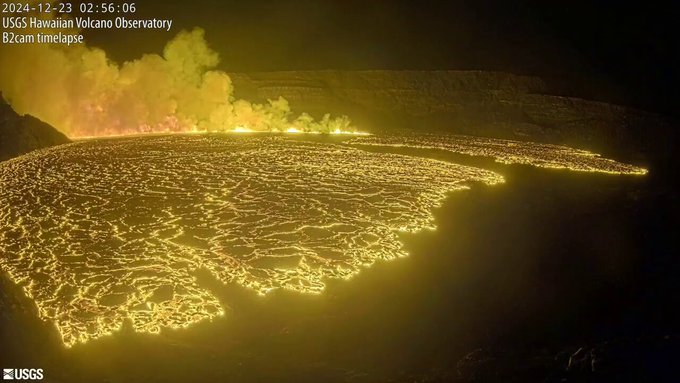
December 23, 2024, 2:09 p.m., Pacific: Kilauea has erupted — in the summit caldera — and the social media flood about it is almost as voluminous as that initial flow:
This morning, around 2:20 AM, a new #Kilauea eruption began within Kaluapele (the summit caldera). It was caught on camera by #HVO's B2cam. Images taken by the webcam were compiled into this timelapse video that shows lava fountains feeding lava flows across the caldera floor. pic.twitter.com/w52KpHOtau
— USGS Volcanoes🌋 (@USGSVolcanoes) December 23, 2024
https://platform.twitter.com/widgets.js
The Two Pineapples went up:
HVO Director Ken Hon did a livestream earlier today:
HAWAIIAN VOLCANO OBSERVATORY DAILY UPDATE
U.S. Geological Survey
Monday, December 23, 2024, 10:59 AM HST (Monday, December 23, 2024, 20:59 UTC)KILAUEA (VNUM #332010)
19°25’16” N 155°17’13” W, Summit Elevation 4091 ft (1247 m)
Current Volcano Alert Level: WATCH
Current Aviation Color Code: ORANGEActivity Summary: Kīlauea volcano began erupting this morning, December 23. Fissures on the caldera floor are erupting lava fountains and feeding lava flows in Halemaʻumaʻu and on the downdropped block within Kaluapele (the summit caldera). Eruptive activity is confined to Halemaʻumaʻu and the downdropped block within the caldera, and a plume of volcanic gas is blowing downwind to the southwest. No unusual activity has been noted along Kīlauea’s East Rift Zone or Southwest Rift Zone.
Summit Eruption Observations: Webcam images indicate that the new eruption commenced within Kaluapele (the summit caldera) in Hawai‘i Volcanoes National Park at 2:20 a.m. HST. The main eruptive vent is located on the southwest side of Kīlauea’s summit caldera, generating lava flows onto Halema‘uma‘u crater floor and the downdropped block area to the east. Between approximately 2:30 a.m. and 4:30 a.m., vents briefly opened to the north-east along the caldera floor but these vents have since slowed. Currently the initial vent along the caldera’s southwest wall remains active and is the dominant effusive source; maximum measured fountain heights overnight were over 295 ft (90 m) tall and had decreased to 230 feet (70 feet) during overflight at 9:30 a.m. HST. Lava flows have currently covered more than 500 acres of the caldera floor and the eruption is generating a vigorous plume of volcanic gas, which is reaching elevations estimated at 6,000-8,000 feet above sea level and being transported downwind to the southwest. HVO field crews observed glowing lava bombs and other ejecta being deposited on the west caldera rim area, within the closed area of Hawaiʻi Volcanoes National Park, underscoring the hazardous nature of this area. Spatter from the fountains and tephra/Pele’s hair in the plume downwind have prevented HVO crews from obtaining measurements of SO2 emission rate on the ground or by helicopter. However, based on the emissions from the five summit eruptions at Kilauea from 2020 to 2023, we estimate that SO2 emissions thus far may be averaging on the order of 50,000-100,000 t/d.
View the Kīlauea summit eruption livestream: https://www.youtube.com/usgs/live.
Summit Observations: Elevated earthquake activity beneath the summit began at approximately 2 a.m. HST this morning, December 23. It was accompanied by rapid summit inflationary ground motion recorded on the UWD and SDH tiltmeters located in the summit region. With the start of lava effusion, eruptive tremor (a signal associated with fluid movement) began and is still evident in seismic monitoring data. At approximately 2:45 a.m. HST, summit region tiltmeters switched to deflation, which persists as of this writing. The Kīlauea Iki tiltmeter to the east also shows deformation associated with the active eruption.
Rift Zone Observations: Shallow earthquake counts in the upper and middle East Rift Zone (ERZ) remain at low levels. Over the last 24 hours, there was 1 recorded earthquake in the middle ERZ, 1 in the upper ERZ, and 7 in the Southwest Rift Zone (SWRZ); all were below magnitude-2.0. The ESC tiltmeter on the upper part of the ERZ shows deformation associated with the active eruption. Deformation rates remain low in the middle and lower ERZ and SWRZ as recorded by GPS instruments and tiltmeters.
Analysis: The ongoing eruption at the summit of Kīlauea is the sixth eruption within the caldera since 2020. These eruptions in the summit region have lasted for about a week to more than a year in duration. This eruption, like most others, started with vigorous lava and volcanic gas effusion, which has been decreasing over time.
Hazards: The eruption is occurring within a closed area of Hawai’i Volcanoes National Park. High levels of volcanic gas—primarily water vapor (H2O), carbon dioxide (CO2), and sulfur dioxide (SO2)—are the primary hazard of concern, as this hazard can have far-reaching effects down-wind. As SO2 is continuously released from the summit during the eruption, it will react in the atmosphere to create the visible haze known as vog (volcanic smog) downwind of Kīlauea. Vog information can be found at https://vog.ivhhn.org/.
Hawaiian lava flows generally advance slowly downslope and are currently confined to Halemaʻumaʻu and the eastern part of Kīlauea caldera. Additional hazards include Pele’s hair and other volcanic fragments from the lava fountains that will fall downwind of the fissure vents and land on the ground within a few hundred meters (yards) of the vent (s), or on the rim of the caldera west of the erupting vents. Strong winds may waft lighter particles to greater distances downwind. Residents and visitors should minimize exposure to these volcanic particles, which can cause skin and eye irritation.
Other significant hazards also remain around Kīlauea caldera from Halemaʻumaʻu crater wall instability, ground cracking, and rockfalls that can be enhanced by earthquakes within the area closed to the public. This underscores the extremely hazardous nature of Kīlauea caldera rim surrounding Halemaʻumaʻu crater, an area that has been closed to the public since late 2007.
Featured image: M. Patrick/USGS, public domain
 Flight To Wonder