This restless caldera in the Bay of Naples has frequent seismic swarms, but earlier this year (2024), as noted in the previous post, a set of moderately strong tremors occurred, causing some building damage in Pozzuoli and Naples.
It was a wake-up call, and many citizens began taking the evacuation plan for an eruption at Campi Flegrei personally (nearby Vesuvius is better known and, although sound asleep at the moment, has its own plan).
No mass evacuation was called, fortunately.
An eruption didn’t occur, but the online local media reported a series of intense discussions among government/emergency management officials and staff of the National Institute for Geophysics and Volcanology (INGV), who noted that earthquakes as powerful as magnitude 5 could occur — this would damage infrastructure and many buildings (some are very old and historic; there also is much more recent but shoddy and often unlicensed construction).
An eruption still seems less likely; online reliable sources I have read suggest, that if one did occur, it would probably be similar to Monte Nuovo’s eruption in the 1500s rather than another Campanian Ignimbrite or Neapolitan Yellow Tuff cataclysm, but even the low-level event would devastate this densely populated urban area.
🌋🌋🌋
INGV shared a seismology study (Italian) at its website in July, and in September 2024, an amazingly detailed description of the internal plumbing (Italian), with this image:
Gah!
But INGV reports that Campi Flegrei’s famous bradyseism is currently on the downswing, and from the few papers I have read, the deep big magma reservoir might be cooling down (which bodes well for the foreseeable future, this layperson suspects — at least in terms of anyone getting supersized during our lifetime).
All in all, Campi Flegrei will continue to make news into 2025.
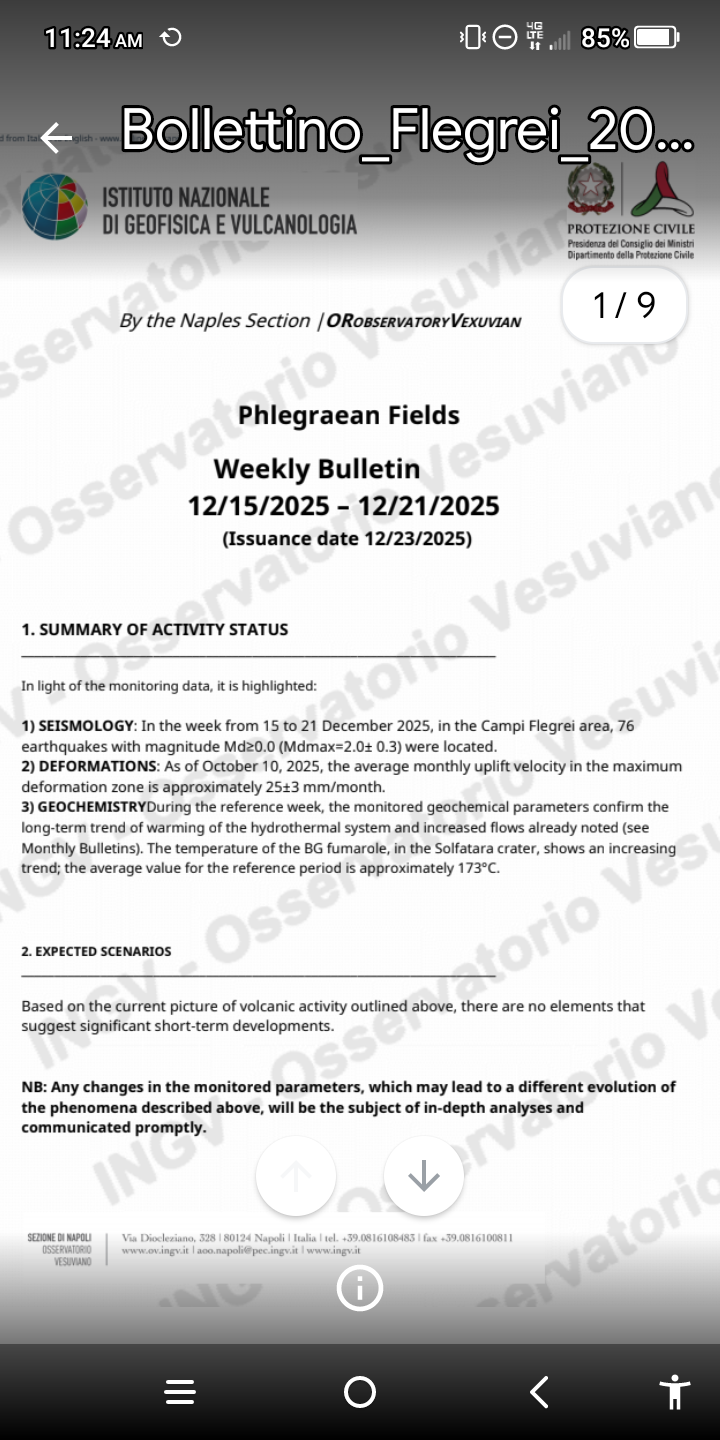
December 26, 2025, 11:27 a.m., Pacific: Campi Flegrei is still at Yellow alert, with some swarming now and then.
Here is a screenshot of the current INGV bulletin summary (translation by Online Doc Translator):
April 7, 2025, 6:00 a.m., Pacific: This paper by acknowledged experts is a preprint, meaning that it hasn’t been completely peer-reviewed yet, but it’s an interesting look at possible eruption scenarios, if their underlying assumption that magma is causing the recent unrest is correct (quite a few knowledgeable role argue for a hydrothermal system cause instead).
March 25, 2025, 2:05 p.m., Pacific: From INGV’s latest update, via Online Doc Translator:
]…2) DEFORMATIONS: After the seismic events of Md=4.6 (13/03) and Md=3.9 (15/03) a decrease in the ground uplift velocity was recorded, the value of which can be defined with the acquisition of further data, which will be available in the coming weeks.
3) GEOCHEMISTRY: No significant changes in the geochemical parameters monitored in the reference week were reported compared to the already known trends of increased flows and heating of the hydrothermal system. The temperature sensor installed in a fumarolic emission 5 meters from the main fumarole of Pisciarelli in the last week showed an average value of ~97°C.
2. EXPECTED SCENARIOS
________________________________________________________________________
Based on the current picture of volcanic activity outlined above, there are no elements that suggest significant short-term developments.
NB Any changes in the monitored parameters, which may lead to a different evolution of the phenomena described above, will be the subject of in-depth analyses communicated promptly.
March 19, 2025, 3:01 p.m., Pacific: INGV has done an in-depth post (autotranslated) on the burst-swarm quakes mentioned in the paper referenced in the update below, and they also give a good picture — in graphics as well as words — of the bradyseism deformation ongoing in this caldera.
March 18, 2025, 8:56 p.m., Pacific: No new big quakes, but apparently the recent M4.4 (upgraded to a M4.6 per Cronaca Flegrea) was actually a doublet —
It is nice to see that the volcano-tectonic framework adopted by Scotto di Uccio et al. (2024) consistently matches the distribution of seismicity of the recent EQ doublet producing a record-breaking Md 4.6 earthquake widely felt by the population. Nice work @aldozollo 🌋 https://t.co/kaSo6CT6zQpic.twitter.com/SPn2Stsw7p
— Jacopo K. Natale, Ph.D. (@JacopoKNatale) March 18, 2025
— and it reactivated a fault (the significance of which I don’t know, other than this probably explains the surprising acceleration values and some of the resulting damage):
Campi Flegrei’s double quake on Mar 13 (Md4.6) reactivated La Pietra fault, 1km lenght. Up to 1g shaking sharply attenuating with distance. Early warning systems worked.https://t.co/WUWms8BFuY
March 15, 2025, 3:40 p.m., Pacific: A M3.9 happened in the same general area today. INGV does not mention swarms.
Cronaca Flegrea reports that two women were injured, 242 people have had to leave unsafe buildings, and an important highway overpass was closed until authorities declared it safe.
[Layperson speculation] I see three possible outcomes, given that INGV noted no evidence of an impending eruption:
Hydrothermal explosion in the Solfatara-Pisciarelli area. After reading this paper, I think this is the likeliest outcome, unfortunately, though it’s not inevitable. “Where” is obvious but “when” cannot be known, since these things happen without warning. “How big” is uncertain, too.
A 5-pointer. This is the strongest quake that Dr. Di Vito, of INGV, reportedly thinks is possible here.
Continued seismicity, a/k/a death of a thousand cuts.
[/layperson speculation]
March 14, 2025, 1:06 p.m., Pacific: Twelve hours ago, INGV declared the end of the swarm, and included a note about the rules they use to define swarms (it’s a matter of elapsed time).
Despite its location, Campi Flegrei has displayed a total disregard for impeccable Latin logic and, an hour ago, had a M3.5.
The volcano is stronger than us, and ultimately always wins, but logic and rapid response and learning are how to save the most lives in these crises.
Here is a browser translation of their recent post (Italian) about the swarm:
Campi Flegrei: the earthquake of March 13, 2025 (Md 4.4) and the update on bradyseism
March 14, 2025
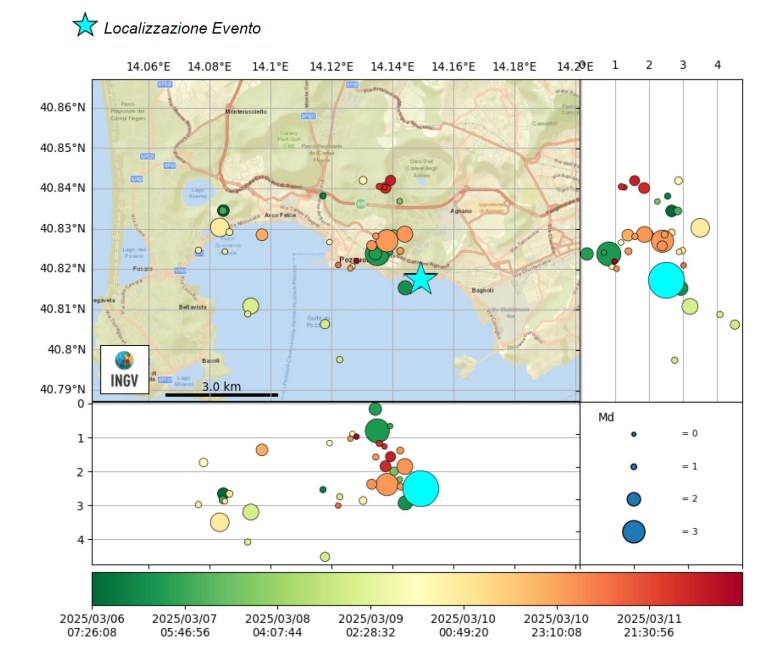
At 01:25 Italian time yesterday, 13/03/2025, the Monitoring Room of the Vesuvius Observatory – INGV located a seismic event of preliminary magnitude Md 4.4±0.3 , in the Campi Flegrei area , along the coast of the Gulf of Pozzuoli (La Pietra – Dazio) and very close to the populous district of Bagnoli (Figure 1).
Figure 1 – Seismicity map of Campi Flegrei between March 6 and March 13, 2025: only earthquakes with magnitude M ≥ 1.0 are reported. The size of the symbols is proportional to the magnitude, as indicated in the box at the bottom right. The star and the turquoise circle indicate the Md 4.4 event of March 13, 2025.
The earthquake that shook the entire metropolitan area of Campi Flegrei and many neighborhoods of the city of Naples occurred at a depth of about 2.5 km. From that moment a seismic swarm began , which ended on the night between March 13 and 14, with a total of 44 events with magnitude ≥ 0 of which only 9 with magnitude Md between 1.0 and 1.7.
As already reported on many other occasions, the seismicity of the Campi Flegrei area is strictly related to volcanic dynamics and in particular to the phases of deformation and uplift of the ground (part of the phenomenon known as bradyseism). The current bradyseismic crisis, which began in 2005, has so far produced a maximum uplift of about 140 cm in the central area of the caldera, measured in a small area 500 meters south of Rione Terra (Pozzuoli).
In the past, other phases of ground uplift accompanied by seismicity have occurred, the most recent of which in the periods 1969-1972 and 1982-1984 . The most energetic earthquakes during those crises were recorded on 4 October 1983 and 14 March 1984, both with a magnitude Md of 4.0. And it is worth remembering that the second was characterized by such intense seismicity that it caused serious damage to the buildings of Pozzuoli and a partial evacuation of its inhabitants.
During the current bradyseismic crisis, the largest seismic events were recorded on 27 September 2023 ( Md 4.2 ), 2 October 2023 ( Md 4.0 ), 20 May 2024 ( Md 4.4 ) and 26 July 2024 ( Md 4.0 ), whose locations are shown in Figure 2, together with those of the events with magnitude M ≥ 3.0, starting from 1983. It should be underlined that although in the last 10 years an increase in the number and energy of the recorded events has been observed, they show a magnitude ≤ 1.0 for the most part (about 97%).
Figure 2 – Map of the epicenters located by the Vesuvius Observatory Seismic Network from 1983 to today, including the event of March 13, 2025 (turquoise star), relating to earthquakes of magnitude M ≥ 3.0. On the right of the map, the projections of the hypocenters oriented north-south; at the bottom, oriented east-west (the turquoise circle indicates the Md 4.4 event of March 13, 2025). The size of the symbols is proportional to the magnitude, as indicated in the box at the bottom right.
The current situation (February – March 2025)
In the last three weeks , the average ground uplift rate in the zone of maximum deformation near Rione Terra in Pozzuoli, has been around a preliminary value of ~30±5 mm/month (as reported in the Campi Flegrei weekly bulletin, 3-9 March 2025). An examination of the data in the February monthly bulletin highlights that: a) in the previous months, since August 2024, the same area, at the centre of the caldera, had shown an average uplift rate of ~ 10 mm/month; b) only during the second half of February 2025 this value had risen to ~15±5 mm/month (Figure 3).
Figure 3 – (a) Time series of the altitude variations of the GNSS station of the Rione Terra station, Pozzuoli (RITE) from 01/01/2024 to 10/03/2025; (b) Length variation of the SOLO-ARFE baseline (Solfatara – Arco Felice) from 01/01/2024 to 10/03/2025.
In the general framework in which deformations and seismicity at Campi Flegrei continue to be closely associated, yesterday’s Md 4.4 earthquake fits into a context of a rapidly increasing rate of uplift that had not been detected during the event of the same magnitude on May 20, 2024. That event had in fact occurred in conditions of progressive and continuous deformation, demonstrating the fact that there is no direct relationship between the rate of uplift of the ground and magnitude and that, if it were necessary to reiterate, it is not possible to establish either when earthquakes arrive or what intensity they will have.
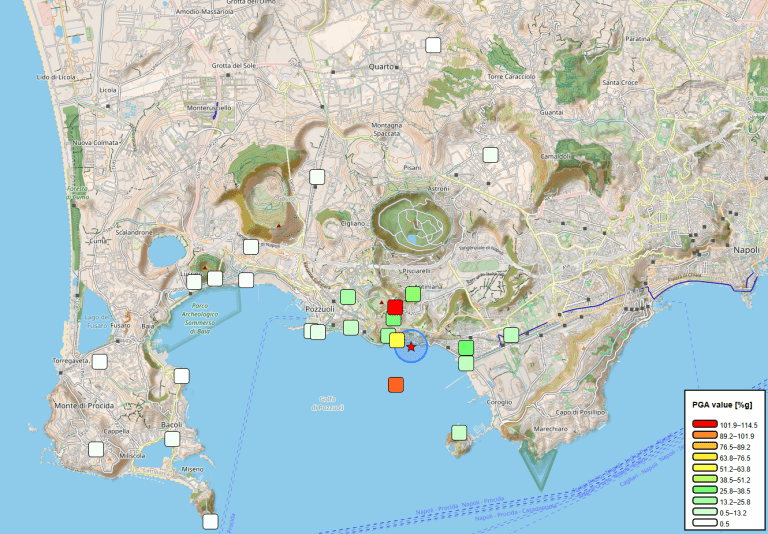
Thanks to the recent implementation and completion of an accelerometric network, which includes both ground stations and stations installed on the seabed of the Gulf of Pozzuoli, for some months and on the occasion of significant seismic events, shaking maps have been published that report the values of ground accelerations, expressed as a percentage of the gravitational acceleration. These maps are produced for different areas of the Phlegraean area and one was produced for yesterday’s Md 4.4 magnitude event (Figure 4), on which very high acceleration values are observed , between 0.6 and 1 g (where g is the gravitational acceleration), especially towards the edge of the Solfatara and Pozzuoli, towards the sea and towards the east, in the direction of the Posillipo hill and the city of Naples.
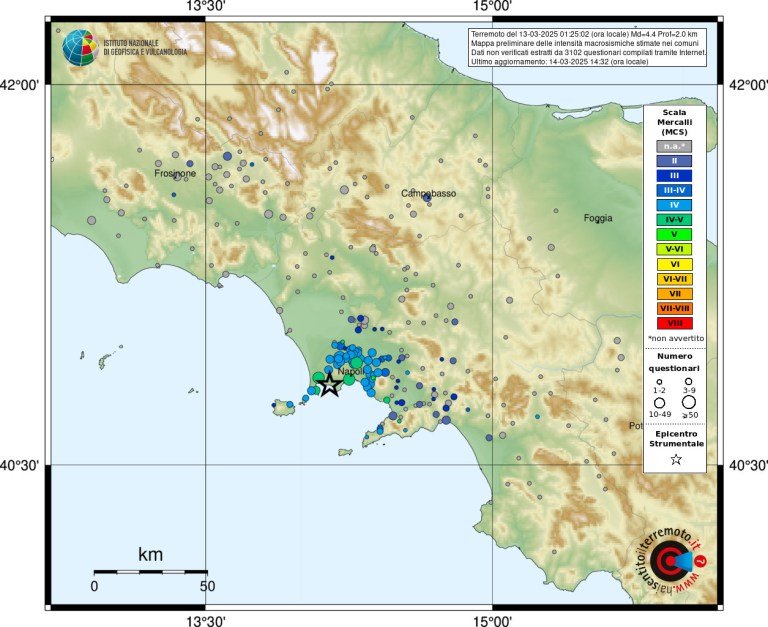
Even with some directional characteristics, yesterday’s earthquake was felt in a vast area that goes from Bacoli in the west to the eastern districts of Naples near the Vesuvian area, and in various municipalities present in the NE-N-NW quadrants of the Neapolitan area , up to Giugliano and Marano. This can be seen with a certain ease from the map of the felts obtained thanks to the data collected through the questionnaires of ” Have you felt the earthquake? ” which show felts estimated, at the moment, up to the V MCS degree (Figure 5).
Figure 5 – Map of resentments obtained thanks to the data collected through the questionnaires “Did you feel the earthquake?”, updated on 03/14/2025.
Eruption imminent?
Although for many months we have continued to record fluctuating and variable, but sustained, variations in some parameters such as the speed of ground deformation and CO2 emissions, the other parameters detected by the Vesuvius Observatory-INGV monitoring system as a whole do not currently show evidence of an imminent volcanic eruption, especially in light of an analysis of all the geophysical and geochemical parameters as a whole . For example, there are no seismic signals indicating the movement of magma towards the surface nor geophysical and geochemical anomalies that would indicate a disturbance of the hydrothermal system. The scenarios that we can expect in the short term must therefore be inserted into the geophysical framework that the Campi Flegrei caldera has been highlighting for some time: seismicity will continue as long as the ground uplift is underway and earthquakes of energy comparable to that of today’s earthquake, or slightly higher, will still be possible. An intensification of the bradyseismic crisis remains possible, as well as a decrease, with a transition from uplift to subsidence (as occurred in the crises of the last century).
What is the Vesuvius Observatory doing these hours?
Despite the seismic event having occurred only 2.5 km as the crow flies from the Vesuvius Observatory headquarters, with the inevitable involvement of the night shift personnel, the entire organizational procedure that guarantees the expected communications to the Civil Protection bodies, at its various levels, and to the population, was carried out according to the expected standards. Furthermore, in the past weeks, as well as in the days preceding last night’s seismic event, the various groups of researchers at the Vesuvius Observatory with monitoring duties have intensified the measurement campaigns of all the physical and chemical parameters useful for defining the phenomenon in progress.
The copy-and-paste of that block quote didn’t carry over emphasis and links in the original.
Some things in it that drew my attention are (my emphasis):
“…in the last 10 years an increase in the number and energy of the recorded events has been observed…”
“…in the previous months, since August 2024, the same area, at the centre of the caldera, had shown an average uplift rate of ~ 10 mm/month; b) only during the second half of February 2025 this value had risen to ~15±5 mm/month (Figure 3).”
“…yesterday’s Md 4.4 earthquake fits into a context of a rapidly increasing rate of uplift that had not been detected during the event of the same magnitude on May 20, 2024. “
“…very high acceleration values are observed , between 0.6 and 1 g (where g is the gravitational acceleration), especially towards the edge of the Solfatara and Pozzuoli, towards the sea and towards the east, in the direction of the Posillipo hill and the city of Naples.”
“Although for many months we have continued to record fluctuating and variable, but sustained, variations in some parameters such as the speed of ground deformation and CO2 emissions, the other parameters detected by the Vesuvius Observatory-INGV monitoring system as a whole do not currently show evidence of an imminent volcanic eruption…”
The scenarios that we can expect in the short term must therefore be inserted into the geophysical framework that the Campi Flegrei caldera has been highlighting for some time: seismicity will continue as long as the ground uplift is underway and earthquakes of energy comparable to that of today’s earthquake, or slightly higher, will still be possible. An intensification of the bradyseismic crisis remains possible, as well as a decrease, with a transition from uplift to subsidence (as occurred in the crises of the last century.”
There is no point in a layperson speculating on all that. From the little bit I know, however, it sounds reassuring in the doom-gloom-padded room sensationalism aspect — no eruption of any sort (most likely one is a Monte Nuovo style “normal” eruption) in the foreseeable future. That said, this layperson thinks the change in behavior recently is significant enough to warrant keeping a close eye on this situation.
By the way, did you know that Campi Flegrei is not technically a supervolcano?
I’m willing to give total respect to a volcano whose eruptions have sent pyroclastic flows up and over the nearest range of the Appenine Mountains, but according to the source I’m using in the supervolcanoes series:
This goes to the crux of the abuse and misuse of supervolcano due to a lack of attention or awareness of the formal definition established by Miller and Wark in 2008 and the conflation of the volume and magnitude measures. There are some caldera volcanoes that over their lifetime have exceeded 450 km3 in cumulative output of felsic magma, but have never had a supereruption, per se. These are not supervolcanoes. One of the most common misrepresentations is Campi Flegrei, the famous European or Italian “supervolcano” or “Europe’s Yellowstone” (a Google Search brings up many of such comparisons from Newsweek, National Geographic, Wired, and the BBC), which does not fit its’ proposed status. The so-called Campanian “supereruption” is currently estimated at 181–265 km3 DRE, a mass of 4.7–6.9 × 10¹⁴ kg, a magnitude (M) of 7.7–7.8 and a VEI of 7 (Silleni et al., 2020). It is possible that when more work is done, Campi Flegrei may rise to the status of a supervolcano, but at present it does not fit the bill as defined above. However, we do note that given its location, a future eruption with a magnitude comparable to the Campanian Ignimbrite would be even more catastrophic than a true supereruption in a remote region like the Altiplano/Puna of the Andes, for instance.
I’m a big fan of impeccable logic.
March 13, 2025, 8:22 p.m., Pacific: The swarm continues, per INGV, with 44 quakes thus far, but apparently people only felt the first one (M4.4). That did a lot a damage but only one injury has been reported per the BBC.
March 12, 2025, 10:00 p.m., Pacific: A new seismic swarm started with a 4-pointer a few hours ago. Online local media report damage but no injuries. People are staying in the streets and authorities are holding meetings.
Also of note, a house in Pozzuoli was closed today because of very high CO2 levels. Its occupants are all okay.
March 8, 2025, 6:12 p.m., Pacific: INGV has a page (Italian) on recent quakes magnitude 4+ — there are also linked articles on swarms, too.
March 1, 2025, 12:32 a.m., Pacific: There was another swarm after that, with 27 quakes, the strongest being M2.1. Within the hour, INGV reports on Facebook that another swarm has begun, with the strongest quake thus far also M2.1.
As I understand it, all of this is geothermal; monitoring of the volcanic parameters reportedly shows no changes.
I can’t help wondering if the repeated hammering of teleseismic waves from a distant point in the same basin (Greece’s Amorgos-Anydros swarm, which apparently is now declining) has affected Campi Flegrei’s hydrothermal field, causing bubbles that now are “knocking the pipes” — this is entirely layperson speculation, though.
It must be nerve-wracking for local residents.
February 20, 2025, 11:28 p.m., Pacific: INGV reports the swarm is over. It had 34 quakes, the strongest being only a 2-pointer.
There is no other news at the moment. Cronaca Flegreawonders if the crisis is over.
I’ll bet that everyone in Pozzuoli, Naples, and environs is ready for a long and seismically stable weekend!
February 20, 2025, 3:41 a.m., Pacific: Well! INGV declared one swarm over and another has begun. I got into it a little at TalkWeather.
February 19, 2025, 11:29 p.m., Pacific: The swarm has ended after 672 quakes, per Cronaca Flegrea.
Apparently almost all of Pozzuoli cleared out on their own initiative.
The swarm was very concentrated, per this knowledgeable tweeter:
A look at the seismic swarm in the Campi Flegrei area in #Italy.
There have been 200+ earthquakes since February 10th, 2025, ranging from M<1 to two M3.9 events (INGV data). The "busiest" day was Feb. 18th, with 88 events.
It will be interesting to hear what boffins have to say about it technically after they’ve studied it a bit.
February 18, 2025, 8:48 p.m., Pacific: INGV’s last update on Facebook was nine hours ago, and they said the next one would be out in three to six hours, if needed, so that non-news is good.
Their weekly bulletin is out, too, through the 16th, and it confirms what spokespeople have been telling the media: no significant changes have been noted in monitoring parameters.
Finally, Il Mattino has a self-translating article 😎 (this link probably will be in English) up that goes into detail about the crisis. Authorities and scientists say over and over to a very anxious public that this is not volcanic, they find no worrisome changes in the monitoring, and there is a plan and they are following it.
That last point especially, in this layperson’s opinion, is excellent reassurance against panic.
However, that said, Cronaca Flegreareports (Italian) that the swarm continues, surpassing 600 quakes now and with at least two 3-pointers overnight.
February 18, 2025, 9:32 p.m., Pacific: This swarm is lasting much longer than typical ones.
Within the hour, INGV posted this update (Facebook translation):
Since 15:53 (UTC) on 15/02/2025 there is an earthquake in the Campi Flegrei area. At the time of issuance of this Communicato 450 earthquakes with magnitude Md mag 0.0 and a maximum magnitude Md = 3.9 ril 0.3. The map shows the locations of events with magnitude Md le 1.0. Further updates will follow depending on the evolution of the phenomenon. Find out more at https://buff.ly/4k1MrNE
Ten minutes later, they reported a M3.1 in the swarm. According to this report (Italian), that was the strongest of twenty quakes overnight.
Dr. Di Vito was quoted in the media yesterday as saying that no changes have been noted in volcano monitoring parameters.
February 17, 2025, 5:02 a.m., Pacific: There’s a big swarm ongoing that started yesterday. Mayors of Pozzuoli and Naples tell media that there is no catastrophe scenario, according to experts, and emergency meetings are ongoing.
1/4 Prosegue senza sosta l'importante sciame sismico in corso da ieri pomeriggio ai #CampiFlegrei, dove nelle ultime 24 ore sono stati registrati oltre 210 terremoti, i più forti dei quali rimangono quelli di M 3.9 delle 15:30 e delle 00:19. pic.twitter.com/U3U0cU2ReP
December 25, 5:03 a m., Pacific: In terms of monitoring, the INGV weekly bulletins describe no changes. As far as this layperson can tell, the biggest hazards in the short term are earthquakes up to the M5 range and a steam explosion, neither of which have precursors.
Perhaps those recent very shallow quakes were, in lay terms only, a failed steam explosion. Perhaps (again, lay speculation only), the risk is now back down to baseline — which still is elevated — since no “boom!” has occurred in the interval.
I’ll leave this pinned a while longer, though, just in case.
December 7, 2024, 10:42 a.m., Pacific: Just two things from this morning’s social media, but they are significant.
X translation: “Seismic activity in Campi Flegrei, Italy has increased today. The latest records from INGV’s CSOB observation point (eastern edge of Solfatara crater) and epicenter distribution since December. The epicenters are concentrated just south of Solfatara crater, and most of the earthquakes are very shallow, less than 1 km deep.”
This news article in a Facebook post shared by INGV.
Per Google translation,
Di Vito: “The crust continues to deform, we continue to monitor the crisis”
The director of the Vesuvius Observatory on the seismic swarm: “Currently there are no evident changes in the bradyseismic scenario”
06/12/2024
“Since this morning we have recorded about twenty events, some felt by the population. The most intense was of magnitude 3.4 . The seismicity is concentrated in the area around the Air Force Academy of Pozzuoli, at a relatively low depth”. This is the analysis of Mauro Di Vito, director of the Vesuvius Observatory, on the seismic swarm underway at Campi Flegrei.
“The crust continues to deform, even at a reduced speed: it has accumulated stress and is releasing it. The scenarios? We continue to follow this crisis to understand if there are changes, but currently they are not evident”.
I just came across this, and it’s a hopeful sign that it’s all from yesterday — apparently there are no updates yet today but I will do some in-depth checking and add news from today below, if needed.
The alert level currently is unchanged, at Yellow.
Quick update, 7:26 p.m., Pacific: I found no major news posted today but summed things up at TalkWeather.
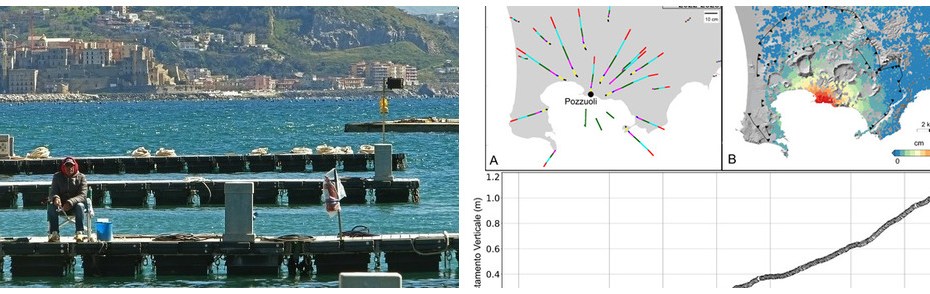
Featured image: Adriana Lortete/Shutterstock, left, and INGV, right.



 Flight To Wonder