Fido’s family doesn’t need a pet-food trademark!
Videos at the end of this post cover dog breeds today, but domesticated wolves, i.e., dogs, are only part of the family Canidae picture (though a very important part to us).
Dr. Wikipedia tells us that family Canidae is composed of more than thirty canine species, divvied up into two groups:
- Wolf-like doggos and close relatives
- Foxes and fox-like species
This is probably true, but we can’t get into as much detail about Canidae here as we did yesterday with cats.
We could — if I had started writing with an eye on how dogs evolved, but it was cats, and the Dog Day Afternoon posts simply began as a way to introduce a set of carnivores that we’re familiar with and that certainly influenced cat evolution.
Since then, though, I’ve learned that canids are fascinating in their own right.
In fact, one of the projects being considered for 2025 is a series, paralleling the “Fangly Fact About Cats,” called something along the lines of “doggone facts about the dog family.”
What do you think about that?
It’s only a possibility, but in the meantime the question comes up: how did dogs and their near kin evolve?
There are some imaginative videos about it online. I like this one, which starts out with Cimolestes, a dinosaur-era little mammal that some experts suggest might be ancestor to all of order Carnivora:
The earliest known caniform ancestor is Miacis, from North America. One of its presumed descendants, Hesperocyon, is the earliest known true canid — MUCH older than Proailurus, the Dawn Cat — though its group went extinct, along with the Borophaginae, or bone-crushing dogs, leaving subfamily Caninae, today’s canids, as the lineage’s evolutionary winner.
That’s an extremely cool visualization, but isn’t it taking a walk on the wolf side of things? What about foxes and fox-like canids?
Unfortunately, they get overlooked in the evolution videos I see, so let’s instead look at the foxes we have today:
For a complete list of canine species, see Table 46-1 (rather technical).
And here are just a few videos that caught my eye. They are about —
A golden jackal
Seeing carefree monkeys browsing along in a wildlife video is sort of like seeing teenagers at the start of a horror flick…
Note: Not an African wolf
🐺🦊🐺
Bushdogs
It’s so hard to think of these roly-poly little water hunters as dogs — but they are:
🐺🦊🐺
Zorro
More specifically, zorro culpeo or just plain culpeo, the Andean fox.
As noted in some earlier posts, South American foxes resemble the red fox and other members of genus Vulpes because of convergent evolution, not because of a close taxonomic relationship.
🐺🦊🐺
Red foxes
They’re play-fighting and first one and then the other notices something unusual about the surface under their feet:
This is right up there on my animal favorites list with the raccoon catching snowflakes!
🐺🦊🐺
Okay, time to dial up the charisma…
Wolves
Here is a top-ten collection from the BBC:
Meanwhile, in North Carolina, a red wolf update from this fall:
🐺🦊🐺
And now, everyone’s friend —
Dogs
Actual comment from the first video: “All dogs are in a higher group called ‘good bois.'”
Part 1:
Part 2:
Some lagniappe:
Dogs can never speak the language of humans, and humans can never speak the language of dogs. But many dogs can understand almost every word humans say, while humans seldom learn to recognize more than half a dozen barks, if that. And barks are only a small part of the dog language. A wagging tail can mean so many things. Humans know that it means a dog is pleased, but not what a dog is saying about his pleasedness. (Really, it is very clever of humans to understand a wagging tail at all, as they have no tails of their own.) Then there are the snufflings and sniffings, the pricking of ears – all meaning different things. And many, many words are expressed by a dog’s eyes.
— From “The Hundred and-
One Dalmatians,” in tails.com’s list of the ten best dogs in literature.
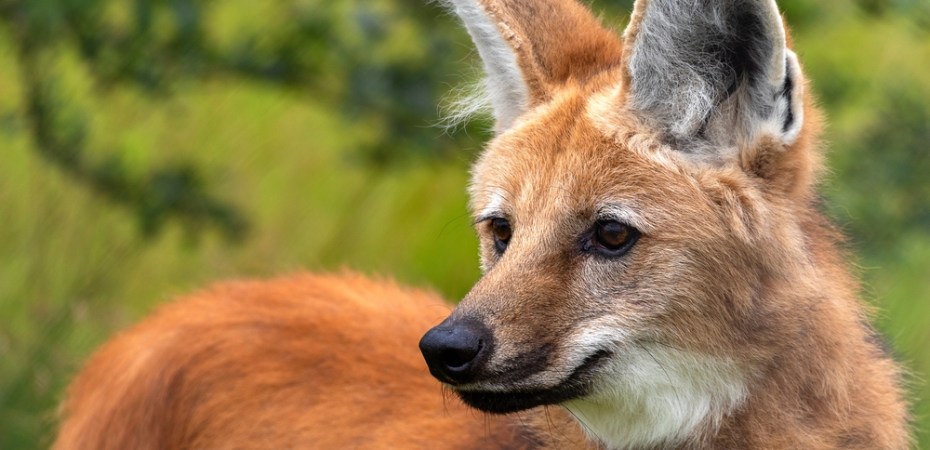
Featured image: Kev Gregory/Shutterstock; this is a maned wolf, which is neither a wolf nor a fox, but I chose it because in this view we can’t really tell what it is, though obviously it’s in the dog family.
 Flight To Wonder