
Mauricio Antón’s reconstruction of the Dawn Cat — Proailurus. (Figure 2.4 in Werdelin et al.)
Before we get to the meerkats (and their close relatives) in this series on Feliformia, let’s ask a question just to bring in a few interesting facts about how cats evolved.
DNA studies show that meerkats and Malagasy carnivores are relatively young groups (Hassanin et al.), but how old is Fluffy’s family?
Molecular studies on its descendants (today’s cats) suggest that Proailurus — the oldest known fossil cat — goes back more than 20 million years. (Werdelin et al.)
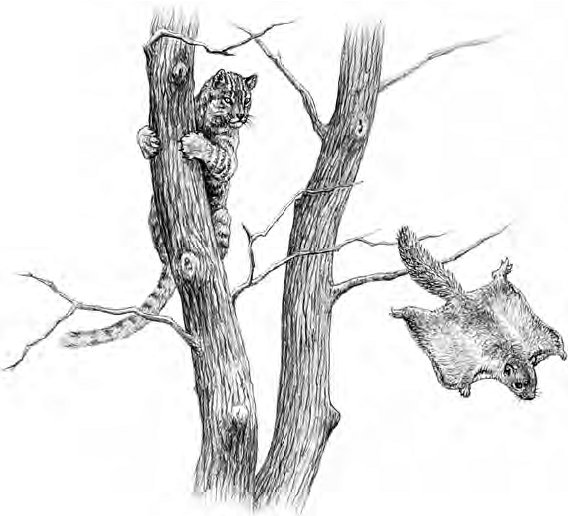
One of the pseudaelurine offspring of Proailurus was Styriofelis, a likely ancestor of living cats. It prowled the forest almost twenty million years ago. (Image: Mauricio Antón, Figure 2.5 in Werdelin et al.)
Accurately dating the cat family’s evolution is not easy. For consistency, and because it’s more recent (2021), I’m going with Hassanin et al., who put the origin of family Felidae at some point between 24 and 27 million years ago.
That’s older than Eupleridae and the meerkats, older than hyenas — older even than the civet/genet group we will meet soon.
But it’s not nearly as old as the strangely cute little feliform we are meeting today.
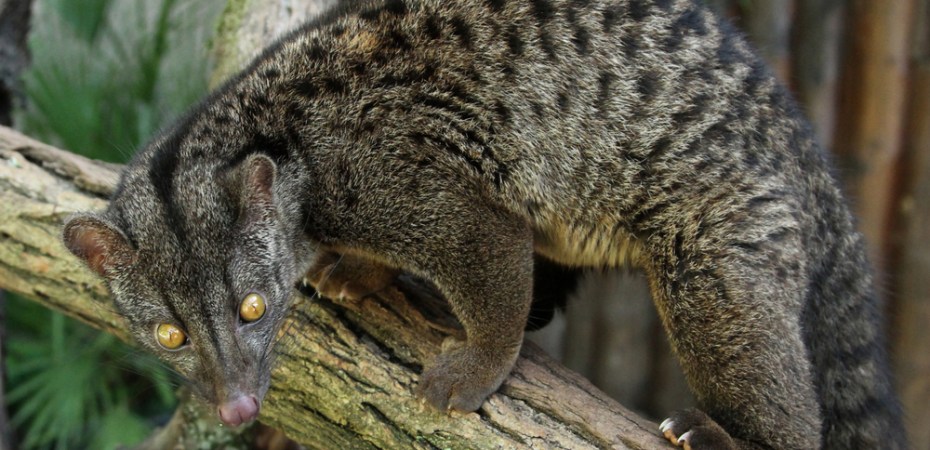
Family Nandiniidae is a 34- to 31-million-year-old group of geezers who have just one living representative — Nandinia binotata, the African palm civet.
Wait. What…?
Was that a cat?
Well, no.
For one thing, Fluffy has the whole milk-drinking thing down to a science. African palm civets — not so much:
Note the raccoon-like face on this feliform! Also, it’s easy to see where Nandinia’s other common name — the two-spotted palm civet — comes from (although I count way more than two spots!).
For another, Hassanin et el. report that Nandinia is the first feliform group in their study to branch off on its own (at that point, this layperson thinks, cats and what later became the other feliform families were all mixed together, pretty much undifferentiated).
Interestingly, this occurred at around the time that Earth’s climate transitioned (jargon alert) from “greenhouse” to “icehouse.”
Cause and effect?
As far as I can tell, it’s impossible to say — Earth is so big and complex and living beings interact and evolve in so many ways.
We can’t even be sure where cats evolved — many experts think that it was somewhere in Asia, but other possibilities exist. (Werdelin et al.)
In any event, soon after Nandinia climbed onto a separate branch, another group followed their example, as we’ll see next time.
🐾🐾🐾
More information:
- IUCN Red List status: Least Concern
- Wikipedia page
- Synapsid Notebook post
🐾🐾🐾
A little lagniappe:
Featured image: Michal Sloviak/Shutterstock
Sources:
Besides a whole bunch of reading a few years ago that I did while looking into how cats evolved (references available on request):
Hassanin, A.; Veron, G.; Ropiquet, A.; Jansen van Vuuren, B.; and others. 2021. Evolutionary history of Carnivora (Mammalia, Laurasiatheria) inferred from mitochondrial genomes. PloS One, 16(2): e0240770.
Werdelin, L.; Yamaguchi, N.; Johnson, W. E.; and O’Brien, S. J. 2010. Phylogeny and evolution of cats (Felidae), in Biology and Conservation of Wild Felids, 59-82.
 Flight To Wonder