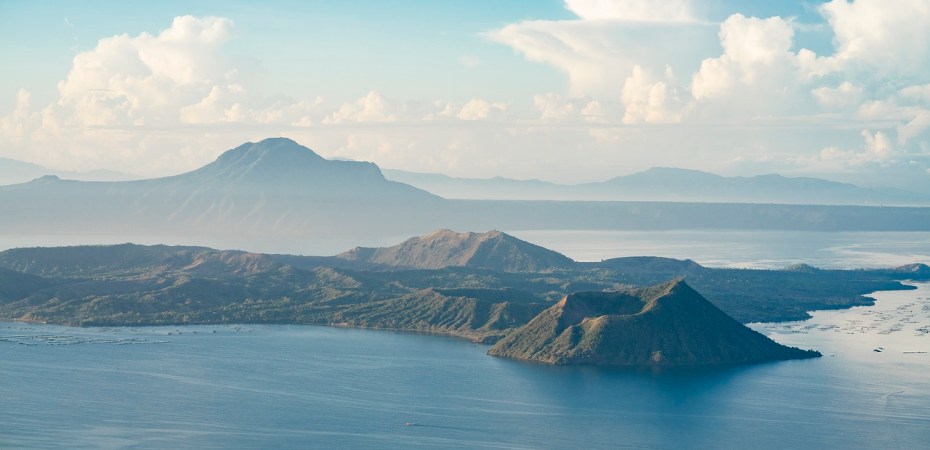
Many people think that Taal Volcano Island (TVI), shown here in the midst of Lake Taal, is “Taal Volcano.”
Taal is actually a big caldera volcano that’s only partly filled by Lake Taal (a crater lake). TVI is its currently active center and hosts more than forty vents on land and underwater, with Main Crater and its little crater lake the most recent site of volcanism.
Though small, TVI is a huge tsunami and pyroclastic-flow threat to the many people living and working along Lake Taal’s shore, just a few miles away. For this reason, the Philippines chose Taal, south of Manila, as their Decade Volcano in the 1990s even though Mount Pinatubo, north of Manila, was wreaking havoc at the time.
Taal is the bigger threat.
🌋🌋🌋
Location:
14.002° N, 120.993° E, in Batangas Province on southwestern Luzon, the Philippines. The GVP Volcano Number is 273070.
Nearby Population:
Per the Global Volcanism Program page:
- Within 5 km (3 miles): 717,090.
- Within 10 km (6 miles): 717,090.
- Within 30 km (19 miles): 2,380,326.
- Within 100 km (62 miles): 24,814,047.
Those are official numbers. In addition, an estimated 5,000 people lived on Volcano Island in 2016, even though the island is designated as a Permanent Danger Zone, for obvious reasons, and has no services. (Delos Reyes)
Current Status:
Level 1, with 0 the lowest and 5 the highest in this alert system.
Biggest recorded event:
Per Delos Reyes, in 1754 TVI’s Main Crater unexpectedly erupted in mid-May and kept at it until early December.
Residents of Manila had to use artificial light during the day, while Taal’s 1754 eruption column may have been as high as 25 miles at times.
Pyroclastic flows and base surges laid down thick deposits and caused huge tsunamiwaves that washed away whatever lakeside towns weren’t already buried underneath ash.
The death toll isn’t clear. Brown et al. documented 6 deaths from tsunami and 6 from ashfall, but many more people than that probably perished.
This is the “worst-case” event that today’s emergency managers base their plans on.
Monitoring:
The Philippines Institute of Volcanology and Seismology (PHIVOLCS). Here is their Taal bulletin page and general advisories.
Tokyo Volcanic Ash Center (VAAC) issues advisories to aircraft when needed.
Updates:
December 11, 2025, 8:27 a.m., Pacific: Taal continues to be restless, occasionally with long tremor episodes that last for a day or more, but it has done nothing that caused PHIVOLCS to raise the alert level.
In fact, at least twice since my last update, PHIVOLCS spokespeople, after small phreatic or phreatomagmatic outbursts from Main Crater Lake on Volcano Island, have assured the public that they do not see an impending major eruption at those times.
And there has been none.
The responsible emergency management agencies do encourage Taal’s millions of human neighbors to stay aware and to be ready to move fast, if needed.
SO2 counts have been in three digits for a while now (Taal occasionally pushes that to five digits!), and Volcano Island reportedly continues to slowly inflate.
September 18, 2025, 8:53 a.m., Pacific: I missed something in the daily PHIVOLCS bulletins. Starting on September 1, in the midst of that 7-day-plus extended tremor episode, they stopped reporting long-term deflation of the caldera and inflation of the western and southwestern flanks of Volcano Island and began to report short-term inflation of Volcano Island.
Nothing else has changed. The alert level is still 1, low-level unrest. The island is still inflating and SO2 emissions are still in the four-digit range.
Another tremor episode began early in the morning of September 16 and it continues, per the current bulletin.
September 12, 2025, 1:18 p.m.: Taal continues to be restless. It had a tremor event lasting several days, starting on August 27. That has been over for a while, but volcanic earthquakes continue intermittently and recently there were very mild phreatic bursts from Main Crater Lake.
So far, so good. Level 1 remains in effect, but if the caprock fails or there is sufficient magmatic pressure buildup (no sign of that in current PHIVOLCS reports), things could happen fast.
August 10, 2025, 1:02 p.m., Pacific: An advisory today from PHIVOLCS:
TAAL VOLCANO ADVISORY
10 August 2025
2:00 PM
This is a notice of increased seismic energy release from Taal Volcano.
Since 05:25 AM today, 10 August 2025, stations of the Taal Volcano Network (TVN) situated on Taal Volcano Island (TVI) have been recording a pronounced increase in real-time seismic energy measurement, or RSAM, simultaneous with continuing volcanic tremor. A total of nineteen (19) volcanic earthquakes has been recorded by the TVN since 09 August 2025. Visual observations noted a moderate to voluminous plume from the Taal Main Crater since the start of RSAM increase. Taal has been degassing low levels of sulfur dioxide or SO2 since June 2025 with the latest emission measured on 8 August 2025, averaging 374 tonnes/day. These sharp increase in RSAM and vigorous steaming from the Main Crater may lead to a phreatic or even a minor phreatomagmatic eruption.
DOST-PHIVOLCS reminds the public that Alert Level 1 prevails over Taal Volcano…
July 17, 2025, 7:35 a.m., Pacific: Taal just had a minor phreatomagmatic eruption a few hours ago:
Earlier this month, PHIVOLCS had noted increased seismic energy.
The alert level remains low, at Level 1. A VAAC advisory was issued.
October 20, 2024: As of this writing, Taal has been having daily phreatic bursts for a while now:
— and reportedly, a small magma intrusion is near the surface, but PHIVOLCS does not expect a large magmatic eruption.
This layperson thinks that venting through the little Main Crater lake on TVI — bubbling like a pot on the stove in the above video — is sufficient to relieve pressure from the increased hydrothermal activity caused by this magma intrusion.
If conditions change and the pressure increases, we might see another hydrothermal field explosion (which I think is what happened in 2020, with only minimal amounts of lava reaching the surface then). [/Layperson speculation]
Earlier posts:
- Vog crisis, June 2024 (also one in September 2023)
- June 2022 through May 2024 post
- Taal Volcano Awakes (January 2020)
Featured image: Image by Marc Parra from Pixabay
Sources:
- Acocella, V.; Di Lorenzo, R.; Newhall, C.; and Scandone, R. 2015. An overview of recent (1988 to 2014) caldera unrest: Knowledge and perspectives. Reviews of Geophysics, 53(3): 896-955.
- Bato, M. G.; Lundgren, P.; Pinel, V.; Solidum Jr, R.; and others. 2021. The 2020 eruption and large lateral dike emplacement at Taal volcano, Philippines: Insights from satellite radar data. Geophysical Research Letters, 48(7): e2021GL092803.
- Brown, S.K.; Jenkins, S.F.; Sparks, R.S.J.; Odbert, H.; and Auker, M. R. 2017. Volcanic fatalities database: analysis of volcanic threat with distance and victim classification. Journal of Applied Volcanology, 6: 15.
- Delos Reyes, P. J. 2019. An interdisciplinary study of the hazards associated with an AD1754 style eruption of Taal Volcano, Philippines. University of Sydney, doctoral thesis.
- Global Volcanism Program (GVP). 2020. Taal. https://volcano.si.edu/volcano.cfm?vn=273070 Last accessed July 17, 2023.
- Hargrove, T. R., and Medina, I. 1988. Sunken ruins in Lake Taal: an investigation of a legend. Philippine Studies, 330-351.
- Ku, Y. P.; Chen, C. H.; Song, S. R.; Iizuka, Y.; and Shen, J. J. S. 2009. A 2 Ma record of explosive volcanism in southwestern Luzon: Implications for the timing of subducted slab steepening. Geochemistry, Geophysics, Geosystems, 10(6).
- Lagmay, A. M. F. 2021. Taal volcano eruption: The importance of science and science communication. National Academy of Science and Technology, Philippines (NAST PHL) Science Advisory 2021-01.
- Lagmay, A. M. F.; Balangue-Tarriela, M. I. R.; Aurelio, M.; Ybanez, R.; and others. 2021. Hazardous base surges of Taal’s 2020 eruption. Scientific Reports, 11(1): 1-11.
- Moore, J. G.; Nakamura, K.; and Alcaraz, A. 1966. The 1965 Eruption of Taal Volcano: Catastrophic explosions are caused by lake water entering a volcanic conduit. Science, 151(3713): 955-960.
- Newhall, C. 1996. IAVCEI/International Council of Scientific Union’s Decade Volcano projects: Reducing volcanic disaster. status report. US Geological Survey, Washington, DC. Retrieved from https://web.archive.org/web/20041115133227/http://www.iavcei.org/decade.htm
- ___. 1999. IAVCEI’s Primary IDNDR Project: Decade Volcanoes. IAVCEI News 1999. 2:8-9. https://tinyurl.com/ycxtsu4h (PDF)
- Oppenheimer, C. 2011. Eruptions That Shook the World. Cambridge: Cambridge University Press. Retrieved from https://play.google.com/store/books/details?id=qW1UNwhuhnUC
- Oregon State University (OSU). 2020. Taal. http://volcano.oregonstate.edu/taal Last accessed March 19, 2020.
- Paris, R., and Ulvrova, M. 2019. Tsunamis generated by subaqueous volcanic explosions in Taal Caldera Lake, Philippines. Bulletin of Volcanology, 81(3): 1-14.
- Ramos, E. G. 2002. Origin and geologic features of Taal Lake, Philippines. Aquatic Ecosystem Health & Management, 5(2): 155-162. (Abstract only)
- Rappler.com. January 26, 2020. TIMELINE: Taal Volcano’s January 2020 eruption. https://r3.rappler.com/newsbreak/iq/249503-timeline-taal-volcano-eruption-2020
- Torres, R. C.; Self, S.; and Punongbayan, R. S. 1995. Attention focuses on Taal: Decade volcano of the Philippines. Eos, Transactions American Geophysical Union, 76(24): 241-247. (Abstract only.)
- Van Eaton, A. R.; Herzog, M.; Wilson, C. J. N.; and McGregor, J. 2012. Ascent dynamics of large phreatomagmatic eruption clouds: the role of microphysics. Journal of Geophysical Research: Solid Earth, 117(B3).
- Weather Atlas. 2022. Climate and monthly weather forecast, Batangas, Philippines. https://www.weather-atlas.com/en/philippines/batangas-climate Last accessed June 23, 2022.
- Yamaya, Y.; Alanis, P. K. B.; Takeuchi, A.; Cordon, J. M.; and others. 2013. A large hydrothermal reservoir beneath Taal Volcano (Philippines) revealed by magnetotelluric resistivity survey: 2D resistivity modeling. Bulletin of volcanology, 75(7): 1-13.
- Zlotnicki, J.; Sasai, Y.; Johnston, M. J. S.; Fauquet, F.; and others. 2018. The 2010 seismovolcanic crisis at Taal volcano (Philippines). Earth, Planets and Space, 70(1): 1-23.
 Flight To Wonder