In North America, “wildcat” means bobcat. In Eurasia and Africa, it means, well, wildcat — a group of small felines that never managed to cross the Atlantic on their own.
Some never even left Scotland.
Only one kind of wildcat has ever immigrated into the Americas. This major event occurred long after the very first “cat of the forest” (in Latin, Felis silvestris) appeared in Europe’s fossil record.

It also was a boon companion during the crew’s off time, which might not have been this spiffy but probably was just as relaxing for all involved. (Image: Simon, CC BY-NC-ND 2.0)
By that time the furry little American newcomer wasn’t wild any more. It was a domesticated African wildcat that already had a long history with H. sapiens, and it paid for passage across the Atlantic by keeping rodent stowaways to a minimum on the various exploration, conquest, settlement, and commercial expeditions that set out for the New World from the Old.
Here are three facts about the evolution of an African mesopredator and its transformation into our beloved Fluffy.
88. Our ancestors and Fluffy’s evolved over at least two ice ages.
What with having our own lives to lead, we tend to compress the dramatic history of life on Earth into something along the lines of “fireball Earth” –> “weird ancient life” –> “almost total Permian wipeout” –> “dinosaurs” –> “K/T extinction” –> “mammals rule” –> “caveman/Ice Age/sabercat/mammoth” –> “people settle down to farm and build cities, and history begins.”
That’s not incorrect (except the “caveman” part), but it skips a lot of important and really cool details. It also doesn’t give us a sense of the immense depth of those four billion years or show us how intricate evolution really is.
Luckily, we don’t need to get into all that here other than to point out that ice ages have many impacts on evolution, and that both H. sapiens and F. silvestris are children of Plio-Pleistocene “icehouse Earth.”
Ice and evolution
It all happens slowly — expansion of polar ice caps down to the mid-latitudes, followed by poleward retreat, a warm spell, and then another expansion — but it really messes up evolution (another slow process).
Here’s one way that happens:
- Mass migrations occur as the glacial front advances. Various forms of life end up in unusual places — for instance, woolly mammoths roam Spain and ibex move down out of ice-capped mountains to feed on alpine plants in southern Europe’s river valleys.
- After the ice age winds down, everyone heads back to their former haunts again, if they can — but those places aren’t exactly the same as before, nor are these the exact same animals and plants that made up the old ecosystem.
Some species might have gone extinct, leaving empty niches to fill. Among ice-age survivors, lots of genes have mixed into new combinations during the time of refuge.
Evolution is going to take a different path now than it would have taken without an ice age.
Out of this and other complexities have come both people and wildcats, and no one can be sure of every step they took along the way.
However, let’s try to get a general idea of how wildcats evolved.
Ice, people, and ancestral Fluffy
Here’s how this layperson understands her reading to date (see source list); the story probably will change with future new discoveries/interpretations.
Our planet’s most recent Big Freeze thermostat setting cycled on for the first time during the Pliocene epoch, roughly 2.5 million years ago — around the time that our long-ago ancestors and those of wildcats first show up in the fossil record (in separate places, as far as I know).
Geoscientists have identified at least four polar ice cap advances/retreats on Earth since then, but there probably have been more than that, with evidence left by some glaciations being bulldozed out of existence by the next round of moving ice.
The story of wildcats (and of H. sapiens) mainly involves the last two ice ages, but both of our ancestral lines can be traced back to the days when cold first started creeping down toward the Equator.
As the initial new ice caps grew out of central areas in Canada, Scotland, Sweden, and possibly northern Russia, early members of our own primate group Homo (though not yet sapiens) were emerging in Africa.
As they kept busy fending off lions, leopards, hyenas, and at least three different kinds of sabercat, small Felis lunensis was living in Italy.

Probably not like this. (Image: Michael Holler, CC BY-NC 2.0)
No one knows where it came from.
This 2-million-year-old kitty has left only a few fossils in Europe, just enough to show that it was built much like modern wildcats, except for larger teeth (if you want to imagine the Cheshire Cat here, go right ahead!).
As far as anyone can tell, lunensis evolved into F. silvestris shortly before the next to last ice age began some 350,000 years ago.
Wildcats continued to evolve, eventually turning into today’s rugged furball: the European wildcat.

Tambako the Jaguar, CC BY-ND 2.0
Meanwhile, Homo sapiens appeared in Africa perhaps 300,000 years ago, although the timing is still under debate.
Whenever our species actually evolved, molecular studies done by Fu et al. (source list) suggest that the most recent common ancestor of all modern people lived around 157,000 years ago, towards the end of that next to last ice age.
Then a new kind of wildcat arrived on the scene (if it wasn’t already around).
Some members of silvestris must have gone exploring because, about 130,000 years ago, during the warm spell in between the last two ice ages, a few wildcat fossils were laid down in Africa and the Middle East.
These show the steppe wildcat look — sleekly built, long-legged and probably with the same shorthair coat that steppe cats have today:
Yes, it looks like a housecat; members of this wildcat line would eventually become Fluffy.
So wildcats and people were both on the planet now, and apparently on the move. But if they met, no traces of the encounter have come down to us.
89. African wildcats are more tolerant of humans than European wildcats are.
Fossils show that during the last ice age some more European wildcats tried moving into the Middle East.
This time, other wildcats were there to stop them.
African wildcats had prowled up into the Middle East when the worst ice-age temperatures, anywhere from 10° to 40° F colder than today, eased a bit — and they didn’t want competition.
A good thing, too!
If African wildcats hadn’t done this, there probably wouldn’t be domestic cats around today.
You see, European wildcats are next to impossible to tame, and presumably this was also true of them 20,000 years ago. Unlike the steppe cats, they never would have approached the humans who were about to move into the Middle East and settle down.
Africa’s wildcats are wild but they can be tamed (though it’s still a long way from “tame” to “domesticated” for any animal).
Also they tolerate a human presence well enough to include our stuff in their individual hunting territories — something very few animals can do (some grain-eaters, notably rodents, are human-tolerant, too — the first farmers were about to start growing and storing grain, and you can see where this is going).
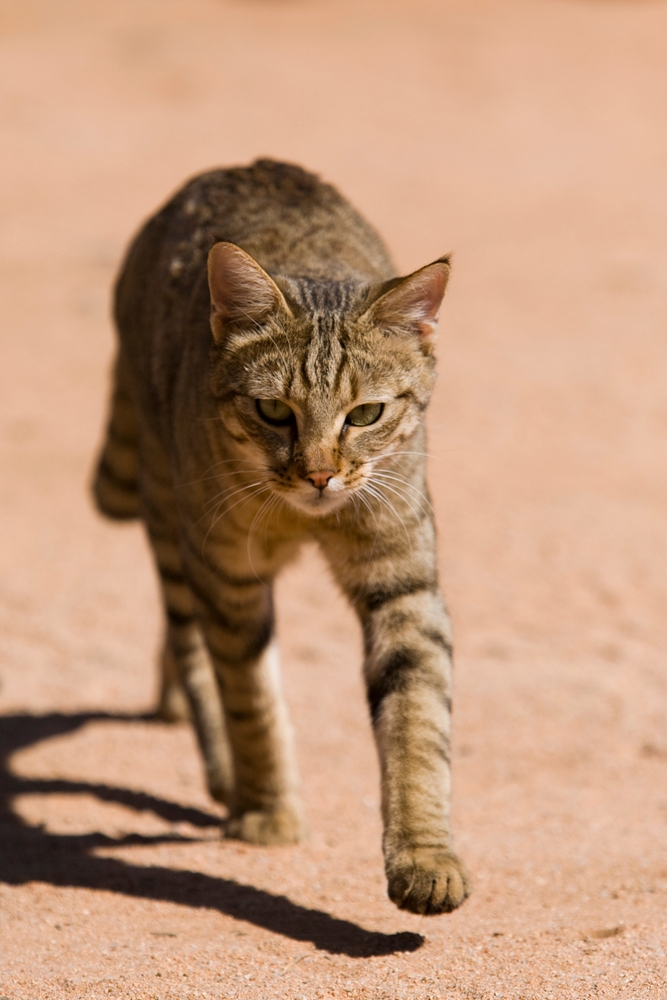
Please don’t call me Shirley. (Image: Robert Harding Video/Shutterstock)
European wildcats avoid us. Today’s African wildcats will sometimes sit close to settlements and have even been seen in the outskirts of major cities.
Surely that must have happened in the past, too.
How easy that all-important first contact must have been, too, in a much quieter, slower paced world as people built and cats explored something new: houses and farms.
90. People and African wildcats got together right after the last ice age ended.
As the last ice age slowly ended, the final low-latitude ice sheets melted away some 14,000 years ago.
Parts of the Middle East became parklands filled with nut trees and wild varieties of wheat and other nourishing foods, including wild peas and lentils.
This attracted various plant-eaters along with their predators, including human hunter-gatherers, nomads who set up base camps in the region.
To make a long story short — and to jump over the gaps in our understanding of just exactly how H. sapiens made such a dramatic change in lifestyle — things worked out so well for those people that they turned the camps into farms and small villages.
Their new grain stores attracted rodents and other small animals, which brought in the African wildcat.
Genetic studies show that, at least 10,000 years ago, human and cat met.
Each assessed the other’s strengths and weaknesses. Human and cat each saw benefit in establishing a connection.
The two species then came together, forming a close bond that still enriches their descendants’ lives today.
Quick writing update: No caniform post tomorrow, October 5, but chances of a Krakatoa Part 3 on Sunday look good. Then, some time during next week, a feliform gallery post followed by return to the Friday (feliforms) and Saturday (caniforms) guest videos, and ultimately, Felidae and Canidae again. Thank you for your interest!
If you are enjoying the “Fangly Facts” series, tips are welcome via the secure Stripe donation link. I won’t be saving your email for marketing or other spam, so here’s a big thank you in advance!
Sources include:
Belknap, D. F. 2018. Quaternary. https://www.britannica.com/science/Quaternary#ref921947 Last accessed January 3, 2019.
Callaway, E. 2017. Oldest Homo sapiens fossil claim rewrites our species’ history. https://www.nature.com/news/oldest-homo-sapiens-fossil-claim-rewrites-our-species-history-1.22114
Cat Specialist Group. 2023. African wildcat. http://www.catsg.org/index.php?id=112 Both accessed last on December 14, 2023.
___. 2023. European wildcat. http://www.catsg.org/index.php?id=101
Culver, M.; Driscoll, C.; Eizirik, E.; and Spong, G. 2010. Genetic applications in wild felids, in Biology and Conservation of Wild Felids, ed. Macdonald, D. W., and Loveridge, A. J., 107-124. Oxford: Oxford University Press.
Driscoll, C. A.; Menotti-Raymond, M.; Roca, A. I.; Hupe, K.; and others. 2007. The Near Eastern origin of cat domestication. Science. 317: 519-522.
Driscoll, C. A.; Macdonald, D. W.; and O’Brien, S. J. 2009. From wild animals to domestic pets, an evolutionary view of domestication. Proceedings of the National Academy of Sciences, Supplement 1, 106: 9971-9978.
Eldredge, S., and Biek, B. 2010. Ice ages — What are they and what causes them? https://geology.utah.gov/map-pub/survey-notes/glad-you-asked/ice-ages-what-are-they-and-what-causes-them/
Encyclopaedia Britannica. n.d. Wildcat, mammal, Felis silvestris. https://www.britannica.com/animal/wildcat-mammal-Felis-silvestris
Fu, Q.; Mittnik, A.; Johnson, P. L.; Bos, K.; and others. 2013. A revised timescale for human evolution based on ancient mitochondrial genomes. Current Biology, 23(7): 553-559.
Heptner, V. G., and Sludskii, A. A. 1972. Mammals of the Soviet Union, volume II, part 2: Carnivora (hyaenas and cats). Moscow: Vysshaya Shkola Publishers. English translation by Rao, P., 1992. General editor: Kothekar, V. S. New Delhi: Amerind Publishing. https://archive.org/details/mammalsofsov221992gept
Herbst, M. 2009. Behavioural ecology and population genetics of the African wild cat, Felis silvestris Forster 1870, in the southern Kalahari. Doctoral dissertation, University of Pretoria.
Hewitt, G. 2000. The genetic legacy of the Quaternary ice ages. Nature, 405(6789): 907.
Johnson, W. E.; Eizirik, E.; Pecon-Slattery, J.; Murphy, W. J.; and others. 2006. The Late Miocene Radiation of Modern Felidae: A Genetic Assessment. Science, 311:73-77.
Kitchener, A. C.; Van Valkenburgh, B.; and Yamaguchi, N. 2010. Felid form and function, in Biology and Conservation of Wild Felids, ed. Macdonald, D. W., and Loveridge, A. J., 83-106. Oxford: Oxford University Press.
Kitchener, A. C.; Breitenmoser-Würsten, C.; Eizirik, E.; Gentry, A.; and others. 2017. A revised taxonomy of the Felidae: The final report of the Cat Classification Task Force of the IUCN Cat Specialist Group. https://repository.si.edu/bitstream/handle/10088/32616/A_revised_Felidae_Taxonomy_CatNews.pdf
Kurtén, B. 1965. On the evolution of the European wild cat, Felis silvestris Schreber. Acta Zoologica Fennica. 111:3-29.
Lisiecki, L. E., and Raymo, M. E. 2005. A Pliocene-Pleistocene stack of 57 globally distributed benthic δ180 records. Paleoceanography, 20, no. 1.
Lyle, M.; Barron, J.; Bralower, T. J.; Huber, M.; and others. 2008. Pacific Ocean and Cenozoic evolution of climate. Reviews of Geophysics, 46: RG2002,
Macdonald, D. W.; Loveridge, A. J.; and Nowell, K. 2010a. Dramatis personae: An introduction to the wild felids, in Biology and Conservation of Wild Felids, eds. Macdonald, D. W., and Loveridge, A. J., 3-58. Oxford: Oxford University Press.
McHenry, H. M., and Coffing, K. 2000. Australopithecus to Homo: transformations in body and mind. Annual Review of Anthropology, 29(1): 125-146.
O’Brien, S. J., and Johnson, W. E. 2007. The evolution of cats. Scientific American. 297 (1):68-75.
Prothero, D. R. 2006. After the Dinosaurs: The Age of Mammals. Bloomington and Indianapolis: Indiana University Press. Retrieved from https://play.google.com/store/books/details?id=Qh82IW-HHWAC.
Sunquist, M. and Sunquist, F. 2002. Wild Cats of the World. Chicago and London: University of Chicago Press. Retrieved from https://play.google.com/store/books/details?id=IF8nDwAAQBAJ
Tallavaara, M.; Luoto, M.; Korhonen, N.; Järvinen, H.; and Seppä, H. 2015. Human population dynamics in Europe over the Last Glacial Maximum. Proceedings of the National Academy of Sciences, 112(27): 8232-8237.
Werdelin, L.; Yamaguchi, N.; Johnson, W. E.; and O’Brien, S. J. 2010. Phylogeny and evolution of cats (Felidae), in Biology and Conservation of Wild Felids, eds. Macdonald, D. W., and Loveridge, A. J., 59-82. Oxford: Oxford: University Press.
Yamaguchi, N.; Kitchener, A. C.; Ward, J. M.; Driscoll, C. A.; and Macdonald, D. W. 2004. Craniological differentiation between European wildcats (Felis silvestris silvestris), African wildcats (F. s. lybica) and Asian wildcats (F. s. ornata): implications for their evolution and conservation. Biological Journal of the Linnean Society, 83:47-63.
Zachos, J.; Pagani, M.; Sloan, L.; Thomas, E.; and Billups, K. 2001. Trends, rhythms, and aberrations in global climate 65 Ma to present. Science, 292: 686693.
 Flight To Wonder