Guest Video: What to Do Before, During, and After a Volcanic Eruption
This is probably sourced in experience rather than official status.
Experienced advice can be helpful, too, which is why I went with this one while looking for a guest video today in order to give myself enough time to finish the Krakatoa Part 3 post (it might be out later today; if not, then early this coming week).
The Philippine viewpoint matters, too, because the Krakatoa post gets into tsunamis from volcanic eruptions and Taal is infamous for those:
…Taal volcano has produced 33 historical eruptions, and five notable eruptions generated tsunamis in the lake in 1716, 1749, 1754, 1911 and 1965 [3,4]. The 1716 eruption was a subaqueous volcanic explosion that was located in the southern basin of the caldera and near the southern point of Taal Island. The decompression of the gas trapped inside the magma lifted the water in the lake, forming a wave that impacted the shores. The maximum inundation in the southwestern area reached a height of approximately 17 m on land [5]. The 1749 eruption clearly produced a wave in response to the violent VEI4 (volcanic explosivity index) phreatomagmatic eruption [3,4]. The eruption vent was located north of Taal Island, and the wave impacted the northern shores of the lake. The 1754 event killed 20 people through building collapse of roofs induced by the weight of the volcanic ash deposited on the roofs [4]. Thus, observations clearly indicated the existence of a tsunami wave during this event. A phreatomagmatic to phreatoplinian eruption occurred in 1911 on Taal Island. A tsunami with a wave height of approximately 3 m affected villages on the western shore of the lake, and 20–50 people (depending on sources) were drowned [3]. The 1965 eruption was also a phreatomagmatic eruption that generated a new crater on the southwestern flank of the island [4]. In total, 190 to 355 fatalities occurred when tsunami waves impacted the western shore of the lake, with a wave runup of 4.7 m above the mean level of the lake [6]…
Erupting volcanoes in relatively shallow water, close to shore, are bad.
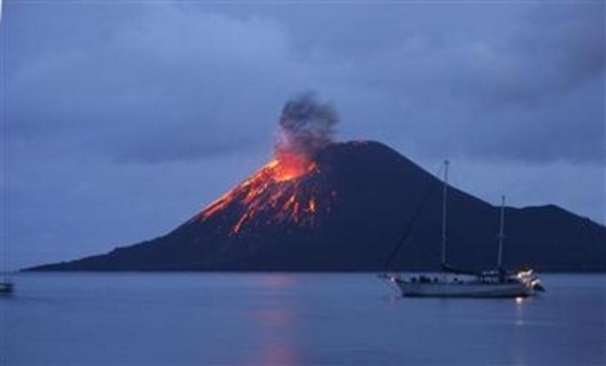
So are collapsing volcanoes surrounded by water, as Anak Krakatau demonstrated on December 22, 2018.
So is having a violence-prone volcano out in the Sunda Strait, as the world learned in 1883.
🌋🌋🌋
For official advice on preparing for a volcano emergency, look around online for reliable sources. To get you started, here are some recommendations from New Zealand and a US place less well known for volcanoes: Teton County, Wyoming.
A part of Yellowstone is in Teton County, but that is hardly a cause for despair (check out the Yellowstone Volcano Observatory’s page for more information) and the Wyoming folk offer sound advice.
And please don’t forget —
Featured image: Sicilian road during an eruption at Mount Etna, May 20, 2010, by Pandora Photos/Shutterstock


 Flight To Wonder