
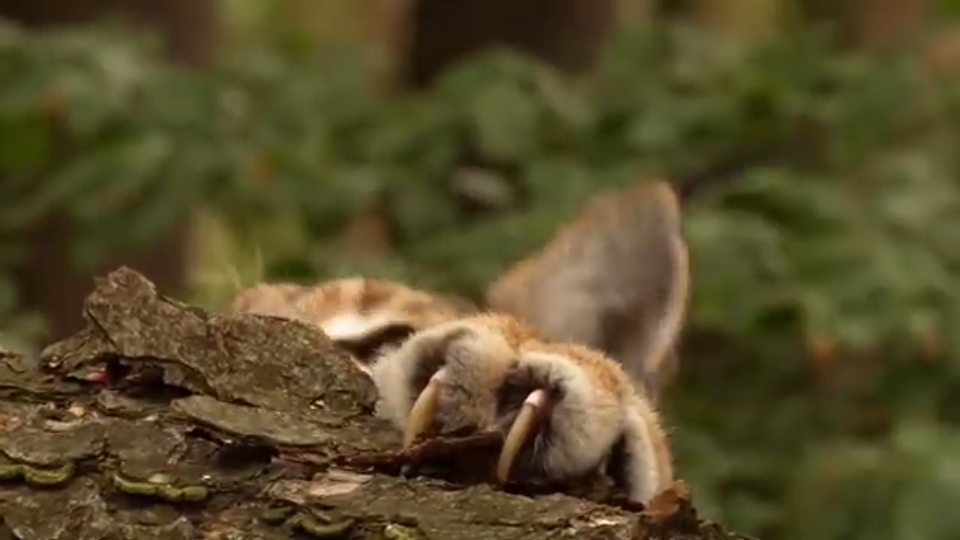
From this video on the Eurasian lynx.
Pointed ears ending in hairy tufts; an extreme muttonchop beard; bright amber eyes that reveal inner depths and more than a little wildness — the lynx purrfectly fits our conception of a forest goblin!
It is a cat — granted, one that’s unusually leggy, bobtailed, and apparently walking around in its pajamas — but still, a cat.
Instead of spooky shenanigans, all it really wants is a rabbit or some other prey.
What are lynxes, and why do they look so different from other cats?
Scientists are asking these questions, too. So far, they have found out that —
85. There are four lynx species on the planet.
Two are in North America and two are in Eurasia.
Ranking the groups by age with the help of a study used by Werdelin et al. (source list), the oldest living lynx species is:
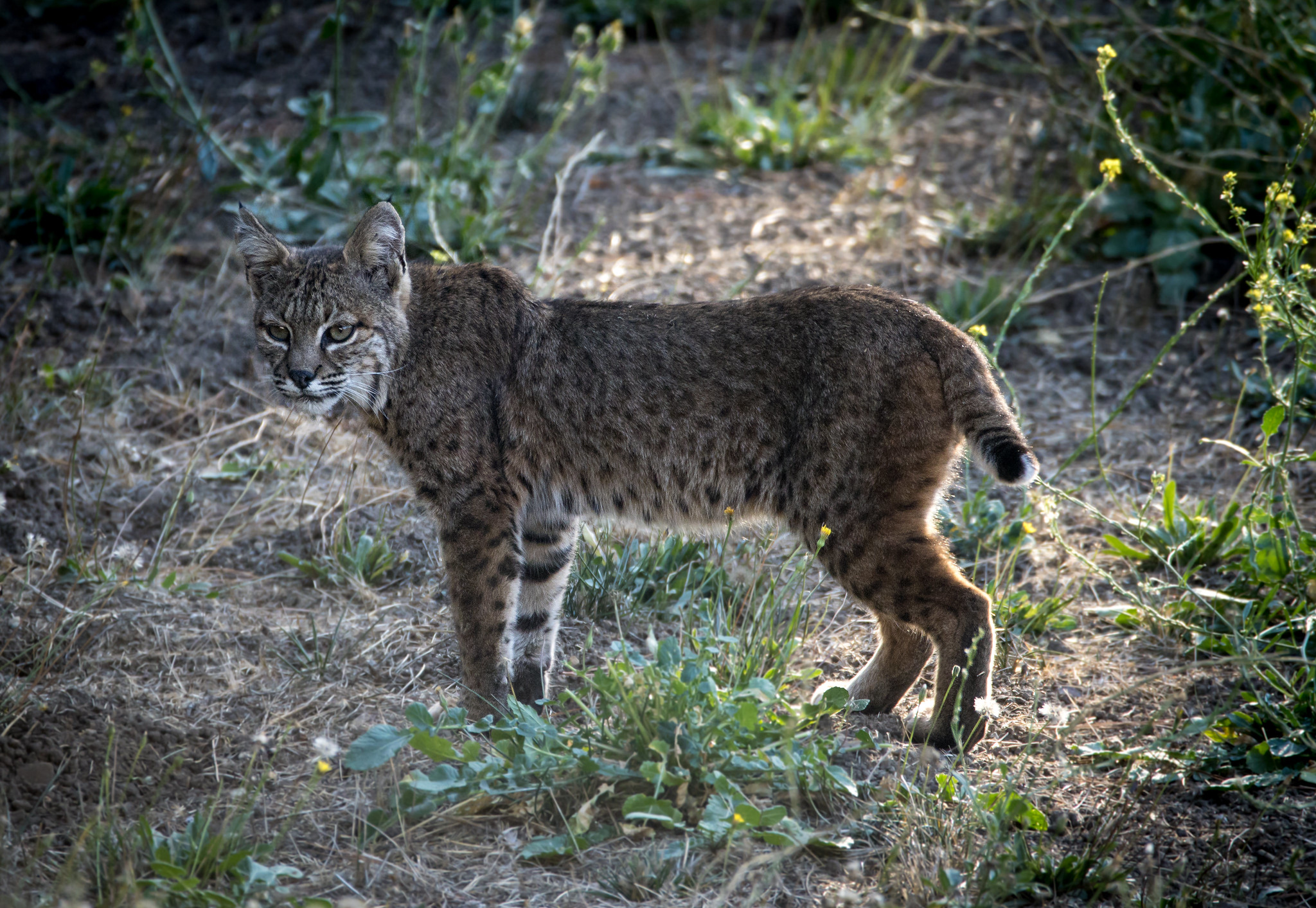
Wade Tregaskis, CC BY-SA-NC 2.0
The Bobcat (Lynx rufus)
These North American wildcats reportedly go back almost four million years.
“Bob” is not its first name but refers to the cat’s short tail, which averages less than 6 inches long. (Canada lynx tails aren’t any longer, but those cats weren’t seen as often by settlers and didn’t get a nickname.)
An adult bobcat stands 18 to 24 inches tall at the shoulder and can weigh anywhere from 10 to 30 pounds or more.
Its spotted or streaked fur has a tawny, reddish to yellowish or gray background, depending on the setting.
Also, bobcats are the only melanistic (black) lynx reported thus far:
Melanism aside, the fur color varies so much because bobcats range through many environments — from temperate to subtropical climates and in lands as different as coastal swamps and semi-desert plateaus — extending from southern Canada down through most of the US “Lower 48” on into Mexico as far south as Oaxaca State.
The camera work in this following video makes me a little dizzy, but it has great closeups of a bobcat in South Texas working through the “rodent buffet” and just spending time on a dirt riad:
Bobcats don’t handle deep snow or intense cold very well or they would push farther north, much to the dismay of the mellower —

Liam Cowan/Shutterstock
Canada Lynx (Lynx canadiensis)
Yes, conservationists do report that wherever these two lynxes meet along a zone that, in current climate conditions, follows approximately the US-Canada border, bobcats usually drive off their northern cousins (though not always, since hybridization between the two lynxes has been noted here, too).
As a species, Canada lynxes are about two million years old, according to Werdelin et al.
The Canada lynx is the same overall size as a bobcat. Its hind legs are longer, though, giving it a noticeably sloped back, and Canadian lynx paws are much larger than a bobcat’s.
In fact, this lynx has developed a sort of “snowshoe” — not too surprising, given the cat’s range through boreal forests of Alaska and Canada, from the Arctic on down into some mountainous and/or snowy parts of the northern United States.
Canada lynx toes are unusually long and the foot bones spread out to make very broad paws. These are covered with a thick layer of fur on and in between the pads, giving the cat not only warmer feet but also the feline equivalent of a snowshoe!
Canada lynx can chase hares across snow without breaking through the crust. They might even be able to avoid competition from bobcats and coyotes in the southern part of their range by staying on high slopes that have a thick snow cover other predators can’t get through.
The next two species are “only” about one million years old each and both are in Eurasia.

Rudmer Zwerver/Shutterstock
Eurasian Lynx (Lynx lynx)
Standing almost 30 inches tall at the shoulder, this is the lynx family’s Hulk — the only lynx to regularly take prey the size of roe deer, although it doesn’t turn up its nose at rabbits and other small animals when the hoofed plant-eaters are scarce.
The cat’s powerful hind legs can propel it as much as 9 feet forward in a leap, and it packs some weight — up to 80 pounds or more, per Sunquist and Sunquist, although the Cat Specialist Group lists a more conservative 40 to 50-pound range for Eurasian lynxes (as in many cat species, male lynxes are somewhat bigger than the females).
Eurasian lynxes range across all of northern Eurasia as well as south into the central Asian high country and Tibet.
For at least part of the year this is snow country. Eurasian lynxes do develop “snowshoes” somewhat like those of the Canada lynx — but only in the winter and not in the high mountains, where the need for sure footing on steep rocky slopes requires fur-free paw pads (predation scenes):
Eurasian lynxes usually have spotted coats, especially in southern Europe and the Caucasus Mountains. As expected with such a wide range, the cat’s background fur color varies with location and season.
If it’s spots you’re interested in, you should visit Spain or Portugal and try to find —

Ondrej Prosicky/Shutterstock
The Iberian Lynx (Lynx pardinus)
Yes, this is the really rare one, seen here in Sierra de Andujar, Andalusia, Spain.
This is also one very spotted lynx, and its bright yellowish red to tawny colored fur background only makes those dark little dots stand out even more!
At one time biologists thought that this was a Eurasian lynx subspecies, but further research has revealed genetic differences.
Those, as well as unique anatomical features such as coat texture and markings, a body size half that of the big “Hulk” goblin cat, and a differently shaped beard, all show that Iberian lynxes are a species in their own right.
They used to prowl through other parts of Europe during the Pleistocene ice ages and even coexisted with Eurasian lynxes in a few places, but now you will only find Iberian lynxes in two small parts of Spain and, perhaps, in a tiny area in Portugal where scientists are trying establish a rewilded population of Iberian lynx.
In terms of the whole lineage, boffins are still trying to understand why lynxes have that unique look.
Whatever the reason, it is certainly working out for them because —
86. Lynxes hold some impressive records.
Starting off locally, bobcats are the most common wild cat in North America, even though they sometimes are hunted by mountain lions (the other candidate for that title).
Eurasian lynxes have the widest range of any cat, roaming the world’s largest continent from its Atlantic to its Pacific shores, as well as down through the central highlands into Tibet.
Not all lynx family records are positive ones, though.
For example, Canada lynxes are the only cat known to go into population swings along with prey.
This cat depends so much on snowshoe hares that its range is identical to theirs, and when they have one of their cyclical population slumps, so does the lynx!
Iberian lynxes have the most unenviable record — they are the most endangered cat in the world.
These cats rely on rabbits — not quite as much as the Canada lynx does, but enough to almost wipe them out when Europe’s rabbits almost all died out from disease, starting in the 1950s.
It was a heavy blow for the Iberian lynx, which was also stressed by poaching and loss of habitat as urban areas expanded out into more rural parts of the Iberian Peninsula.
Macdonald et al. report that eighty percent of all Iberian lynx in the wild perished between 1960 and 1978. Then more than eighty percent of the survivors vanished from 1987 and 2008!
Really, the Iberian lynx should be extinct now.
Instead, there is hope.
Conservationists are slowly bringing it back. And the few rabbits that are still around might be developing an immunity to the disease, which is good news for everyone except gardeners and farmers.
87. Paleontologists aren’t completely certain how lynxes evolved, or where.
It’s reasonable to suppose that lynxes evolved in North America, where the oldest species are today.
That is, it would be reasonable if lynx ancestors and other fossil cats that might or might not have been lynxes hadn’t left their bones all over the Northern Hemisphere back in Pliocene and Pleistocene times, when today’s lynx species were getting started.
Molecular tests like those used by Werdelin et al. produce helpful dates, but these need to be checked against the fossil record in order to get the full picture of how lynxes evolved.
This is especially challenging because of the problem described in an earlier episode of our story: the fact that most cat fossils, past and present, look alike.
Fortunately, scientists like challenges.
They are hard at work in Europe, trying to establish a connection between modern lynxes and what many feel is the oldest fossil lynx – a roughly three-million-year-old cat known by the catchy name of “issiodorensis.”
In North America, they are sorting through three- to four-million-year-old bones of cats with monikers like “rexroadensis” and “lacustris,” trying to decide what might have been linked to lynxes, partnered with pumas, or standing in solidarity with South America’s small cats.
We cat lovers don’t care. In fact, we’re rather proud of our neighborhood goblin cats for baffling the boffins.
Not all questions about cats need to be answered with sureness and a clarity akin to daylight.
Cats are mysterious, nocturnal, and yet drawn close enough to light every now and then to show us the brightness of their eyes.
If that’s all they are willing to reveal, then let the rest remain in shadow — just a suggestion of the living, breathing small cat that lives alongside us today.
They keep us a little wild, too, in a good way — a wildness tempered by compassion and love.
And perhaps a little envy.

This is just part of the work it took to get that and other images. Watch all the way to the end for the color shots! ❤
If you are enjoying the “Fangly Facts” series, tips are welcome via the secure Stripe donation link. I won’t be saving your email for marketing or other spam, so here’s a big thank you in advance!
Sources include:
Cat Specialist Group. 2023. Bobcat. http://www.catsg.org/index.php?id=96 All last accessed December 12, 2023.
___. 2023. Canada lynx. http://www.catsg.org/index.php?id=97
___. 2023. Eurasian lynx. http://www.catsg.org/index.php?id=99
___. 2023. Iberian lynx. http://www.catsg.org/index.php?id=98
Cuccu, A.; Valenciano, A.; Azanza, B.; and DeMiguel, D. 2023. A new lynx mandible from the Early Pleistocene of Spain (La Puebla de Valverde, Teruel) and a taxonomical multivariate approach of medium-sized felids. Historical Biology, 35(1): 127-138.
Davis, J. 2019. Darwin’s rabbit is revealing how the animals became immune to myxomatosis. https://www.nhm.ac.uk/discover/news/2019/february/darwins-rabbit-is-revealing-how-the-animals-became-immune-to-myxomatosis.html
Johnson, W. E.; Eizirik, E.; Pecon-Slattery, J.; Murphy, W. J.; and others. 2006. The Late Miocene Radiation of Modern Felidae: A Genetic Assessment. Science, 311:73-77.
Kitchener, A. C.; Van Valkenburgh, B.; and Yamaguchi, N. 2010. Felid form and function, in Biology and Conservation of Wild Felids, ed. Macdonald, D. W., and Loveridge, A. J., 83-106. Oxford: Oxford University Press.
Macdonald, D. W.; Loveridge, A. J.; and Nowell, K. 2010. Dramatis personae: An introduction to the wild felids, in Biology and Conservation of Wild Felids, eds. Macdonald, D. W., and Loveridge, A. J., 3-58. Oxford: Oxford University Press.
Rewilding Europe. n.d. Return of the missing lynx. https://rewildingeurope.com/rewilding-in-action/wildlife-comeback/lynx/
Sunquist, M. and Sunquist, F. 2002. Wild Cats of the World. Chicago and London: University of Chicago Press. Retrieved from https://play.google.com/store/books/details?id=IF8nDwAAQBAJ
Werdelin, L. 1981, January. The evolution of lynxes. In Annales Zoologici Fennici (pp. 37-71). Finnish Academy of Sciences, Societas Scientiarum Fennica, Societas pro Fauna et Flora Fennica and Societas Biologica Fennica Vanamo.
Werdelin, L.; Yamaguchi, N.; Johnson, W. E.; and O’Brien, S. J.. 2010. Phylogeny and evolution of cats (Felidae), in Biology and Conservation of Wild Felids, eds. Macdonald, D. W., and Loveridge, A. J., 59-82. Oxford: Oxford University Press.
Wikipedia. 2023. Iberian lynx. https://en.wikipedia.org/wiki/Iberian_lynx Last accessed December 13, 2023.
 Flight To Wonder