
Not that pumas (a/k/a mountain lions or cougars) date jaguars or anything like that.
The two cat species do share living space, however, and conservationists would love to know how they do that.
Watch it all the way through for the puma’s exit ❤. This camera captured pumas, jaguars, and some of the small plant-eaters that keep both large cats well fed. There’s also an ocelot and a tayra not-a-jaguarundi.
Field conditions are challenging in the remote American rainforests where jaguars and pumas meet, so boffins get clues about what might be going on by watching similar cats interact in the more open terrain of Africa and Asia.
Leopards, tigers, lions, and cheetahs
Over there, leopards (the jaguar’s almost doppelganger) are subordinate to lions and tigers —
Situational awareness: better late than never. Of note, as far as I know this type of interaction has never been documented between jaguars and pumas.
— yet leopards are plentiful.
Why is that?
Something complex is going on among the cats that is difficult for humans to pin down.
Oh, we’ve got some idea of how wild felines coexist.
That lioness didn’t know it, but she was practicing competitive exclusion by going after the leopard — the fewer cats around to compete, the more food there is for lions.
It’s what many of us laypeople think of as “survival of the fittest,” but Nature is often much more flexible (and fitness actually is a very subtle and complex subject).
The more cat species, the better (as long as an ecosystem can diversify and support them all).
That way, Family Felidae, which has been around since at least the early Miocene, is unlikely to go extinct (as did happen to a possible sister family, the Barbourofelidae).
For instance, leopards have been observed letting tigers have first choice of prey and habitats — a smart move, and not self-defeating. There usually is plenty of leftover food and lots of room for the leopard.
On South African game preserves, lions and leopards reportedly divvy up prey by size, with the King of Beasts, naturally, taking the larger animals, while the leopard has a smorgasbord of smaller beasts to choose from.
Wildlife biologists hidden away in blinds and/or reviewing camera-trap images nod and check off “resource partitioning” on their lists.

Jaguars don’t live up in the Andes — (Image: Antonia Estary, CC BY-SA-NC 2.0)
When food is scarce, those big cats use the same hunting ground at different times (with the leopard keeping an eye out for lions and seldom wandering far from a tall tree or other refuge).
In a four-wheel-drive vehicle parked behind some shrubs, the specialists nod and check off jargon terms like “temporal partitioning” or (if the leopard has to scoot up a tree) “spatial partitioning.”

“U calls it whatever. I calls it attempted murder!”
A cheetah — the puma’s cousin — comes along, gets one whiff of lions, and leaves the area, setting off a flurry of checks among observers for “avoidance.”
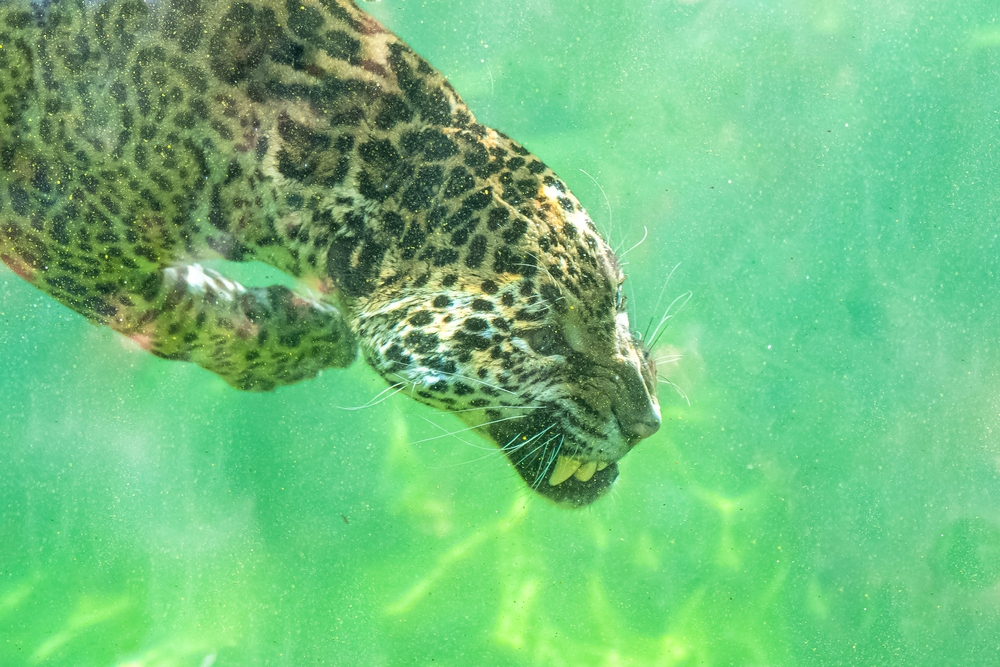
— and pumas, along with most other cats, don’t like water. (Image: Wirestock Creators/Shutterstock)
Resource partitioning, time or space partitioning, avoidance — it’s a start.
But deep down, all conservationists know that “there is no single key to coexistence” (as sources quoted by Lovari et al., in the reference list, put it).
This is why, despite the many difficulties in studying them, papers continue to be written about possible jaguar and puma interactions where their ranges meet: the lowland tropical forests.
Maybe the cats coexist here in unique ways!
Perhaps — but the cats aren’t talking.
79. Pumas are not easy to study.
Puma concolor might be the fourth largest member of Felidae today (after tigers, lions, and yes, jaguars), but this cat — whether locals call it a cougar, panther, mountain lion, or puma — keeps a surprisingly low profile.
That is partly due to its secretive behavior. Pumas often hunt at night and they know how to take advantage of even the slightest cover, as this video of a youngster stalking through a barren rocky landscape in Chile shows:
It’s just as easy for a puma to sneak around and away from conservationists and anyone else who might want to study this American wild cat.
Also concealing the puma from field observation are its coat coloring — almost as good as an invisibility cloak! — and its agility and speed.
The cats cannot avoid camera traps, but their lack of individual markings frustrates attempts to use these images to count how many pumas there are in an area and how the cats move around in that neighborhood.
Radio collars would help, of course, but first you have to find the cat and catch it.
In the rainforest.
80. Jaguar and puma habits overlap.
We’re mainly talking about resources (prey and habitat) here.
Both are ground-based hunters (in contrast, those acrobatic small cats known as margays use spatial partitioning by hunting up in the trees).
That said, research findings are varied and sometimes contradictory.
- Studies often do show resource partitioning, with jaguars taking larger prey. Other studies report that jaguars and pumas take the same sized prey but maybe focus on different species.
- Temporal partitioning is unlikely, since jaguar and pumas seem to hunt at the same time of day or night, following the activity patterns of local prey.
- There doesn’t seem to be much spatial partitioning going on between jaguars and pumas in the rainforest, although it’s difficult to be sure when you rely on camera traps that catch slim, long-legged pumas on game trails but not the jaguars, who tend to muscle their way cross-country through the forest, confounding camera-trap research.
In sum, unlike leopards and tigers or leopards and lions, jaguars and pumas might have many similarities in their activity patterns, prey choices, and habitat use — no obvious differences have been found yet to explain their coexistence.
Yet. The boffins are still at work.
81. Medium-sized prey and a mixed environment might contribute to jaguar-puma coexistence.
This section is brief because it includes information from just one of the many papers out there, to give you some idea of what the ongoing research is like.
This paper by Scognamillo et al. does address the questions about jaguar/puma coexistence.
The team radiocollared and studied jaguars and pumas in Venezuela’s llanos region, an area of grassy plains and savannahs dotted with cattle pastures, woodlands, and evergreen and deciduous forests. It seasonally floods during the rainy season (except for upland forested regions).
Or as they put it, very scientifically, “In general, the landscape can be characterized as a complex mosaic of interdigitated forests and open areas with vegetation types based on interactions of elevation, substrate and hydrology.”
They also note that it is popular with ecotourists, and a random search online confirms that (there are lots of capybaras, caiman, horses, and cattle in this video, but no cats):
It’s important to keep the expert description in mind, since the scientists go on to say that the mix of different settings here might help jaguars and pumas coexist.
Actually, there does seem to be room here for predators to spread out and exploit microhabitats.
A second factor that might be helping real-world jaguars and pumas coexist is the presence of so many medium-sized prey animals. There might be enough to support both cats, so they have no need to compete for food.
There is no guarantee that this one paper is especially correct, though it’s highly cited.
It merely gives a sense of closure to the episode, even if a new hypothesis comes along later that completely overturns it.
True, scientists like questions, but we laypeople prefer answers.
Time and further research will show how close this team might be to the solution of the coexistence conundrum that this feline odd couple presents to Science.
If you are enjoying the “Fangly Facts” series, tips are welcome via the secure Stripe donation link. I won’t be saving your email for marketing or other spam, so here’s a big thank you in advance!
Sources include:
Balme, G. A.; Pitman, R. T.; Robinson, H. S.; Miller, J. R.; and others. 2017. Leopard distribution and abundance is unaffected by interference competition with lions. Behavioral Ecology, 28(5): 1348-1358.
Caragiulo, A.; Dias-Freedman, I.; Clark, J. A.; Rabinowitz, S.; and Amato, G. 2014. Mitochondrial DNA sequence variation and phylogeography of Neotropic pumas (Puma concolor). Mitochondrial DNA, 25(4): 304-312.
Culver, M.; Johnson, W. E.; Pecon-Slattery, J.; and O’Brien, S. J. 2000. Genomic ancestry of the American puma (Puma concolor). Journal of Heredity, 91(3): 186-197.
Elbroch, L. M., and Kusler, A. 2018. Are pumas subordinate carnivores, and does it matter?. PeerJ, 6, e4293.
Foster, V. C.; Sarmento, P.; Sollmann, R.; Tôrres, N.; and others. 2013. Jaguar and puma activity patterns and predator‐prey interactions in four Brazilian biomes. Biotropica, 45(3): 373-379.
Harmsen, B. J.; Foster, R. J.; Silver, S. C.; Ostro, L. E.; and Doncaster, C. P. 2009. Spatial and temporal interactions of sympatric jaguars (Panthera onca) and pumas (Puma concolor) in a neotropical forest. Journal of mammalogy, 90(3): 612-620.
Lovari, S.; Pokheral, C. P.; Jnawali, S. R.; Fusani, L.; and Ferretti, F. 2015. Coexistence of the tiger and the common leopard in a prey‐rich area: the role of prey partitioning. Journal of Zoology, 295(2): 122-131.
Macdonald, D. W.; Loveridge, A. J.; and Nowell, K. 2010. Dramatis personae: An introduction to the wild felids, in Biology and Conservation of Wild Felids, eds. Macdonald, D. W., and Loveridge, A. J., 3-58. Oxford: Oxford University Press.
Matte, E. M.; Castilho, C. S.; Miotto, R. A.; Sana, D. A.; and others. 2013. Molecular evidence for a recent demographic expansion in the puma (Puma concolor)(Mammalia, Felidae). Genetics and Molecular Biology, 36(4): 586-597.
Scognamillo, D.; Maxit, I. E.; Sunquist, M.; and Polisar, J. 2003. Coexistence of jaguar (Panthera onca) and puma (Puma concolor) in a mosaic landscape in the Venezuelan llanos. Journal of Zoology, 259(3): 269-279.
Sunquist, M. and Sunquist, F. 2002. Wild Cats of the World. Chicago and London: University of Chicago Press. Retrieved from https://play.google.com/store/books/details?id=IF8nDwAAQBAJ
Taber, A. B.; Novaro, A. J.; Neris, N.; and Colman, F. H. 1997. The food habits of sympatric jaguar and puma in the Paraguayan Chaco. Biotropica, 29(2): 204-213
 Flight To Wonder