A cat that resembles a wolf AND a spotted cat?
The comparison might not occur to us today upon seeing a wild jungle cat — then again, it might:
The Roman naturalist Pliny the Elder described it that way. He was a well-respected statesman, soldier, and scientist who died during a rescue mission while Mount Vesuvius was erupting all over Pompeii and other nearby places.
If he said he saw such an animal, then that’s what it looked like:
It was at the games of Pompeius Magnus that the chama was first exhibited, an animal called rufius by the Gauls, having the figure of a wolf, with the spots of a pard [an old word for any spotted cat]…These animals have not been seen in Rome since that time.
Later on, when eighteenth-century European scientific travelers first saw such a cat in the Eurasian wilds, they remembered this first-century description and used Pliny’s term for the species, not the cat’s local name, kirmyschak.
Felis chaus.
Down through time, transcription errors had crept into the old Roman’s book on natural history and “chama” was now “chaus.”
The Felis part took some time to establish but most taxonomists now accept that jungle cats are indeed part of the lineage that also includes Fluffy.
What else do the boffins say about jungle cats?
Among other things —
73. Chaus is the most common small cat in much of mainland Asia.
“Chaus” is my favorite nickname for this little feline.
What Asian jungles does it inhabit?
None. At least, there are no reports of it in the sort of closed canopy forest that we think of as jungle.
Chaus does like cover, though — the jungly area at a forest’s edges where canopy doesn’t block daylight as much, as well as reed beds and other vegetation in wetlands and along streams.
This latter habit has earned jungle cats the much more accurate nicknames of “reed cat” and “swamp cat.”
Such places not only provide cover and a safe place to bear their young but also attract the jungle cat’s favorite prey: rodents and other small animals.
Besides the usual feline stalk-and-pounce hunting tactic, the cats have been observed leaping straight up to catch a bird, climbing trees, and catching fish in their mouth while swimming.
Long-legged Chaus is more versatile than its small feline competitors in other ways, too.
Jungle cats can fit into a variety of habitats and have been seen in irrigated fields, arid regions, grasslands, bushy scrub, deciduous forests, and in the high country, including the Himalayas, but always close to a water source and thick plant growth.
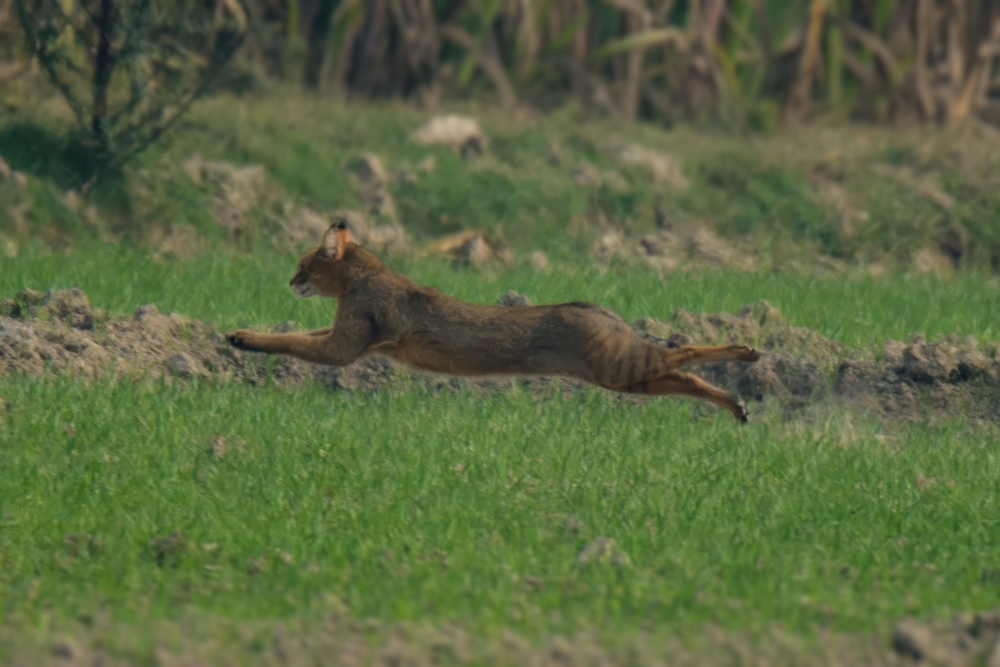
Their adaptations to airflight are still in Beta. (Image: MuhammadAliRajput/Shutterstock)
Jungle cats also can tolerate human-dominated ecosystems. It even settles down near towns and farms, which is great for agricultural pest control but not so good when they go after the domestic poultry.
With this adaptability, its hunting skill, and a tolerance for the nearby presence of humans, Chaus has established a wide range — from Egypt’s Nile River Valley north to the Caspian Sea and Volga River (where cold winters limit its spread) and eastward through the Middle East and India to China and parts of Southeast Asia.
Speaking of Egypt —
74. Chaus is the “other” Ancient Egyptian house cat.
You might have heard that domestic cats were worshipped in Ancient Egypt.
To hit just a few of the high points, archaeology shows that a lion-headed goddess — Bastet — was worshipped there several centuries before the Sphinx and Great Pyramids were built.
Over the next one thousand years, domestic cats began appearing in texts and artwork — underneath chairs (one of the earliest cat memes!), eating from bowls, decorated with jewelry, and outdoors helping their human friends hunt waterfowl along the river.
In some of that art, it’s hard to tell if the sleek, long-legged felines are African wildcats or jungle cats.
Over a few more thousand years — Ancient Egypt lasted a long time — Bastet somehow morphed into a cat-headed goddess associated with fertility.
During her yearly festival, everyone offered her a cat mummy.
This is the unpleasant part of the story, although it played an important role in the domestication of cats.
Over time, literally millions of cats were raised in temples — history’s first known catteries — and then sacrificed to Bastet.
We see this very differently than the Ancient Egyptians did, but it was the first time that humans had taken control of a cat species, selecting individuals that could live in groups and were not bothered by nearness to people — key factors in domestication that other animals had already gone through.
The good news is that some of those temple cats must have escaped their doom, since genetic testing of cat mummies and modern Egyptian street cats shows a match!
The question of which wild cat species was involved in Ancient Egypt’s cat worship and as household pets long puzzled biologists.
Though they suspected that it was the African wildcat, some of those Ancient Egyptian cats looked a lot like Chaus.
DNA studies now show that most of the cat mummies tested were African wildcats, but a few — 3 out of 190, in one study — were jungle cats.
That isn’t many, but given the scale of the temple operations, why didn’t Chaus become domesticated, too?
No one really knows.
It all happened long ago and many details of those times are lost forever.
Returning to present times —
75. Jungle cats are the wild parent of the Chausie fancy cat.
These days, genetics is a well-developed science and cat fanciers have recognized that jungle cats and domestic cats probably hybridized in Egypt.
Why not develop a new cat breed through such a cross?
True, hybridization often results in sterile offspring, but not so much in cats, surprisingly enough.
This is because all feline species, except Latin America’s ocelot lineage, have the same number of chromosomes and very similar genomes.
More than forty cross-breeds in Family Felidae have produced fertile offspring — and most of those happened naturally.
Some fanciers experimented in the 1960s and 1970s. During the 1990s they started a formal program to produce the “Chausie” — a cross between jungle cats and a variety of fancy cats, including (but not limited to) Abyssinians and domestic shorthairs.
This takes time, both to breed out dangerous wild traits and to comply with exotic animal laws and cat registry requirements.
It worked. In 2013 the Chausie was accepted as a championship breed by The International Cat Association.
Out in the wild, seldom seen Felis chaus is a champion, too.
If you are enjoying the “Fangly Facts” series, tips are welcome via the secure Stripe donation link. I won’t be saving your email for marketing or other spam, so here’s a big thank you in advance!
Sources include:
Bökönyi, S. 1969. Archaeological problems and methods of recognizing animal domestication, in The Domestication and Exploitation of Plants and Animals, eds. Ucko, P. J., and Dimbleby, G. W., 219-229. London: Duckworth.
Butler, E. P. n. d. Bast https://henadology.wordpress.com/theology/netjeru/bast/ Last accessed November 5, 2017.
Cat Specialist Group. 2023. Jungle cat. http://www.catsg.org/index.php?id=114 Last accessed December 4, 2023.
Colorado State University Center for Environmental Management of Military Lands (CMML). Timeline of Egyptian History & Culture. https://www.cemml.colostate.edu/cultural/09476/egypt02-01enl.html Last accessed October 9, 2017.
Driscoll, C. A.; Clutton-Brock, J.; Kitchener, A. C.; and O’Brien, S. J. 2009. The taming of the cat. Scientific American, 300(6): 68-75.
Driscoll, C. A.; Macdonald, D. W.; and O’Brien, S. J. 2009. From wild animals to domestic pets, an evolutionary view of domestication. Proceedings of the National Academy of Sciences, Supplement 1, 106: 9971-9978.
Driscoll, C. A.; Menotti-Raymond, M.; Roca, A. I.; Hupe, K.; and others. 2007. The Near Eastern origin of cat domestication. Science, 317: 519-522.
Kurushima, J. D.; Ikram. S.; Knudsen, J.; Bielberg, E.; and others. 2012. Cats of the pharaohs: Genetic comparison of Egyptian cat mummies to their feline contemporaries. Journal of Archaeological Science, 39(10): 3217-3223.
Macdonald, D. W.; Loveridge, A. J.; and Nowell, K. 2010. “Dramatis personae”: An introduction to the wild felids, in Biology and Conservation of Wild Felids, eds. Macdonald, D. W., and Loveridge, A. J., 3-58. Oxford: Oxford University Press.
Montague, M. J.; Li, G.; Gandolfi, B.; Khan, R.; and others. 2014. Comparative analysis of the domestic cat genome reveals genetic signatures underlying feline biology and domestication. Proceedings of the National Academy of Sciences, 111(48): 17230-17235.
Murphy, W. 2015. Genetic analysis of feline interspecies hybrids. https://www.vin.com/apputil/content/defaultadv1.aspx?pId=12513&catId=51026&id=6976361
Serpell, J. A. 2014. Domestication and history of the cat, in The Domestic Cat: The Biology of its Behaviour, eds. Turner, D. C., and Bateson, P., 83-100. New York: Cambridge University Press. Retrieved from https://play.google.com/store/books/details?id=m-NRAgAAQBAJ
Sunquist, M. and Sunquist, F. 2002. Wild Cats of the World. Chicago and London: University of Chicago Press. Retrieved from https://play.google.com/store/books/details?id=IF8nDwAAQBAJ
The International Cat Association. 2018. Chausie Breed. https://www.tica.org/breeds/browse-all-breeds?view=article&id=834:chausie-breed&catid=79
Wikipedia. 2023. Chausie. https://en.wikipedia.org/wiki/Chausie Last accessed December 5, 2023.
___. 2023. Jungle cat. https://en.wikipedia.org/wiki/Jungle_cat Last accessed December 5, 2023.
 Flight To Wonder