There are sand-colored arid places on this blue planet that sometimes surprise us with their sage-scented greenery — Mexico’s Sonoran Desert, for example, or the Mojave Desert of the southwestern US.
The bobcat surprised everyone, perhaps including itself. (Saguaro National Park, near Tucson, has a Sonoran Desert ecosystem, by the way.).
The “desert” name for all of those rainfall-challenged places is accurate, but most of us living in humid, more temperate regions usually picture the desert as very austere.
This, basically.
Such ultimate deserts do exist, of course. Believe it or not, they also contain life.
Sand seas, shifting with the breeze — not so much. However, Sahara & Friends offer alternatives for any living beings that can adapt to such habitats as:
- Rocky desert
- Sand and gravel desert
- Stable dune groups where just enough drought-resistant vegetation exists to put down roots and hold the dunes in place.
Any living beings —
Tassili n’Ajjer, Algerian Sahara, where people have lived for at least six thousand years.
Even out in the wilds where humans cannot stay for long, there are sometimes plants.
And where there are plants there will be plant eaters, animals that you might know as pets, like hamsters and gerbils, as well as many other small rodents, reptiles, and birds.
Plant eaters attract predators. Among these, in the ultimate deserts of North Africa, Arabia, and southwestern/central Asia, is just one kind of cat.
It’s not a bobcat.
Cole and Wilson (in this episode’s source list) call it “nocturnal, subterranean, and secretive.”
“Adorable” — they forgot to mention “adorable”!
Let’s meet this little feline: Felis margarita, the sand cat.
70. This is the only cat to live exclusively in true desert.
Before we start, just for the record, F. margarita was not named after the drink.
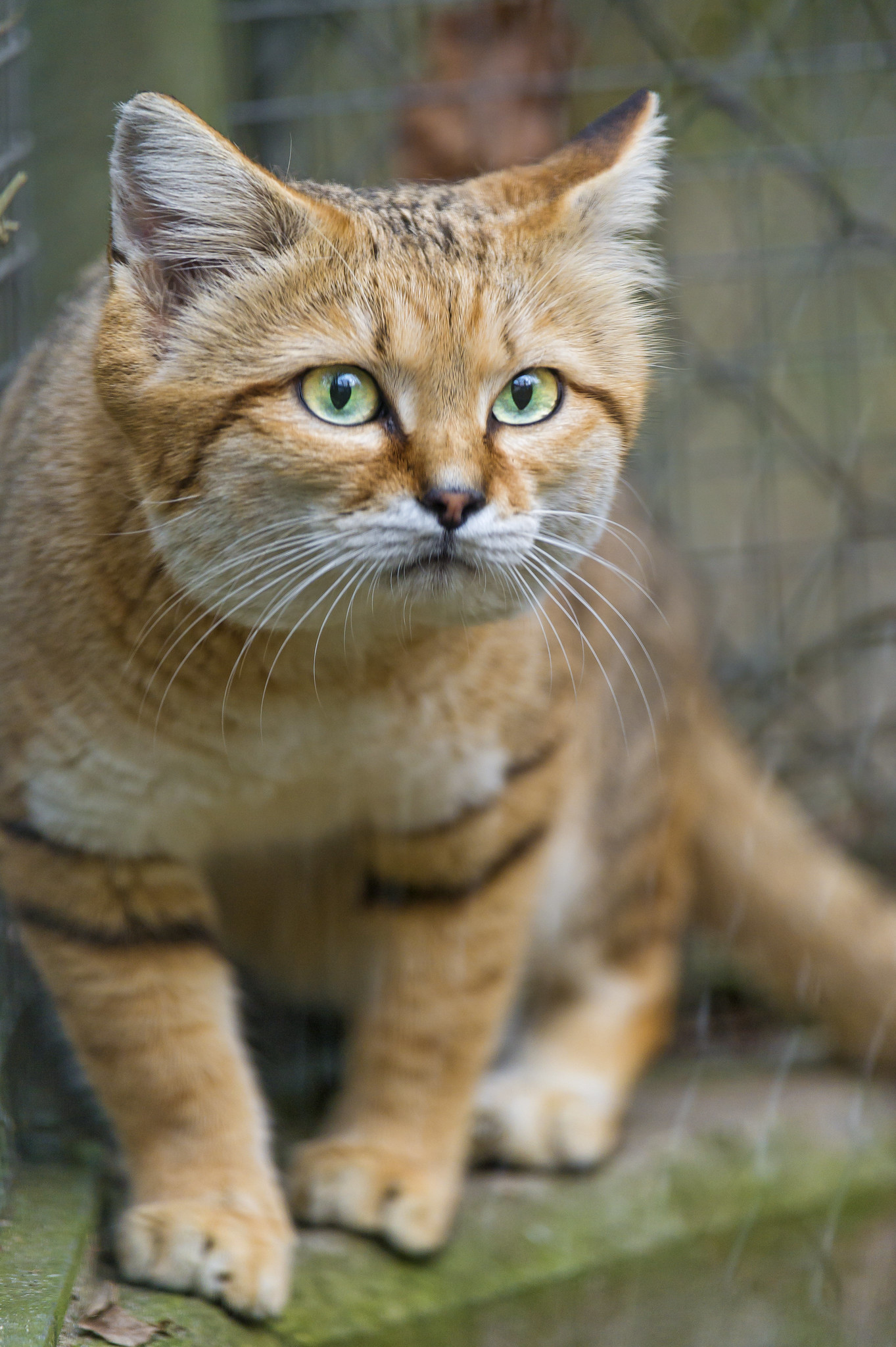
Tambako the Jaguar, CC BY-ND 2.0
The nineteenth-century naturalist who first scientifically documented the little cat in Algeria named it in honor of his expedition’s leader, General Margueritte.
Now let’s get to cats and deserts.
All sorts of wild kitties call the Sonoran Desert home: bobcats and mountain lions mostly, but also the occasional ocelot, jaguarundi, and jaguar.
In Africa, lions, leopards, and cheetahs roam the Kalahari Desert’s Okavango Delta even when river flooding is over and the land has dried.
African wildcats and other small relatives of the house cat’s “Felis” lineage prowl the Kalahari, too.
You will never see those cats as natives of a sandy desert, far from water, where air temperatures rise above 100° F and the upper sand layer can be a blistering 176° F or more.
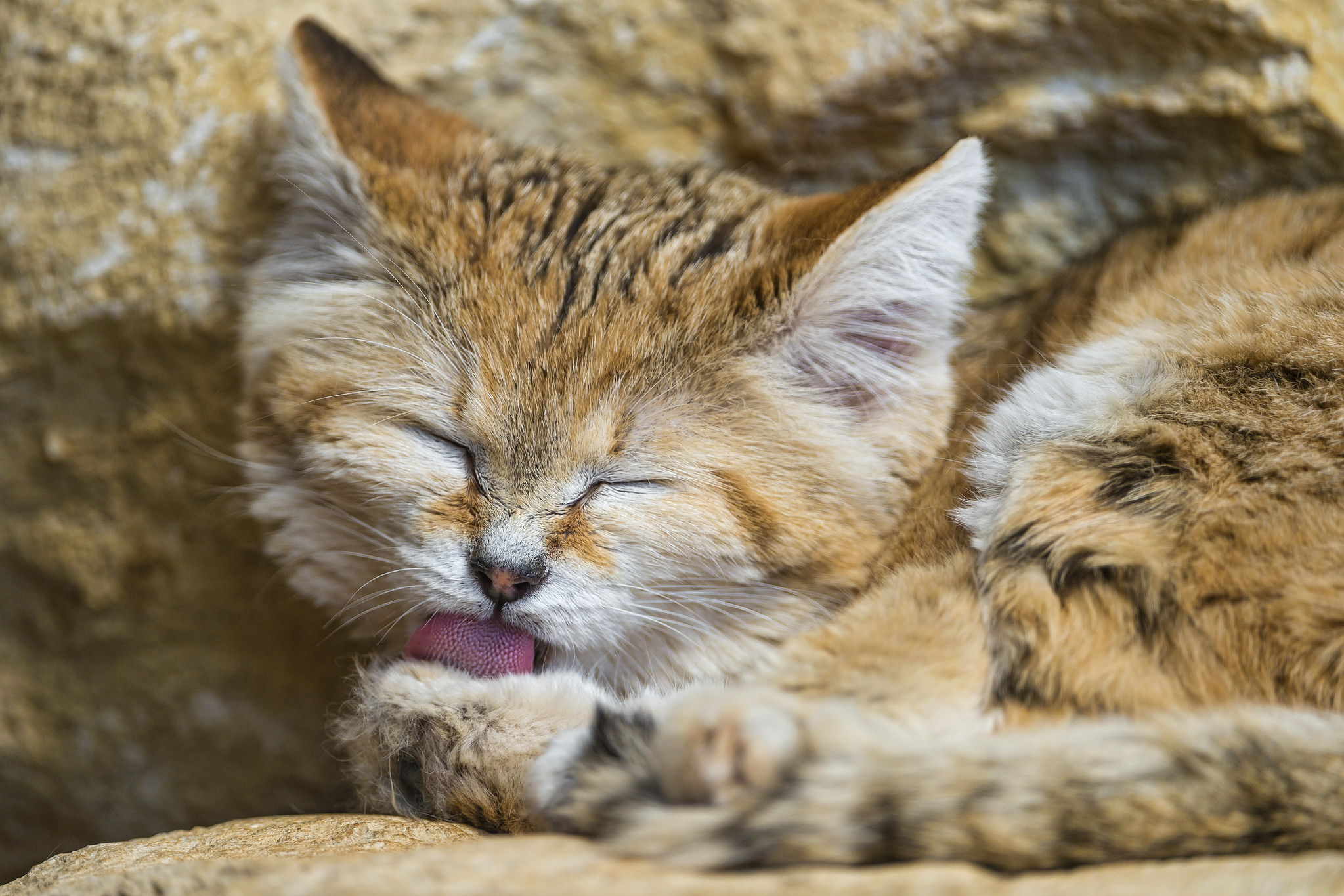
It’s cleaning the top of its paw — you are looking at the paw pads! (Image: Tambako the Jaguar, CC BY-ND 2.0)
Yet there are cat tracks in that sand, blurry ones as though the cat was wearing “shoes” — a layer of hair that protects its paws from the heat.
This is the only member of Family Felidae able to take an ultimate desert’s heat 24/7/365.
At night, inland Saharan temperatures plummet after sunset to an average of 25° Fahrenheit; during winter, the mercury drops below zero in some Asian deserts.
Lions, leopards, cheetahs, and various small cats that are not F. margarita — shorthairs, all — do not find that congenial.
But a small cat finds the absence of such predators and competition VERY pleasing, indeed!
If, in addition to furry paw protection, it grows soft, dense, sand-colored fur (with a warm winter-time undercoat in northern parts of its range), the large temperature swings can be handled, particularly if the cat is good at night hunting and keeps still during the day, avoiding that brutal heat as much as possible.
Given all the prey in these sparsely vegetated sections of the ultimate desert, such evolutionary changes are quite a bargain for the right little feline!
That is, a sand cat.
F. margarita has other desert adaptations, too.
That hairy ruff around the face is cute, but underneath the fur, the sand cat’s head is rounder than seen in most cats.
Sound tends to die out quickly in desert air. Nevertheless, predator and prey both rely on hearing during their night-long activity.
As a result, many desert mammals have evolved unusually large ears. In the sand cat’s case, this also involves anatomical changes inside the skull that not only make for a round head but also improve the cat’s hearing.
Sand cats probably can hear sounds up to a quarter of a mile farther away than Fluffy can.
Too, they can hear prey moving underground and dig it out.
About that digging —
71. Sand cats live underground.
Moroccan sand cats tend to crouch down between rocks, but in places where there is more soil, sand cats use burrows to shelter from predators, the baking sun, the nighttime/winter chill, and that dry, dry wind.
This might seem like odd behavior for a cat, but there aren’t many other options.
In central/southwest Asia, the feline that nomads call “the cat that digs holes” earns its nickname by doing just that, if it can’t find a suitable empty desert fox den.
Sand cats, with the aid of rather blunt and poorly retracted hind claws, will enlarge a convenient rodent hole that might be under a bush, beneath rocks, or even out in the open somewhere, angling their new home down as much as three feet underground.
Presumably the original owners either previously abandoned their hidey-hole or are very recently deceased after the cat heard movement underground and decided to investigate.
However, Sunquist and Sunquist describe one sand cat den that contained Mom, three kittens — and five gerbils, still at home!
Unfortunately, the scientists could not document the backstory to that domestic scene or how things eventually played out for them all.
Let us think positively and hope that the kittens grew up and left home, Mom moved on, and Mrs. Gerbil said to Mr. Gerbil, “I thought they’d never leave.”
72. There isn’t much data on sand cats.
Hooray for the cats, some might be tempted to say; let them live in peace!
It’s an understandable point of view, but unfortunately, the rest of the world does not leave the cats alone and sometimes the cats go extinct.
So conservationists have to keep an eye on them, and this is quite challenging with sand cats because of their size, shyness, and rarity.
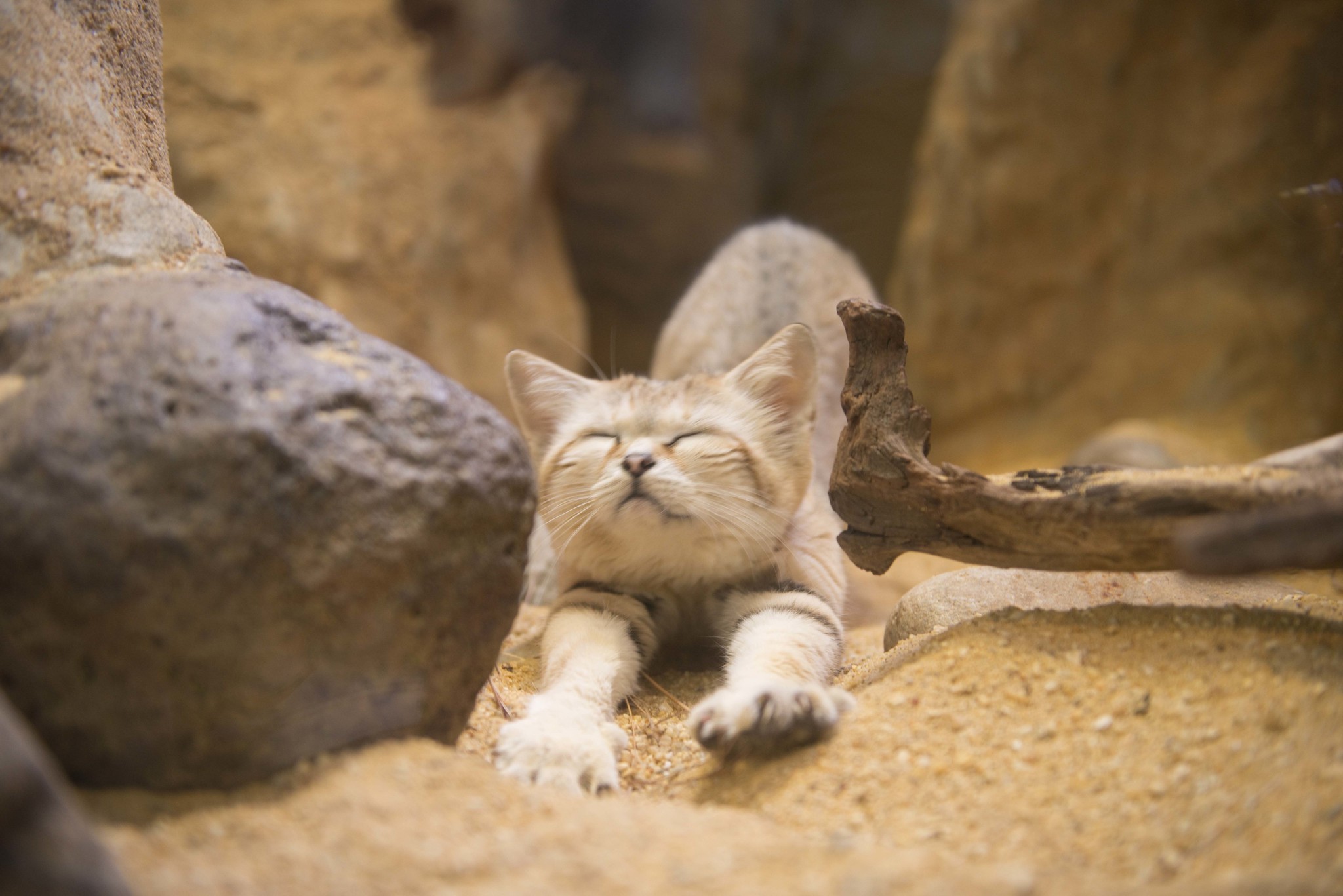
There is a reason why most sand cat images and videos that you see online are from zoos. (Image: Connor Mallon, Smithsonian’s National Zoo, CC BY-NC-ND 2.0)
The extreme places where they live also make fieldwork difficult.
Wildlife experts would like to know if sand cats are at risk of extinction, but they seldom can find F. margarita out in the wild.
This is why everyone was so excited in 2017, when researchers doing night field work in the Sahara unexpectedly came across a sand cat den:
The delighted conservationists waited for the kittens to get used to them, did not approach the den, and then carefully set up remote cameras. As well, they looked for and found the kittens’ mother nearby, and put a radio collar on her.
This was the first time anyone was able to study sand cat families in the wild!
Mom soon moved her kittens to a new location (which the scientists did not attempt to find) but not before the team was able to collect some valuable information to add to the growing database on this nocturnal, subterranean, secretive, and adorable desert cat.
If you are enjoying the “Fangly Facts” series, tips are welcome via the secure Stripe donation link. I won’t be saving your email for marketing or other spam, so here’s a big thank you in advance!
Sources include:
Arizona-Sonora Desert Museum. 2023. Cats. https://www.desertmuseum.org/books/nhsd_cats.php#:~:text=Rare%20Cats%20of%20the%20Sonoran,are%20presently%20listed%20as%20Endangered
Baker, H. 2021. Why do deserts get so cold at night? https://www.livescience.com/why-do-deserts-get-cold-at-night.html#:~:text=That%27s%20because%20temperatures%20in%20the,the%20night%2C%20according%20to%20NASA
Breton, G. 2017. Sand Cat Kittens Spotted in the Wild for First Time. https://panthera.org/blog-post/sand-cat-kittens-spotted-wild-first-time
Cat Specialist Group. 2023. Sand cat. http://www.catsg.org/index.php?id=115 Last accessed December 1, 2023.
Cole, F. R., and Wilson, D. E. 2015. Felis margarita (Carnivora: Felidae). Mammalian Species, 47(924): 63-77.
Huang, G.; Rosowski, J.; Ravicz, M.; and Peake, W. 2002. Mammalian ear specializations in arid habitats: structural and functional evidence from sand cat (Felis margarita). Journal of Comparative Physiology A, 188: 663-681.
Kitchener, A. C.; Van Valkenburgh, B.; and Yamaguchi, N. 2010. Felid form and function, in Biology and Conservation of Wild Felids, ed. Macdonald, D. W., and Loveridge, A. J., 83-106. Oxford: Oxford University Press.
Macdonald, D. W.; Loveridge, A. J.; and Nowell, K. 2010. “Dramatis personae”: An introduction to the wild felids, in Biology and Conservation of Wild Felids, eds. Macdonald, D. W., and Loveridge, A. J., 3-58. Oxford: Oxford University Press.
Okavango Delta World Heritage. 2023. Wildlife in the Okavango Delta. https://www.okavango.com/okavango-delta-wildlife.php#:~:text=With%20the%20reintroduction%20of%20rhino,populations%20in%20the%20Okavango%20Delta
Sliwa, A.; Azizi, S.; Alifal, E.; Essalhi, A.; Endichi, M.; and Breton, G. 2017. First sand cat kittens sighted in the Moroccan Sahara. Cat News, 66: 19-20.
Sliwa, A.; Azizi, S.; Eddine, M. Z.; Alifal, E.; and Breton, G. 2023. Home ranges of African sand cats (Felis margarita margarita). Journal of Arid Environments, 210, 104909.
Sunquist, M. and Sunquist, F. 2002. Wild Cats of the World. Chicago and London: University of Chicago Press. Retrieved from https://play.google.com/store/books/details?id=IF8nDwAAQBAJ
 Flight To Wonder