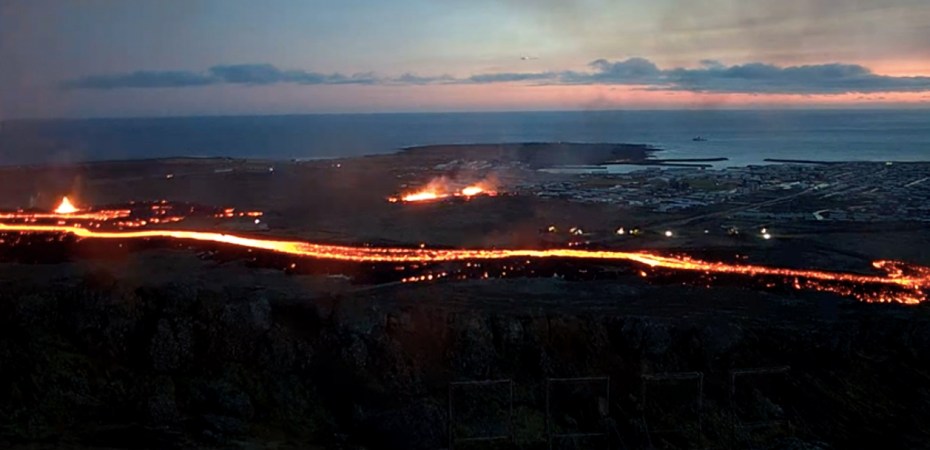
Volcanoes are dramatic and powerful, which is why they get media coverage even when they’re not wreaking ruin and spreading despair.
Just the names of some volcanoes are newsworthy — Vesuvius, Mount St. Helens, Mount Fuji, and others.
So is the name of a country: the otherwise low-profile island nation of Iceland, up near the Arctic Circle.
It’s an odd name for such a fiery place.
Volcanophiles know it well but Iceland came to everyone’s attention when an eruption at southern Iceland’s Eyjafjallajokull in 2010 stopped North Atlantic air travel for a while.
Since then the island produced other spectacular, if less disruptive, eruptions in 2011 (Grimsvotn), in 2014-15 (Bardarbunga/Holuhraun), and starting in 2021, the current series of Fires (a local term for repeated fissure eruptions) on the Reykjanes Peninsula.
These very dramatic images from the May-June 2024 eruption show ongoing volcanism that is complicating life for many Icelanders, most of whom live on this peninsula. The Fires themselves involve only about 100 miles2 of Iceland’s 40,000-square-mile area.
Tourists from many lands come to experience this amazing country and its volcanoes.
Most are carefree but some visitors do realize that they are vacationing on a mid-ocean ridge and strolling between two of Earth’s largest tectonic plates (North America and Eurasia), taking selfies.

Or posing with the bridge. (Image: Peter Thoeny, CC BY-NCSA 2.0)
That’s incredibly cool but is it really a good idea, seeing that Iceland has been erupting so much?
Yes, it’s a wonderful idea.
Until government officials say otherwise, Iceland is open for tourism.
As for safety:
- Its people are friendly and have lived with volcanoes for 1,400 years.
Sometimes the volcanoes have won, during that long stretch of time, and sometimes people came out on top.
And now they’ve got heavy machinery!
Volcanoes are so much a part of daily Icelandic life that world-class local volcanologists, like Dr. Magnus Tumi Gudmundsson and Dr. Thorvaldur Thordarson (autotranslated links), to name just two, are media personalities known by their first names!
At home or abroad, everyone is ultimately responsible for their own safety, of course, but don’t hesitate to relax with Icelanders when the opportunity arises.
Follow their rules and advice, if a volcano makes the news, and you’ll be fine.
- Iceland has effective volcano contingency plans developed by experts with plenty of hands-on experience. (It involves too much to get into here, but Bird et al., in the reference list, devote Section 2 of their paper to an outline of the nation’s emergency management structure.
Emergency responders facilitated the rapid evacuation of Grindavik in November 2023 after a series of strong earthquakes occurred and a large magma-filled dike formed that extended under the town and its harbor. (Fortunately, there was no eruption until December 18th and then the fissure vents opened up almost two miles north of town.)
It’s comforting to be around people during emergencies — preferably people who know what to do and have the skills to do it.
The thought of having to face a volcano emergency while in a foreign land is scary, but in the unlikely event of one while you’re in Iceland, you will meet experienced emergency managers who want very much to keep you safe and sound. Listen to them and follow their instructions.
- In addition to human welfare concerns, Iceland knows that happy, informed tourists are good for the economy. So, starting in 2010, it established specific volcanism-related resources for the tourism industry, including an English-language website with all sorts of information to help you learn about the country’s active volcanoes and their current status. (Bird et al.)
As I write this, Saturday, August 3, 2024, it’s Merchants Day Weekend in Iceland and at least half of all Icelanders reportedly are camping out at festivals across the country (or enjoying them remotely from home as “Couch Potatoes”).
They are descendants of Vikings — of course many are getting their buzz on, too.
There are other festivals, too, and alcohol free.
This love of festivals offers us outsiders a clue as to why Iceland’s people have been so resilient during the extremely difficult last eight months of eruptions in the Sundhnuks area near Grindavik and Svartsengi.
At times they seemed to be channeling their inner berserker.
Experiences ever since their ancestors moved in, back in the 800s AD, have shown Icelanders how important it is to enjoy good things and to party when you can — life also involves major buzzkills that must be dealt with.
Speaking of buzzkills, experts discussing the current Fires say that the Reykjanes Peninsula is “waking up.”
Is this a bad thing for tourists? And why can’t we visit the new eruptions like we could in Fagradalsfjall?
That second question is easy to answer with two videos.
This is the start of a mild-mannered and easygoing Fagradalsfjall eruption (Litli-hrutur, 2023)
This is how all of the Sundhnuks eruptions have started thus far:
Sure, activity eventually focuses on a single vent, as it did at Fagradalsfjall, but the ground here is uneven and cracked; around it is an active flow field, with ponded lava, breakouts, and unless the wind is favorable, lots of toxic gas.
It’s a good place for emergency managers to practice rescues —
— but would you ever want to be a real-life rescuee?
As for the first question…
The Reykjanes Peninsula
Most Icelanders live and work here, and so it’s not good news for them that the peninsula is indeed waking up after an eight-century nap.
That sounds ominous, but it’s actually typical behavior for this part of the mid-ocean ridge, insofar as anything about such a complex place can be called “typical.”
The complexities here make for a pretty geological map, though (and that’s all I’m going to say about them!).

Source, CC BY-SA 4.0,
On map view, the Reykjanes Peninsula resembles a row of books on a shelf, all tilted sideways. (Einarsson et al., 2020)
Volcanologists divide those “books” into volcanic systems — anywhere from two to eight of them, depending on which researcher you consult.
Geologists who can read that rocky archive say that, down through time, there have been cyclical fissure eruptions from these systems just like the ones we’re seeing currently (although there is still debate about which volcanic systems are involved now).
In general, Reykjanes Peninsula volcanic systems wake up every eight hundred to a thousand years or so. (Caracciolo et al.)
As I understand it, each system goes off, one after the other, with each one hosting fissure eruptions for a decade or so. After a few centuries of this, the peninsula then quiets down for another long snooze.
The last eruption cycle before this twenty-first century one finished up in the 1200s AD.
That was some four hundred years after settlement, but still very few people lived here at the time.
Population growth has happened during the centuries of geological quiet, along with the establishment of roads, a major geothermal power plant, and vital infrastructure.
That is all at risk. Now that Fires are upon them again, Icelanders have much work to do, and they must adjust to the new circumstances as effectively and quickly as possible.
It’s quite a challenge, but I’m sure that Iceland is up to it.
And tourists?
Since Keflavik International and most of the Reykjavik metropolitan area are outside the volcanic systems, we tourists are relatively unaffected, in the sense that we won’t need to flee a lava flow (unless we’ve been very, very stupid).
The Blue Lagoon, which is close to the Sundhnuks eruption area, stays open unless circumstances call for an evacuation. Iceland’s other thermal spas are unaffected, as far as I know.
General things for tourists to watch out for include (but aren’t limited to):
- Annoying and occasionally toxic levels of volcanic gas whenever winds blow the plume of a distant eruption over us.
- If any peninsula eruptions involve ground water or the sea, there will be some ash fall, too, when the wind comes from the right direction.
- Transportation difficulties, depending on which roads lava flows might reach. (I’m limiting discussion to the Reykjanes Peninsula, where eruptions have been frequent and close to important stuff, but as the recent Katla jokulhlaup showed, volcanoes occasionally affect transportation routes in other parts of Iceland, too. Here is an official page, in English, that lists warning notices (and returns to normal status) for Icelandic volcanoes. Of note, some volcanoes, including Katla, Hekla, and Reykjanes Peninsula fires, might give very little warning, so it’s a good idea to look into the availability of real-time emergency text messages in whatever part of the country you plan to visit.
- Indoor heating failure during winter. Steps have been taken to see that it doesn’t happen again, but in February 2024, lava cut one of the main geothermal pipes at the Svartsengi power plant — Keflavik Airport was one of the places left in the cold for a few days, fortunately, without serious freeze damage.
To sum up, Iceland has many volcanoes but it’s safe for tourists and is a great place to visit.
Only a small area is affected by the eruption activity that we see in dramatic images and video online.
Top-notch scientists and emergency management specialists work here and Icelanders themselves have coexisted with the Earth’s fire for almost 1,200 years — follow their lead.
Finally, the best safety tip for tourists is this: be safe.
Don’t lose yourself completely — stay aware of your surroundings; listen to others, native or visitor, who obviously know what they’re talking about; and use some common sense (ranging from simple things like dressing warmly this close to the Arctic Circle all the way up to avoiding harm by not walking across that deceptively solid-looking but thin crust on top of fresh lava).
And then, when you get back, tell us all about your terrific Iceland adventure!
Some lagniappe:
Why walk on lava when Iceland sometimes lets you drive on it?
If you enjoyed the writing in this post, tips are welcome via the secure Stripe donation link. I won’t be saving your email for marketing or other spam, so here’s a big thank you in advance!
Featured image: James St. John, CC BY 2.O
Sources:
The source list in previous posts, plus:
Buck, W. R.; Einarsson, P.; and Brandsdóttir, B. 2006. Tectonic stress and magma chamber size as controls on dike propagation: Constraints from the 1975–1984 Krafla rifting episode. Journal of Geophysical Research: Solid Earth, 111(B12).
Gudmundsson, M. T.; Larsen, G.; Höskuldsson, Á.; and Gylfason, Á. G.
2008. Volcanic hazards in Iceland. Jökull, 58: 251-268.
Hartley, M. E.; Morgan, D. J.; Maclennan, J.; Edmonds, M.; and Thordarson, T. 2016. Tracking timescales of short-term precursors to large basaltic fissure eruptions through Fe–Mg diffusion in olivine. Earth and Planetary Science Letters, 439: 58-70.
Larsen, G. 1984. Recent volcanic history of the Veidivötn fissure swarm, southern Iceland—an approach to volcanic risk assessment. Journal of Volcanology and Geothermal Research, 22(1-2): 33-58.
Larsen, G., and Gudmundsson, M. T. 2014. Volcanic system: Bárðarbunga system. Catalogue of Icelandic Volcanoes, 1-11.
Moreland, W. 2017. Explosive activity in flood lava eruptions: a case study of the 10th century Eldgjá eruption, Iceland. Ph.D. thesis, University of Iceland. https://opinvisindi.is/bitstream/handle/20.500.11815/324/PhD%20Thesis_v10-5.pdf?isAllowed=y&sequence=1
Oppenheimer, C. 2011. Eruptions That Shook the World. Cambridge: Cambridge University Press. Retrieved from https://play.google.com/store/books/details?id=qW1UNwhuhnUC
Oppenheimer, C.; Orchard, A.; Stoffel, M.; Newfield, T. P.; and others. 2018. The Eldgjá eruption: timing, long-range impacts and influence on the Christianisation of Iceland. Climatic Change, 147: 369-381.
Thordarson, T. 2003. The 1783–1785 AD Laki-Grímsvötn eruptions I: A critical look at the contemporary chronicles. Jökull, 53: 1-10.
Thordarson, T.; Miller, D. J.; Larsen, G.; Self, S.; and Sigurdsson, H. 2001. New estimates of sulfur degassing and atmospheric mass-loading by the 934 AD Eldgjá eruption, Iceland. Journal of Volcanology and Geothermal Research, 108(1-4): 33-54.
Thordarson, T.; Larsen, G.; Steinthorsson, S.; and Self, S. 2003. The 1783–1785 AD Laki-Grímsvötn eruptions II: Appraisal based on contemporary accounts. Jökull, 53: 11-47.
Thordarson, T.; Self, S.; Miller, D. J.; and others. 2003. Sulphur release from flood lava eruptions in the Veidivötn, Grímsvötn and Katla volcanic systems, Iceland.
Click to access Sulphur-Release-from-Holocene-Basalt-Eruptions-in-the-East-Volcanic-Zone-Iceland.pdf
Witze, A. 2015. Island on Fire. https://hazards.colorado.edu/article/island-on-fire-societal-lessons-from-iceland-s-volcanoes
Zjilstra, A. 2016. The Eldgja eruption: Iceland’s baptism by fire. https://www.volcanocafe.org/the-eldgja-eruption-icelands-baptism-by-fire/
 Flight To Wonder