Jaguars are beautiful big cats, but they’re not quite leopard doppelgangers.

Tambako the Jaguar, CC BY-ND 2.0
While having spots like a leopard, jaguars have a much larger head and a stockier build.
Scientists note that the jaguar’s sturdy fangs and those well-developed muscles are what makes this cat’s head so huge.
Then they perform some quick calculations and announce with awe that, in addition to robust teeth, jaguars have one of the strongest bites relative to body size in the order Carnivora!
What the boffins don’t yet understand is why this feline powerhouse usually takes relatively small prey compared to the large mammals targeted by leopards and lions.
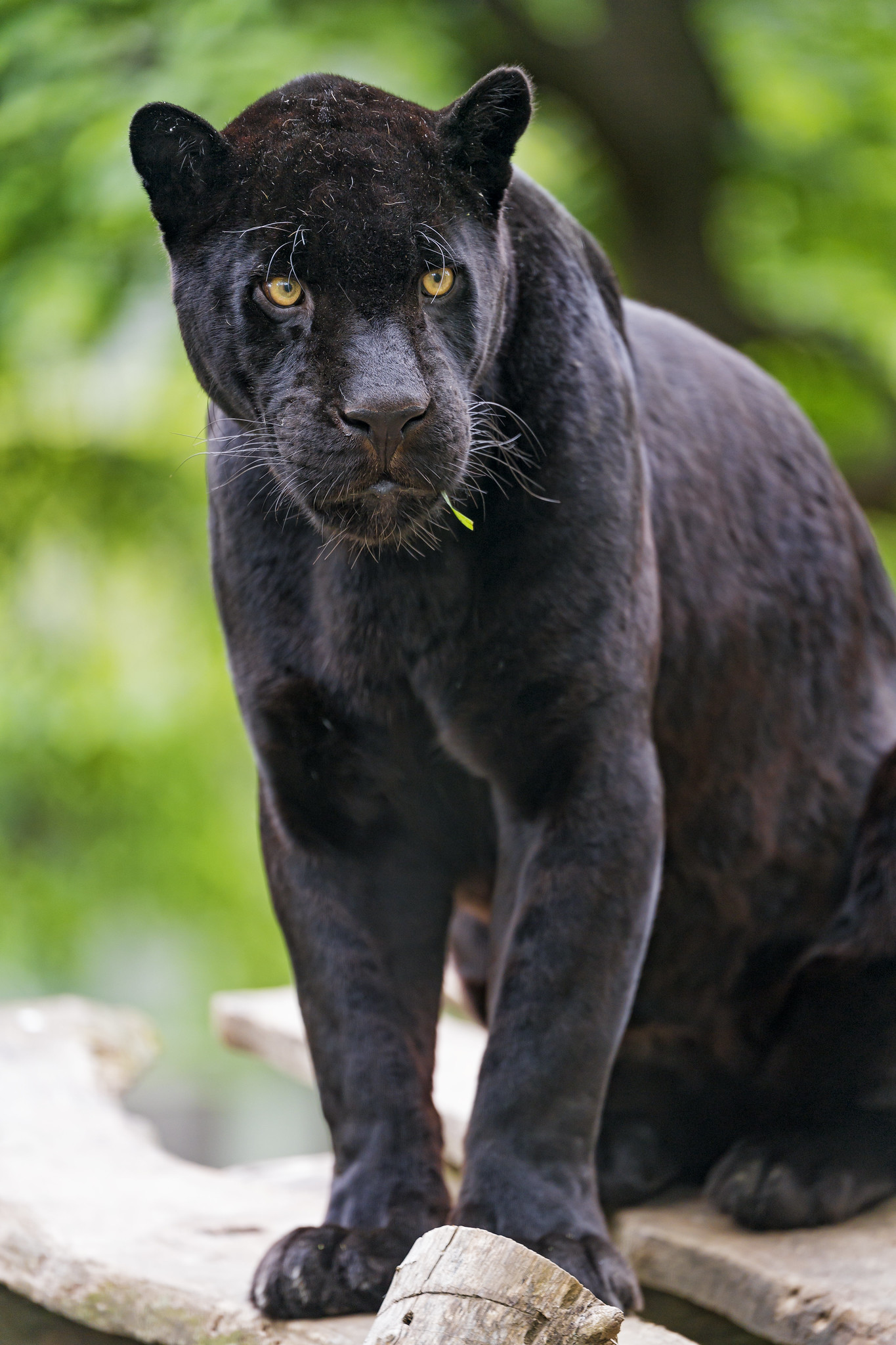
Like leopards, jaguars also come with black fur. They also apparently like grass as much as house cats do. Tambako the Jaguar, CC BY-ND 2.0.
For that matter, in a world with Asian tigers, lions (in India), leopards and snow leopards — in addition to Africa’s leopards and lions — why are jaguars the only big cat in ALL the Americas?
That’s odd — but most of us can live with such arcane mysteries. Not scientists.
Scientists want answers, especially when the animal concerned is on the IUCN’s Red List.
Adding to their curiosity about jaguars is the knowledge that those big prey animals we see in Africa — the wildebeests, antelopes, zebras, and so forth — are all survivors of a mass extinction some ten thousand years ago that took out critters their size and bigger on every continent except Africa.
This includes North and South America where jaguars, for some unknown reason, simply got smaller, losing almost a quarter of their body mass and carrying on through the extinction event.
That’s an automatic A-plus for survival skills, but it does raise an important question.
Why didn’t jaguars just vanish like the other large American carnivores did, including several cat species along with short-faced bears and some canids?
Paleontologists and wildlife experts are still working on it, but here are three of the facts about jaguars that they have uncovered along the way.
64. Jaguars are the only big cats that regularly eat reptiles.
Oh, they go after almost anything that is available — capybaras (big rodents), armadillos, peccaries (wild pigs), etc. — but in wetland areas like Brazil’s Pantanal, where such medium-sized prey is rare, jaguars routinely hunt reptiles like the caiman.
Skillfully, too, as this video shows (predation scenes):
Let’s wait to address why jaguars indulge in saurophagy (the scientific word for “reptile eating”) until the last of this episode’s facts. There is another cool fact we need to know first —
65. Jaguars have a unique killing bite.
If you watched that video at the above link, you saw this bite: the jaguar’s teeth pierced both the unfortunate caiman’s thick skin AND its skull, instantly killing it.
No other wild cat routinely does this “chomp” attack.
All other members of Family Felidae either use a nape bite to kill prey by severing the spinal cord or they suffocate their victim by clamping down on its throat or nose, as a leopard tries to do in this video (the impala escapes):
A leopard, not a jaguar. If you’re ever uncertain, look for little spots inside the larger ones — only jaguars have them.
Such tactics are effective and they also minimize risk to the cat.
The jaguar’s skull bite certainly works, too, but it’s rough on the teeth. What evolutionary advantage could be worth the risk of breaking the tools you live by?
It doesn’t seem to make sense in the world as we know it. But jaguars did survive that mass extinction — perhaps “the chomp” has something to do with that.
66. For most of their time on Earth, jaguars have not been apex predators.
It’s a little hard to believe after watching that caiman video, isn’t it?
But back in Ice Age times, there were giants prowling the Americas, and the jaguar had to play second fiddle to them —
I did this angry Smilodon fatalis for a book cover a few years ago. Extreme mouth opening in frontal view is about as tricky as it gets to draw, so I worked from 3D files of CT-scanned skulls to make sure I got the proportions right pic.twitter.com/Dv9jZ3UaH0
— Mauricio Anton (@MAntonPaleoart) June 8, 2020
https://platform.twitter.com/widgets.js
— technically, it had to be a mesopredator, which is what bobcats, ocelots, and other middle to small-sized wild cats are today.
We have mentioned some of the large critters that jaguars had to deal with.
Top cats in the competition included (but were not limited to) Smilodon populator, which was much larger than its northern relative — S. fatalis — that we know so well from the La Brea asphalt seep.
S. fatalis was a little more than 3 feet tall at the shoulder and weighed anywhere from 350 to 600 pounds, according to some estimates.
S. populator stood almost 40 inches tall at the shoulder and weighed as much as 880 pounds!
Pleistocene jaguars were “only” about the size of a modern African lion and might have maxed out at around 400-500 pounds.
How did they coexist?
It’s likely that jaguars did not directly compete with the sabertooths or with fellow big cats like Panthera atrox.
Some experts suggest that, instead, the jaguar developed a preference for reptiles, turtles, and other such prey that wouldn’t attract apex Pleistocene prowlers — smaller animals that came through the end-Pleistocene megafauna extinction along with the jaguar.
In such circumstances, the advantages of that “chomp” bite for a mesopredator might have outweighed the dental risks.
It’s only a surmise, but features like this that puzzle modern researchers probably were practical adaptations for carnivores back in the day — otherwise, they would not have evolved.
They linger on in the jaguar, but Atrox and the sabertoothed cats are no more.
That epoch ended only about ten thousand years ago — recently, in geologic terms.
Other big cats would have moved in the next time a land bridge opened up — even if H. sapiens hadn’t found ways to cross the sea and hadn’t brought some to these shores — but as things have turned out, jaguars remain and will always be the native feline rulers of the Americas.

Meunierd/Shutterstock
If you are enjoying the “Fangly Facts” series, tips are welcome via the secure Stripe donation link. I won’t be saving your email for marketing or other spam, so here’s a big thank you in advance!
Sources include:
Brito, E. S.; Miranda, E.; and Tortato, F. R. 2018. Chelonian predation by jaguars (Panthera onca). Chelonian Conservation and Biology, 17(2): 280-283.
Cat Specialist Group. 2023. Jaguar. http://www.catsg.org/index.php?id=95 Last accessed November 8, 2023.
Eizirik, E.; Kim, J. H.; Menotti‐Raymond, M.; Crawshaw Jr, P. G.; and others. 2001. Phylogeography, population history and conservation genetics of jaguars (Panthera onca, Mammalia, Felidae). Molecular Ecology, 10(1): 65-79.
Eizirik, E.; Yuhki, N.; Johnson, W. E.; Menotti-Raymond, M.; Hannah, S. S.; and O’Brien, S. J. 2003. Molecular genetics and evolution of melanism in the cat family. Current Biology. 13: 448-453.
Figueiró, H. V.; Li, G.; Trindade, F. J.; Assis, J.; and others. 2017. Genome-wide signatures of complex introgression and adaptive evolution in the big cats. Science Advances, 3(7): e1700299.
Hayward, M. W.; Kamler, J. F.; Montgomery, R. A.; Newlove, A.; and others. 2016. Prey preferences of the jaguar Panthera onca reflect the post-Pleistocene demise of large prey. Frontiers in Ecology and Evolution, 3: 148.
Johnson, W. E.; Eizirik, E.; Pecon-Slattery, J.; Murphy, W. J.; and others. 2006. The Late Miocene radiation of modern Felidae: A genetic assessment. Science, 311:73-77.
Kitchener, A. C.; Van Valkenburgh, B.; and Yamaguchi, N. 2010. Felid form and function, in Biology and Conservation of Wild Felids, ed. Macdonald, D. W., and Loveridge, A. J., 83-106. Oxford: Oxford University Press.
Kitchener, A. C.; Breitenmoser-Würsten, C.; Eizirik, E.; Gentry, A.; and others. 2017. A revised taxonomy of the Felidae: The final report of the Cat Classification Task Force of the IUCN Cat Specialist Group. https://repository.si.edu/bitstream/handle/10088/32616/A_revised_Felidae_Taxonomy_CatNews.pdf
Martin, L. D., and Neuner, A. M. 1978. The end of the Pleistocene in America. Transactions of the Nebraska Academy of Sciences and Affiliated Societies, 337. https://digitalcommons.unl.edu/cgi/viewcontent.cgi?article=1336&context=tnas Last accessed November 26, 2019.
Moreno, A. K. M., and Lima-Ribeiro, M. S. 2015. Ecological niche models, fossil record and the multi-temporal calibration for Panthera onca (Linnaeus, 1758)(Mammalia: Felidae). Brazilian Journal of Biological Sciences, 2(4): 309-319.
Macdonald, D. W.; Loveridge, A. J.; and Nowell, K. 2010. Dramatis personae: An introduction to the wild felids, in Biology and Conservation of Wild Felids, eds. Macdonald, D. W., and Loveridge, A. J., 3-58. Oxford: Oxford University Press.
Macdonald, D. W.; Loveridge, A. J.; and Rabinowitz, A. 2010a. Felid futures: crossing disciplines, borders, and generations, in Biology and Conservation of Wild Felids, eds. Macdonald, D. W., and Loveridge, A. J., 599-649. Oxford: Oxford University Press.
Miranda, E. B.; Menezes, J. F. D.; and Rheingantz, M. L. 2016. Reptiles as principal prey? Adaptations for durophagy and prey selection by jaguar (Panthera onca). Journal of Natural History, 50(31-32): 2021-2035.
Nyakatura, K., and Bininda-Emonds, O. R. P. 2012. Updating the evolutionary history of Carnivora (Mammalia): a new species-level supertree complete with divergence time estimates. BMC Biology, 10:12.
O’Brien, S. J., and Johnson, W. E. 2005. Big cat genomics. Annual Review of Genomics and Human Genetics, 6: 407-429.
O’Brien, S. J., and Johnson, W. E. 2007. The evolution of cats. Scientific American, 297 (1): 68-75.
Quigley, H.; Foster, R.; Petracca, L.; Payan, E.; and others. 2017. Panthera onca (errata version published in 2018). The IUCN Red List of Threatened Species 2017: e.T15953A123791436. https://www.iucnredlist.org/species/15953/123791436
San Diego Zoo. 2019. Jaguar: Panthera onca. https://animals.sandiegozoo.org/animals/jaguar Last accessed November 25, 2019.
Schultz, C. B.; Martin, L. D.; and Schultz, M. R. 1984. A Pleistocene jaguar from North-Central Nebraska. Transactions of the Nebraska Academy of Sciences and Affiliated Societies, 228. https://digitalcommons.unl.edu/cgi/viewcontent.cgi?article=1227&context=tnas Last accessed November 26, 2019.
Smith, F. A.; Tomé, C. P.; Elliott Smith, E. A.; Lyons, S. K.; and others. 2016. Unraveling the consequences of the terminal Pleistocene megafauna extinction on mammal community assembly. Ecography, 39(2): 223-239.
Sunquist, M. and Sunquist, F. 2002. Wild Cats of the World. Chicago and London: University of Chicago Press. Retrieved from https://play.google.com/store/books/details?id=IF8nDwAAQBAJ
Turner, A., and Antón, M. 1997. The Big Cats and Their Fossil Relatives: An Illustrated Guide to Their Evolution and Natural History. New York: Columbia University Press.
Werdelin, L.; Yamaguchi, N.; Johnson, W. E.; and O’Brien, S. J. 2010. Phylogeny and evolution of cats (Felidae), in Biology and Conservation of Wild Felids, eds. Macdonald, D. W., and Loveridge, A. J., 59-82. Oxford: Oxford University Press.
Wikipedia. 2019. Jaguar. Last accessed November 26, 2019.
___. 2019. Jaguars in Mesoamerican culture. https://en.wikipedia.org/wiki/Jaguars_in_Mesoamerican_cultures Last accessed August 28, 2019.
___. 2019. Panthera gombaszoegensis. https://en.wikipedia.org/wiki/Panthera_gombaszoegensis Last accessed November 15, 2019.
 Flight To Wonder