“Bay” is one of those multiple-meaning words. What could it have to do with cats?
“Sittin’ with my cat at the bay, watchin’ the tide roll away…” (Otis Redding sang it differently.) No, that’s not it.
Hounds bayed at the cat as it ran up the tree. Uh-uh.
“But how could she know that this dancin’ bay pony
Meant more to him than life…” (Willie Nelson) YES!
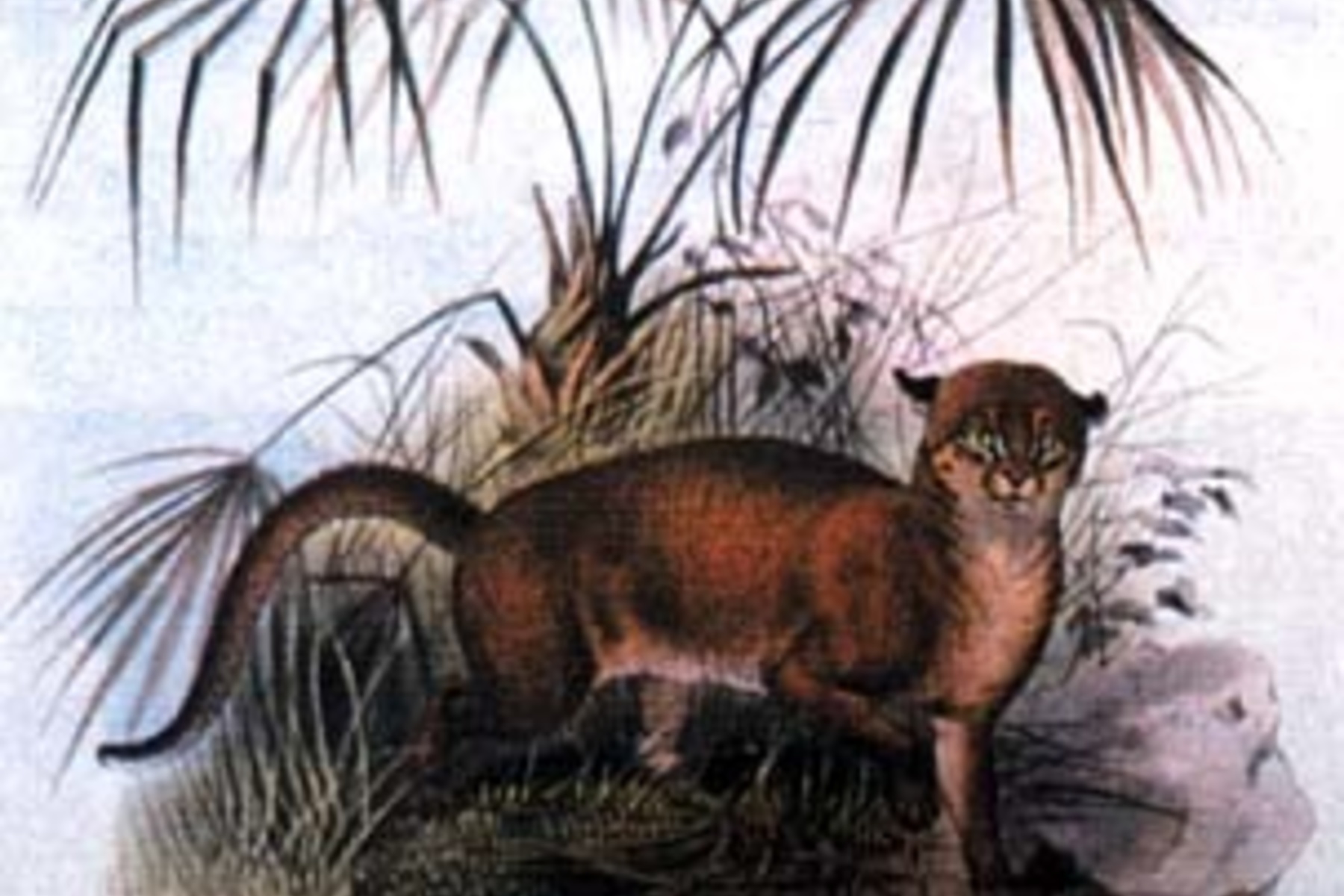
Not a pony. In the 1800s, John Gray came close to the bay cat’s true appearance. (Image: Wikimedia, CC BY-SA 3.0)
It’s that last one, and for a long time, fur color was all that Science knew about this beautiful reddish-brown Asian cat.
58. The bay cat and its two close relatives.
Pelts were collected, probably along Borneo rivers, in 1855, 1888, 1894, and through 1928 — eight in all.
Scientists were fascinated by the mystery animal but never saw a living cat until 1992, when a trapper brought in a very sick female that physically resembled the Asiatic golden cat except for her bay fur color.

Online searches bring up this 2005 image from Sarawak; if there are others, I haven’t found them yet. (Image: Jim Sanderson via Wikimedia, CC BY-SA 3.0)
Genetic testing confirmed, first, that this was not a golden cat but a separate species, and second, that it matched the cats those nineteenth and early twentieth-century pelts had come from.
More DNA testing has revealed that the very different-looking marbled cat is a close relative of bay cats, as is the Asiatic golden cat (in some but not all studies, as we saw last time).
Some taxonomists currently classify these three cats as members of the bay cat lineage.
Debate over their scientific names went back and forth until 2017, when Kitchener et al. (in the reference list) decided that marbled cats, though part of the bay cat lineage, should have their own genus — Pardofelis, meaning “spotted cat.”
They put bay cats and Asiatic golden cats into the Catopuma genus (a nineteenth-century scientific term whose meaning I have been unable to discover).
And that seems to have been that for research on bay cats.
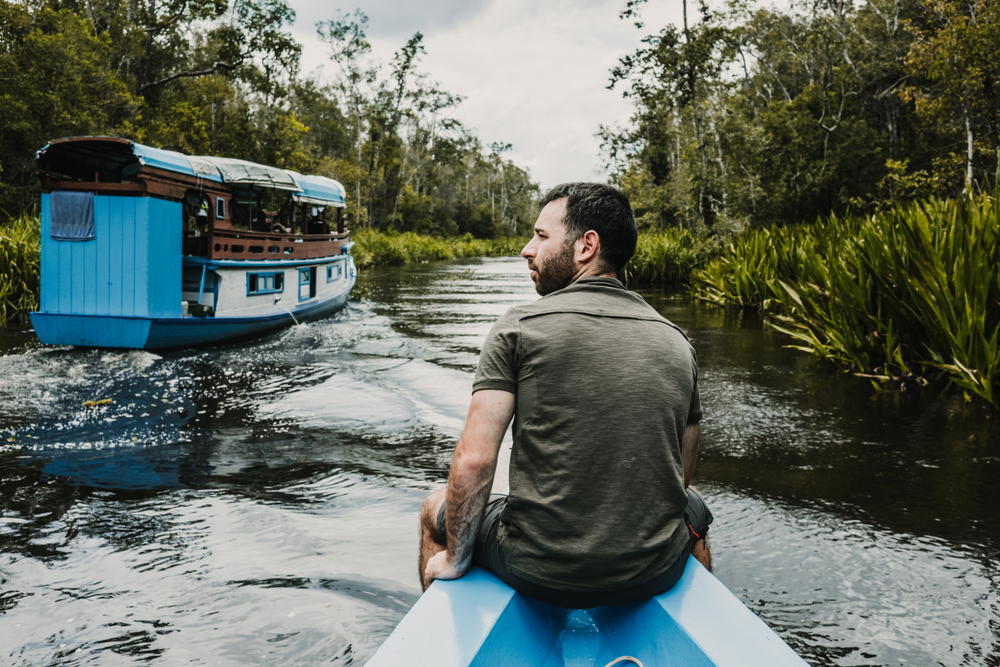
Parts of Borneo are developed these days but rivers are still the easiest way to travel through the interior. (Image: Lucia Romero/Shutterstock)
It isn’t because no one tried to find out more about Catopuma badia.
It’s because, until recently, Borneo — the third largest island on Earth — was covered by impenetrable rainforests, ringed with coastal mangrove swamps, and home to headhunters.
Good luck finding and studying a wild cat the size of a large house cat in there!
Borneo is changing now.
It’s complicated, but I understand that the island began to open up as the world arrived in a big way during World War Two, and many coastal residents fled into the interior during the Japanese occupation.
Further social mixing occurred after the war as Borneo’s people then were caught up in various independence movements and political negotiations that have since given Borneo its current status as a part of three nations: Indonesia, Brunei, and Malaysia.
Then, starting in the 1980s, settlers moved into Borneo and logging operations started.
Yes, it’s sad to think of that vast rainforest falling to saws and heavy machinery, but these are the people who came across that sick bay cat in 1992 and sold it to the boffins.
Zoos and labs pay good money for rare bay cats — and that is a problem.
59. Research into bay cats has unintended consequences.
Much more is known today about Borneo’s diverse plant and animal life.
Disclaimer: I know nothing about this company but liked the video when it came up in a search. Also, there is a brief shot of a flat-headed cat at night and a few views of a clouded leopard. ❤
Nevertheless, field workers seldom catch a bay cat in their camera traps.
This brief appearance is a major success for wildlife experts.
That might be because there are only a few bay cats out there.
When conservationists showed villagers pictures of various wild cats known to be on Borneo, the locals recognized clouded leopards, marbled cats, the little leopard cat, and others — but they did not recognize the bay cat.
Are bay cats headed for extinction?
With so little information available, it’s next to impossible for anyone to know.
Data! The scientists need more data!
Trappers know that zoos and breeding facilities will pay thousands of dollars for a live bay cat, even though bay cats are one of the few small cats listed as Endangered, and they are fully protected over most of their range.
The cats are trapped and might suffer from it. We just don’t know about it.
For instance, as far as I can tell from online sources, the fate of that Sarawak bay cat photographed in 2005 is unknown.
As Sunquist and Sunquist wrote in 2002, “Ironically, the high value placed on these rare cats is jeopardizing the survival of the species…Unless demand decreases, which is unlikely, Western zoos and captive breeding facilities may ultimately be responsible for the extirpation of this species.”
In 2023 the Cat Specialist Group noted the same concern on its species page.
Nothing had changed, in this regard, for twenty-one years — that’s not how conservation is supposed to work.
60. Bay cats are only found on Borneo.
Marbled cats range from northern India and Nepal through Southeast Asia; leopard cats are one of the most common Asian wild cats; and even the small flat-headed cat is also found in Malaysia and Sumatra.
How these widespread cat species got to Borneo is clear enough: during the ice age, sea level was much lower and Borneo was one of the high spots on a huge peninsula that now is mostly flooded.
The cats simply walked in and then got trapped on Borneo by rising seas.
Until 1992, everyone assumed that the same thing happened to bay cats, which were just golden cats who took a slightly different evolutionary course after they were isolated from mainland Asia by the sea.
But that notion flew out the window when genetic testing showed that bay cats aren’t Asiatic golden cats. They are a unique species that evolved before Borneo was isolated.
Where did they originate? On the mainland, where they ultimately vanished? On Borneo, where they still hang on long after those bay cats who migrated into Asia during the last ice age perished?
The Borneo bay cat intrigues workers for many reasons, but thus far, the answers are few and far between.
If you are enjoying the “Fangly Facts” series, tips are welcome via the secure Stripe donation link. I won’t be saving your email for marketing or other spam, so here’s a big thank you in advance!
Sources include:
Cat Specialist Group. 2023. Borneo bay cat. http://www.catsg.org/index.php?id=118 Last accessed October 31, 2023.
___. 2023. Marbled cat. http://www.catsg.org/index.php?id=122 Last accessed October 31, 2023.
Etymology Online. 2023. Bay (adj). https://www.etymonline.com/word/bay#etymonline_v_5345 Last accessed November 1, 2023.
Johnson, W. E.; Eizirik, E.; Pecon-Slattery, J.; Murphy, W. J.; and others. 2006. The Late Miocene Radiation of Modern Felidae: A Genetic Assessment. Science, 311:73-77.
Kitchener, A. C.; Breitenmoser-Würsten, C.; Eizirik, E.; Gentry, A.; and others. 2017. A revised taxonomy of the Felidae: The final report of the Cat Classification Task Force of the IUCN Cat Specialist Group. https://repository.si.edu/bitstream/handle/10088/32616/A_revised_Felidae_Taxonomy_CatNews.pdf
Macdonald, D. W.; Loveridge, A. J.; and Nowell, K. 2010. “Dramatis personae”: An introduction to the wild felids, in Biology and Conservation of Wild Felids, eds. Macdonald, D. W., and Loveridge, A. J., 3-58. Oxford: Oxford University Press.
Mohd-Azlan, J., and Sanderson, J. 2007. Geographic distribution and conservation status of the bay cat Catopuma badia, a Bornean endemic. Oryx, 41(3): 394-397.
Nyakatura, K., and Bininda-Emonds, O. R. P. 2012. Updating the evolutionary history of Carnivora (Mammalia): a new species-level supertree complete with divergence time estimates. BMC Biology, 10: 12.
Sunquist, M. and Sunquist, F. 2002. Wild Cats of the World. Chicago and London: University of Chicago Press. Retrieved from https://play.google.com/store/books/details?id=IF8nDwAAQBAJ
 Flight To Wonder