
Besides being a wonderful travel destination —
I want one of those pizzas.
— Procida made the news this past week for something potentially very serious.
As noted in the Campi Flegrei post:
July 11, 2024, 12:35 p.m., Pacific: All heck quite understandably broke loose today in Campanian/Neapolitan emergency management circles (emphasis added):
MONTE DI PROCIDA – A seismic swarm has been underway in the Campi Flegrei area since 11.57 am. The event of greatest magnitude, 2.6, was located at 11.59 am, in the Astroni-Pisciarelli area near the Pozzuoli toll booth of the ring road, at a depth of approximately 3 km. The Municipal Operations Center was immediately summoned and expeditious checks were started with technical and Municipal Police personnel. In the same hours, a landslide event was also recorded along the Monte di Procida ridge overlooking the Miliscola coast. This circumstance, in fear of correlations between the two episodes, led to the Prefecture of Naples convening (remotely) an ad horas meeting of the Rescue Coordination Center for 3pm today, in which the Municipality of Monte di Procida, the Municipality of Bacoli, the Port Authority, the Guardia di Finanza, the COPS of the State Police, the Operations Center of the Carabinieri, the Fire Brigade, and, obviously, the Campania Region with the Department of Civil Protection, as well as the National Institute of Geophysics and Volcanology.
THE SUMMIT – During the meeting, the director of the Vesuvian Observatory, Mauro Di Vito, expressly believed he could exclude correlations between the landslide event recorded in Miliscola and the seismic swarm in progress, believing rather that it was a small detachment of sandy materials, which eroded and caused a dusty mass fed by the wind, as frequently happens in the area (already closed off and subject to a high risk of landslides), as also ascertained by the technicians of the municipal technical office, who immediately intervened on site together with the Local Police following the activation of the COC…
— Source (Italian)
I know very little about Procida Island.
It’s part of the Campania Plain volcanic region, but all I could say about Procida in those posts was that it hasn’t erupted in well over ten thousand years.
In reading up on the area after Thursday’s news, I learned that Procida and Ischia might be connected in some way with the nearby Campi Flegrei caldera, one of the world’s most dangerous volcanoes.
That’s interesting because, in looking up videos for a Sunday post, you can hardly see Procida for all the people on it.
And as this long tourist-walk video shows, the place is gorgeous.
Is there really volcanic hazard here?
I cannot go into detail on it right now because of other projects, but here is the little bit of information that came up in a quick online search (the source list will help you get started, if you are curious and want more details):
- That landslide near Miliscola actually happened on the mainland, in Campi Flegrei’s southwest sector.

But there’s some bad news —
- Procida is considered part of Campi Flegrei’s southwest sector, which overall hosts the remnants of fourteen monogenetic — one-shot — volcanoes, per Perrotta et al.
There also is a tectonic lineament running toward Campi Flegrei (Pozzuoli Bay and its shores) from the southwest. It crosses Ischia — see part of big Ischia Island in the lower left corner of the above map? — and the lineament runs right down the middle of Procida Island.
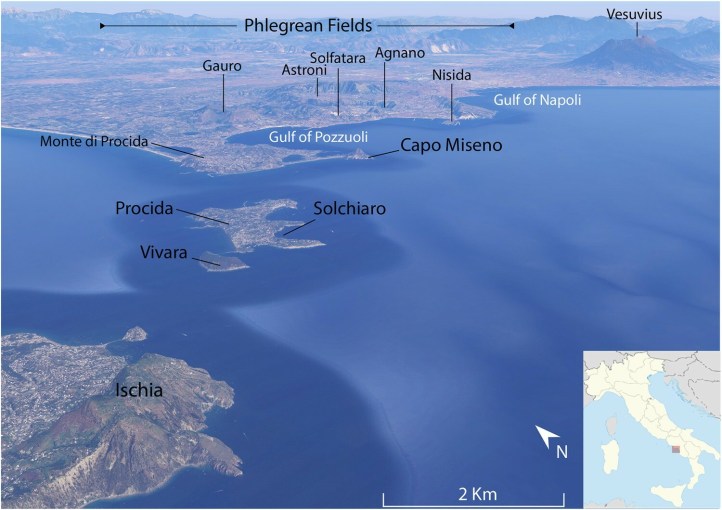
Figure 1., Sbrana et al., https://doi.org/10.1080/17445647.2021.1982033 , CC BY-SA 4.0.
Now for some good news —
- This lineament does not guarantee a high risk of eruption all along its length all of the time — volcanic activity requires other factors.
Campi Flegrei, of course, is dangerous. So is Ischia, which actually is a small but feisty caldera volcano.
Procida, in between those two fire holes? Not so much, even though it is composed of at least eight old volcanoes (mostly underwater), according to Aiello et al., and it used to have explosive eruptions.
Most visitors on the ground don’t notice the relict volcanoes that they are standing on, but Figure 1 in the Aiello et al. paper shows them, along with some tuff structures like Vivara.
They look like a conglomeration of circles on that graphic. In real life, wind, water, and human activity have eroded the ancient fire mountains in ways that now give Procida its peculiar shape.

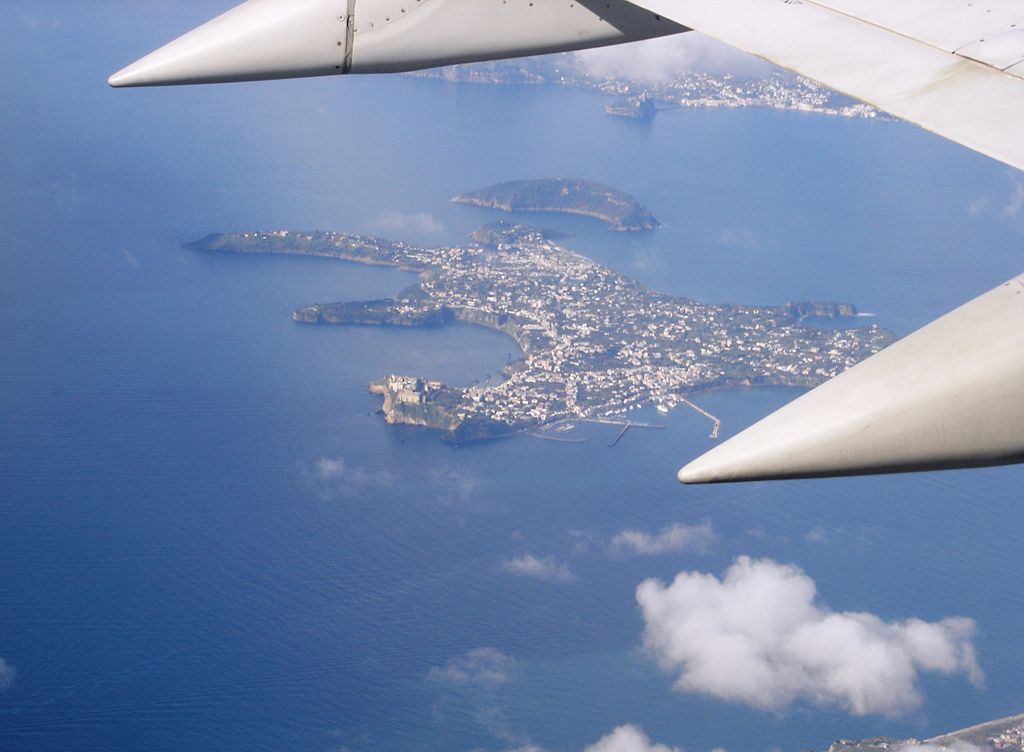
If this were a leaping cat, Vivara would be its tail, above left. (Image: Retaggio via Wikimedia, CC BY-SA 3.0.)
They are old.
As this layperson understands it, Procida’s fires went out right after Campi Flegrei’s last big blast — the Neapolitan Yellow Tuff (NYT) — some 12,000 to 18,000 years ago (different experts give different dates).

Why did Procida stop erupting? Probably for the same reason that Campi Flegrei’s post-NYT eruption style switched over to monogenetic low-level volcanism — but that’s just this layperson’s guess.
Something happened down there and little evidence exists up here to show investigators what it was.
Let’s give the boffins a break — this is not the easiest place to study, being mostly underwater as well as almost completely covered with human stuff.
Geoscientists only started intensive work in the southwest sector after Campi Flegrei’s bradyseism crises in the 1970s and 1980s.
There is a lot going on here.
Campania is one of the most complex volcanic regions on Earth. It is basically crumpling up under a variety of forces unleashed by the great Africa-Eurasia continental collision (note: layperson terms; scientists are more accurate and detailed but hard to follow, and they don’t always agree on important points).
And Procida, per Aiello et al., is complex, too, for geological reasons that these researchers describe in detail.
Yet volcanologists already knew enough about the region to quickly assess things last week.
Fortunately, their answers were reassuring.
Geoscientific research continues on.
Some Naples-area volcano is bound to go off eventually. Since knowledge is power, the more time that passes between now and the next eruption, the better prepared its human neighbors will be to face it and overcome whatever challenges it might throw their way — and the sooner we all can go back to the good life.
‘Scuse me, I have a hankering for pizza…
Featured image: Mikolaj Niemczewski/Shutterstock
Sources:
Aiello, G.; Barra, D.; De Pippo, T.; Donadio, C.; Petrosino, C. 2007. Geomorphological evolution of Phlegrean volcanic islands near Naples, southern Italy. Zeitschrift fur Geomorphologie, 51(2): 165-190. https://scholar.google.com/scholar?hl=en&as_sdt=0%2C38&q=barra%2C+geomorphological+evolution%2C+phlegrean&btnG=#d=gs_qabs&t=1720888074914&u=%23p%3DlQCMMrpLIzEJ
Bellucci, F.; Woo, J.; Kilburn, C. R.; and Rolandi, G. 2006. Ground deformation at Campi Flegrei, Italy: implications for hazard assessment. Geological Society, London, Special Publications, 269(1): 141-157.
De Natale, G.; Troise, C.; Pingue, F.; Mastrolorenzo, G.; and others. 2006. The Campi Flegrei caldera: unrest mechanisms and hazards. Geological Society, London, Special Publications, 269(1): 25-45.
De Vivo, B.; Petrosino, P.; Lima, A.; Rolandi, G.; and Belkin, H. E. 2010. Research progress in volcanology in the Neapolitan area, southern Italy: a review and some alternative views. Mineralogy and Petrology, 99(1-2): 1-28.
Di Vito, M. A.; Sulpizio, R;, Zanchetta, G.; and D’Orazio, M. 2008. The late Pleistocene pyroclastic deposits of the Campanian Plain: new insights into the explosive activity of Neapolitan volcanoes. Journal of Volcanology and Geothermal Research, 177(1): 19-48.
Milia, A.; Torrente, M. M.; and Giordano, F. 2006. Gravitational instability of submarine volcanoes offshore Campi Flegrei (Naples Bay, Italy), in Volcanism in the Campanian Plain: Vesuvius, Campi Flegrei and Ignimbrites–Developments in Volcanology, 9, ed De Vivo, B., 69-83. Elsevier, Amsterdam/Oxford.
Milia, A.; Torrente, M. M.; Giordano, F.; and Mirabile, L. 2006. Rapid changes of the accommodation space in the Late Quaternary succession of Naples Bay, Italy: the influence of volcanism and tectonics, in Volcanism in the Campanian Plain: Vesuvius, Campi Flegrei and Ignimbrites–Developments in Volcanology, 9, ed De Vivo, B., 53-68. Elsevier, Amsterdam/Oxford.
Paoletti, V.; D’Antonio, M.; and Rapolla, A. 2013. The structural setting of the Ischia Island (Phlegrean Volcanic District, Southern Italy): inferences from geophysics and geochemistry. Journal of Volcanology and Geothermal Research, 249, 155-173.
Peccerillo, A. 2005. Plio-Quaternary Volcanism in Italy (Vol. 365), 13, 129-167. Springer-Verlag Berlin Heidelberg. https://scholar.google.com/scholar?hl=en&as_sdt=0%2C38&q=peccerillo+plio+quaternary&oq=peccerillo#d=gs_qabs&t=1720887417363&u=%23p%3D7nkIKqMDJ6cJ
Perrotta, A.; Scarpati, C.; Luongo, G.; Morra, V.; and others. 2010. Stratigraphy and volcanological evolution of the southwestern sector of Campi Flegrei and Procida Island, Italy. Stratigraphy and Geology of Volcanic Areas, 171-91. https://scholar.google.com/scholar?hl=en&as_sdt=0%2C38&q=perrotta%2C+stratigraphy%2C+procida&btnG=#d=gs_qabs&t=1720887632052&u=%23p%3DqDv_ODm9pu0J
Sbrana, A.; Marianelli, P.; and Pasquini, G. 2021. The Phlegrean Fields volcanological evolution. Journal of Maps, 17(2): 557-570. https://www.tandfonline.com/doi/full/10.1080/17445647.2021.1982033
Scandone, R.; Giacomelli, L.; and Speranza, F. F. 2006. The volcanological history of the volcanoes of Naples: a review, in Volcanism in the Campanian Plain: Vesuvius, Campi Flegrei and Ignimbrites–Developments in Volcanology, 9, ed De Vivo, B., 1-26. Elsevier, Amsterdam/Oxford.
 Flight To Wonder