
For centuries, Western explorers knew of a mysterious golden brown cat living in central and western Africa, but they seldom saw any sign of it in those dense woods.
Then, as now, it kept out of sight.
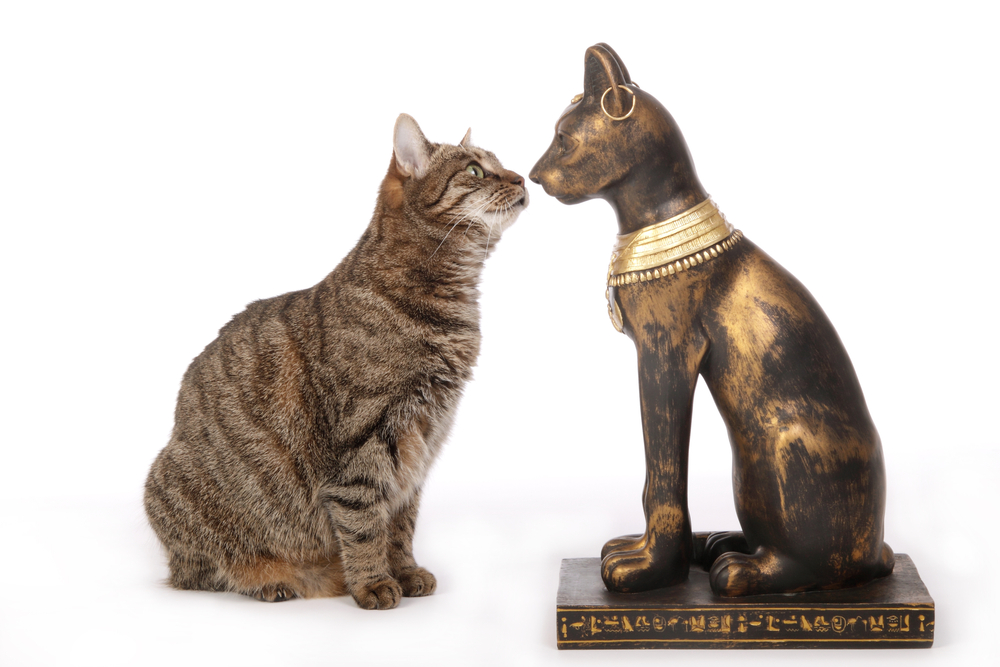
“Is you de Golden Cat?” (Image: mariesacha/Shutterstock)
Local people said this African golden cat was fierce, but from carcasses of cats killed by villagers protecting their poultry and livestock, as well as from pelts sold occasionally in fur markets, biologists could tell that this was not one of the pantherines.
The mystery feline was about the size of a lynx, smaller than the only other cat found in Africa’s rainforest — Panthera pardus, the leopard — and it was definitely not a lynx.
Taxonomists first tackled the task of giving this African golden cat a scientific name in 1827, but that’s hard to do when you don’t know what the living cat looks like.
No one managed to photograph a live one until 2002, with the first video only obtained in 2011, when a young male golden cat sat down in front of a research camera in Gabon:
Such gorgeous images might have settled the matter — except that another golden cat had been described in 1827, too, in Asia.
That one — seen in India, Nepal, and in various forested regions of Southeast Asia and Sumatra — was somewhat easier to study, although few videos of it can be found online today.
Here is an Asiatic golden cat in Myanmar (that brief walkthrough is the whole sighting):
At first glance, the two golden cats certainly resemble each other.
Since the simplest explanation is often the best, it’s safe to assume that that African and Asiatic golden cats are related, right?
Well, that depends on who you ask —
55. Asiatic and African golden cats might or might not be related.
The Cat Specialist Group pages on each of these beautiful cats, linked at the end of this episode, contain interesting images and graphics, as well as text.

Nordnordwest via Wikimedia, public domain.
If you check those pages out and compare the little maps showing each cat’s range, you’ll notice that they live in parts of the world that have long been separated by the Indian Ocean and a lengthy, rugged overland trek.
Some wildlife biologists take this farther, noting that both African and Asian golden cats prefer forested habitat and that, thanks to plate tectonics, central/western Africa and Asia haven’t shared forests for tens of millions of years.
Since this span of time is much longer than either species has been around, how could the two cats be related?
Many experts, including the Cat Specialist Group, use this and other arguments to support their hypothesis that African and Asiatic golden cats aren’t related; they only look somewhat alike because they have separately adapted to the same sort of environment in similar ways.
This convergent evolution does happen in animals from time to time.
Molecular biology tests seem to back it up, by showing a relationship between African golden cats and the Caracal lineage, and they connect Asiatic golden cats to an entirely different group: Catopuma (a line containing two other small cats — not pumas — that we will meet soon).
Unfortunately, the results of this genetic testing sometimes can be interpreted in various ways.
When it comes to golden cats, those interpretations actually contradict each other!
Early tests suggested that African and Asiatic golden cats were related; then came the findings showing they weren’t; and now, according to Kitchener et al., some recent studies do suggest that African and Asian golden cats are related!
The merry-go-round seems likely to continue for a while.
56. African golden cats are that continent’s only forest-dependent cat.
Were you surprised to hear that the only other cat in Africa’s rainforest is a leopard?
There simply aren’t that many small cat species in Africa. Those present prefer to prowl more open spaces.
As for big cats, while it’s true that very old movies show lions charging through the jungle, that doesn’t happen in real life.
Pride lands are savannas, beaches, and other open terrain.
Yes.
Since lions don’t go into African rainforests, leopards can be the apex predator here, even though they also live in other ecosystems.
Golden cats apparently are forest specialists and so must keep a lower profile, evolving ways to coexist –with leopards in Africa and Asia, as well as with tigers and a host of smaller Asian cats.
Perhaps that’s why both African and Asian golden cats use a wide range of forest types, from tropical evergreen all the way to open broadleaf woods. They even exploit dense new undergrowth in logged areas, prime rodent territory!
Like many feline species in humid tropical forests, golden cats are sometimes black.
57. Golden cats are not always golden.
About five percent of Africa’s golden cats are melanistic (black fur), which is not surprising given their humid environment.
Asia’s golden cat has a black phase, too, and in some areas that is more common than the gold color.
In terms of body build, the African golden cat looks like a utility player, with short, powerful legs and a solid frame.
A sports announcer would say it can go the distance.
Asiatic golden cats are more springy, as if they leap around in trees or along uneven ground.
Their legs are longer and they have a sleek muscular body, but the first thing we notice is the face.

Asiatic golden cat. (Wikimedia, CC BY-SA 3.0)
Is that — makeup?
No, it’s just a disruptive camouflage arrangement of dark and light fur that probably conceals the medium-sized cat quite well as it stalks toward prey in assorted settings.

African golden cat. (Panthera, CC BY-NC-SA 2.0)
African golden cats aren’t that gaudy, although they do have white fur markings around their eyes and on their cheeks, as well as some spots.
In West Africa, golden cats can be spotted all over!
In the eastern part of their range, African golden cats tend to have a solid coat color that’s usually golden but can be grayish sometimes.
The Asiatic golden cat has a somewhat wider variety of coat colors, probably as an adaptation to the different settings it uses.
Up north, in China, golden cats even have rosettes:
Researchers call this an “ocelot phase,” since the rosettes on a cat that size do make it look like the small Latin American spotted cat.
Whether or not they are related, the golden cats of Africa and Asia are well suited to their respective habitats.
Experts still know very little about them, but digital camera technology and other advances are showing everyone more and more details about these secretive but fascinating felines.
If you enjoyed the series, tips are welcome via the secure Stripe donation link. I won’t be saving your email for marketing or other spam, so here’s a big thank you in advance!
Sources include:
Cat Specialist Group. 2023. African golden cat. http://www.catsg.org/index.php?id=106&L=0%253Fid%253D192%253Fid%253D49%253Fid%253D31%253Fid%253D Last accessed October 30, 2023.
___. 2023. Asiatic golden cat. http://www.catsg.org/index.php?id=117 Last accessed October 30, 2023.
Johnson, W. E.; Eizirik, E.; Pecon-Slattery, J.; Murphy, W. J.; and others. 2006. The Late Miocene Radiation of Modern Felidae: A Genetic Assessment. Science, 311:73-77.
Kitchener, A. C.; Breitenmoser-Würsten, C.; Eizirik, E.; Gentry, A.; and others. 2017. A revised taxonomy of the Felidae: The final report of the Cat Classification Task Force of the IUCN Cat Specialist Group. https://repository.si.edu/bitstream/handle/10088/32616/A_revised_Felidae_Taxonomy_CatNews.pdf
Macdonald, D. W.; Loveridge, A. J.; and Nowell, K. 2010. “Dramatis personae”: An introduction to the wild felids, in Biology and Conservation of Wild Felids, eds. Macdonald, D. W., and Loveridge, A. J., 3-58. Oxford: Oxford University Press.
Panthera. 2011. Panthera releases first known footage of African golden cat, as featured on CNN & National Geographic. http://web.archive.org/web/20110919065629/https://panthera.org/african-golden-cats-0
Sollmann, R.; Hunter, L. T.; Slotow, R.; Macdonald, D. W.; and Henschel, P. 2016. Effects of human land-use on Africa’s only forest-dependent felid: The African golden cat Caracal aurata. Biological Conservation, 199: 1-9.
Sunquist, M. and Sunquist, F. 2002. Wild Cats of the World. Chicago and London: University of Chicago Press. Retrieved from https://play.google.com/store/books/details?id=IF8nDwAAQBAJ
Vaughan, A. 2015. Dramatic footage of African golden cat sheds light on species. https://www.theguardian.com/environment/2015/jan/29/first-ever-footage-african-golden-cat-sheds-light-species Last accessed December 21, 2019.
Werdelin, L.; Yamaguchi, N.; Johnson, W. E.; and O’Brien, S. J. 2010. Phylogeny and evolution of cats (Felidae), in Biology and Conservation of Wild Felids, eds. Macdonald, D. W., and Loveridge, A. J., 59-82. Oxford: Oxford University Press.
Wikipedia. 2023. Convergent evolution. https://en.wikipedia.org/wiki/Convergent_evolution Last accessed October 30, 2023.
 Flight To Wonder