
You probably know this cat, although its name might not sound familiar.
This is that medium-sized tawny shorthair with dark tufted satellite-dish ears and the ability to do a six-foot-plus standing jump straight up in order to grab a passing bird out of the air for dinner.
Perhaps you’ve even seen the slow-motion video of that exact move (minus the bird murder) that PBS shared in 2016.
Scientists have puzzled over the caracal for a long time.
Those ear tufts, the extra-long hind legs and oversized paws, and that relatively short tail led many to believe it was some sort of a lynx.

Not a lynx (left), Tambako the Jaguar, CC BY-ND 2.0; Iberian lynx (right), Diego Delso, delso.photo via Wikimedia, CC BY-SA
A closer look showed this not to be the case.
Then, because of its small round head, large gleaming eyes, short muzzle, and a few other similarities to house cats, experts decided that, despite weighing about 35 pounds, the caracal probably was part of the domestic cat group — Felis — along with wildcats, jungle cats (tufted ears!), and others.
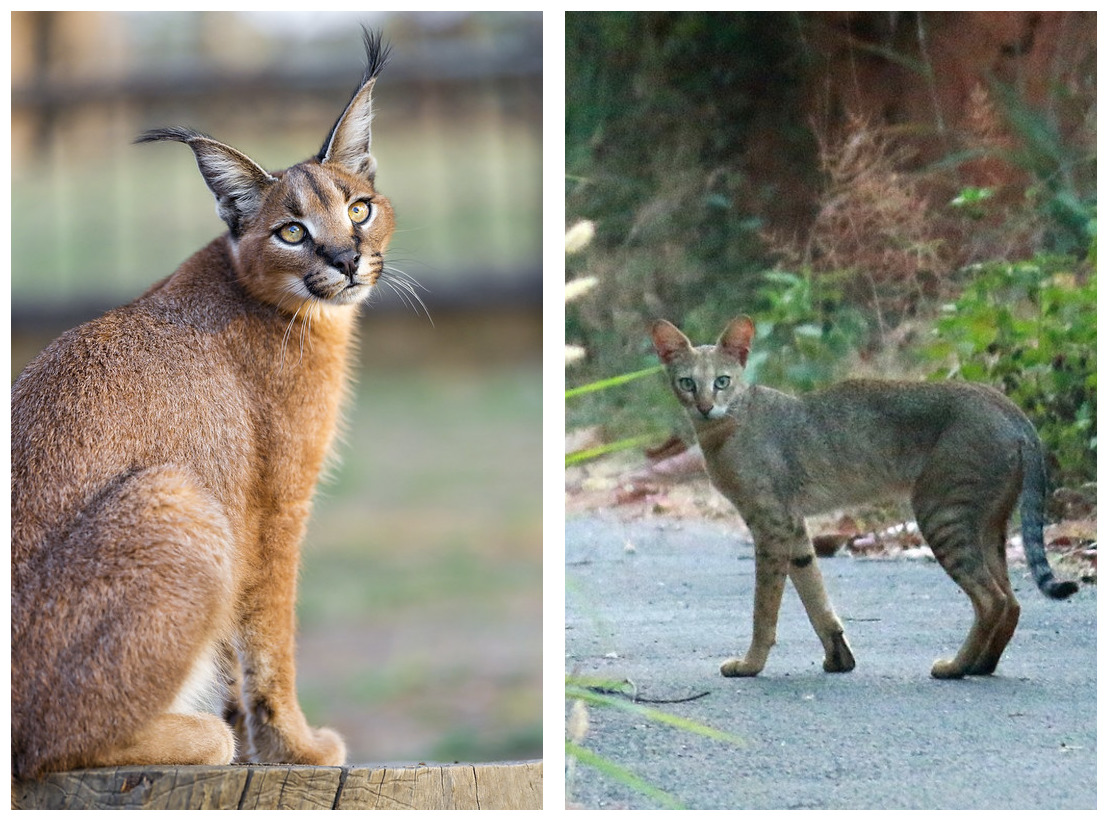
Not a “Felis,” Tambako the Jaguar as above; Jungle cat, Shino jacob kootanad via Wikimedia, CC BY-SA 4.0.
Years later they had to rewrite the textbooks again when molecular biology showed that caracals actually are a unique lineage, with some relationship to long-legged, savanna-prowling servals and the mysterious African golden cat of the rainforest.

Caracal, Tambako the Jaguar, as above; African golden cat, Panthera, CC BY-NC-ND 2.0 (this isn’t an ideal angle, but rare and shy African golden cats are seldom photographed).
Africa’s tropical rainforests are one of only two habitats where you won’t find caracals. They also avoid the most extreme central parts of both the Saharan and Namibian deserts.
Other than that, caracals are good to go. You might see them anywhere, although their population size varies — in some places, like Egypt, they are rare, while southern Africa abounds with caracals.
And not just out in rural areas.
Caracals also prowl the Middle East and parts of southern Asia, including India and Turkmenistan.
One of their Middle Eastern nicknames gave caracals their most common name — in Turkish, karakul means “black ears.”
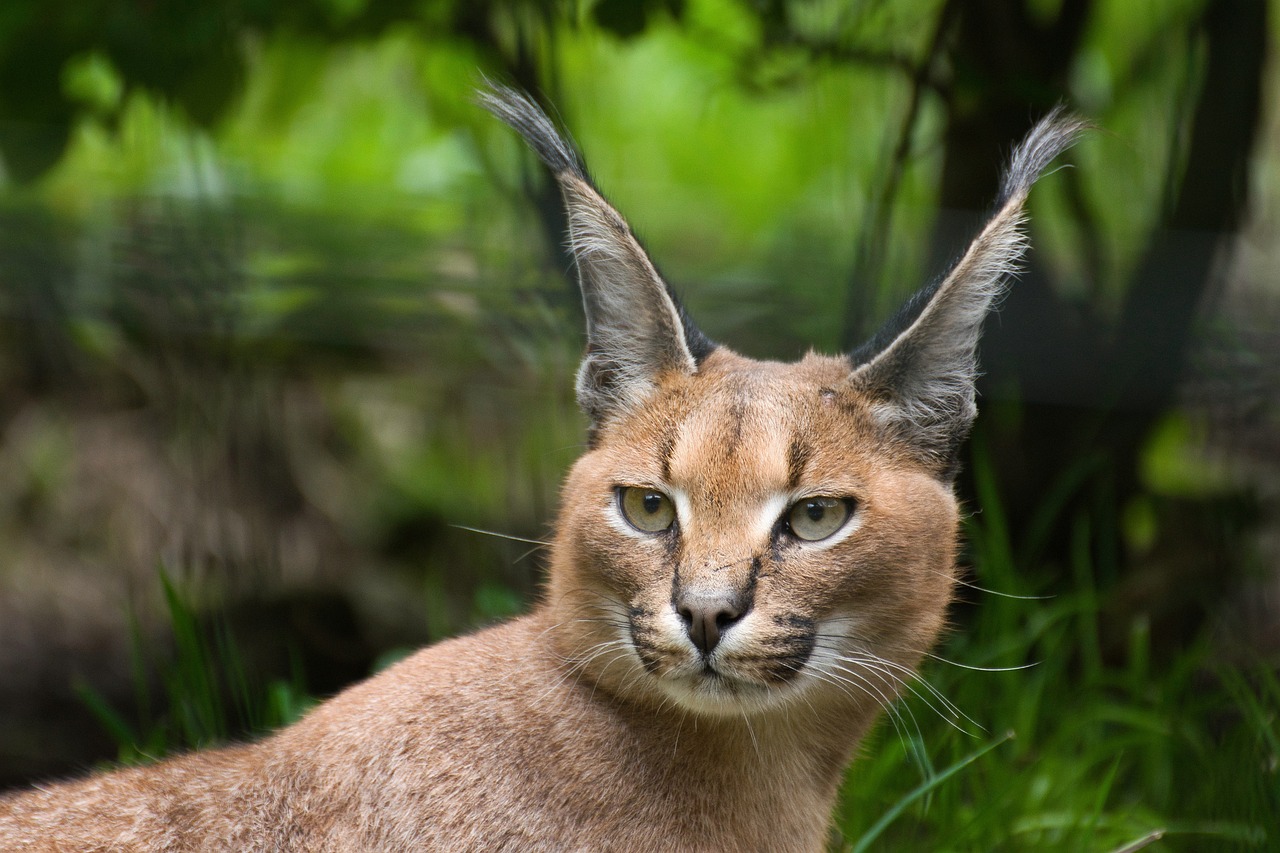
Image by Oliver Magritzer from Pixabay
What’s going on with those ears, anyway?
52. Caracal ears make excellent signalling devices and perhaps also improve the cat’s hearing.
The color and size of those long, tassled ears make them ideal signal flags to other caracals in a dangerous world.
With hungry cheetahs, leopards, lions, hyenas, and various other meat-eaters around, caracals need to keep a low profile. Yet they also need to advertise for and communicate with mates, as well as raise kittens.
Calls are helpful, but these draw unwanted attention. This is also true with scent marking — another classic cat communication strategy.
So caracals have developed an ear color that dramatically contrasts with their light-colored solid coat — a pattern that other caracals, young and old, will recognize.
While other animals just see dark “shadows” and a pale color blending in with the background, the caracal hidden upwind of danger is using twenty muscles around each ear, silently wigwagging away to its kittens or a suitor.
Or just something along the lines of “It’s a good life.” A cat can say many things with ears like that.
The cat’s ear tufts, which can be up to two inches long in adults, provide emphasis. Some biologists suggest that tufts might also be hearing aids, channeling sound into the ear!
That’s not as weird an idea as we might think.
Caracals thrive in dry places — India’s thorn scrub forests, for example, or semi-arid savannas like the Kalahari.
This might seem unrelated to their ears but here is the connection: in very dry air, the low-frequency prey sounds that predators listen for don’t travel far.
As a result, many desert carnivores have evolved unusually large outer and inner ear structures
Bat-eared and fennec foxes carry this to radar-dish extremes, and sand cats have supersized ears inside and out.
To a lesser extent, so do caracals.
On the other paw hand, cheetahs live in the same places as caracals, but their ears are normal. Why?
It’s because these speedsters locate prey by sight; hearing is less important to their survival than it is for caracals, sand cats, and desert foxes.
Predation scenes. In this more humid environment, the cat uses all of its senses but check out those ears — constantly tuned in on the birds.
53. Caracals are one of the nine “conflict cats.”
That’s human-felid conflict rather than cats caught in crossfire during war, which can happen to any unfortunate animal.
It’s an important conservation issue because, generally speaking, wild cats cause problems for people in two ways:
- Attacks on humans. Caracals are too small to be deadly, though any cat will fight if it feels threatened.
This is a major concern with lions, leopards, and tigers, of course, particularly in areas next to nature reserves. Jaguars and mountain lions rarely attack people, and there has never yet been a confirmed snow leopard or cheetah attack.
- Attacking pets and livestock/poultry. This is where caracals come in. Along with the Eurasian lynx, caracals are large enough to take animals the size of livestock and trophy game.
Unlike warthogs, livestock are not nimble and usually are kept in enclosures that hinder escape.
This predation can cause a huge economic loss to small business owners, sometimes in a single night!
Although caracals are widespread, few studies have been done on them in the wild. Research thus far suggests that they don’t turn to livestock right away.
Caracals apparently favor small prey like rodents and hares, turning next to gazelles and similar-sized wild plant eaters, attacking livestock only when there is little wild prey to be found.
Caracals are opportunists, though, and in southern Africa, particularly in Cape Town, they are not only numerous but also have gotten used to the presence of human beings.
While caracals have enthusiastic fans in Cape Town, there is a darker side to the story. Pets are disappearing and residents in some parts of the city are demanding that something be done about these urban wild cats.
On metropolitan streets and in rural countrysides, euphemistically named “control operations” are carried out, but caracal numbers appear steady and may even be increasing in southern Africa.
This could be due to elimination of jackals at the same time.
Jackals compete with caracals; their disappearance might be giving caracals more opportunities to expand (biologists call this a “mesopredator release”).
Wait for it…
The dispersal effect probably plays a role, too, with empty territories filled by new caracals.
This often happens with cat culling programs.
“Dispersal” just means that young cats, like most mammals, leave the den at a certain age and wander around until they can establish or take over a territory for themselves.
There usually is a sizable population of these “floaters” at any given moment.
When “control operations” remove a territory owner, one of the dispersers moves in. If that cat is taken out, in comes another — over and over again.
Caracals are particularly good at this because of their ability to travel long distances without water. Even in harsh environments, they can live solely on fluids provided by their prey.
Caracal “floaters,” therefore, cover considerable acreage.
Human-felid conflict is a very broad topic, too much to get into here.
At least we can see here that smaller cats, like caracals and lynxes, are caught up in it along with the “big guys” that everyone knows about.
After so much complexity, let’s close with a simple but cool fact —
54. The caracal’s fierce look is just sun protection.
According to Sunquist and Sunquist, caracals have been described as fierce because of their grim facial expression.
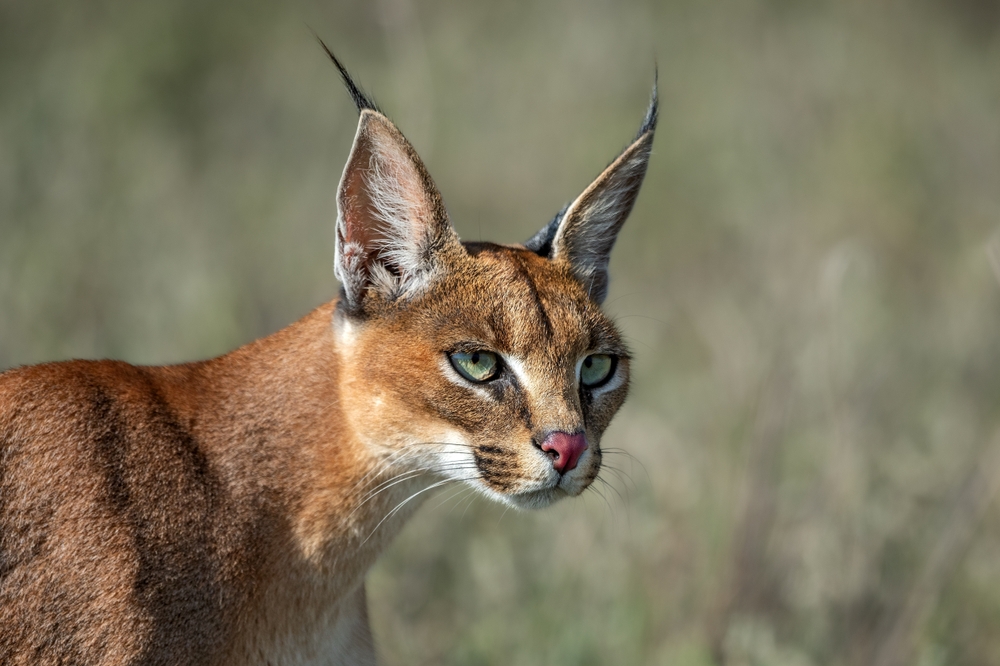
Som Moulick/Shutterstock
You can see this at the end of that PBS video linked above.
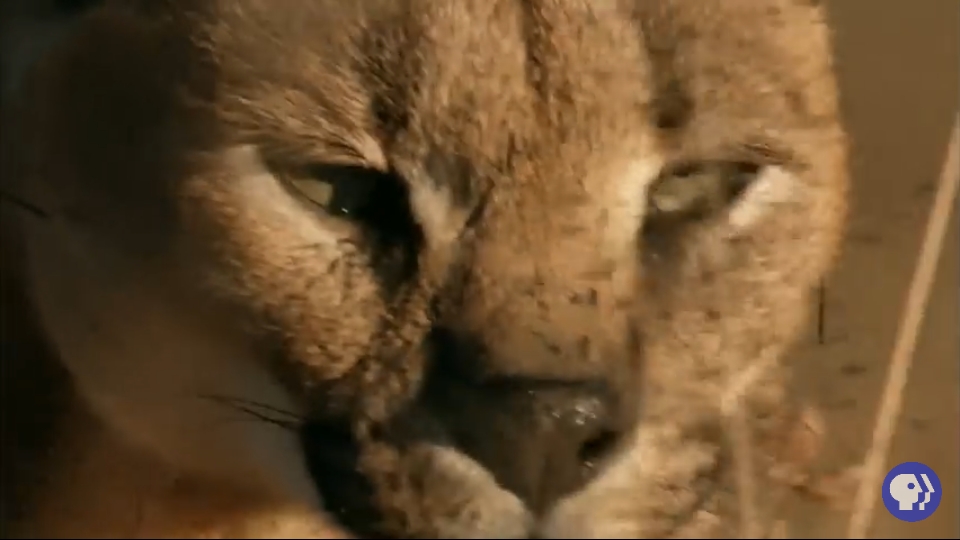
The cat drops back to Earth and stalks away into the bush, eyes half closed in annoyance because it didn’t get the bird — or so we think.
But caracals are not naturally mean.
Caracals in Cape Town are haughty, perhaps, in the way they stalk past admiring pedestrians, but that’s all.
Indeed, royalty once kept tamed caracals for bird hunting! They aren’t at all naturally fierce towards us.
Actually, that caracal in the PBS video is facing the setting sun when it lands and so it uses a built-in sun shield: drooping its upper eyelids.
If only Science could come up with something for us that’s as pretty and that also keeps the glare out of our eyes, too.
Oh wait.
If you enjoyed the series, tips are welcome via the secure Stripe donation link. I won’t be saving your email for marketing or other spam, so here’s a big thank you in advance!
Sources include:
Africa Freak. 2023. 17 Caracal Cat Facts – Are Caracals Dangerous to Humans & More. https://africafreak.com/caracal
Cat Specialist Group. 2023. Caracal. http://www.catsg.org/index.php?id=111 Last accessed October 28, 2023.
Huang, G.; Rosowski, J.; Ravicz, M.; and Peake, W. 2002. Mammalian ear specializations in arid habitats: structural and functional evidence from sand cat (Felis margarita). Journal of Comparative Physiology A, 188: 663-681.
Johnson, W. E.; Eizirik, E.; Pecon-Slattery, J.; Murphy, W. J.; and others. 2006. The Late Miocene Radiation of Modern Felidae: A Genetic Assessment. Science, 311:73-77.
Kitchener, A. C.; Van Valkenburgh, B.; and Yamaguchi, N. 2010. Felid form and function, in Biology and Conservation of Wild Felids, ed. Macdonald, D. W., and Loveridge, A. J., 83-106. Oxford: Oxford University Press.
Kitchener, A. C.; Breitenmoser-Würsten, C.; Eizirik, E.; Gentry, A.; and others. 2017. A revised taxonomy of the Felidae: The final report of the Cat Classification Task Force of the IUCN Cat Specialist Group. https://repository.si.edu/bitstream/handle/10088/32616/A_revised_Felidae_Taxonomy_CatNews.pdf
Loveridge, A.; Wang, S. W.; Frank, L.; and Seidensticker, J. 2010. People and wild felids: conservation of cats and management of conflicts, in Biology and Conservation of Wild Felids, eds. Macdonald, D. W., and Loveridge, A. J., 161-195. Oxford: Oxford University Press.
Macdonald, D. W.; Loveridge, A. J.; and Nowell, K. 2010. “Dramatis personae”: An introduction to the wild felids, in Biology and Conservation of Wild Felids, eds. Macdonald, D. W., and Loveridge, A. J., 3-58. Oxford: Oxford University Press.
Sunquist, M. and Sunquist, F. 2002. Wild Cats of the World. Chicago and London: University of Chicago Press. Retrieved from https://play.google.com/store/books/details?id=IF8nDwAAQBAJ
Urban Caracal Project. n.d. https://www.urbancaracal.org/
Veals, A. M.; Burnett, A. D.; Morandini, M.; Drouilly, M.; ans Koprowski, J. L. 2020. Caracal caracal (Carnivora: Felidae). Mammalian Species, 52(993): 71-85.
Werdelin, L.; Yamaguchi, N.; Johnson, W. E.; and O’Brien, S. J. 2010. Phylogeny and evolution of cats (Felidae), in Biology and Conservation of Wild Felids, eds. Macdonald, D. W., and Loveridge, A. J., 59-82. Oxford: Oxford University Press.
 Flight To Wonder