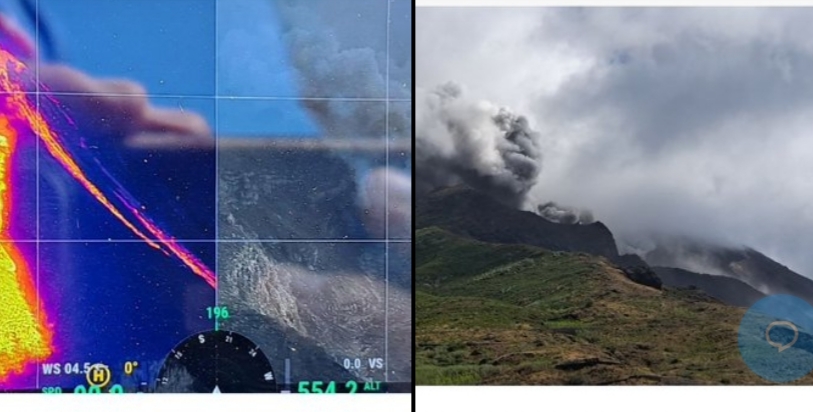
July 31, 2024, 12:03 p.m., Pacific: Stromboli is back to Strombolian explosions, says INGV in their nine-page detailed bulletin (Italian, PDF) today. Larger explosions and other changes may occur, too. It sounds like the whole summit crater area has been reshaped.
July 15, 2024, 11:58 a.m., Pacific: The lava flows have stopped, and there is only occasional ash emission from the summit area, which has changed dramatically in shape (before, left; after, right):
#Stromboli: in seguito all'intenso parossismo di giovedì, la terrazza craterica che svettava sulla Sciara del Fuoco non esiste più. Ecco un confronto realizzato dall'LGS (Laboratorio di Geofisica Sperimentale dell'Università di Firenze, link qui sotto). pic.twitter.com/dNfaicGq97
— Il Mondo dei Terremoti (@mondoterremoti) July 15, 2024
https://platform.twitter.com/widgets.js
July 23, 2024, 2:01 p.m., Pacific: They’ve lowered the alert level to Orange. 🙂
July 12, 2024, 7:18 a.m., Pacific: From INGV (Facebook translation):
COMUNICATO DI ATTIVITA’ VULCANICA del 2024-07-12 08:25:33(UTC)-STROMBOLI.
VOLCANIC ACTIVITY STATEMENT for
2024-07-12 08:25:33(UTC) – STROMBOLI.The National Institute of Geophysics and Volcanology, Etneo Observatory, informs that from the analysis of the images of the surveillance network cameras and by the INGV personnel on the field it is possible to observe that the spillway on the Sciara of Fire caused by the effusive activity has been stopped. Currently there are no active outpours. Following the
paroxistic phenomenon of July 11, morphological variations have been
recorded in the crater area where the lack of explosive activity persists.The average width of the seismic signal is at low levels with few fluctuations on average level. Analysis of seismograms indicates low seismic activity.
Regarding deformations, the clinometric network, after the transient recorded during the paroxistic activity yesterday, does not show significant variation.
The GNSS network does not record any
significant change.
Hopefully, there will be no more surprises and Strombolian lava bubble popping soon will return to the reshaped summit crater area.
July 11, 2024, 9:36 a.m., Pacific: Stromboli had a paroxysm around midday local time — first one since 2019.
Here is INGV’s statement from Facebook (Facebook translation):
VOLCANIC ACTIVITY STATEMENT on 2024-07-11 12:46:59(UTC) –
#STROMBOLI.
The National Institute of Geophysics and Volcanology, #EthneoObservatory, informs that from the analysis of the images of the surveillance network cameras and by the INGV personnel in the field it is possible to observe that at around 12.07 UTC a paroxistic event occurred at the summite craters. Such activity has produced an #erruptivecolumn and a #pyroclasticflow along the Sciara del Fuoco. The flow has spread to the sea tens of meters from the
coastline. The long-sleeve phenomenon was exhausted around 12:10 UTC. From a seismic point of view, as of 12:07 UTC, all Stromboli stations have registered a seismic transient associated with a sequence of explosive events for a total duration of about 8 minutes, the most energetic of which (12:08:50 UTC) is associated with the paroxistic event at summite craters. The average magnitude of the tremor has reached a very high level in correlation with the paroxistic event followed by a rapid decline until it currently reaches the average level. Regarding permanent deformation control networks,sensors in clinometric stations and GNSS show no significant variation.
Di seguito i video dell'evento parossistico di #Stromboli di oggi 11 luglio ripresi da personale #INGV presente a Ginostra, #Stromboli. pic.twitter.com/tve0INnsC8
— INGVvulcani (@INGVvulcani) July 11, 2024
https://platform.twitter.com/widgets.js
I see no further news yet online — including no mention of casualties or tsunami 🙂 Will see how this develops.
July 10, 2024, 5:07 a.m., Pacific: This article (Italian) summarizes the amazing changes at Stromboli.
I can’t get Google Translate’s website function to work with many Italian websites, for some unknown reason, but treat yourself and copy-and-paste that text from the “Stromboli sorvegliato speciale” article because the changes they describe are significant — as in, Strombolian activity has stopped at Stromboli!
As I understand it, the big pyroclastic flows occurred from structural collapses at the summit, where crater topography has changed (such changes often happen at active volcanoes — in fact, it just happened at Etna, too).
Smaller pyroclastic flows are spawned by smaller collapses and “rolling” along the ongoing lava flows.
Stromboli also had one of its major explosive events.
What’s peculiar is that, after some crater collapse up at the summit, seismic monitoring showed an inrush of magma into the conduit, but this magma is at unusually low levels, currently feeding two lava flows.
There is no activity up at the summit.
Obviously the “lighthouse of the Mediterranean” has not gone totally dark —
— but something has changed, and the boffins are still trying to figure out what happened.
July 8, 2024, 8:21 a.m., Pacific: There are no major changes in the news. Vulkane.net has an excellent article up (autotranslated) discussing the flank eruption and increased seismicity.
And INGV released a combo video of the ocean entry yesterday:
July 7, 2024, 8:19 a.m., Pacific: Local Team eventually did upload that video to YouTube. Per Lingo Tube translation, magma periodically gets low in the conduit for reasons they don’t understand but that probably have to do with the ongoing Africa-Eurasia collision.
It’s hard for us laypeople to realize that studying volcanoes in Italy is somewhat like trying to study the wiring of a dashboard cigarette lighter — showing my age here 😉 — in a truck cab during a slow-mo front end collision with another truck.
Anyway, Stromboli is still at red alert today. Per Facebook translation, INGV Vulcani reports:
VOLCANIC ACTIVITY STATEMENT on 2024-07-07 12:05:48 (UTC) – STROMBOLI.
The National Institute of Geophysics and Volcanology, Etneo Observatory, informs that INGV personnel in the field observed an intensification of efficient activity on the Sciara del Foco, produced by two mouths at an altitude of 485 m slm and that the outflow, well fed, reaching the coastline, formed a small delta lavico, currently expanding. The lava flow, coming in contact with the seawater, causes the formation of a vapor cloud. You can also see the rolling of incandescent lava blocks that, when falling into the sea, cause small air explosions and modest fluctuations of the water’s surface. The average width of the seismic signal remained stable at medium-low values until about 10:25 UTC, when it showed a peak at average values. Analysis of seismograms continues to highlight a low level of activity essentially characterized by signals associated with continuous rock rolling episodes. Since late yesterday afternoon, low- energy events have been recorded, well visible at the STRA seismic station, with a peak in frequency around 5-6 Hz, on which they are currently being investigated. Analysis of soil deformation data do not highlight variations outside of ambient and background noise fluctuations on monitoring networks.
July 6, 2024, 7:11 a.m., Pacific: I see no recent updates from INGV yet. Someone I follow reposted this, from about five hours ago, saying (per Twitter translation) that it was a clear summary of the situation.
However, it is in Italian and that media source doesn’t yet have it on their YouTube page (where I could use Lingo Tube):
Allerta rossa a #Stromboli, il vulcanologo dell'INGV: "Il magma adesso è molto basso, a una quota non usuale, e quindi siamo in una situazione sicuramente di perturbazione del sistema." pic.twitter.com/OkJ3NoGiot
— Local Team (@localteamit) July 6, 2024
https://platform.twitter.com/widgets.js
Twitter translation:
Red alert at #Stromboli , the INGV volcanologist: “The magma is now very low, at an unusual altitude, and therefore we are certainly in a situation of disruption to the system.”
Lingo Tube translation of this 21-hour-old video, which has excellent visuals of Stromboli in the first half, shows that their main concern is landslide, which they say could cause tsunami affecting perhaps even mainland Italy’s Calabrian coast, as well as Sicily.
At the time that video was posted, Stromboli island hadn’t been evacuated but the beaches were closed (despite beachside interviews at video’s end) and, of course, climbing the volcano is forbidden. I think they also stopped tourist landings, which is a blow to islander income.
Thing is, landslides and flank collapses, unlike eruptions, can happen without showing any precursor whatsoever, even briefly.
This continues to be a very dangerous situation.
July 5, 2024, 4:20 p.m., Pacific: According to Google translation of the link in this tweet, lava has resumed flowing but there is no seismic signal of explosiveness, nor any increased ground deformation.
COMUNICATO DI ATTIVITA' VULCANICA del 2024-07-05 20:26:39(UTC) – STROMBOLI.
L'INGV-OE comunica che è stata osservata una ripresa dell'attività effusiva sulla Sciara del fuoco a partire dalle 18:55 UTC. https://t.co/VDTbt3dpNo #Stromboli #INGV #OsservatorioEtneo pic.twitter.com/PTzmnHMtJc— INGVvulcani (@INGVvulcani) July 5, 2024
https://platform.twitter.com/widgets.js
I’m not sure why there have been pyroclastic flows with these relatively small basaltic lava flows.
It could be gassiness and/or something to do with the pyroclastic rubble on the Sciara, some of which, they said yesterday, was dislodged by moving lava, resulting in that debris avalanche.
Right now, they report a very low seismic signal, which is typical for an effusive eruption. Let’s see how long Stromboli maintains this.
July 5, 2024, 8:53 a.m., Pacific: There are lots of good visuals on social media from INGV (see below) and updates that indicate ongoing lava flows with pyroclastic currents down the Sciara but no mention of explosive paroxysms. 🙂
The most recent update (via Google Translate):
STROMBOLI PRESS PRESS
The National Institute of Geophysics and Volcanology, Etna Observatory, communicates that from network of surveillance cameras and by INGV personnel in the field, it was observed that the lava flow emitted from the vent at 510 m above sea level on the Sciara del Fuoco, appears at the moment poorly fed and produces episodic rolling down the slope of material which it detaches itself from the lava front. A modest flow was also observed at 12:31 UTC pyroclastic which, propagating along the Sciara del Fuoco, reached the coastline.After the last announcement, the average amplitude of the seismic signal remained at a medium level and amplitude transients related to phenomena are only sporadically observed gravitational in the Sciara del Fuoco. No significant changes were noted at the stations monitoring of ground deformations.
Further updates will be communicated promptly…
Visuals:
Drone view from yesterday (before drones, activity on the very steep Sciara could only be viewed in relative safety from a stable position at the side or from moving aircraft or boats — now they can do this! 😍):
#Stromboli: condividiamo un altro eccezionale video effettuato da drone dal personale #INGV dei progetti #UNO e #DyNAMO in cui si vede l'apertura della bocca a circa 700m slm di ieri, 4 luglio 2024, alle ore 16:17.#Stromboli #UNO #DyNAMO #INGV pic.twitter.com/0JmFVgrVlG
— INGVvulcani (@INGVvulcani) July 5, 2024
https://platform.twitter.com/widgets.js
Thermal image from mid-morning:
COMUNICATO DI ATTIVITA' VULCANICA del 2024-07-05 08:56:39(UTC) – #STROMBOLI.
L'#INGV-OE comunica che è attivo un flusso lavico da 600m slm, che raggiunge la costa provocando la formazione di vapore e cenere, episodici flussi piroclastici a bassa energia e rotolamenti fino al mare pic.twitter.com/rtl2DvyTET— INGVvulcani (@INGVvulcani) July 5, 2024
https://platform.twitter.com/widgets.js
Original post:
They’ve gone to Red alert at Stromboli because of “a situation of increased imbalance of the volcano,” per Civil Protection (Italian — see English translation at end of this post).
As noted in the recent Sunday Morning Volcano post, this inhabited Aeolian island volcano usually simmers away as “the lighthouse of the Mediterranean” but occasionally will have moderately strong explosive eruptions — and signs were pointing to one of those in the near future (hence the closure of the summit viewing area).
Yesterday, INGV reported a debris avalanche (landslide, but this one also contained some hot material) down the Sciara —
Proseguiamo con #Stromboli… A seguito di un aumento dell'ampiezza del segnale sismico, alle 18:46 si e' osservato un flusso di materiale incandescente lungo la Sciara del Fuoco fino in mare, di cui vi mostriamo immagini riprese dal personale #INGV dei progetti #UNO e #DyNAMO pic.twitter.com/NrjMEo3OnC
— INGVvulcani (@INGVvulcani) July 3, 2024
https://platform.twitter.com/widgets.js
Ancora un'immagine della frana di oggi di #Stromboli vista dal porto dal personale #INGV dei progetti #UNO e #Dynamo pic.twitter.com/YazWBM3c0O
— INGVvulcani (@INGVvulcani) July 3, 2024
https://platform.twitter.com/widgets.js
— that was triggered by an ongoing lava flow:
Altre immagini della nuova colata ben alimentata da #Stromboli effettuate da personale #INGV dei progetti #UNO e #Dynamo pic.twitter.com/WwGGOEi1gz
— INGVvulcani (@INGVvulcani) July 4, 2024
https://platform.twitter.com/widgets.js
Today, several hours ago, INGV reported a new lava flow on the Sciara, this one accompanied by pyroclastic flows:
COMUNICATO DI ATTIVITA' VULCANICA del 2024-07-04 14:44:57(UTC) – #STROMBOLI.
L'INGV-OE comunica che dalle 16:10 si osserva un nuovo flusso lavico dall'area craterica Nord da una bocca a 700m, che si propaga lungo la Sciara del Fuoco con formazione di flussi piroclastici.#INGV pic.twitter.com/kG0DTalTTy— INGVvulcani (@INGVvulcani) July 4, 2024
https://platform.twitter.com/widgets.js
The “imbalance” described by Civil Protection below might refer to the obviously unstable plumbing system with eruption hazards that could include a tsunami on the island (see that Sunday Morning Volcano post).
It could also refer to the possibility of a flank collapse at the Sciara (as mentioned in that post), which is less likely, as far as I know, but could cause a larger tsunami affecting a broader area — the Aeolians and Sicily’s north coast; I don’t know about the mainland.
This is definitely something to keep an eye on.
Google translation of today’s announcement:
Civil Protection: red alert for the Stromboli volcano
The Department will support the local levels of civil protection by ensuring coordination with the operational structures involved
Update of July 4 at 8:00 p.m.The Department of Civil Protection has ordered the passage of alert for the Stromboli volcano from the orange level to the red level and the pre-alarm operational phase.
This decision was taken in light of the assessments that emerged during the meeting with the Competence Centers and the Civil Protection Department of the Sicilian Region. The meeting was convened following the rapid evolution of activities that are affecting the volcano.
The passage of the alert level is based on the reports of the phenomena and on the hazard assessments made available by the Competence Centers, which for Stromboli are the National Institute of Geophysics and Volcanology (Etnean Observatory, Vesuvius Observatory and Palermo Section), the CNR-IREA and the Universities of Florence, Palermo, Pisa and Turin.
The raising of the alert determines the strengthening of the volcano monitoring system and the information connection between the scientific community and the other components and operational structures of the National Civil Protection Service. The Department of Civil Protection shares this information with the civil protection structure of the Sicilian region which, especially in relation to local impact scenarios, alerts the territorial civil protection structures and adopts any measures in response to emergency situations.
With the transition to the operational phase of Pre-alarm, the local level of civil protection is activated at the Advanced Operations Center – COA, which will be supported by experts from the National Department of Civil Protection, ensuring the connection with the operational structures involved.
The Mayor of the Municipality of Lipari, who took part in the meeting, has already arranged initial precautionary measures aimed at protecting the people present on the island. The mayor will be constantly informed about the evolution of the situation in order to be able to guarantee constant and correct information to the population.
Regardless of the volcanic phenomena at a local level, which can have frequent variations, a situation of increased imbalance of the volcano persists. The population present on the island is therefore invited to keep themselves informed and to scrupulously follow the indications provided by the local civil protection authorities.
Featured image: INGV
 Flight To Wonder