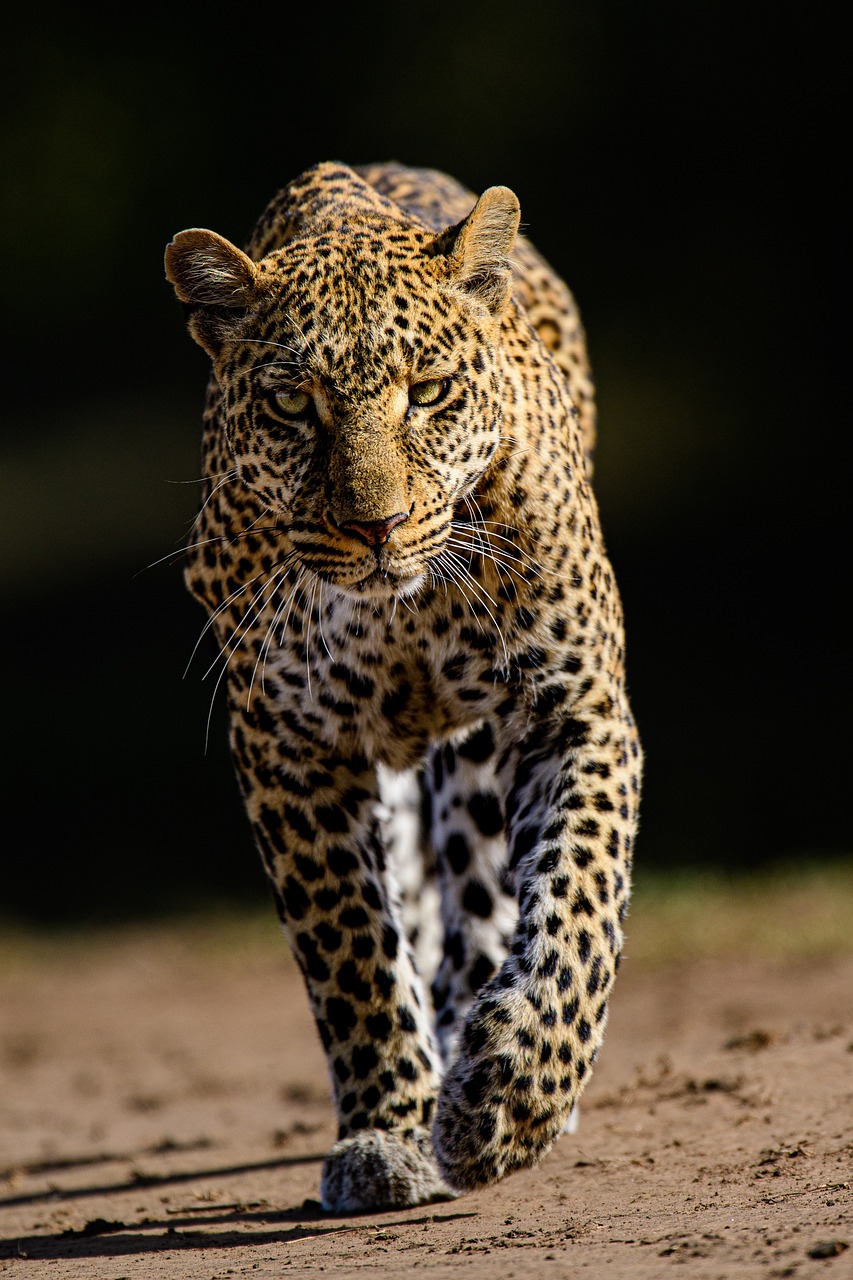
“Meow.” (Image: matrishva vyas from Pixabay)
According to Google, “Why do leopards have spots on their bodies?” is the Number One search question on this famous feline, the largest spotted cat in the world.
It’s for camouflage, of course, but when we factor in the slink factor — that is, the way this big cat, more than any other, can stealthily creep up on its prey using every small-cat stalking trick in the book — well, spots almost seem superfluous.
Predation scenes
But spots do help to conceal the leopard in all environments, including human settlements and cities.
You might think that a wild big cat, with or without spots, would stand out on Main Street, but apparently leopards fit right in. No one notices them until pets start disappearing and/or, very rarely, people are attacked.
Usually the cat stays in stealth mode and everyone remains oblivious.
Sunquist and Sunquist describe how, when a captive leopard escaped in one Indian city, rangers called in to recapture it found six additional leopards!
Things get chaotic when people realize the leopard is there.
This video, uploaded by Animal Rescue India in 2019, shows rescuers first protecting people (and themselves) from a frightened leopard’s charge and then protecting the leopard from frightened people trying to kill it (which is totally against the law in India):
The rescue group noted, at the video’s page, that the cat was only slightly injured, and after a vet examined it, they later released it in a safer area.
However understandable it might be on both sides, there is way too much fear!
Finding a balance between humans and this big cat is hard, but here are a few facts to help you see leopards as they really are.
37. Leopards are the only big cat still found in its historic range.
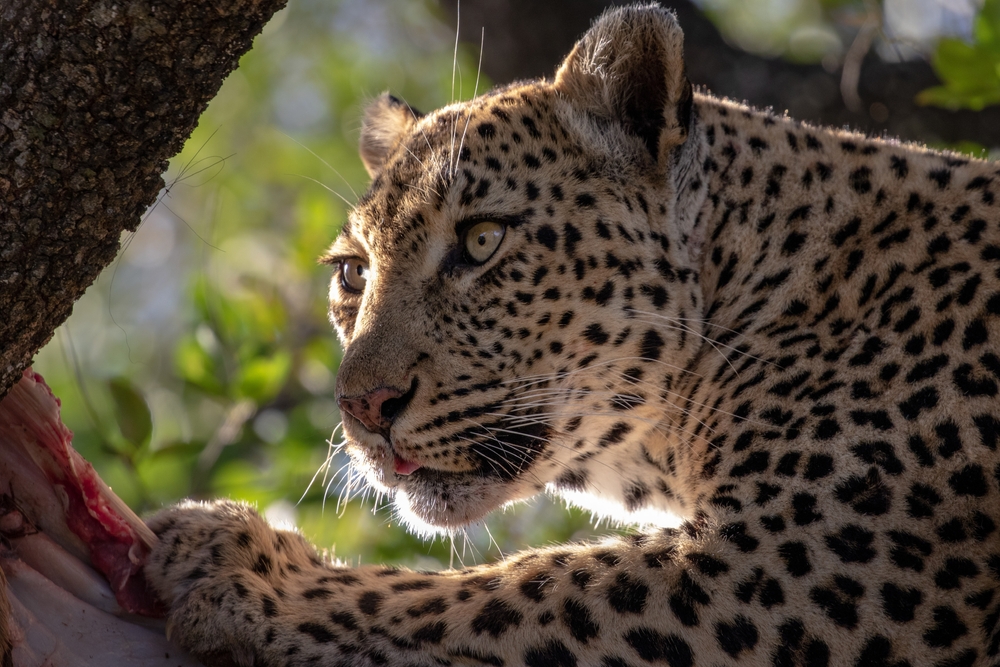
JCMGATOR/Shutterstock
Panthera pardus is what they call an opportunistic generalist — it eats everything from watermelons, beetles, and carrion to medium-sized plant-eaters (lions and tigers get the big ones), and occasionally, sigh, domestic animals and people.
The leopard is also very adaptable, changing its hunting hours to match those of prey, for instance, or developing coat colors that blend in with the local scenery, such as pale fur in semi-desert conditions and more intensely colored or even black fur in humid forests.
That flexibility allows leopards to maintain a presence in almost all of their historic range, though with an estimated loss of about two-thirds of their original numbers due to natural factors as well as the expanding presence of H. sapiens.
The range of every other big cat has shrunk dramatically.
Leopards still exist from Sub-Saharan Africa through the Middle East, southern Eurasia, southeast Asia, and the island of Java (but not Sumatra or Borneo), on up into parts of China and the Russian Far East.
As leopards have spread through Africa and Eurasia, various groups have gotten isolated.
These went on to develop slight differences from the others.
Wildlife biologists use such differences to identify leopard subspecies. Because the traits are often subtle, there can be disagreement over these subspecies.
On its leopard page, under “Description,” the Cat Specialist Group proposes eight subspecies.
Of these:
- African leopards are the most numerous, especially in the dry woodland savannas of eastern and southern Africa.
And as we’ve already seen in this series, leopards are the only big cats in African rainforests — a biome they must share with tigers in Asia. - India is not far behind Africa’s leopard count, with an estimated 12,000 to 14,000 cats.
That said —
38. Some leopards are critically endangered.
Subspecies besides those in Africa and India are endangered, including Persian leopards (mostly in Iran) and Sri Lankan leopards, which number less than a thousand in the wild.
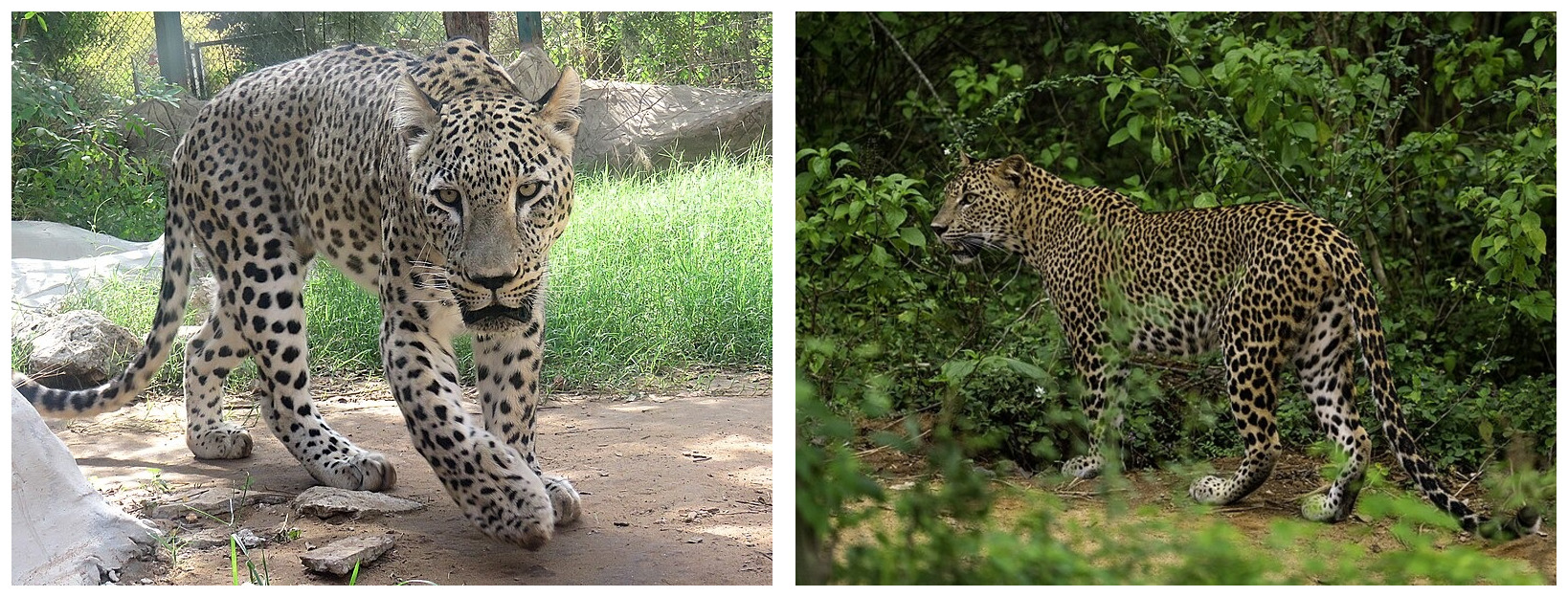
The Persian leopard (left, image by botend via Wikimedia, CC BY-SA 4.0) has a pale coat that blends into desert backgrounds, while the Sri Lankan leopard (right, image by Casey Klebba via Wikimedia, CC BY-SA 4.0) lives in an equatorial humid region and has a more intense coat color.
All these subspecies are critically endangered:
- Arabian leopards. Fewer than 200 individuals.
- Javan leopard. Less than 250 breeding individuals.
There are spotted ones, with vivid coat colors, too.
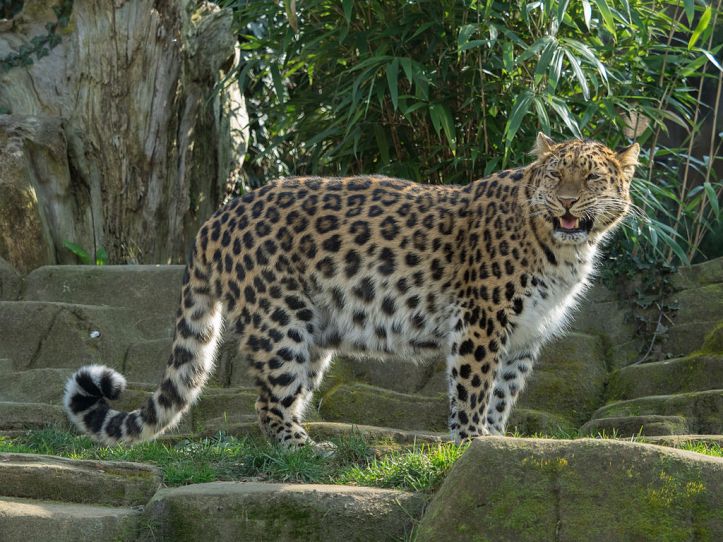
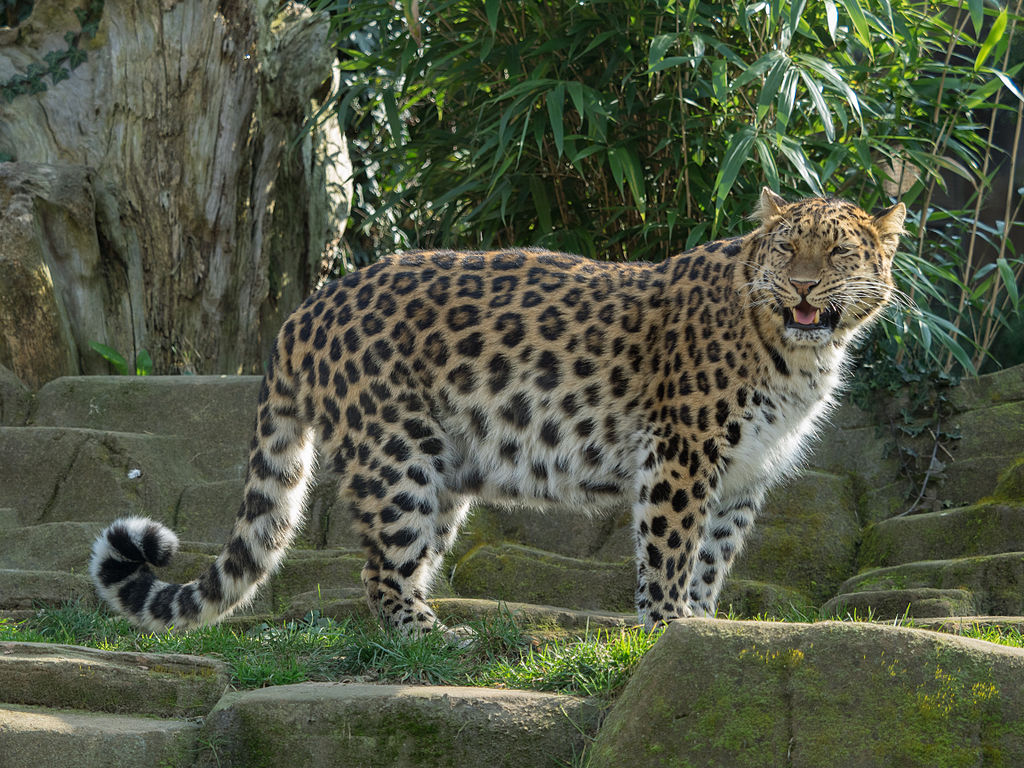
- Amur leopard. Fewer than 50 left in wild parts of China and Russia (their situation on the Korean peninsula is unknown). This is the one you might have heard about, since it is one of the rarest, if not the rarest, of all cats.
William Warby via Wikimedia, CC BY-SA 2.0
Wait. That’s a snow leopard!
Isn’t it?
39. Amur leopards and snow leopards have similar adaptations but they are two different wild cats.
Amur leopards have a different look from African leopards, thanks to their Siberian/North Chinese mountain setting.
Their fur is thick, spotted but very light in color, with a dense wooly undercoat. Their tails are extremely furry, too, and Amur leopards sometimes wrap the tail around their paws for warmth when they sit.
Does this sound like any other cat you might have heard of?
Yes, snow leopards have these same characteristics and many more — enough to earn them their own set of fangly facts later on!
Right now, all we need to know is that genetic tests show snow leopards are in the big cat group Panthera, but they are not leopards.
They have their own scientific name: Uncia.
Genetic testing even shows snow leopards to be closely related — not to Pardus but to the striped BIG cat that we’re going to meet next time.
Meanwhile, our look at leopards closes on a positive note: the World Wildlife Fund reports that Amur leopards are making a comeback!
That’s worth a good (though non-lion-like) roar!
If you enjoyed the writing in this post, tips are welcome via the secure Stripe donation link. I won’t be saving your email for marketing or other spam, so here’s a big thank you in advance!
Sources include:
Allen, W. L.; Cuthill, I. C.; Scott-Samuel, N. E.; and Baddeley, R. 2011. Why the leopard got its spots: relating pattern development to ecology in felids. Proceedings of the Royal Society B, 278: 1373-1380.
Athreya, V.; Odden, M.; Linnell, J. D.; and Karanth, K. U. 2011. Translocation as a tool for mitigating conflict with leopards in human‐dominated landscapes of India. Conservation Biology, 25(1): 133-141.
Carnivora.net. 2023. Amur leopard vs. snow leopard. https://carnivora.net/amur-leopard-v-snow-leopard-t6663.html
Cat Specialist Group. 2023. Leopard. http://www.catsg.org/index.php?id=110 Last accessed October 18, 2023.
<b<Heptner, V. G., and Sludskii, A. A. 1972. Mammals of the Soviet Union, volume II, part 2: Carnivora (hyaenas and cats). Moscow: Vysshaya Shkola Publishers. English translation by Rao, P.M., 1992. General editor: Kothekar, V. S. New Delhi: Amerind Publishing. https://archive.org/details/mammalsofsov221992gept
Jacobson, A. P.; Gerngross, P.; Lemeris Jr, J. R.; Schoonover, R. F.; and others. 2016. Leopard (Panthera pardus) status, distribution, and the research efforts across its range. PeerJ 4 : e1974.
Kitchener, A. C.; Breitenmoser-Würsten, C.; Eizirik, E.; Gentry, A.; and others. 2017. A revised taxonomy of the Felidae: The final report of the Cat Classification Task Force of the IUCN Cat Specialist Group. https://repository.si.edu/bitstream/handle/10088/32616/A_revised_Felidae_Taxonomy_CatNews.pdf
Macdonald, D. W.; Mosser, A.; and Gittleman, J. L. 2010. Felid society. Biology and Conservation of Wild Felids, 125-160.
Odden, M.; Athreya, V.; Rattan, S.; and Linnell, J. D. 2014. Adaptable neighbours: movement patterns of GPS-collared leopards in human dominated landscapes in India. PLoS One, 9(11): e112044.
Platt, J. R. 2013. The 6 most endangered feline species. https://blogs.scientificamerican.com/extinction-countdown/6-most-endangered-feline-species/
Sunquist, M. and Sunquist, F. 2002. Wild Cats of the World. Chicago and London: University of Chicago Press. Retrieved from https://play.google.com/store/books/details?id=IF8nDwAAQBAJ
Uphyrkina, O.; Johnson, W. E.; Quigley, H.; Miquelle, D.; and others. 2001. Phylogenetics, genome diversity and origin of modern leopard, Panthera pardus. Molecular Ecology, 10(11): 2617-2633.
World Wildlife Fund. 2023. Amur leopard — Probably the world’s rarest cat? https://www.wwf.org.uk/learn/wildlife/amur-leopardsamur-leopards
 Flight To Wonder