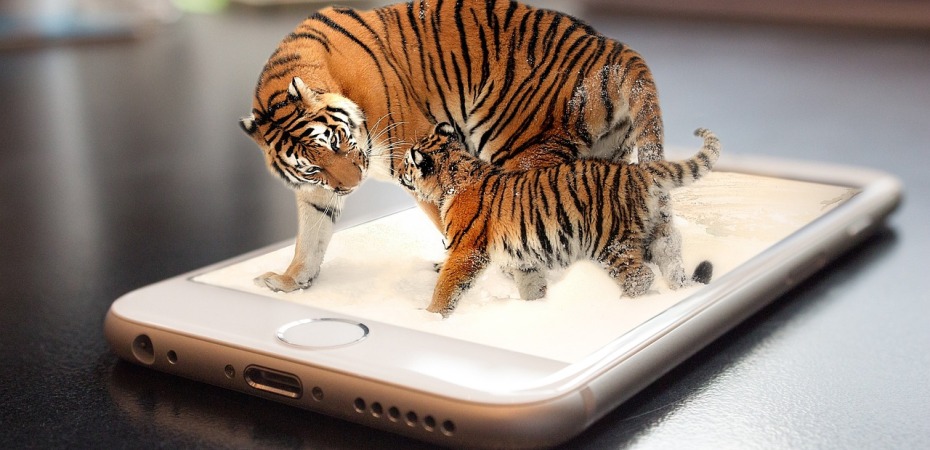
And you thought YOUR cat gets the zoomies!
Okay. It’s an ad, with FX. But I don’t care one way or the other about the product — the visuals are fun. And here’s how they did it.
31. Cheetahs are large, but they are not really one of the big cats.
Cheetahs are about the same size as leopards and they coexist in the wild with both leopards and lions.
It’s tempting to call all three species “big cats,” and many online sources do just that.
Scientific cat “herders”? Not so much.
Taxonomists can’t overlook important differences:
- Between cheetahs and big cats (for instance, cheetahs aren’t built like leopards and they purr, while big cats roar).
- Between cheetahs and the rest of the cat family (most notably, cheetahs are Family Felidae’s only pursuit predator, running down prey while all other cats stalk and ambush their victim with, at most, a short sprint).
The Hindi name for this beautiful racer — chita — means “spotted.”
Some eighteenth and nineteenth century Western taxonomists tried calling it Cynaelurus or Cynofelis, using a Latin root word for “dog” since this cat is a dog-like pursuit hunter and its paw pads are thick and hard, like a dog’s, with blunt unsheathed claws.
Those claws, seen in no other cat, earned the cheetah its modern scientific name in 1828: Acinonyx (Dr. Wikipedia translates that as “immobile nails”).
None of this explained why the cat was so unusual, but at least they had a good scientific name for it.
Almost a hundred years later, zoologist Reginald Innes Pocock took another look at the cheetah’s “dog” qualities. He also thought about the cheetah’s purring (which big cats don’t do) and other details.
He finally decided that this distinctive feline had diverged very early from the rest of Family Felidae, and he put it into a separate category — Acinonychinae.
For many decades afterwards, experts divvied up Felidae according to which cats roared (big cats) and which ones purred (all the rest) — plus weird old Acinonychinae, somehow.
Then molecular biology became possible in the late twentieth century, along with powerful computers and software that could handle large databases.
Research using this new technology settled the cheetah family mystery once and for all (although the question of exactly how the cat evolved is still under discussion).
Cheetahs are related to a large cat — just not one of those in Panthera (the big cats).
Acinonyx is the oldest living member of the puma lineage, which first appeared about 4.6 million years ago, per molecular studies — ancient to us, but about midway along the relatively rapid evolution of cats over the last 10.8 million years.
Now, about “Acinonyx rex“…
32. There are cheetahs and then there are king cheetahs.
The name stirs our imagination, but unfortunately, Acinonyx rex doesn’t really exist — and never has.
It seemed likely enough back in 1927, though.
R. I. Pocock (again) thought up the new species name after someone showed him a pelt that had been put up for sale the year before.
It definitely belonged to a cheetah but displayed dark blotches and stripes instead of spots, along with a black mane running down the back of the neck.
Cheetah cubs have adorable little silvery manes (probably for camouflage), but these disappear as the cat matures.
Then living king cheetahs were sighted in Zimbabwe, Botswana, and Transvaal, and only in those places.
Rex certainly appeared to be a new species, but further studies have shown that it isn’t.
These rare beauties actually are regular cheetahs (Acinonyx jubatus, with jubatus referring to the cub’s mane) that have a gene mutation that occurs in the populations of a specific geographic location (Zimbabwe, Botswana, and Transvaal).
It’s a recessive gene, meaning that both parents must have it and will pass it along to 25% of their cubs.
Other cats have this gene, too, although different mutations happen.
Surprisingly, this gene also is involved in producing a domestic cat’s tabby pattern. When it mutates in house cats, Fluffy gets a gorgeous blotched tabby pattern of swirls and bull’s-eyes.
When this happens, the Feline Handbook of Human-Cat Etiquette and Noms (Fluffy, Fluffy, and Fluffy, eds.) dictates that you then must change your cat’s name to H.R.H. Fluffy.
One thing is certain. King cheetahs take this look to a spectacularly royal extreme:
33. Tricks of the trade: How cheetahs are built for speed.
There are some excellent online videos on cheetah anatomy out there, including:
They cover many of the body adaptations that help cheetahs do their thing.
Here are some lesser known differences between cheetahs and other cats.
“Tires”
We’ve already mentioned the heavy paw pads and the four exposed blunt claws that act like spikes on a sports shoe.
Those paws also have unique ridges (like tire treads) that give the cat better footing during a chase.
Hooks and muscle
Cheetahs have large thigh muscles to power them along, of course, as well as extra-sturdy limbs for running (although this reduces their ability to climb or grasp objects the way other cats do).
The cheetah does have the longest legs of any cat, but these are still shorter than those of its prey — short enough to provide needed muscle power instead of a little more speed.
Here’s how cheetahs use that front-loaded muscle.
There is a fifth claw — the dew claw — part way up a cheetah’s foreleg. All cats have these, of course, but in cheetahs the dewclaw is large and very sharp.
During a chase, as the cheetah closes in it reaches out with its strong foreleg and either hooks its victim with that sharp dewclaw or swats it down with a single blow — something that would be physically impossible if it had evolved antelope-style legs that are just built for running.
A head for business
Once the prey is down, cheetahs usually use a suffocating throat bite for the kill. They must — their teeth are unusually small and cannot deliver the typical feline neck bite through vertebrae to sever the prey’s spinal column.
During evolution, those teeth have gotten smaller as the cheetah’s nasal passages have widened and its skull has domed up to hold as much air as possible.
This is not to make the cat lightheaded.
Air intake is important to jet aircraft, and it is also vital to an animal that goes from zero to 50 mph in two seconds and then chases down its prey at over 60 mph.
In warm to hot weather!
Cheetahs expend so much energy during a chase that they pant afterwards for anywhere from five minutes to an hour, catching their breath and cooling down their brain, before they eat.
The adaptations aren’t just in their heads. Cheetahs also have a deep chest and enlarged lungs, heart, and adrenal glands to help them along when the race is on.
Finally, when dinnertime comes again, cheetahs have special adaptations in their eyes — called a “visual streak” — that enhances their ability to see prey movements along a flat horizon.
Cheetahs, the most specialized of all cats, are indeed living wonders.
Chatty living wonders in this Toronto Zoo video:
If you enjoyed the writing in this post, tips are welcome via the secure Stripe donation link. I won’t be saving your email for marketing or other spam, so here’s a big thank you in advance!
Sources include:
Cat Specialist Group. 2019. Cheetah. http://www.catsg.org/index.php?id=107
Durant, S. M.; Dickman, A. J.; Maddox, T.; Waweru, M. N.; and others. 2010. Past, present, and future of cheetahs in Tanzania: their behavioural ecology and conservation. Biology and Conservation of Wild Felids, 373-382.
Johnson, W. E.; Eizirik, E.; Pecon-Slattery, J.; Murphy, W. J.; and others. 2006. The Late Miocene Radiation of Modern Felidae: A Genetic Assessment. Science, 311:73-77.
Kitchener, A. C.; Van Valkenburgh, B.; and Yamaguchi, N. 2010. Felid form and function, in Biology and Conservation of Wild Felids, ed. Macdonald, D. W., and Loveridge, A. J., 83-106. Oxford: Oxford University Press.
Kitchener, A. C.; Breitenmoser-Würsten, C.; Eizirik, E.; Gentry, A.; and others. 2017. A revised taxonomy of the Felidae: The final report of the Cat Classification Task Force of the IUCN Cat Specialist Group. https://repository.si.edu/bitstream/handle/10088/32616/A_revised_Felidae_Taxonomy_CatNews.pdf
Macdonald, D. W.; Mosser, A.; and Gittleman, J. L. 2010. Felid society. Biology and Conservation of Wild Felids, 125-160.
Marker, L.; Dickman, A. J.; Mills, M. G. L.; and Macdonald, D. W. 2010. Cheetahs and ranchers in Namibia: a case study. Biology and Conservation of Wild Felids, 353-372.
Sunquist, M. and Sunquist, F. 2002. Wild Cats of the World. Chicago and London: University of Chicago Press. Retrieved from https://play.google.com/store/books/details?id=IF8nDwAAQBAJ
Turner, A., and Antón, M. 1997. The Big Cats and Their Fossil Relatives: An Illustrated Guide to Their Evolution and Natural History. New York: Columbia University Press.
Werdelin, L.; Yamaguchi, N.; Johnson, W. E.; and O’Brien, S. J. 2010. Phylogeny and evolution of cats (Felidae), in Biology and Conservation of Wild Felids, eds. Macdonald, D. W., and Loveridge, A. J., 59-82. Oxford: Oxford University Press.
Wikipedia. 2023. Cheetah. https://en.wikipedia.org/wiki/Cheetah Last accessed October 16, 2023.
Wiktionary. 2023. Cyno- https://en.m.wiktionary.org/wiki/cyno-#:~:text=English-,Etymology,cynic Last accessed October 16, 2023.
 Flight To Wonder