Since most wild cats are at home in trees, why didn’t they all develop that margay/marbled cat/clouded leopard ability to rotate their ankles and go down the trunk face first?
It’s a good question — unanswered as of yet, but paleontologists have it in mind as they search for more cat fossils.
They have other questions, too. Perhaps the biggest one is this: why did the beautiful cone-toothed cats we see today, with their primitive build, survive the end-Pleistocene extinction while the highly advanced sabercats died out?
No one knows. But the boffins have uncovered some interesting facts about those extinct fangly cats.
25. Ice-age sabercats were the last of a long line of highly evolved felines.
Back in Pleistocene times, the death trap that is now California’s La Brea Tarpits must have been a terrible place to visit.
Today there is a museum, and La Brea is a human celebration of (among other critters) fossil “cats” and “dogs” in the form of Smilodon — the state fossil! — and dire wolves.
Saving the dire wolves for tomorrow, everyone loves Smilodon’s dirk-like upper canines, although these continue to puzzle experts in ancient life.
How did the cat use those “teeth shaped like double-edged knives” (the meaning of “Smilodon”)?
To famous paleontologist Edwin Drinker Cope, in 1880, it seemed possible that
…the length of these teeth became an inconvenience and a hindrance to their possessors. I think there can be no doubt that the huge canines in the Smilodons must have prevented the biting off of flesh from large pieces, so as to greatly interfere with feeding, and to keep the animals in poor condition.
Cope also noted that those dirk teeth would interfere with the cat’s mouth opening, “causing early starvation.”
This made sense at the time, though it was incorrect, and soon everyone saw Smilodon and other fossil sabercats that came to light as evolutionary dead ends that maxed out one part of their anatomy and paid the price with extinction.
Many of us, if we ever think about it, still have this misconception, unaware that new discoveries and insights have forced paleontologists to rethink the issue:
- Fossil sabercats were numerous. Many of them had anatomical differences that indicate a variety of thriving species. For example, Homotherium — an ice-age scimitar-toothed sabercat — prowled across several continents during the same time period as Smilodon.
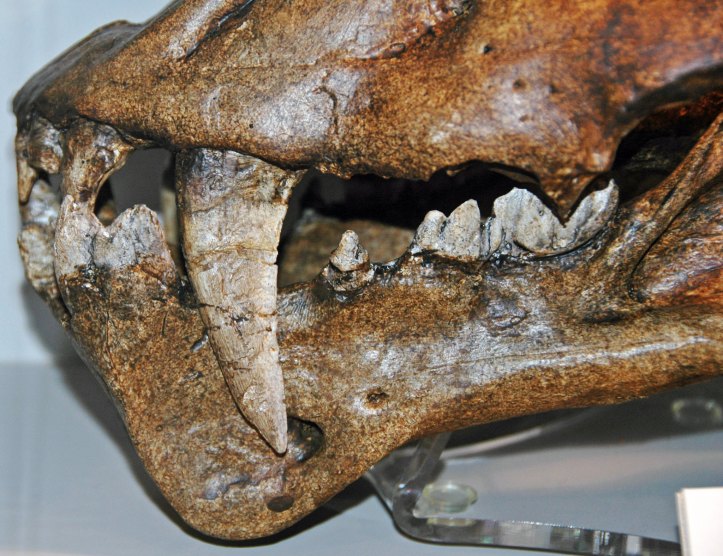
This dirk-toothed cat had smaller saberteeth than Smilodon, but you still wouldn’t want to meet it, especially at night. Homotherium was around until 11,000 years ago. (Image: James St. John, CC BY 2.0)
- Smilodon fossils have only been found in North and South America. At least three species roamed these lands: Smilodon fatalis (La Brea); S. gracilis; and humungous S. populator — all a sign of successful evolution, not failure.
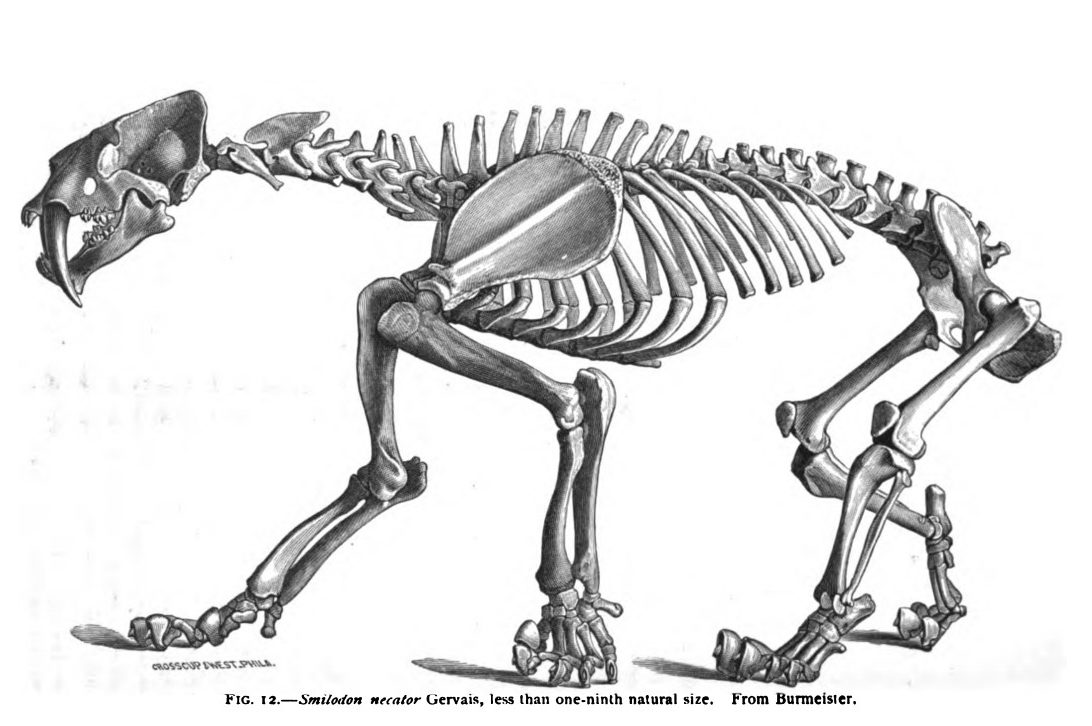
- Smilodon, in particular, was much more massive than modern cats. Along with subtle differences that only a scientist could spot — including skull changes that allowed the cat to open its mouth very wide indeed! — Smilodon’s legs were strong enough to support incredibly powerful muscles and it had a much longer neck than cats do today. Some paleontologists have identified such features in other types of fossil sabercat, leading them to propose the existence of an anatomical “sabertooth complex,” much more evolved than anything the cone-tooths have come up with.
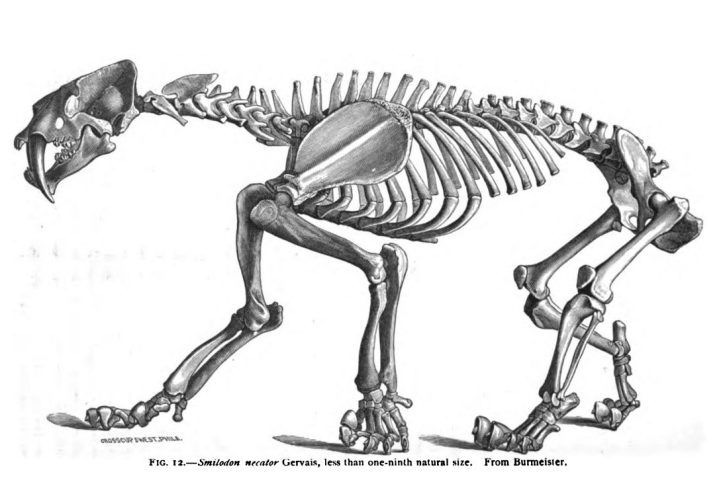
Everyone’s favorite fossil cat — as long as it’s just a fossil! E. D. Cope opened his paper on extinct American cats with this image.
In short, there was a whole world of sabercats, going back some fifteen to twenty million years to the Miocene epoch.
Amazingly, those sabercats were only #6 on the hit parade of sabertoothed mammal (and mammal-like) predators that have walked Earth over the last 270 million years.
Number one, as far as we know, was a distant mammal ancestor and lived (more likely ruled) during Permian times — it looked like a combination of tyrannosaurus and sabertoothed cat, two animals that would evolve much, much later.
We can’t be sure why, but having saberteeth is obviously an evolutionary advantage for some animals, including cats — but not all the time, as the current absence of sabertooths shows (it’s true that clouded leopards have long fangs, but there are significant differences between them and sabercats).
Ancestors of cone-toothed cats, meanwhile, did their own thing. Genetic testing suggests that the line of modern cats first appeared eleven million years ago, while the very first cats — also cone-tooths — are almost three times as old, possibly starting out in the Oligocene.
But cone-tooths took a much more conservative approach to evolution than the sabercats did.
26. Modern cats are built very much like the Dawn Cat.
That Dawn Cat — Proailurus — probably isn’t the first cat ever, but it is the oldest one that we have identified yet, in 20-million-year-old French fossil beds.
Proailurus was about the size of today’s bobcat and already looked like a cat, with a shortened face and a long back.
Though somewhat flat-footed, Proailurus had very flexible ankle/wrist joints (sideways, that is, not to 180 degrees).
This must have made it quite agile in trees but Proailurus, like Fluffy, probably wouldn’t have broken any speed records on the ground.
As Werdelin et al. put it, “In Proailurus we have (as far as it is known) an essentially modern felid except for a few minor details…which has shorter limbs than modern felids.”
The basic build of modern cats hasn’t changed very much over time.
But this implies that family Felidae’s line can be completely traced through the fossil record, which is not yet the case.
A study by Johnson et al. suggests that we have only discovered about a quarter of the cats that ever existed!
So paleontologists are still digging. They have come up with a complex of fossil cats — called Pseudaelurus — that probably were ancestors of both conical-toothed cats and the sabercats, but many pieces to this puzzle have yet to be uncovered.
27. Cats past and present have always coexisted.
How could two lines as different as sabercats and cone-tooths be descended from the same kitty?
This is one of those simple-sounding questions that get intricate very quickly.
I’m not even going to try to answer it but will point out that those early cats did not exist in a vacuum — they must have been influenced in many ways by their environment and the animals around them.
For instance, some top predators in their world already had saberteeth. According to Werdelin et al., these barbourofelids — now extinct — were probably related in some way to Felidae (the cat family that includes both cone-tooths and sabercats).

Barbourofelis fricki, Museo di Paleontologia di Firenze, by Ghedoghedo via Wikimedia, CC BY-SA 3.0.
Whatever factors made Miocene barbourofelids possible could also operate on at least some of the members of this new cat family, moving them toward the sabercat path that would ultimately produce Smilodon and many others.
The cone-tooths are more of a mystery since no one yet knows for sure how Proailurus developed its feline form, let alone why this shape has been so successful down through time.
One popular hypothesis has cats evolving in eastern Eurasia, separated from the west by a vast strait of water across the center of the continent.
When global sea levels drastically dropped, about 33 million years ago (some ice sheets were forming on Antarctica), this water barrier disappeared and all sorts of Asian animals (including cat-like feliforms) moved into Europe, outcompeting the natives and causing a “Great Break,” or Grande Coupure, in the fossil record.
Proailurus fossils were laid down in what is now France not too long after that mass extinction.
You see how complicated it is? There’s major climate change, extinctions, adaptive radiations of the newcomers, etc. — paleontologists are very interested in this time period for all sorts of reasons, including but not limited to how cats evolved, but there are still more questions than answers.
As for how cone-tooths and sabercats could coexist, it likely comes down to the fanglies:
- We know how most cone-tooths hunt: stalk, ambush, dispatch prey with a neck bite or suffocating windpipe bite.
- We don’t yet know for sure how sabercats hunted, but it must have been very different, perhaps with the cat knocking down its prey, pinning it to the ground, and slashing with the saberteeth to exsanguinate their victim. (😲 Time out to check and make sure they are all extinct. They are.)
The two types of cat probably coexisted by going after different prey.
Perhaps they also used different habitats, with big sabercats staying on the ground while smaller cone-tooths hunted through the canopy.
There’s room for all sorts of scientific speculation about those early days, but next time we’ll take a look at how today’s cats coexist…
If you enjoyed this post, tips are welcome via the secure Stripe donation link. I won’t be saving your email for marketing or other spam, so here’s a big thank you in advance!
Sources include:
Antón, M. 2013. Sabertooth. Bloomington: Indiana University Press.
Barnosky, A. D.; Koch, P. L.; Feranec, R. S.; Wing, S. L.; and Shabel, A. B. 2004. Assessing the causes of late Pleistocene extinctions on the continents. Science, 306(5693): 70-75.
Christiansen, P. 2008. Phylogeny of the great cats (Felidae: Pantherinae), and the influence of fossil taxa and missing characters. Cladistics, 24(6): 977-992.
Cope, E. D. 1880. On the extinct cats of America. The American Naturalist, 14(12), 833-858.
Gradstein, F. M.; Ogg, J. G.; and Hilgen, F. G. 2012. On the geologic time scale. Newsletters on Stratigraphy. 45(2): 171-188.
Johnson, W. E.; Eizirik, E.; Pecon-Slattery, J.; Murphy, W. J.; and others. 2006. The Late Miocene Radiation of Modern Felidae: A Genetic Assessment. Science, 311:73-77.
Kitchener, A. C.; Van Valkenburgh, B.; and Yamaguchi, N. 2010. Felid form and function, in Biology and Conservation of Wild Felids, ed. Macdonald, D. W., and Loveridge, A. J., 83-106. Oxford: Oxford University Press.
Kitchener, A. C.; Breitenmoser-Würsten, C.; Eizirik, E.; Gentry, A.; and others. 2017. A revised taxonomy of the Felidae: The final report of the Cat Classification Task Force of the IUCN Cat Specialist Group. https://repository.si.edu/bitstream/handle/10088/32616/A_revised_Felidae_Taxonomy_CatNews.pdf
Martin, L. D., and Neuner, A. M. 1978. The end of the Pleistocene in America. Transactions of the Nebraska Academy of Sciences and Affiliated Societies, 337. https://digitalcommons.unl.edu/cgi/viewcontent.cgi?article=1336&context=tnas
Rothwell, T. P. 2001. Phylogenetic systematics of North American Pseudaelurus (Carnivora: Felidae). Columbia University.
Sunquist, M. and Sunquist, F. 2002. Wild Cats of the World. Chicago and London: University of Chicago Press. Retrieved from https://play.google.com/store/books/details?id=IF8nDwAAQBAJ
Turner, A., and Antón, M. 1997. The Big Cats and Their Fossil Relatives: An Illustrated Guide to Their Evolution and Natural History. New York: Columbia University Press.
Van Valkenburgh, B. 2007. Déjà vu: the evolution of feeding morphologies in the Carnivora. Integrative and Comparative Biology, 47 (1): 147-163.
Werdelin, L., and Dehghani, R. 2011. Carnivora, in Paleontology and Geology of Laetoli: Human Evolution in Context, Volume 2: Fossil Hominins and the Associated Fauna, Harrison, T., ed., 189-232. Springer, Dordrecht.
Werdelin, L.; Yamaguchi, N.; Johnson, W. E.; and O’Brien, S. J.. 2010. Phylogeny and evolution of cats (Felidae), in Biology and Conservation of Wild Felids, eds. Macdonald, D. W., and Loveridge, A. J., 59-82. Oxford: Oxford University Press.
 Flight To Wonder