19. Lineages = Cat family tree branches.
Domestic cats are sometimes called the “lion in our living room.”
Fluffy certainly plays the part, but is our beloved pet really King of the Beasts, indoor version?
Just how close are house cats and lions, anyway?
Questions like these affect taxonomists and paleontologists the way catnip affects Fluffy.
Researchers drawn to fascinating Family Felidae face tough challenges, though:
- Living cats are hard to find in the wild, let alone study.
- Fossil cats are even rarer, but these must be located, dug up, and correctly identified so experts in ancient life can get the most accurate idea of how cats evolved.
- When fossil ancestors of today’s cats are found, the material usually is in fragments and, even when assembled, looks pretty much alike, except for size — apart from a few unique lifestyle adaptations here and there, cats have always followed the same basic blueprint under the skin. So much for ancient species identification!
However, boffins are very clever.
Over many decades, they developed an approach — systematics — to get the most out of each precious fossil that comes their way.
Now that molecular biology has made it possible to study evolution through the DNA in living beings, even more information is possible.
One catch here is that DNA results can be ambiguous. Another is that extinct cats left no descendants, so there is little to no genetic material left to test.
Academic debate continues over the details of how cats evolved, but you and I aren’t going for our PhD here.
We’re just relaxing over some fangly cat facts and wondering how lions and house cats might be related.

Like this, according to Wikimedia (public domain).
There’s a model for that — more than one, actually, but let’s keep things simple and just look at one of the most popular models, by Johnson et al. in the source list.
These researchers genetically divided modern cats into branches (technically, “phylogenetic lineages”) and then, using various molecular clues in modern cat DNA, worked their way backwards all the way to Miocene times and the earliest known fossil cats.
This model suggests that, back in the day, the brand-new cat family split into two groups:
- Panthera (today’s big cats and their ancestors, like the cave lion)
- All the rest.
So right away there is a disconnect between Fluffy and Leo. But what about the cats that we have already met in this story?
Lynxes have their own lineage, while those ever-changing little South American cats sit on the ocelot genetic branch.
Leopard cats have a lineage named after them. It also includes the tiny rusty-spotted cat and others.
As for Fluffy and the wildcats (dibs on the band name)…
20. There is a domestic cat lineage.
Cat-fancy changes aside, Fluffy is a domesticated African wildcat, so this could be called “the wildcat lineage.”
Of course, it never will be.
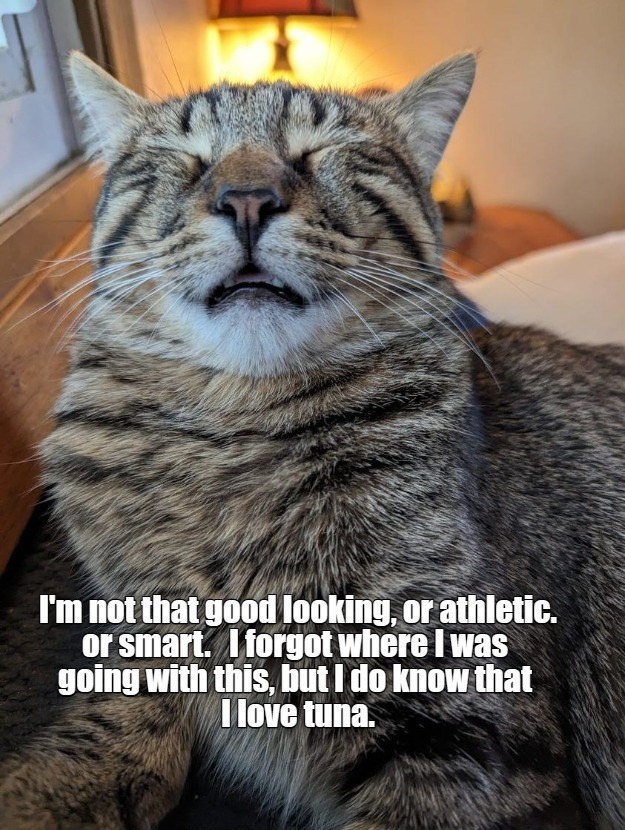
Not with THIS in the lineage! (Image: Some genius at ICHC a while ago that I wish I could credit but have lost the link and it’s buried in that high-volume site. Do you know who did this? 👏👏)
Other cats sitting on the same genetic branch of the family tree as Fluffy include (per Johnson et al.):
- Black-footed cats, one of the smallest kitties in the world. We have already met this “anthill tiger.”
- Sand cat. This small African/Middle Eastern feline is the only cat that lives in deserts. Its gnarly adaptations, like furry paw pads for walking on hot sand, enable the sandy-colored hunter to survive even Saharan and Arabian desert conditions — as long as there are some plants around to provide cover and support a prey base of small rodents, lizards, birds, and snakes.
- Jungle cat. You might see this tawny cat — the largest and perhaps oldest lineage member — near water anywhere from southeastern Europe through Africa’s Nile River Valley to India, Southeast Asia, and China. “Jungle” is really a misnomer as it often lives in swamps and reeds. Cat fanciers will recognize its scientific name — Felis chaus. This easygoing little wild one has been bred with domestic cats to produce the Chausie fancy breed.
Really, they could have called this lineage “The Adorables”!
So how distantly related are Fluffy and lions?
According to Johnson et al., after Panthera went its own way, the next split was between the bay cat lineage and everyone else. (We’ll meet some cats in every lineage as the story goes on.)
Next to leave the main line was the caracal lineage, then the ocelot group, then the puma line (see next section), and then the leopard cat and its friends.
The domestic cat lineage is the last branch (to date) of the main line.
Almost eleven million years of evolution separate Fluffy from lions!
About that puma lineage…
21. Mountain lions, cheetahs, and jaguarundis share a lineage.
Believe it or not, mountain lions and cheetahs are close cousins, despite the fact that;
- They’re on opposite sides of the Atlantic Ocean.
- Mountain lions are world-class jumpers, but they have never been observed breaking mammal land speed records.
A cheetah’s speed isn’t just about catching a meal.
- Cheetahs do not hold the Guinness record for highest jump by a mammal (23 feet straight up from standing still).
This wasn’t the Guinness trials. This was just Tuesday.
However, biologists and paleontologists were surprisingly chill with the idea even before recent DNA testing confirmed that the two cats are closely related.
To those in the know, jaguarundis were the joker in this deck.
- Jaguarundis don’t look like cats (though clearly are).
- They have the standard 38 chromosomes, not that unusual 36-count found in other Latin American small cats.
- No one really knows very much about them, although jaguarundis do seem to have some puma-like behaviors.
But everyone accepted the puma lineage connection when molecular testing showed a link.
As you can see, the three cats have that long body and tail; all three have springy legs capable (in two cases) of setting world records in both the horizontal and vertical planes, while jaguarundis are quite good at racing up and down tree trunks and performing acrobatics through the rainforest canopy while in search of a meal.
The big question is how the cats evolved into their present settings.
It’s controversial — much depends on whether or not the fossil cat known as an American “cheetah” was, in fact, the ancestor of modern cheetahs.
It seems to have been speedy enough, but some paleontologists argue that it was more a cheetah-like ancestral puma.
All of that is way above our pay grade, so we’ll let the scientists work it out and sign off for now in wonder at a world that today contains three such unusual but beautiful feline cousins.
If you enjoyed this post, tips are welcome via the secure Stripe donation link. I won’t be saving your email for marketing or other spam, so here’s a big thank you in advance!
Sources include:
Cat Specialist Group. 2023. Jungle cat. http://www.catsg.org/index.php?id=114
___. 2023 Sand cat.
http://www.catsg.org/index.php?id=115
Faurby, S., Werdelin, L., and Svenning, J. C. 2016. The difference between trivial and scientific names: There were never any true cheetahs in North America. Genome Biology. 17: 89.
Giordano, A. J. 2016. Ecology and status of the jaguarundi P uma yagouaroundi: a synthesis of existing knowledge. Mammal Review, 46(1): 30-43.
Hodnett, J. P.; White, R.; Carpenter, M.; Mead, J.; and Santucci, V. 2022. Miracinonyx trumani (carnivora: felidae) from the rancholabrean of the Grand Canyon, Arizona and its implications for the ecology of the ‘American cheetah’. Late Cenozoic Vertebrate Paleontology: Tribute to Arthur H. Harris. Morgan GS, Baskin, JA, Czaplewski, NJ, Lucas, SG, McDonald, HG, Mead, JI, White, RS Jr., Lichtig, AJ eds.,(New Mexico Museum of Natural History and Science Bulletin 88): 157-186.
Johnson, W. E.; Eizirik, E.; Pecon-Slattery, J.; Murphy, W. J.; and others. 2006. The Late Miocene Radiation of Modern Felidae: A Genetic Assessment. Science, 311: 73-77.
Kitchener, A. C.; Breitenmoser-Würsten, C.; Eizirik, E.; Gentry, A.; and others. 2017. A revised taxonomy of the Felidae: The final report of the Cat Classification Task Force of the IUCN Cat Specialist Group. https://repository.si.edu/bitstream/handle/10088/32616/A_revised_Felidae_Taxonomy_CatNews.pdf
Macdonald, D. W.; Loveridge, A. J.; and Nowell, K. 2010. Dramatis personae: An introduction to the wild felids, in Biology and Conservation of Wild Felids, eds. Macdonald, D. W., and Loveridge, A. J., 3-58. Oxford: Oxford University Press.
Nyakatura, K., and Bininda-Emonds, O. R. P. 2012. Updating the evolutionary history of Carnivora (Mammalia): a new species-level supertree complete with divergence time estimates. BMC Biology, 10:12.
O'Brien, S. J., and Johnson, W. E. 2007. The evolution of cats. Scientific American. 297 (1):68-75.
O’Brien, S. J.; Johnson, W.; Driscoll, C.; Pontius, J.; and others. 2008. State of cat genomics. Trends in Genetics, 24(6): 268-279.
O'Brien, S. J.; Koepfli, K. P.; Eizirik, E.; Johnson, W.; and others. 2016. Response to comment by Faurby, Werdelin and Svenning. Genome Biology. 17: 90.
Smith, A. 1994. Systematics and the Fossil Record: documenting evolutionary patterns. (Snippet.) https://onlinelibrary.wiley.com/doi/book/10.1002/9781444313918.
Sunquist, M. and Sunquist, F. 2002. Wild Cats of the World. Chicago and London: University of Chicago Press. Retrieved from https://play.google.com/store/books/details?id=IF8nDwAAQBAJ
Werdelin, L.; Yamaguchi, N.; Johnson, W. E.; and O'Brien, S. J. 2010. Phylogeny and evolution of cats (Felidae), in Biology and Conservation of Wild Felids, eds. Macdonald, D. W., and Loveridge, A. J., 59-82. Oxford: Oxford University Press.
Edited April 25, 2024
 Flight To Wonder
Wildcats play a vital role in India’s ecosystems, and efforts to conserve these magnificent creatures are essential for maintaining biodiversity and ecological balance. Understanding their various types, habitats, and distribution is crucial for effective conservation strategies.
https://www.indianetzone.com/44/small_cats.htm