Surprise!
The namesake of our word “volcano” is not a tall and pointy stratovolcano like Vesuvius, nor is it a Hawaiian-like shield made out of dark basalt lavas.
From the deck of a cruise ship gliding through the Mediterranean about twelve miles north of Sicily, Vulcano looks like an eight-square-mile, earth-colored aircraft carrier accompanying the scenic geological flotilla (and UNESCO World Heritage site) known as the Aeolian Islands.
Upon closer inspection, Vulcano has a strangely flattened look, as through someone has been hammering on it —

ThomasLENNE/Shutterstock
— say, a god named Vulcan, using its fires as a forge.
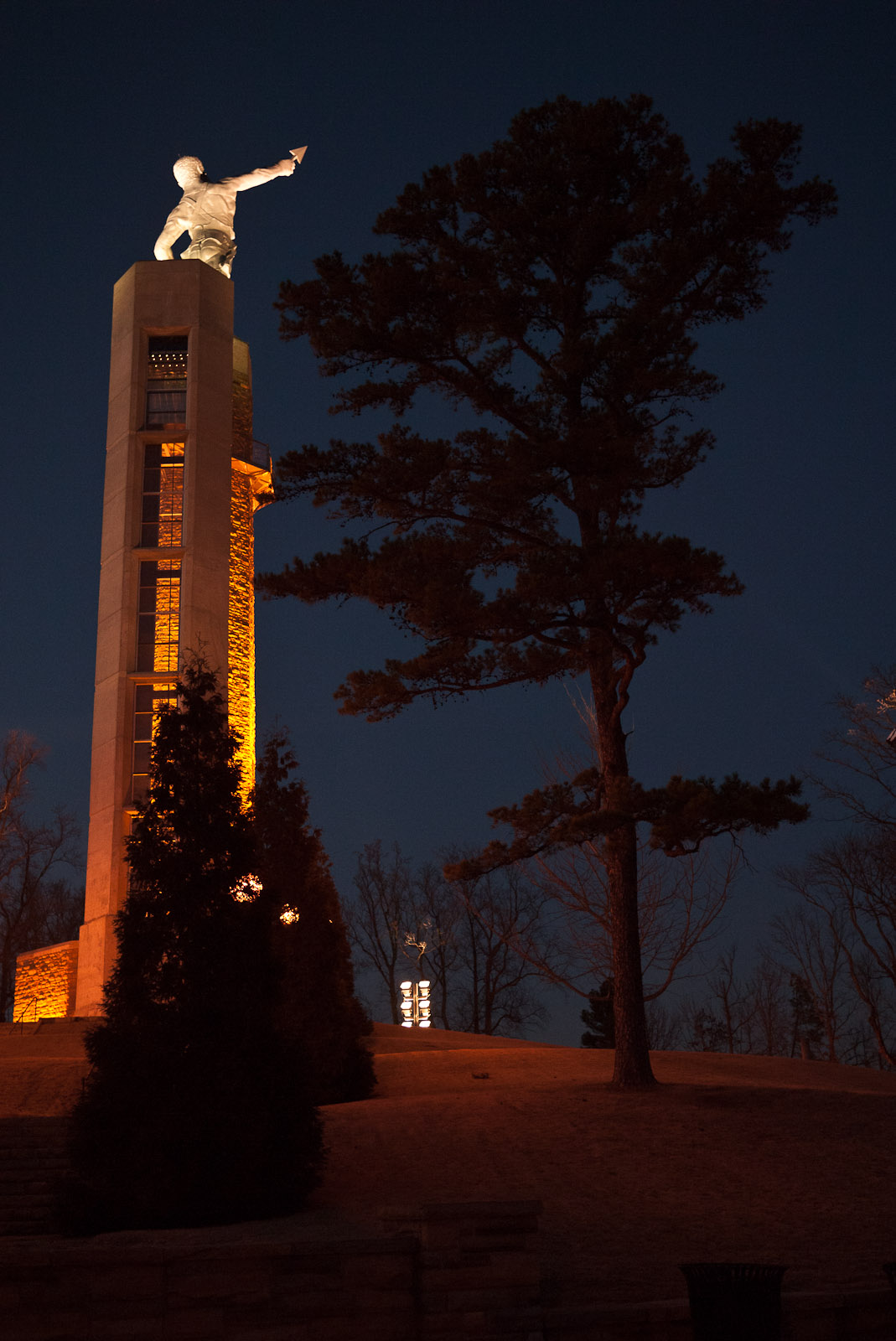
Few people realize that Vulcan is a BIG Crimson Tide fan. (Image: Greg Willis via Wikimedia, CC BY-SA 2.0)
That explanation worked for the ancient Romans, who named the island after their divine Olympian blacksmith.
Vulcano’s uniquely complicated features present more of a challenge to some of their descendants: Italian volcanologists who monitor and try to classify this fire-breathing island.
For now, the boffins are going with “volcanic complex or composite stratovolcano (?)” (INGV) as they continue their research (see Selva et al. in the source list, for example).
However, if your definition of a volcano is basically “Earth’s gaping maw filled with ashy ruin and lined with steaming pillars of reeking sulfurous vapor, towering over a town,” then Vulcano is a perfect fit:
The first impression from that drone view of Vulcano’s lava-free but fuming vent is of an enormous natural presence, powerful, mostly unseen yet operating constantly on a scale greater than anything humans are capable of.

The continents simply will not hold still! (Image: EarthScope)
Nowadays, geoscientists attribute that power, not to an ancient Roman god, but to complex plate tectonics and a slow-motion ongoing collision between the continents of Africa and Eurasia.
Frankly, either explanation for this island’s existence is mind boggling!
Yet there it is, and apparently Vulcan or Vulcano — whichever you prefer — seems to have spilled a little molten material into the sea at the island’s north end, between it and nearby Lipari (which is also volcanic).
That low-lying lava deck is called Vulcanello. It first erupted in the 180s BC and eventually connected up with Vulcano Island as a peninsula.
When no evacuation order is in effect, Vulcanello is a pleasant place to live — it’s covered with trees and is home to scenic scoria cones and hydrothermal features, as well as roads and resorts that fill three towns — Porto Vulcano, Porto Levante, and Porto Ponente — plus there are some villas and hideaways tucked under the forest canopy.
Some 1,600 feet above Vulcanello, which last erupted in the mid-1500s, the treeless, shelterless main volcanic crater smolders, but its fires are banked right now.
Vulcano last erupted in 1890 and was most recently restive in 2021, when some parts of the island, including Porto Levante, were evacuated because of toxic gas buildup.
October 3, 2021; I don’t think the fumaroles usually roar like that. (Also, please do not do this without training, thorough knowledge of the volcano, and volcanological equipment or else you will probably die horribly.)
Let’s follow the drone ashore and look around. It’s okay to leave the gas mask behind for this excursion.
Gran Cratere/La Fossa
That drone video initially takes us from sea level up to Vulcano’s gaping maw — the quite accurately named Great Crater, or Gran Cratere in Italian (of note, all but one of our namesake volcanoes this month are in Italy, the birthplace of modern volcanology).
The Great Crater is almost 600 feet deep, more or less funnel shaped, and rusty except where fumaroles have turned the rocks into grayish-tan clay.
Down at the bottom of the crater, a small lake reflects the cloudy sky in our video, but those loosely piled cinder walls around it are too steep to climb around on.
There is so much loose rock lying around because Vulcano gives its name to a type of intermittent explosive eruption that shatters rising magma.
We see rocks near the Great Crater because larger lava fragments and the heavier examples of those inedible but charmingly named “breadcrust bombs” from vulcanian eruptions here and at many other volcanoes always pile up around their vent.
Gravity insists that they do this.
What goes up in any vulcanian eruption comes down quickly if it’s something big.
Getting back to our drone video, Vulcano’s crater lake is probably acid and toxic gases likely fill that low area, so we stay on the network of gray dirt paths that criss-cross and run along the crater rim.
In addition to all that shattered lava rock lying around up here since 1888-1890 (the first ever scientifically recorded vulcanian eruption), the drone video shows us those aforementioned reeking fumaroles at the crater’s edge, surrounded by gray altered material and yellow fields of crystallized and occasionally molten sulfur (fumarole temperatures go up when Vulcano is restless).
Whenever the gentle Mediterranean breeze dies down, Vulcan’s forge can be a very smelly place!
Low hills that fade off southward into the distance behind the crater hint at the many ways that volcanism has shaped all of this island in the past, though recent activity focuses on the Great Crater and Vulcanello.
As the drone turns to take us down to the flatland where most (but not all) island people work and live, you can just make out one or two tiny human figures walking on one of the crater’s paths.
They give us a sense of scale — yes, Gran Cratere is quite gran!
Yet it is not a caldera although it sits inside one (remember, this is a very complex fire mountain, even for boffins).
Once we get down to Vulcanello and look back up at the Great Crater area, it appears as though the crater blew out the top of a rather tall island cliff of crumbly tan and gray rocks that show scars from at least one other blast and maybe some landslides, too.
But appearances can be misleading.
That is not an island cliff. It is a two-mile-wide volcanic cone built out of tuff — eruption material that the very active Great Crater has spewed out ever since the last ice age ended a little over ten millennia ago.
This cone now fills the above-water part of Vulcano’s Caldera della Fossa, which also extends down along the seafloor and overall is much more apparent to geologists than to us laypeople.
What we don’t see on the tuff cone is lava that ran down and formed the flat peninsula of Vulcanello.
In other words, neither the gods nor Nature spilled molten rock into the sea here.
This lava actually came up out of the water at some point during the days of Ancient Rome!
Vulcanello
Romans first noted discoloration and roiling waters in the strait between Vulcano and Lipari islands more than two centuries before Pliny the Elder perished, farther north, during the Pompeii eruption of Mount Vesuvius in 79 A.D.
These sea disturbances just north of Vulcano must have reinforced the “forge of the gods” idea!
Then Vulcanello exploded its way up to the surface and eventually became dry land.
Today’s researchers have found an underwater pillow-lava field east of Vulcanello and other evidence that the flat lava platform is actually the top of a large underwater structure that has built itself up through two thousand-plus years of mostly effusive eruptions, with inevitable phreatic blasts from magma-seawater interactions.
Once above sea level, Vulcanello erupted intermittently through about 1550 A.D., with lava fountains building the scoria cones we see there today.
Although its lava is chemically different from that erupted from the Great Crater, the two volcanic vents occasionally have erupted at the same time.
In the sixteenth century, debris finally connected Vulcanello to Vulcano Island through a small isthmus, which sometimes floods now during bad weather.
Is it safe?
As you can tell from the drone video’s close-ups of a hot mud pool and images of yellowish-gray hydrothermal rock, Vulcanello still has a fiery heart.
The Gran Cratere obviously is still active, too.
What about the people living so close to these Earth fires — some five hundred year-round residents and about fifteen thousand tourists seasonally.
Are they safe?
Well, no one is ever completely safe on an active volcano. But in terms of hazard and risk, Vulcano is one of the most heavily monitored volcanoes in the world.
Volcanologists are well aware that, as Selva et al. put it:
Given the small size of the island…the tourist interest in volcano-related phenomena (hot muds, fumaroles, etc.), and the high exposure of inhabited areas, the volcanic risk at Vulcano is high, even for small events…
That is why Selva et al., along with many other geoscientists, carefully study Vulcano and constantly assess its current state.
This hard work paid off, to take a recent example, in 2021. Thanks to evacuations and other actions, there were no human casualties, although volcanic gases did kill some domestic animals.
As an ancient Greek or Roman might say, it is dangerous to approach the gods — but sometimes worth the risk.
On any volcano, no one can predict sudden events like a hydrothermal explosion or the abrupt collapse of a wall of altered rock.
Vulcano’s visitors and residents take their chances with hazards like those.
Fortunately, monitoring for more common hazards at Vulcano is thorough — everyone there knows that lives and wellbeing depend on following the recommendations of civil authority and emergency managers.
More work is needed, as Selva et al. and other volcanologists point out.
Thanks to the work already done, the rest of us can make informed decisions on when or how or even if we dare to approach this beautiful, scary, unforgettable “forge of the gods” and namesake of all the fire mountains known today.
Monitoring:
INGV (Italy’s National Institute of Geophysics and Volcanology): https://www.ingv.it/en/volcano
More information:
Global Volcanism Program page.
UNESCO Aeolian Islands World Heritage Centre: https://whc.unesco.org/en/list/908/
If you enjoyed this post, tips are welcome via the secure Stripe donation link. I won’t be saving your email for marketing or other spam, so here’s a big thank you in advance!
Sources include:
Clarke, A. B.; Voight, B.; Neri, A.; and Macedonio, G. 2002. Transient dynamics of vulcanian explosions and column collapse. Nature, 415(6874): 897-901.
Clarke, A. B.; Ongaro, T. E.; and Belousov, A. 2015. Vulcanian eruptions, in “The Encyclopedia of Volcanoes,” (pp. 505-518). Academic Press.
Clocchiatti, R.; Del Moro, A.; Gioncada, A.; Joron, J. L.; and others. 1994. Assessment of a shallow magmatic system: the 1888–90 eruption, Vulcano Island, Italy. Bulletin of Volcanology, 56: 466-486.
Explore Volcanoes. 2024. Vulcano. http://www.explorevolcanoes.com/vulcano-volcano-italy.html#:~:text=Once%20at%20the%20top%20a,visible%20on%20the%20crater%20floor Last accessed February 4, 2024.
Selva, J.; Bonadonna, C.; Branca, S.; De Astis, G.; and others. 2020. Multiple hazards and paths to eruptions: A review of the volcanic system of Vulcano (Aeolian Islands, Italy). Earth-Science Reviews, 207: 103186.
Wikipedia. 2024. Vulcano. https://en.m.wikipedia.org/wiki/Vulcano Last accessed January 31, 2024.
 Flight To Wonder