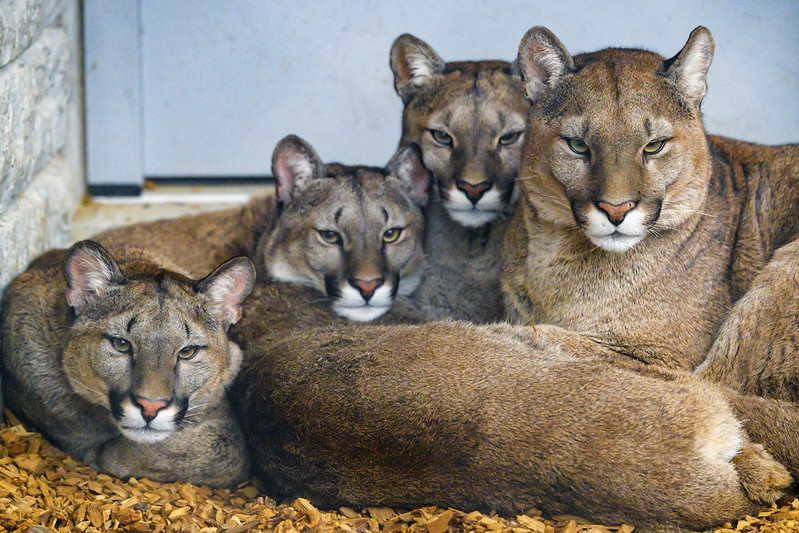
Tambako the Jaguar, CC BY-ND 2.O.
The mountain lion/cougar/panther/puma isn’t the only wild cat with multiple monikers.
People have always named cats in different ways.
Western science’s practice of applying a unique name to each species — which turns our mountain lion/cougar/panther/puma into Puma concolor no matter how you look at it — only began in the eighteenth century.
Why did they keep Puma? Simply because the person who first scientifically described this cat — Linnaeus, in 1771 — thought it was a good idea.
Taxonomy rules are strict, but there is a little flexibility when naming something.
Overall, this system enables boffins to know exactly what cat someone is talking about, and how it might be related to other cats.
Those of us outside Academia, though, tend to get lost in all that jargon. Our attention wanders and we lose sight of some beautiful felines.
That’s a pity, so ixnay with the atinlay!
This post will instead get into misperceptions about wild cats based on their common names.
For instance —
16. Big cats: Snow leopards aren’t leopards.
This is more about people trying to understand wild cats than about technical differences (which do exist between the two species, of course).
Cats have roamed the wild for a long time, with humans always trying to herd them by name.
Today we’ve got this down to a science — one called “taxonomy” — but early Greeks and Romans lacked most of the scientific tools for it.
They nevertheless had some successes.
For example, then, as now, tawny lions, with their big manes and regal bearing, impressed everyone. These unique big cats will always have the name that the ancients gave them: Leo.
Modern taxonomists have included it in the lion’s scientific name: Panthera leo.
Long-ago naturalists goofed with Cameleopard, though — giraffes are not camel hybrids and their spots are different from those of the pardos (Greek), a male cat also known back in the day by its “lion/spotted cat hybrid” name of leopard.
We still use that name today but now know that leopards and lions are two completely different cats (thanks to taxonomy work done by Linnaeus and many others during and since the 1700s).
The leopard’s scientific name does contain a callback to that one Greek term, though: Panthera pardus.
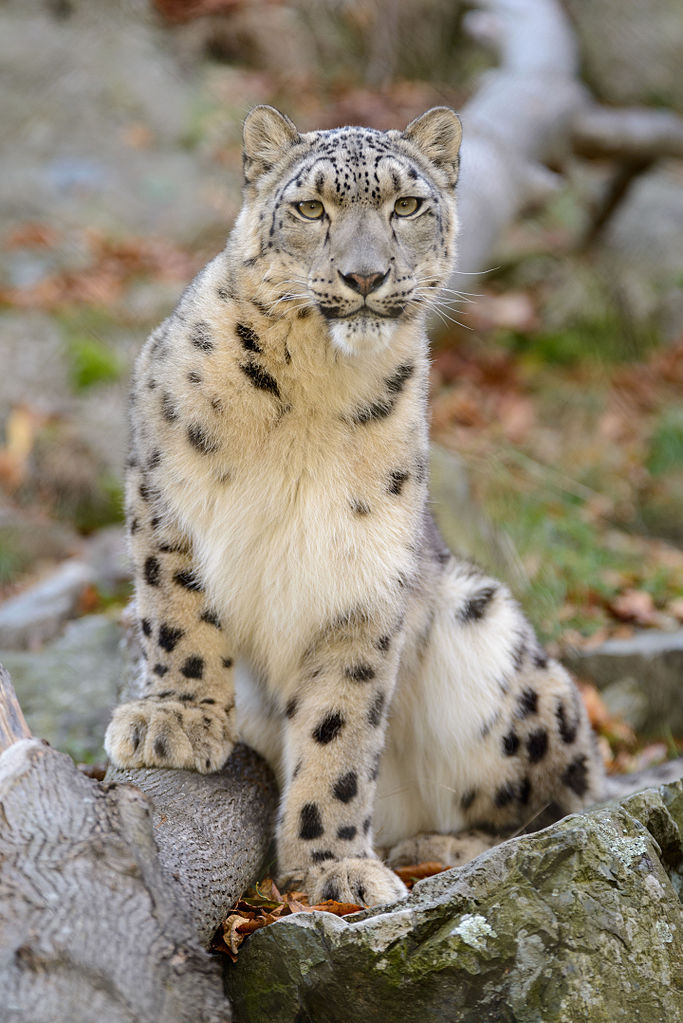
“What about me?” — P. uncia. (Image: Eric Kilby via Wikimedia, CC BY-SA 2.0)
Those old-timers had so many cats in their world — and not just big ones, either.
There was the lyncea, for instance. We know this beautiful cat as a lynx, but ancient writers weren’t fussy and also used the term for any moderately large spotted wild cat.
By the 1300s, the “L” was gone and the word transformed into once (French), or “ounce” in English.
None of this mattered in the least to, say, a fourteenth-century Nepalese herder who was quite well aware of a fairly large cat nearby that prowled along Himalayan cliffs and ridges — occasionally raiding livestock pens — and called it something along the lines of hiun chituwa.
This time around, Westerners did not use the local term when they first learned of a remote cat through explorers’ tales and the occasional pelt.
Once, they decided, was a good term for this moderately large spotted wild cat — latinized as uncia — while the new feline’s spots and its high-altitude home earned it the popular name of snow leopard.
The Nepalese herder went on calling it hiun chituwa.
By the 1970s and 1980s, wildlife biologists finally could study this rare cat and they decided that it was a separate big cat species: Panthera uncia.
Panthera means that snow leopards are big cats, but they have their own species.
The ranges of P. uncia and P. pardus can overlap a bit.
When this happens, the two are like ships of different nationality, passing in the night — not at all like close kin meeting on a mountain path.
17. The leopard cat isn’t a leopard, either.
If asked what Asia’s most common wild cat is, you might guess “leopard” because of all those social media posts and news stories about leopards showing up in urban parts of India.
That is a horrible problem, but the commonest cat in Asia is not Panthera pardus.
It’s the much smaller and less threatening Prionailurus bengalensis: the leopard cat.
“Say what, now?” you might be thinking, but if there are any owners of a Bengal cat there with you, they are probably smiling and nodding their heads.
Their wild-domestic hybrid fancy breed is named for the bengalensis part of their leopard cat ancestor’s binomial name.
The silver coloration on this Bengal cat is from fancy breeders; in the wild, a golden background and brown to black coat markings are the norm.
The whole story is told in that linked article about Bengal cats, which are large for a house cat.
Leopard cats are smaller than some other felids in the wilds of Asia, but they get around.
These little spotted cats are highly adaptable, ranging through twenty-one countries and thriving in such different habitats as coastal wetlands and the Himalayan foothills.
These trail cam views of leopard cats are from Sumatra, in Indonesia.
Leopard cats also roam northward into parts of the Russian Far East that have four inches or less of winter snow cover (any deeper and the cat wouldn’t be able to get around).
As you might expect, leopard cats have many regional names. Here are some, translated into English:
- Siberia: The Amur cat (there is also a big cat called the Amur leopard — again, totally different species).
- China: The rosettes look like coins to some people, who call this little cutie the “money cat.”
- Japan: Leopard cats are named after the islands where they live, and so we have the Iriomote cat and the Tsushima cat.
No other small Asian cat has such a broad geographic range — and yes, as we will see in later episodes, there are several other small Asian cats!
18. Jaguarundi are not close relatives of jaguars.
We’ve seen this basic difference already in Asia, with leopards and leopard cats.
It holds true in the Americas, too.
- Jaguars (Panthera): The only big cat native to North and South America.
- Jaguarundis: The most common small cat in some Brazilian states and also found throughout much of Latin America.
Here, though, the two cats don’t look at all alike.
- Jaguars resemble African leopards on steroids, with massive jaws.
- Jaguarundis? You might mistake one for a weasel or at least take several long looks before deciding that it is, in fact, a cat.
These trail cam views are from Costa Rica. The two color phases — red and dark gray — can occur in the same litter.
The similarity in names comes from how indigenous communities saw these two cats.
The Tupi used jaguara for any large predator, and seventeenth-century Portuguese colonists heard this as “jaguar.”
The little weasel cat was yawaum’di — “dark jaguar” (this little predator does have solid coat colors, not rosettes or spots).
Today’s name for this small wild kitty is closer to the word used by Guarani speakers (a group close to the Tupi, but with a separate language) — yaguarundi.
Oddly enough, jaguarundis are close relatives to the puma, which brings us full circle.
Old Puma concolor is one of the two cat species mistakenly thought to be big cats — but let’s get into that misperception next time.
If you enjoyed the writing in this post, tips are welcome via the secure Stripe donation link. I won’t be saving your email for marketing or other spam, so here’s a big thank you in advance!
Sources include:
Cat Specialist Group. 2023. Jaguarundi. http://www.catsg.org/index.php?id=93
___. 2023 Leopard cat. http://www.catsg.org/index.php?id=123
___. 2023. Snow leopard. http://www.catsg.org/index.php?id=100
Etymology Online. 2023. Jaguar (n). https://www.etymonline.com/word/jaguar#etymonline_v_1641
___. 2023. Leopard (n.) and links therein. https://www.etymonline.com/word/leopard#etymonline_v_6691
___. 2023. Lion (n). https://www.etymonline.com/word/lion#etymonline_v_9573
___. 2023. Lynx (n.). https://www.etymonline.com/word/lynx
___. 2023. Ounce (n. 2). https://www.etymonline.com/word/ounce#etymonline_v_9961
Giordano, A. J. 2016. Ecology and status of the jaguarundi P uma yagouaroundi: a synthesis of existing knowledge. Mammal Review, 46(1): 30-43.
Heptner, V. G., and Sludskii, A. A. 1972. Mammals of the Soviet Union, volume II, part 2: Carnivora (hyaenas and cats). Moscow: Vysshaya Shkola Publishers. English translation by Rao, P.M., 1992. General editor: Kothekar, V. S. New Delhi: Amerind Publishing. https://archive.org/details/mammalsofsov221992gept
Hu, Y.; Hu, S.; Wang, W.; Wu, X.; and others. 2014. Earliest evidence for commensal processes of cat domestication. Proceedings of the National Academy of Sciences, USA. 111(1): 116-120.
International Society of Endangered Cats (ISEC): Leopard cat https://wildcatconservation.org/wild-cats/asia/leopard-cat/ and Iriomote https://wildcatconservation.org/wild-cats/asia/leopard-cat/iriomote-cat/ fact sheets. Last accessed September 8, 2017.
Izawa, M., and Doi, T. 2015. Prionailurus bengalensis ssp. iriomotensis. (errata version published in 2016) The IUCN Red List of Threatened Species 2015:e.T1815A97215980.
Johnson, W. E.; Eizirik, E.; Pecon-Slattery, J.; Murphy, W. J.; and others. 2006. The Late Miocene Radiation of Modern Felidae: A Genetic Assessment. Science, 311: 73-77.
Kitchener, A. C.; Breitenmoser-Würsten, C.; Eizirik, E.; Gentry, A.; and others. 2017. A revised taxonomy of the Felidae: The final report of the Cat Classification Task Force of the IUCN Cat Specialist Group. https://repository.si.edu/bitstream/handle/10088/32616/A_revised_Felidae_Taxonomy_CatNews.pdf
Luo, S. J.; Zhang, Y.; Johnson, W. E.; and others. 2014. Sympatric Asian felid phylogeography reveals a major Indochinese–Sundaic divergence. Molecular Ecology, 23(8): 2072-2092.
Macdonald, D. W.; Loveridge, A. J.; and Nowell, K. 2010. Dramatis personae: An introduction to the wild felids, in Biology and Conservation of Wild Felids, eds. Macdonald, D. W., and Loveridge, A. J., 3-58. Oxford: Oxford University Press.
McCarthy, J. L.; Wibisono, H. T.; McCarthy, K. P.; Fuller, T. K.; and Andayani, N. 2015. Assessing the distribution and habitat use of four felid species in Bukit Barisan Selatan National Park, Sumatra, Indonesia. Global Ecology and Conservation, 3: 210-221.
Ross, J.; Brodie, J.; Cheyne, S.; Hearn, A.; and others. 2015. Prionailurus bengalensis. The IUCN Red List of Threatened Species 2015: e.T18146A50661611. https://www.iucnredlist.org/species/18146/50661611
Sunquist, M. and Sunquist, F. 2002. Wild Cats of the World. Chicago and London: University of Chicago Press. Retrieved from https://play.google.com/store/books/details?id=IF8nDwAAQBAJ
Vigne, J. D.; Evin, A.; Cucchi, T.; Dai, L.; and others. 2016. Earliest “domestic” cats in China identified as leopard cat (Prionailurus bengalensis). PloS One, 11(1): e0147295.
Werdelin, L.; Yamaguchi, N.; Johnson, W. E.; and O’Brien, S. J. 2010. Phylogeny and evolution of cats (Felidae), in Biology and Conservation of Wild Felids, eds. Macdonald, D. W., and Loveridge, A. J., 59-82. Oxford: Oxford University Press.
Wikipedia. 2023. Binomial nomenclature. https://en.wikipedia.org/wiki/Binomial_nomenclature
___. 2023. Jaguarundi. https://en.m.wikipedia.org/wiki/Jaguarundi
___. Leopard cat. https://en.m.wikipedia.org/wiki/Leopard_cat
 Flight To Wonder