
All of this month’s other “Namesake” posts are about volcanoes. Today, though, we need to introduce a nerd person.
It’s okay, because along the way we will also meet a very exciting Decade Volcano (Italy’s Mount Vesuvius) in the midst of its most famous eruption.
Scientists, in fact, call that big blast by the name we all recognize — the Pompeii eruption of 79 AD.
As I learned while researching it for my eBook The Decade Volcanoes and Us, Vesuvius has had even bigger eruptions, like the prehistoric Avellino Pumice, along with many smaller ones of the sort that draw international tourists but occasionally wreck neighborhoods and today will threaten Naples Metro when they occur (Mount Vesuvius has been sound asleep since the 1940s, but that won’t last forever).
Most of us take its AD 79 eruption personally because of the time capsule of ancient Roman life (and sometimes death) that it preserved.
We have literally walked in some of those people’s homes and looked at the pictures on their walls — it only makes us hunger all the more to know what they were like and what they saw and felt on that awful day.
As it turns out, we do have an eyewitness account from someone who lost a family member but survived the eruption himself (barely).
Both he and his doomed uncle were named Pliny, so we use the word “plinian” to describe one of Earth’s most dramatic displays of raw power and majesty — and we owe it to an eighteen-year-old nerd.
What else would you call someone who said — with Vesuvius in full eruption across the bay from his stylish villa on the Misenum cape — that he would rather stay home and work on his studies when asked by his uncle (who had authority to call out the Navy) if he wanted to come along on a rescue mission?
Okay, perhaps “smart,” but not after you read his account — two letters written later in life to tell the historian Tacitus what happened (they are online at several sites; for no particular reason I used this one).

This eighteenth-century painting shows one of the incidents described in those letters. (Image: Wikipedia, public domain)
Pliny the Younger was no coward and he obviously adored his famous relative.
Uncle Pliny accepted his nephew’s reply because he was a scholar as well as a statesman and military leader (and had in fact assigned Pliny the Younger some of that work).
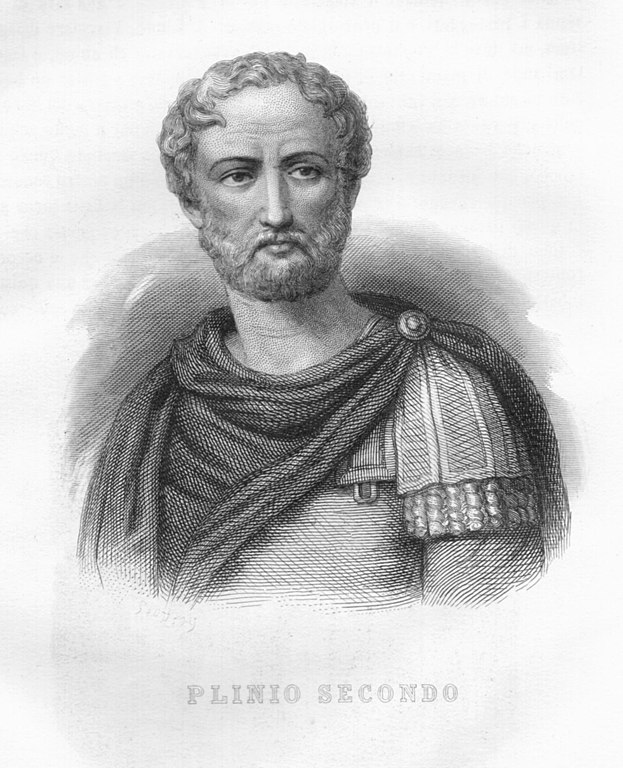
Pliny the Elder probably didn’t look like this, but the art does capture his spirit and accomplishments. (Image: Wikipedia, public domain.
Pliny the Elder went off on the rescue mission while his sister and nephew watched the mountain’s violence increase. They eventually had to evacuate when pyroclastic flows began crossing the bay towards them.
Then the two survivors went back home, with some difficulty, and waited in vain for Pliny the Elder to return.
The Pompeii eruption
Volcanologists study eruptions in two basic ways:
1. Direct observation.
2. Indirectly, through volcanic deposits.
It’s usually “either/or,” with real-time observations of today’s events whenever possible and geological analysis of deposits after the event from past eruptions or from those that weren’t observed.
The Pompeii eruption is different because there is Pliny the Younger’s surprisingly objective description of it and also lots of field data collected since intense research began here along with ruin excavation in the 1700s.
Researchers don’t always agree on what their findings mean. In order to keep things simple (and personal), we will use just one in-depth, recent review by Doronzo et al. to describe the Pompeii eruption.
Other interpretations exist, and you can easily look them up through Google Scholar or your local library.
Excerpts from Pliny’s letter are in italics.
Before we get started:
- Here is the US Geological Survey definition of “plinian” (stratosphere is the key point)
- For an idea of what people in the Naples Bay might have seen in AD 79, here is video of the early moments of a Chilean volcano going plinian in 2015 (S-word use):
Now here are a few glimpses of what the first recorded plinian eruption was like, according to Pliny the Younger:
There had been noticed for many days before a trembling of the earth, which did not alarm us much, as this is quite an ordinary occurrence in Campania…
Vesuvius was just another mountain to these Romans and had been dormant for eight centuries.
It awakened over decades as pulses of hot material rose from the depths, but no one could know this was happening (today’s monitoring instruments would pick it up).
Eventually some 4 cubic km of magma was moving inside and under the mountain, shaking the ground for miles around.
On the 24th (experts aren’t certain now whether it was in August or October), some of this molten material touched groundwater, and low-level steam explosions began to open the volcano’s throat.
These apparently went unnoticed by the scholarly family on Cape Misenum.
But then —
[A]bout one in the afternoon, my mother desired [my uncle] to observe a cloud which appeared of a very unusual size and shape. A cloud, from which mountain was uncertain, at this distance (but it was found afterwards to come from Mount Vesuvius), was ascending, the appearance of which I cannot give you a more exact description of than by likening it to that of a pine tree, for it shot up to a great height in the form of a very tall trunk, which spread itself out at the top into a sort of branches; occasioned, I imagine, either by a sudden gust of air that impelled it, the force of which decreased as it advanced upwards, or the cloud itself being pressed back again by its own weight…
Pressure on the magma inside Vesuvius had eased as the molten rock rose, allowing volcanic gases to bubble out of solution.
The overall effect was similar to what happens when a shaken bottle of champagne is uncorked.
Mount Vesuvius was uncorked by those initial phreatomagmatic throat-clearing explosions.
As in most such events, the lava foam probably shot out at initial speeds of more than 200 mph, but this material was still ten times denser than air and would not have risen into that famous plinian plume if it hadn’t also been very hot.
The plume heated up air, mixed it in, and powerful convection took the much more buoyant mixed column of material up into the stratosphere, where it overshot its point of neutral buoyancy but then settled into it and spread out into an umbrella cloud.
Prevailing winds blew the ash southeast, toward Pompeii, a prosperous trading town seven miles from Vesuvius.
The two Pliny’s were curious about the cloud, but then the uncle received —
…a note from Rectina, the wife of Bassus, who was in the utmost alarm at the imminent danger which threatened her; for her villa lying at the foot of Mount Vesuvius, there was no way of escape but by sea; she earnestly entreated him therefore to come to her assistance…
Many wealthy Romans had villas on the volcano’s flanks, too, and towns like Oplontis and Herculaneum were at its feet.
Pliny the Elder answered the call but could not land his ships anywhere near Vesuvius because of the volcano’s violence.
He went instead to a friend’s house in nearby Stabiae, where he died the next day (possibly from cardiac trouble, or perhaps from toxic gases emanating from a nearby pyroclastic flow that came close but did not reach them).
At first, all of these people close to Vesuvius were all right since the wind was carrying most ashfall overhead to Pompeii, where roofs soon began to collapse.
No doubt many Pompeiians had already fled, but as of this writing, almost four hundred victims have been found underneath the fragments of those heavy roofs.
It wasn’t until around 8 p.m. that the fate of (probably) Rectina and certainly of Herculaneum and Oplontis was sealed.
The eruption’s chemistry changed then. As a result, after soaring more than twenty miles into the sky, that plume became unstable, collapsing during the night in a series of pyroclastic flows.
The villas and towns near Vesuvius were buried, but everyone who was still in Pompeii survived the night, as did Pliny the Elder and his companions in Stabiae.
Around 6:30 the next morning, the ending gust of a pyroclastic flow just touched Pompeii’s outer walls. An hour later, the eruption column completely collapsed and the resulting flow went through town, but didn’t do much damage.
The killer flow came later, after the magma chamber under Vesuvius gave way in huge earthquakes. This last powerful current of death went right through Pompeii, and we all have seen images of the plaster casts of some of its 650 known victims.
I don’t know if this was the flow that almost reached Pliny the Elder, but certainly his sister and nephew were struggling to stay alive back at Misenum —
The sea seemed to roll back upon itself, and to he driven from its banks by the convulsive motion of the earth; it is certain at least the shore was considerably enlarged, and several sea animals were left upon it. On the other side, a black and dreadful cloud, broken with rapid, zigzag flashes, revealed behind it variously shaped masses of flame: these last were like sheet-lightning, but much larger.
That is the first ever written description of a pyroclastic flow, and no one really understood it until 1902, when such currents from Pelee Volcano on Martinique destroyed the city of Saint Pierre and smaller towns, and were first photographed in action.
Back in AD 79, Pliny the Younger and his mother made it through this terrible event. Vesuvius rumbled on for a few more days and then quieted down.
Pompeii was buried under at least thirty feet of ash and debris, and it was never rebuilt.
Here is Zero One’s animation of what the eruption might have looked like from Pompeii:
The first recorded plinian eruption was extreme, according to eyewitnesses, but it did not rock the empire.
A commemorative coin was minted, and Campania never again had the same popularity for vacationing wealthy Romans — but life went on.
The most objective count puts the death toll close 3,000 people, but many more thousands lived here. No records of where they went after the cataclysm of 79 AD have come down to us.
Today millions live around Mount Vesuvius. Not only their lives but also their extensive infrastructure and high-tech society are both vulnerable.
Everyone knows this interlude of volcanic quiet will not last. The question is, will everyone be ready when Vesuvius again stirs?
Monitoring:
The Vesuvius Observatory, National Institute of Geophysics and Volcanology (INGV). http://www.ov.ingv.it/ov/ (Italian)
As of March 2024, Vesuvius is having a few small seismic swarms, but the volcanologists have not raised an alert.
More information:
Global Volcanism Program page.
The updated National Vesuvius Plan. (Italian, PDF)
If you enjoyed this post, tips are welcome via the secure Stripe donation link. I won’t be saving your email for marketing or other spam, so here’s a big thank you in advance!
Sources:
Bonadonna, C.; Cioni, R.; Costa, A.; Druitt, T.; and others. 2016. MeMoVolc report on classification and dynamics of volcanic explosive eruptions. Bulletin of Volcanology, 78: 1-12.
Zebrowski, E. 2002. The Last Days of St. Pierre: The Volcanic Disaster That Claimed Thirty Thousand Lives. Rutgers University Press.
Also, those listed in the Vesuvius chapter of “The Decade Volcanoes and Us,” especially:
Doronzo, D. M.; Di Vito, M. A.; Arienzo, I.; Bini, M.; and others. 2022. The 79 CE eruption of Vesuvius: A lesson from the past and the need of a multidisciplinary approach for developments in volcanology. Earth-Science Reviews, 104072.
Mastrolorenzo, G.; Petrone, P.; Pappalardo, L.; and Guarino, F. M. 2010. Lethal thermal impact at periphery of pyroclastic surges: evidences at Pompeii. PloS one, 5(6): e11127
Oppenheimer, C. 2011. Eruptions That Shook the World. Cambridge: Cambridge University Press. Retrieved from https://play.google.com/store/books/details?id=qW1UNwhuhnUC
Scandone, R.; Giacomelli, L.; and Rosi, M. 2019. Death, survival and damage during the 79 AD eruption of Vesuvius which destroyed Pompeii and Herculaneum. Journal of Research and Didactics in Geography, 2: 5-30.
 Flight To Wonder