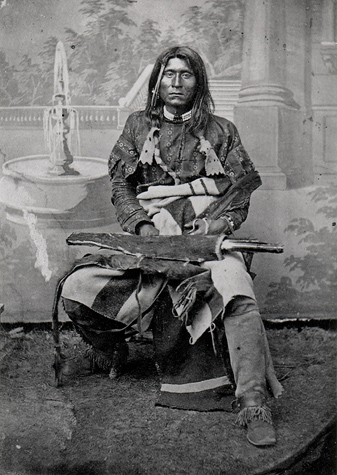
Everyone should see this picture of Strikes Water Brashly, or Kintpuash, and know of the terrible lose-lose choice he had to make in his Medicine Lake stronghold. Why has no biopic, strictly factual, been made? Perhaps because… (Image: Wikipedia, public domain)
People sometimes clash at this northern California volcano — not always nonviolently or fairly, but generally in ways that bring about at least short-term resolution of the conflict.
These days, it is conservationists versus geothermal drilling leases. At the moment, conservationists have the upper hand in court but they know how easily this could change, given the enormous energy potential of Medicine Lake Volcano.
Back in the 1870s, it was an armed band of Modoc native people versus the US Army. The Modocs held their ground throughout the winter of 1872-73 (treachery was their ultimate downfall). In modern times, the park ranger who tells you their story might be someone whose grandparent was born in the stronghold during that struggle. (Source: USGS Roadlog)
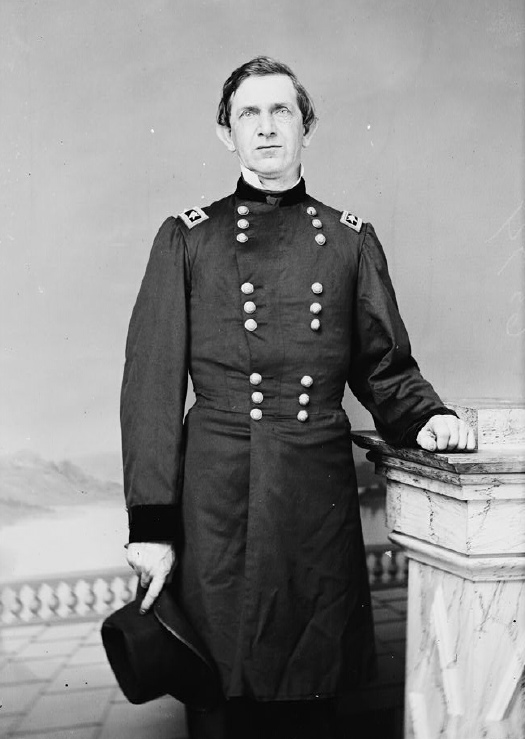
…Kintpuash’s choice led to this man’s murder during a peace conference. That was heinous, but today, I think, we are ready to see both sides of that tragic human drama. (Image: Wikipedia, public domain.)
Major plate-tectonic processes also clash at Medicine Lake Volcano — notably, those that have brought about the Cascades volcanic arc (with Crater Lake to the northwest and Mount Shasta to the southwest of our Sunday Morning Volcano) and, to the east, forces coming from that broad extensional landscape in parts of several states known as Basin and Range.
During the last ice age, huge curtains of fire opened along a fissure on one flank of Medicine Lake Volcano, pouring out enough lava to bury almost a hundred square miles of land when it all drained out of the lava pond that had collected at the base of those impressive fountains.
That emptied-out lava pond is now called Mammoth Crater.
This Pleistocene lava hardened into weird shapes that, tens of millennia later, not only form today’s Lava Beds National Monument but also provided nineteenth-century Modocs with an excellent natural fort.
In the video below, Idaho geology professor Shawn Willsey walks us through the portion of this Mammoth Crater lava field that is now called Captain Jack’s Stronghold (see source list for links to more information about Kintpuash/”Captain Jack” and the Modoc War):
The narration is clear enough as the professor, in summer field gear, walks along dirt paths through an expanse of seemingly flat ground covered with many grass-covered mounds.
Large and small chunks of black basalt poke out of the long, dry grass, and in some places the path winds through tall basalt formations that the geologist calls “tumuli.”
Green fields seen in the distance fill what once was a lake bed.
In Modoc times, Tule Lake hadn’t been drained yet. It was a good source of food and water, even during the war.
But where’s the volcano? Dr. Willsey pans 360 degrees during this video, and all we see are the basalt features, grassy mounds, and what appear to be some small scattered hills, miles away, as well as one long low one.
Medicine Lake Volcano
Well, remember how we said that the lava curtains erupted on the volcano’s flank?
Those lava flows stayed on the volcano.
All of Lava Beds National Monument is just one part of Medicine Lake Volcano.
So are those distant hills — one of which is Mammoth Crater, while others are cinder cones marking sites of some older big Hawaiian-style flank eruptions that have occurred over this volcano’s 500,000-year known history.
That long, low hill in the background is a caldera wall at the center of this amazing volcano.
Medicine Lake Volcano is huge, and most of it sits at a very low angle.
Medicine Lake — the water body — is up in the caldera. Let’s visit it:
In the following video, someone called Katie K shares her 2022 walk at the lake in an area where there aren’t many signs of human presence:
What we don’t see at this angle is something unusual up in the hills (which are actually the caldera rim):
One of Medicine Lake Volcano’s obsidian flows.
Settlers gave the lake its name because indigenous people felt this place was sacred and gathered there for “big medicine” meetings.
That belief lives on today.
A Modoc descendant and member of one of the groups trying to protect the area from geothermal development recently told Kurtis Alexander of the San Francisco Chronicle, “[O]ur people have been severed from these places, but these places haven’t lost their power.”
Locals today from the Western traditions refer to the long hill as Medicine Lake Highland.
Almost all of this volcano is public land administered by either the US Forest Service or the National Park Service. Paved and gravel road access is good, thanks to the many logging operations that happened back when developers were on top of the land-use conflicts.
Medicine Lake Highland’s campgrounds, water recreation (there’s also a Little Medicine Lake up there), summer cabins, and hiking/groomed winter trails make it a popular outdoor recreation center year round.
Geologists, however, call it the center of a shield-shaped composite volcano that has a 50 x 39-mile-wide field of lava flows and occupies almost 800 square miles of the state of California.
Mount Shasta may be the biggest stratovolcano in the arc, but Medicine Lake is by far the largest Cascades volcano in volume.
But bulk alone does not get a volcano into the top fifty on the US Geological Survey (USGS) threat assessment list.
Volcanic hazard
It all comes down to hazard, and that exists here despite the relatively small number of year-round residents, not only because of a very slight chance of Mammoth-sized Hawaiian-style flank lava flows but also because Medicine Lake Volcano has had a few plinian eruptions at higher elevations in the past.
The chances of a major explosive event here are very low, but they are not zero.
Even though this shield-shaped volcano has a summit caldera, just like Kilauea and Mauna Loa volcanoes, it is not a shield volcano for reasons related to the presence of those obsidian flows seen in, on, and around the summit.
The high-silica lava that makes obsidian is called rhyolite or dacite (depending on the silica content). It usually occurs in stratovolcanoes and other explosive volcano types (silica can hold in magmatic gases until they explode, powering a violent eruption).
Rhyolite is responsible for the summit’s spectacularly massive Glass Mountain and Little Glass Mountain obsidian flows that supported a thriving native trading network here back in the day.
A rhyolite eruption along those lines happened at a Chilean volcano in 2011:
This might be what waning stages of Medicine Lake’s Glass Mountain eruption looked like around 1030 AD.
The beginning of that Chaiten eruption in 2008 was even more impressive:
As far as this layperson’s reading can tell her, it appears that the likelihood of seeing such plinian eruptions of Medicine Lake Volcano in our lifetime is tiny.
In fact, while many questions about this unusual fire mountain remain open, Donnelly-Nolan et al. (2007) report that Medicine Lake Volcano isn’t likely to erupt at all any time soon, and when it does, it will most likely produce a small Hawaiian-style eruption.
But a larger basalt flank eruption is not impossible, and there also is the remote but concerning chance of summit-area plinian activity.
And so volcanologists continue to study Medicine Lake Volcano and to beef up their monitoring of this tectonically stressful area, while laypeople continue to enjoy, fight over, and otherwise use this beautiful but volatile part of the US West.
Monitoring:
California Volcano Observatory.
More information:
The Smithsonian’s Global Volcanism Program page.
If you enjoyed this post, tips are welcome via the secure Stripe donation link. I won’t be saving your email for marketing or other spam, so here’s a big thank you in advance!
Sources include:
Modoc history:
Alexander, K. 2023. California’s next national monument could be this remote volcanic landscape. https://www.sfchronicle.com/california/article/new-national-monument-18499981.php
US Geological Survey (USGS). 2006. Roadlog for field trip to Medicine Lake Highland. http://npshistory.com/publications/geology/circ/838/roadlog7.htm
Waters, A. C. 2006. Captain Jack’s Stronghold. http://npshistory.com/publications/geology/circ/838/sec6.htm
Wikipedia. 2023. Kintpuash. https://en.m.wikipedia.org/wiki/Kintpuash Last accessed January 21, 2024.
Other:
Castro, J., and Walter, S. C. 2021. Hybrid rhyolitic eruption at Big Glass Mountain, CA, USA. Volcanica, 4(2): 257-277.
Donnelly-Nolan, J. M. 2011. Geologic map of Medicine Lake volcano, northern California (No. 2927). US Geological Survey. https://pubs.usgs.gov/sim/2927/
Donnelly-Nolan, J. M.; Nathenson, M.; Champion, D. E.; Ramsey, D. W.; and others. 2007. Volcano hazards assessment for Medicine Lake volcano, northern California (No. 2007-5174-A). Geological Survey (US). https://pubs.usgs.gov/sir/2007/5174/a/
Donnelly-Nolan, J. M.; Grove, T. L.; Lanphere, M. A.; Champion, D. E.; and Ramsey, D. W. 2008. Eruptive history and tectonic setting of Medicine Lake Volcano, a large rear-arc volcano in the southern Cascades. Journal of Volcanology and Geothermal Research, 177(2): 313-328.
Donnelly-Nolan, J.M.; Champion, D.E.; and Grove, T.L. 2016, Late Holocene volcanism at Medicine Lake volcano, northern California Cascades: U.S. Geological Survey Professional Paper 1822, 59 p. https://pubs.usgs.gov/publication/pp1822
Ewert, J. W.; Diefenbach, A. K.; and Ramsey, D. W. 2018. 2018 update to the US Geological Survey national volcanic threat assessment (No. 2018-5140). US Geological Survey. https://pubs.usgs.gov/publication/sir20185140
Heiken, G. 1978. Plinian-type eruptions in the Medicine Lake Highland, California, and the nature of the underlying magma. Journal of Volcanology and Geothermal Research, 4(3-4), 375-402. Abstract only.
Nathenson, M.; Donnelly-Nolan, J.M.; Champion, D.E.; and Lowenstern, J.B. 2007. Chronology of postglacial eruptive activity and calculation of eruption probabilities for Medicine Lake volcano, northern California: U.S. Geological Survey Scientific Investigations Report 2007-5174-B, 10 p. http://pubs.usgs.gov/sir/2007/5174/b/%5D.
National Park Service. 2024. Lava Beds National Monument: Nature and Science. https://www.nps.gov/labe/learn/nature/index.htm
US Forest Service, Modoc National Forest. 2024. Medicine Lake Highlands. https://www.fs.usda.gov/detail/modoc/specialplaces/?cid=stelprdb5313077
 Flight To Wonder