Eldey, Catalogue of Icelandic Volcanoes (just in case)
RUV (autotranslated front page). Look for a red box with white dots flashing when coverage is live (here is the last live watch, with earlier ones here, here, here, here, and here) and please be aware that autotranslation might not carry over when you click it; I use either browser translation or Google Translate online).
Still inflating, too. I wonder what InSAR images of the peninsula look like right now.
May 25, 2024, 10:02 a.m., Pacific: The situation remains unchanged, with a reportedly (autotranslated) 18 million m3 estimated sill volume and continued inflow and Svartsengi landrise.
There was a seismic swarm at Hengill last night, thought to be tectonic (autotranslated).
Hengill will shake. It is just east of the peninsula and, in tectonic terms, is a “triple junction” where the South Iceland Seismic Zone, the West Volcanic Zone, and the Reykjanes Ridge/Peninsula meet.
Peter Hermes Furian/Shutterstock
May 21, 2024, 11:38 a.m., Pacific: Here is IMO’s update from about six hours ago — good news for Grindavik and environs in terms of a lava flow there, but a sudden gusher up at the earlier vent area might be overwhelming, with lava already so high on the barriers in some places.
Work on the inner barriers continues.
Magma accumulation under Svartsengi remains stable
21.5.2024
Updated May 21, 2024, at 12:30 p.m
Magma accumulation under Svartsengi remains stable
About 17 million cubic meters of magma have been added to the magma chamber since March 16
Increased probability of a new magma flow and another eruption in the coming days
Most likely to erupt on the Sundhnúks crater series
Eruption warning may be very short
About 200 earthquakes were recorded in the area around the magma corridor during the Whitsunday weekend, most of them below 1.0 in magnitude. This is similar to the seismic activity that has been recorded in recent days, but around 50 earthquakes have been recorded in a 24-hour period, most of them in the areas between Stóra-Skógfell and Hagafell on the one hand and south of Þorbjarna on the other.
Magma accumulation continues under Svartsengi and land is rising there at the same rate as before. At the moment, there is no reason to estimate other than that there is still a considerable probability of a new magma run and another eruption in the Sundhnúks crater series in the coming days.
…
The Sundhnúks crater series is still most likely to erupt
In the news last weekend, there was talk of small earthquake activity that has been ongoing for the past few weeks in the area south of Þorbjarna in the large sickle valley west of Grindavík. In the news, it was mentioned that there might be weaknesses in the earth’s crust that magma could possibly use to reach the surface. Magma flowing from the magma chamber to the area south of Þorbjarna is considered an extremely unlikely scenario at this point. That assessment is based on new model calculations and other data that were discussed at a meeting of scientists this morning. This slow increase in seismic activity is probably a sign of tension release in and around the magma passage on the Sundhnúks crater series due to increased magma pressure in the magma chamber under Svartsengi.
There is still an overwhelming probability that there will be a repeat of magma flowing from the magma chamber at Svartsengi and into the Sundhnúks crater series.
Pay close attention to see if magma is on the move
The Norwegian Meteorological Agency has monitored pressure changes in HS Orku’s boreholes in connection with monitoring the activity in Svartsengi. A sudden change in pressure has been one of the warnings that magma is running from Svartsengi to the Sundhnúks crater series. It has previously been stated that the signs of a new magma flow were local small earthquakes in and around the magma tunnel, acceleration in deformation together with pressure changes in boreholes in the area. This morning, a minor pressure drop was measured in HS Orku’s borehole. No seismic activity or change in deformation was observed to accompany these measured pressure changes. Therefore, the Norwegian Meteorological Agency did not activate contingency plans for possible magma flow.
May 20, 2024, 6:44 a.m., Pacific: Per the Southern Volcanoes Group on Facebook several hours ago (Facebook translated):
Earthquake activity has been increasing on and off
Reykjaneskagi in recent days. About 200 earthquakes have been recorded in the peninsula during the last 48 hours. It was very windy in the country yesterday and prepared for even more earthquakes but the system didn’t count them.
The activity these days follows a pattern that has often been seen before when tension is high. Earthquakes appear here and there and when one earthquake was crossed when the next one starts somewhere else.
Yesterday there was a lot of activity at Reykjanestá, but that cycle now seems to be over.
The Eldey area has been having quite a collection of 1’s and 2’s, and there continue to be swarms in the Sundhknur area as well as south of Thorbjorn — all that from the earthquake graphic only.
May 17, 2024, 11:34 a.m., Pacific: Here’s IMO’s update today, via Google Translate; I added a few highlights:
Magma accumulation under Svartsengi remains stable
• The total volume of magma in the magma chamber under Svartsengi has never been higher since before November 10.
• Additional scenarios need to be considered if magma accumulation continues without a magma flow or eruption
17.5.2024
Updated May 17, 2024, at 17:10
• Magma accumulation under Svartsengi remains stable
• About 16 million cubic meters of magma have been added to the magma chamber since March 16
• Increased probability of a new magma flow and another eruption in the coming days
• Most likely to erupt on the Sundhnúks crater series
• Eruption warning may be very short
About 50 earthquakes were recorded in the area around the magma tunnel yesterday, May 16, most of them below 1.0 in magnitude. This is similar to the seismic activity that has been recorded in recent days, but around 50 to 80 earthquakes have been recorded in a 24-hour period, most of them in the areas between Stóra-Skógfell and Hagafell on the one hand and south of Þorbjarna on the other.
Magma accumulation continues under Svartsengi and land is rising there at the same rate as before. At the moment, there is no reason to estimate other than that there is still a considerable probability of a new magma run and another eruption in the Sundhnúks crater series in the coming days.
The last eruption of the Sundhnúks crater series began on March 16. In the 62 days that have passed since then, about 16 million cubic meters of magma have been added to the magma chamber beneath Svartsengi. This is the longest cycle of magma accumulation since this scenario began in late October 2023.
Updated risk assessment and scenarios
The Norwegian Meteorological Agency has issued an updated risk assessment that is valid until May 21 with everything unchanged. The risk due to gas pollution in area 7 has been increased in connection with the increased probability of a new eruption in area 3. Due to the change, the overall risk in the area is now assessed to be considerable (orange) but was previously some (yellow). The risk due to gas pollution in all other areas is unchanged from last week and assessed as considerable. Due to increased microseismic activity within zone 4, the risk of seismic activity has been increased there.
…
The Norwegian Meteorological Agency has also updated the most likely scenarios:
Scenario 1 – Eruption between Sýlingarfell and Stóra-Scógfell (Middle of zone 3 on hazard assessment map) Similar location to eruptions that started on December 18, 2023, February 8, 2024 and March 16, 2024.
• A probable cause is a local series of small earthquakes between Stóra-Scógfell and Sýlingarfell, acceleration in deformation and pressure changes in boreholes in the area
• Very short notice (less than 30 minutes), even no notice
• Lava could reach Grindavíkurvegu in 2 to 4 hours
Scenario 2 – Eruption south or southwest of Hagafell (Southern part of zone 3 on hazard assessment map) Similar location to eruption that started on January 14, 2024
• A likely precursor is a series of small earthquakes that start near Stóra-Skógfell or Sýlingarfell and move south, acceleration in deformation and pressure changes in boreholes in the area.
• It is likely that the eruption warning in this area would be longer than in scenario 1, but by how much is uncertain.
• Lava could reach the defenses at Grindavík in about 1 hour.
• A magma intrusion extending south of Hagafell will probably cause significant fissure movements in Grindavík.
The total volume of magma in the magma chamber under Svartsengi has never been higher since before November 10. Additional scenarios need to be considered if magma accumulation continues without a magma flow or eruption
Until now, the amount of magma that is added to the magma chamber between magma flows or eruptions has been considered. When it is said that magma pressure is increasing in the magma chamber under Svartsengi, it is good to look at the total amount of magma that is estimated to be present.
From October 25 to November 10, 2023, more than 10 million m 3 of magma accumulated under Svartsengi. When a 15 km long magma tunnel formed on November 10, it is estimated that around 80 million m 3 of magma left the magma chamber . Therefore, it can be assumed that about 70 million m 3 of magma was present in the magma chamber under Svartsengi at that point in time. Magma accumulation has continued uninterrupted since then, and magma has flowed at least five times from Svartsengi to the Sundhnúks crater series. Four of these five times have ended in eruption.
Each magma flow or eruption has not exhausted the magma accumulation area, and therefore the initial position of magma accumulation under Svartsengi is different in each cycle after November 2023 …
There are some similarities between the sequence of events in the Sundhnúks crater series and the one that happened in the Kraflufires that started in 1975. In a 10-year period there were 20 magma flows and 9 of them ended with an eruption. In Kräflueld, the magma flows all entered the same magma passage, but were of different magnitudes. The experience from Kraflueld shows that as the number of magma flows increases, more pressure is needed to start them. Therefore, it must be considered probable that magma flows again from the magma chamber under Svartsengi to the Sundhnúks crater series, but there is some uncertainty as to when sufficient pressure will be reached to start a new magma flow and for magma to reach the surface.
…
It has now come to a point that the total volume in the magma chamber under Svartsengi has never been higher since the magma tunnel was formed on November 10. As time goes by without a new magma flow moving into the Sundhnúks crater sequence, the probability of magma moving to other areas where there is a weakness in the earth’s crust increases.
Small-scale seismic activity has persisted in recent weeks in the area south of Þorbjarna in the large sigdal at Grindavík. In this area, there are weaknesses in the Earth’s crust that magma could exploit to reach the surface. A magma flow from the magma chamber to the area south of Þorbjarna is at this point a less likely scenario than the ones mentioned above. Therefore, this scenario is not taken into account in the updated risk assessment. The Norwegian Meteorological Agency will collect and process data in the coming days to shed more light on this possibility.
May 15, 2024, 10:10 p.m., Pacific: Earlier, there was a swarm at Sundhnukur (autotranslated).
About two hours ago, a respectable swarm happened offshore south of Eldey (emphasis added):
There has been some seismic activity 230 kilometers west-southwest of Eldeyjarboda on Reykjaneshrygg since four o’clock last night. Einar Hjörleifsson, a natural disaster expert at the Icelandic Meteorological Office, says about a dozen earthquakes have been recorded in the area, the largest 3.5 and several between two and three in size.
It seems that the activity has started to be reduced again. In February and early March, earthquakes occurred in similar areas. Einar says that the earthquakes can be attributed to plate movements rather than directly to what is happening in the magma corridor at Sundhnúksgíga…
February and March were when the last two eruptions plus a noneruptive dike intrusion happened at the Sundhknur crater area vents, but tonight’s seismicity in the Eldey area is on the Reykjanes Ridge just south of the Iceland platform, which is underwater and extends a ways off Iceland’s coast.
Interesting tectonic things probably happen as the ridge comes into that platform and then turns into the Reykjanes Peninsula, and the Iceland hotspot/ridge interaction here probably has quite an influence on magmatism, but this layperson is up past her bedtime and isn’t going to speculate further other than to say that the next eruption might be close at hand.
May 15, 2024, 4:39 p.m., Pacific: It’s still rocking north of but close to Grindavik:
May 15, 2024, 9:09 a.m., Pacific: There was a 2-pointer south of Thorbjorn this morning (local time), and the current quake graphic of that area is interesting, too:
There is no news about it or any update on the IMO website about it.
What’s interesting in the list of quakes below the graphic — interesting to this layperson, anyway — are the two occurrences of quakes at Svartsengi and Keilir (that pyramid-shaped mountain in videos of the Fagradalsfjall eruptions and visible from Reykjavik) within minutes of each other.
Not once but twice.
I wonder if something might happen up in the Fagradalsfjall area soon. There must be a connection of some sort, since the sill moved into its present location under Svartsengi in 2020 but the first eruptions were in Fagradalsfjall.
I haven’t come across much expert discussion of these locations or about why the activity changed (obviously the plate boundary jump on November 10th was a big factor in that, but the overall Fagradalsfjall-Svartsengi picture still seems important to this layperson — and unclear).
From reading, I see that plate boundaries are broad deformation zones within Iceland — segmented, too — not the more linear rift valley/spreading center axis typically envisioned atop a mid-ocean ridge. This apparently is due to ridge/hotspot interactions (see Einarsson, 2008, in the source list).
We apparently can’t just say that Svartsengi is part of the North American tectonic plate and the earlier centers of activity in Fagradalsfjall are history now because they’re on the Eurasian plate.
Iceland is much more complicated than that. Sigh.
By the way, while reading up on Iceland I’ve learned that Keilir somehow got that shape from aliens erupting under a glacier during the Pleistocene — cracks must have been arranged juuust right. 😎
May 14, 2024, 6:40 a.m., Pacific: As I said in this TalkWeather post just now, it’s coming.
This RUV cam mosaic might catch it if and when:
And in case it erupts near or in Grindavik, this Visir cam should catch it:
May 10, 2024, 10:49 a.m., Pacific: IMO’s new update, via Google Translate:
Updated May 10, 2024, at 4:15 p.m
• Increased probability of a new magma flow and another eruption in the coming days
• Most likely to erupt on the Sundhnúks crater series
• Eruption warning may be very short
• New risk assessment issued
Little has changed on the landmass since the eruption ended. Magma accumulation continues at the same rate as before. Today, it can be assumed that almost 14 million cubic meters of magma have been added to the magma chamber since the eruption began on March 16.
In previous magma flows and eruptions, about 8 to 13 million cubic meters have been added to the magma chamber under Svartsengi between events before the magma flows from the magma chamber into the Sundhnúks crater series. Now the amount of magma that has been added has reached the upper limit, but the experience from Kraflueld shows that as the number of magma flows increases, more pressure is needed to trigger them. Therefore, it must be considered probable that magma flows again from the magma chamber under Svartsengi to the Sundhnúks crater series, but there is some uncertainty as to when sufficient pressure will be reached to initiate a new magma flow and for magma to reach the surface.
…
The National Weather Service’s 24-hour watch continues to closely monitor the activity. New fissures could open in the area between Stóra-Scógfell and Hagafell, and lava flow could become comparable to the initial phase of the last volcanic eruption in the Sundhnúks crater series. It could happen with very little or no notice. Signs of a new magma flow would be the same as before, local small earthquakes in and around the magma tunnel, acceleration in deformation and pressure changes in boreholes in the area.
Increased seismic activity has been observed in the Sundhnúks crater series in recent days. This increase in seismic activity is probably a sign of tension release in and around the magma passage on the Sundhnúks crater series due to increased magma pressure in the magma chamber under Svartsengi.
Last night, the Norwegian Meteorological Agency’s 24-hour watch noticed increased and localized seismic activity south of Stóra-Skógfell, or in a similar place where previous magma flows have started. Deformation and pressure measurements, which would be signs of magma flow, did not show significant changes. The activity lasted for a rather short time, but it cannot be ruled out that a small amount of magma was making its way there.
It’s not safe to be on the road on the Sundhnúks crater series
The National Weather Service has issued an updated risk assessment. The end of the last eruption affected changes in several areas, but the hazard assessment now reflects risks associated with an increased likelihood of a new magma flow and even an eruption.
Since the earth’s crust in the upheaval zone between Stóra-Skógfell and Hagafell is heavily cracked, it is likely that magma will have an easy way to the surface, and therefore there will not be much seismic activity associated with the upheaval. The warning of a new eruption can therefore be very short or even non-existent. It is therefore very dangerous to be on the road in zone 3 as defined on the Norwegian Meteorological Agency’s risk assessment map.
The new risk assessment is valid until May 17, all things being equal.
May 10, 2024, 4:08 a.m., Pacific: IMO declared the March 16th eruption over on Wednesday, May 8.
Updated May 9, 2024, at 8:05 am
• No activity in the crater for almost 24 hours
• This eruption is over
• Continue to measure land in Svartsengi
• The rate of magma accumulation remains similar to the last few weeks
• The probability of a new magma flow and another eruption continues to increase
• The warning of a new eruption could be very short
• Risk assessment unchanged at this time
Civil Defense experts flew a drone over the eruption centers at Sundhnúk last night and there was no activity to be seen in the crater. The eruption had subsided yesterday and no lava flows were visible from the crater last night. This eruption, which lasted almost 54 days, is over.
…
However, magma accumulation continues beneath Svartsengi, and model calculations assume that around 13 million cubic meters of magma have been added to the magma chamber since the eruption began on March 16. Therefore, it must be considered likely that magma flows back from the magma chamber under Svartsengi to the Sundhnúks crater series before long.
The Norwegian Meteorological Agency will closely monitor the situation at the eruption centers, but for now the risk assessment remains unchanged.
It felt less like a wrap and more like the pause before that second shoe drops.
There have been some seismic swarms since then, and I held off blogging a bit to see what might develop.
So far — nothing at the surface. The peninsula continues to be intermittently quakey.
About 25-30 homes in Grindavik are occupied overnight these days, and Civil Defense told everyone yesterday, per media reports, to be ready to leave at a moment”s notice.
It’s a tense waiting game now.
Today, per RUV a little while ago (autotranslated):
Several small earthquakes hit the magma tunnel on the Reykjaness Peninsula last night from shortly before 2 am. The largest earthquake measured a magnitude of 1.4 according to information from the Icelandic Meteorological Office, but most of them were under magnitude 1.
The eruption that started on March 16 ended on Wednesday, but landrising continues under Svartsengi and there is a risk that magma flow could start again at short notice.
The tremors started at Stóra Skógfell just before two o’clock and then earthquakes spread from Sundhnúk to Stóra Skógfell, according to Sigríðar Magneu Óskarsdóttir, a natural hazard expert at the Norwegian Meteorological Agency. “Everything has now fallen into place,” said Sigríður in an interview with a news agency early this morning.
The related articles at that RUV link won’t automatically translate but that’s not hard to do manually, either with your browser or by running the URL through Google Translate, and they are interesting reads.
This layperson’s concern is that the longer eruption holds off, the more intense will it eventually start off — just a feeling, not based on any facts.
May 7, 2024, 10:45 a.m., Pacific: Here is IMO’s update today, via Google Translate (this layperson highlighted parts that especially caught her attention):
Updated May 7 at 15:45
Continue to measure land in Svartsengi.
The rate of magma accumulation remains similar to the last few weeks
Activity in the crater has decreased in recent days
The probability that the power of the eruption will increase or that new fissures will open continues to increase
The period of increased activity could be very short
A gas distribution forecast can be found here .
Risk assessment unchanged
The eruption of the Sundhnúks crater series continues. Lava flows a short distance from the crater and the activity in the crater is decreasing. There has been little or no change in the southern part of the lava bed near the defenses to the east of Grindavikur in the last week.
Magma accumulation and landris continue in Svartsengi. The speed has remained almost unchanged for the last few weeks (see picture below). These measurements indicate that pressure continues to build up in the magma chamber. There is still a possibility of a new magma flow from the magma chamber under Svartsengi to the Sundhnúks crater series.
Micro-seismic activity has steadily increased over the past week in the area in and around the magma tunnel. The earthquakes, the vast majority of which are less than 1 in size, have been north of the current crater, between Sundhnúk and Stóri Skógfell, south of Þorbjarna in the large sigdalen at Grindavík, and between Grindavík and the eruption stations. This slow increase in seismic activity is probably a sign of tension release in and around the magma passage on the Sundhnúks crater series due to increased magma pressure in the magma chamber under Svartsengi.
…
These two scenarios remain the most likely for the continuation of activity in the Sundhnúks crater series:
New fissures open in the area between Stóra-Scógfell and Hagafell and/or an existing fissure expands due to a sudden increase in lava flow that could be comparable to the initial phase of the last eruption in the area. It could happen with very little or no notice.
It is also possible that magma flow from the magma chamber under Svartsengi to the active crater on the Sundhnúks crater series will gradually increase until there is a balance between the inflow of magma into the magma chamber and the outflow from there to the surface.
Signs of a new magma flow would be, like before, very sudden series of small earthquakes in and around the magma tunnel, acceleration in deformation and pressure changes in boreholes in the area. It is important to point out that the notice can be very short, less than half an hour, or even none.
Risk assessment is unchanged from the last version. Last week, the danger due to lava flow in area 4 (Grindavík) was increased from considerable danger to high, which is based on the scenarios that are now considered the most likely.
…
It is difficult to predict the end of the chain of events that began at the end of October.
As mentioned before, there is uncertainty about the progress of the earthquakes now that the eruption has lasted for more than a month at the same time that magma is gathering in the magma chamber under Svartsengi. Although the scenarios above are considered the most likely, it is still closely monitored whether the magma is looking elsewhere than over to the Sundhnúks crater series. We look at the areas north of Stóra-Scógfell and south of Hagafell and Þorbjarna.
If magma were to break its way to the surface outside of the areas that have already erupted, the warning of such earthquakes would be greater and would manifest itself in much more powerful and intense seismic activity than there has been in the run-up to the last eruptions.
The waiting game continues, but life here at the North America/Eurasia plate boundary is never boring. Sigh.
May 7, 2024, 5:21 a.m., Pacific: There have been two impressive swarms lately:
West of Svartsengi, in the Eldey system, with some 3-pointers and a surprising number of 1-pointers. That impressive swarm died down and then —
East of Svartsengi, near the lake Kleifarvatn, a 3-pointer that was felt in Reykjavik and some aftershocks occurred yesterday, all less than M1 as far as I can tell. It was much shorter than the Eldey swarm.
For each swarm, IMO spokespeople were quoted as saying that it might be triggering from the ongoing Svartsengi uplift.
I held off blogging to see if anything else might happen; thus far, it hasn’t and magma volume down there is approaching 13 million cubic meters, the highest point attained previously before an eruption started.
In response to that overtopping of the Grindavik defenses, they are now building inner walls that should be ready in about three weeks.
Hopefully, Reykjanes Peninsula volcanism will hold off that much longer.
If magma flows out, geoscientists think it is likely that it will either look for the same crack as when it erupts or break up in similar places.
“What we are most concerned about is this initial phase where we see very high flow in a short period of time where there is a large flow of lava that can go far maybe in the first six to seven hours.” Lava can then flow for many kilometers as we have seen at the beginning of all the other eruptions.
It is this initial phase that is the most dangerous, but it is difficult to say how big it will be. But this is maybe 700 cubic meters per second.”
May 4, 2024, 10:11 a.m., Pacific: There is no eruption news, but I had a bright idea while on TalkWeather: What if a caldera is starting? (Relax – this isn’t Yellowstone, Vesuvius, or Pinatubo, and it would likely take centuries, if — a big “if” — that’s what’s going on).
April 30, 2024, 1:35 p.m., Pacific: IMO issued a new update — in short, pressure in the sill is increasing and we should be hearing news of another eruption soon, which is problematical for Grindavik and Hraun since it seems likely that it will bring another fast-flowing stream of lava heading southward. The lava barriers are working, but if that stream flows on top of the current flow…?
At present, according to RUV (autotranslated, inflating lava has formed a ridge north and east of Grindavik and parallel to the barriers. Maybe that will help guide any new flows around the barrier (this wish is pure hope rather than fact based).
Updated April 30 at 14:55
• Landris still measures up to Svartsengi, but there are indications that it has slowed down in the last few days.
• Despite the land subsidence, model calculations show that magma accumulation under Svartsengi continues at a similar rate as before. It indicates that pressure is increasing in the magma chamber.
• The total volume of magma under Svartsengi since March 16 is estimated at over 10 million cubic meters.
• In the last two weeks, the average flow of lava from the crater, which is still erupting, is about a third of the average flow in the first half of the month.
• Measurements and model calculations indicate that there is considerable uncertainty about the future, but it is likely that it will soon lead to news and the power of the eruption on the Sundhnúks crater series could increase.
• Risk assessment updated. The risk of lava flow has been increased, but the risk of eruption has decreased.
The eruption at Sundhnúk continues and lava flows to the south from the crater, just like recently. The southern part of the lava bed continues to thicken where lava flows in closed channels. On Saturday, April 27, a small lava tongue crossed a dike east of Grindavík. No more lava has crossed the dike since then.
The image measurement team of the National Institute of Natural Sciences (NÍ) and Landmæringi Íslands (LMÍ) has been processing satellite images and data since April 25. The area of the lava bed that has formed in the eruption is now 6.16 km 2 and is almost unchanged between measurements. However, the volume and thickness of the lava bed continues to increase and the volume is now 34 ± 1.9 million m 3 and the average thickness of the lava bed is 5.5 ± 0.3 m.
Based on these results, the estimated average lava flow in the eruption between April 15 and 25 is 0.9 ± 0.4 m 3 /s. In previous measurements of the average lava flow for the period from April 3 to 15, it was estimated at 3 to 4 m 3 /s.
…
Landris still measures up to Svartsengi, but there are indications that it has slowed down in the last few days. At the same time, eruptive turbulence has shown a slight increase and microseismic activity has temporarily increased in the Sundhnúks crater series, although there are indications that the land giant is slowing down, model calculations show that magma accumulation under Svartsengi continues at a similar rate as before. The total volume of magma that has accumulated under Svartsengi since the eruption began is estimated at over 10 million cubic meters. The fact that the land giant is slowing but that magma continues to flow into the magma chamber indicates that pressure is building there.
Measurements and model calculations indicate that there is considerable uncertainty about the future, but it is likely that it will soon make headlines. If magma accumulation continues, it is more likely that the power of the Sundhnúks crater series will increase significantly rather than that it will subside. Based on the latest measurements, however, it is difficult to say which of the scenarios below is more likely
• New fissures open in the area between Stóra-Skógfell and Hagafell and/or an existing fissure expands due to a sudden increase in lava flow that could be comparable to the initial phase of the last volcanic eruption in the area. It could happen with very little or no notice.
• It is also possible that magma flow from the magma chamber under Svartsengi to the active crater on the Sundhnúks crater series will gradually increase until there is a balance between the inflow of magma into the magma chamber and the outflow from there to the surface.
…
Gas diffusion prediction
Today’s weather forecast is for a northerly direction (Tuesday) and gas pollution is moving to the south and there could be pollution in and near Grindavík. Lows tonight and then pollution could accumulate near the eruption sites. Turns to the west tomorrow (Wednesday) and southwest in the afternoon. Gas pollution travels to the east at first and could occur at the South coast, but later to the north and northeast and pollution could occur in the Höfúðborg area, Vogur and the Vatnsleysu coast. You can follow the gas distribution forecast here .
Risk assessment updated
At the Norwegian Meteorological Agency’s scientific meeting this morning, the risk assessment was reviewed. The changes are in the risk assessment that the risk due to pyroclastics has been reduced from a considerable risk to low in areas 1 and 6. This change is made because there has not been much pyroclastic release into the atmosphere. The risk in area 4 (Grindavík) has been increased from moderate to high due to lava flow, as the lava tongue has been expanding, albeit slowly, within the area in recent days. This means that the overall risk in zone 4 goes from considerable (orange) to high (red). In addition, there is an increased probability that it will soon lead to news in the area around Sundhnúki, and it is estimated that it is more likely than before that lava can flow quickly to the south.
…
April 28, 2024, 4:09 a.m., Pacific: Magnus Tumi weighs in (link autotranslates).
An excerpt:
“Now there is only uncertainty as to how this will develop, but what can happen is that the fissure will tear open again and the eruption will grow again, it is more likely that the eruption will move to the north, it is closer to the upwelling area,” says the geophysicist.
…
“Measurements don’t go back so far that we know how common this kind of behavior is, if this eruption had happened 60-70 years ago, we wouldn’t have had any measurements that showed us if the land was expanding or what,” he says.
If the current eruption increases, it is not unlikely that it will happen in the same way as in other eruptions that can be cited regarding similar conditions.
Maybe one third
“The big picture is that there is no end in sight to the sequence of events that we have been watching for the last few months, which just tells us that this can continue and we don’t know how long. However, if we look at how much has come up [of magma] in similar eruptions, we could expect that what has happened in the last few years is maybe one third of what can be expected in the next, well now we don’t know absolutely, but maybe in the next 20-30 years,” says Magnús Tumi, carefully pondering every word he says about this prediction model, which his theory finds difficult to establish in the manner of regular science.
…
It is important to keep in mind that the behavior of the Reykjanes Peninsula does not indicate continuous eruptions for years and decades. “That’s not what the peninsula has been doing, but there can be a break and eruptions come back, which then ends in the affected area. So maybe a hundred years will pass until the next eruption, we can’t know anything about that,” the professor explains to the best of his ability.
The Reykjanesskagag eruptions are a long run that can go on for a considerable time with breaks, and it is well worth trying to protect Grindavík as much as possible and use the town when the eruptions subside.
“There’s a lot of activity going on there that’s important to minimize the damage from these forces, it’s the short-term situation that’s full of caveats, but the long-term situation suggests that we’re going to see this trend continue for quite some time and under that we have to to be finished,” concludes geophysicist Magnús Tumi Guðmundsson.
April 26, 2024, 8:46 a m., Pacific: There appear to be no changes, but here’s IMO updated today (via machine translator):
Magma accumulation under Svartsengi since March 16 approaches 10 million m3
Gas is still measured in the area and is clearly visible on a satellite image
26.4.2024
Updated April 26 at 12:30 p.m
• The part of the lava bed near the defenses to the east of Grindavík continues to slowly thicken
• Landris in Svartsengi continues at the same pace
• If magma accumulation continues at a similar rate, there is a greater chance that the power of the eruption on the Sundhnúks crater series will increase significantly.
• There is still a risk of gas pollution in the area. You can follow the gas distribution forecast here and the air quality .
The eruption at Sundhnúk continues and, like since April 5, one crater, a short distance east of Sundhnúk, is active. Lava flows a short distance to the south from the crater in an open lava river, but further in closed channels. The part of the lava bed near the defenses to the east of Grindavík continues to thicken slowly.
…
Landris in Svartsengi continues at the same rate as models predict that the amount of magma added to the magma chamber in Svartsengi since the eruption began on March 16 is now approaching 10 million m 3 as the graph below shows. In previous events, magma has flowed from Svartsengi when between 8 and 13 million m3 have been added to the magma chamber since the last magma flow.
…
If magma accumulation continues at a similar rate, there is a greater chance that the power of the eruption on the Sundhnúks crater series will increase significantly.
• New fissures open in the area between Stóra-Skógfell and Hagafell and/or the existing fissure expands due to a sudden increase in lava flow that could be comparable to the initial phase of the last volcanic eruption in the area. It could happen with very little or no notice.
• It is also possible that magma flow from the magma chamber under Svartsengi to the Sundhnúks crater series will gradually increase until there is a balance between the inflow of magma into the magma chamber and the outflow from there to the surface.
• It is also possible that there will be a magma run that ends with new fissures opening elsewhere than in the area between Stóra-Skógfell and Hagafell. This scenario is considered less likely than the others and would be accompanied by considerable seismic activity and deformation with more advance notice than previous eruptions
On Wednesday, April 24, experts from the Norwegian Meteorological Agency carried out measurements of gas emissions from the eruption. It is estimated at 6-9 kg/s of SO 2 , but in the last measurement made two weeks ago, on April 12, the gas emission was estimated at 10-18 kg/s. There is no evidence that it is drawing gas emissions from the eruption. While the eruption continues, the flow of SO 2 can vary greatly from day to day (as the eruptions at Fagradalsfjall showed). There is still a risk of gas pollution in the area around the crater as well as in settlements on the Reykjanes peninsula, and we advise people in the area to monitor the air quality and learn about the reaction to air pollution from the volcanic eruption.
…
Soda pollution (SO 2 ) in the atmosphere is clearly visible on a satellite image from yesterday, April 25, April at 14:27.
The weather forecast predicts a northerly wind of 5-10 m/s today, Friday, and gas pollution therefore travels to the south from the eruption centers and could be felt in Grindavík.
April 23, 2024, 8:08 a.m., Pacific: From the update IMO just released, it looks as though they consider the active vent and/or the nearby area the most likely spot for a new eruption — makes sense. They don’t rule out other possibilities, though.
Emphasis added (because reportedly there is a push underway to make this site open to tourists):
…As before, lava flows a short distance in an open lava river to the south from the crater, but further in closed channels. The part of the lava bed that runs along the defenses to the east of Grindavík has thickened in recent days, as the accompanying animations show. The pictures show the difference in lava width between 18 and 23 April. The upper images are from the National Defense’s web camera, which is located on a dike east of Grindavík and looks at the lava flow that flowed towards Suðurstrandarvégur at the beginning of the eruption. The lower pictures are also from Alm’s webcamannavarna located on top of Hagafell and looking south.
…
Measurements of the lava flow in the eruption show that since the beginning of April it has been between 3 and 4 m 3 /s. The last measurements are since April 15th, and it is expected that new results will be available next week, which will shed light on whether there have been measurable changes in the lava flow since April 15th.
Landris in Svartsengi is measured at a similar rate, which indicates that magma accumulation continues. Model calculations based on GPS and satellite data estimate that around 7 to 8 million m 3 have been added to the magma chamber under Svartsengi since the eruption began on March 16. In previous magma flows, magma has flowed from Svartsengi when between 8 and 13 million m 3 have been added to the magma chamber since the last magma flow.
If magma accumulation continues at a similar rate, the probability that the power of the eruption on the Sundhnúks crater series will increase significantly increases.
• New fissures open in the area between Stóra-Skógfell and Hagafell or/and an existing fissure expands due to a sudden increase in lava flow that could be comparable to the initial phase of the last eruptions in the area. It could happen with very little or no notice.
• It is also possible that magma flow from the magma chamber under Svartsengi to the Sundhnúks crater series will gradually increase until there is a balance between the inflow of magma into the magma chamber and the outflow from there to the surface.
It is also possible that there will be a magma run that ends with new fissures opening elsewhere than in the area between Stóra-Skógfell and Hagafell. This scenario is considered less likely than the others and would be accompanied by considerable seismic activity and deformation with greater advance notice than past eruptions.
April 23, 2024, 4:54 a.m., Pacific: There’s no eruption news; the cams show what looks to this layperson to be rather sluggish behavior in the crater at present.
The earthquake map (unreviewed, AFAIK) is interesting, though, mostly because it will help you locate two peninsula fissure systems that are frequently mentioned along with Svartsengi.
That line on the right of Grindavik (east) is an ongoing swarm in the Krysuvik system, although others may see things a little differently; names of volcanic systems on the peninsula are almost as varied as those of the researchers who study it.
The 2021-23 Fagradalsfjall eruptions are considered by some to be in the Krysuvik system. Again, other boffins see things differently (I’m still working on the post that will get into the peninsula volcanoes in more detail — reading up on it is challenging, and so is writing it up — but it’s fun, too).
Krysuvik does swarm and Jón Frimann posted on it recently.
I don’t know what, if any, connection it might have with current events in Svartsengi but can’t say that it’s totally unrelated.
To the west of Grindavik, that tannish-orangish triangle is, or is near,the new GPS/GNSS station they established on Eldey (see link at top of post).
Eldey has been having swarms, too, with a few more M2-3-ish quakes than in Krysuvik when it swarms. In this screenshot it appears fairly quiet at the moment.
As for putting it all together, 🤔. I have learned that this general area around Grindavik/Svartsengi is where tectonic stress directions change a bit (for reasons mentioned in the upcoming post, if I can ever finish it).
That complicates efforts at trying to understand earthquakes here, even before we get into possible volcanic and mantle contributions.
But with decades to possibly centuries of volcanism now starting up again in Iceland’s most populous region, after an 800-year nap (~7,000 years in Fagradalsfjall’s case), the effort is worth it.
April 21, 2024, 4:26 a.m., Pacific: Here’s the predictive part of the current IMO update (but read the whole thing):
More uncertainty about the development of the earthquakes in the coming days or weeks
So far, there has been talk of an increased probability of a magma flow and even a subsequent eruption in connection with the sequence of events in the Sundhnúks crater series. It’s good to remember that a magma flow is a sudden and large flow of magma that flows out of a magma chamber and can end up with magma breaking up to the surface. After the magma run on March 2, which did not end in an eruption, there was a change in the activity that had been fairly stable since December.
If magma accumulation continues at a similar rate, the probability of another magma flow increases in the coming days or weeks, even though the eruption is still ongoing. Getting magma flow out of the magma chamber in Svartsengi together with the current eruption is a scenario that has not been seen before. There is therefore more uncertainty about the development of the earthquakes in the coming days or weeks.
A likely sequence of events if a magma flow occurs at the same time as a current eruption:
• Magma flows from the magma chamber under Svartsengi into the Sundhnúks crater sequence, just like the last six times.
• As a result of the magma flow, new fissures may open in the area between Stóra-Scógfell and Hagafell or/and existing vents may expand with a sudden increase in lava flow. It could happen with very little or no notice.
• If a magma flow ends with new fissures opening up elsewhere in the magma tunnel that formed on November 10, a much longer notice can be expected, most likely intense micro-seismic activity, deformation and pressure changes in boreholes.
• It is also possible that there will not be a magma flow, but that the flow in the current eruption stops decreasing and begins to increase steadily until a new balance between the inflow of magma from below and the flow to the surface from the crater is reached.
• If a magma flow ends with new fissures opening somewhere other than in the area between Stóra-Scógfell and Hagafell, such a scenario would very likely be accompanied by high seismic activity and deformation with considerably more advance notice than previous volcanic eruptions.
April 20, 2024, 4:21 p.m., Pacific: The crater is dark and RUV reports (autotranslated) that everyone is edgy, waiting for another eruption; incredibly, the Blue Lagoon is still open.
This layperson suspects that another eruption is coming, probably in the same general area as the last four, but Fagradalsfjall is still a possibility, too. The boffins last reported that seismicity continues there, though fairly deep. Magma can rise quickly, I think — maybe that’s wishful thinking, hoping to move trouble away from the Svartsengi-area people and having a nice long touristy eruption over the summer.
We’ll just have to wait and see.
April 16, 2024, 5:44 a.m., Pacific: IMO posted a one-month assessment (autotranslated) of things to date.
Read the whole thing, but they close with this:
The current situation is new, as there is an eruption in the Sundhnúksgíga series and land is rising in Svartsengi at the same time. The most important thing in the situation now is the same as before, to patrol the area and respond correctly to the changes that occur in the activity each time to prevent further damage and people being in danger due to the upheaval.
Also, here is a post by layperson Jon Frimann on the recent quakes in the Kleifarvatn/Krysuvik area. What he says about tectonic vs. magmatic forces on various crustal structures jives with my reading.
April 15, 2024, 5:44 a.m., Pacific: There has been seismic swarming southwest of Thorbjorn, but that didn’t seem to really change the overall situation so I didn’t blog about it.
However, IMO has been following it closely, issuing updates both yesterday and this morning.
Their last update noted that seismicity stopped about twelve hours ago (around midnight, local time). Since the odd former pattern has continued, despite an ongoing eruption — deformation/triggered quakes — I wonder if this might be the equivalent of the other feature of past eruptions here and at Fagradalsfjall: a drop in seismicity just before an eruption.
Hey, we’re at the three- to four-week mark, too, and if Sundukhnur wasn’t erupting, everyone would be expecting an eruption right now.
April 13, 2024, 5:37 a.m., Pacific: Two and a half hours ago, per RUV (autotranslated) a 3-pointer occurred 6 km below the lake Kleifarvatn.
Per Visir (autotranslated), multiple aftershocks have occurred since then, two of them 1-pointers.
As the IMO expert told RUV, these are triggered quakes similar to those seen before in this area during periods of sill inflation.
[Layperson speculation] What gets me is the familiarity of the pattern — sill inflation, triggered seismicity in the same places (for example, the Eldey area has rocked a bit, too) — during an eruption.
Is it so much the same pattern that it will eventually culminate in magma again reaching the surface somewhere, perhaps as an increase in the currently open conduit, or up in the Fagradalsfjall area again, or in a new area along the November 10 dike, or…?
As the expert said, we must wait and see.
Unfortunately, there seems to be disagreement about the plumbing. Petrologists suggest these eruptions are sourced close to or in the mantle (as pockets of melt), but the University of Iceland seismologists this week came out with a more traditional model that shows a shallower reservoir fed from depth.
AFAIK, the latest lava samples are still being analyzed in Europe. Those might provide more information.
It’s not merely an academic question, given the populated area at risk and the need for accurate forecasting. Thus being a mid-ocean ridge complicates everything PLUS there is the mantle melting anomaly centered under central Iceland to consider (after much reading, I see the “mantle plume” explanation is open to some questions).[/Layperson speculation]
Sigh.
April 9, 2024, 11:45 a.m., Pacific: Here is today’s IMO update (autotranslated). Instead of commenting here, since it covers so much I will try to use those points as a springboard in the next two posts in the Iceland series (“The Ridge, the Mantle, and the Vikings” and “Managing Volcanic Hazard”).
April 8, 2024, 1:07 p.m., Pacific: Here is the 4 p.m. IMO update:
Updated April 8 at 16:10
The eruption continues. One crater active.
Land has risen in Svartsengi by about 2-3 cm from 2.-7. April
Little gas pollution has been observed over the weekend, but temporarily high levels of sulfur dioxide can still be observed around the volcanic eruption and in settlements on the Reykjanes Peninsula. Advise people in the area to monitor air quality.
Today’s weather forecast is for a north-easterly direction, and the gas pollution will therefore reach the south-west, incl. over Grindavík. An easterly direction tomorrow and then you can expect gas pollution west of the eruption centers. Gas distribution forecast here .
The eruption at the Sundhnúks crater series continues and now one crater is active. Lava flow from the crater flowed in a southerly direction yesterday in a rather limited stream, which became an impressive lava river. At the same time, the magma surface in the crater gradually rose until it was almost full. The northern rim of the crater broke at 21:30 last night so magma started flowing in the north direction. Today, April 8, you can see that the lava flow has mostly started to flow to the south again, but the advance of magma that we saw last night and night to the north, seems to have piled up there on the hill. The crater rim continues to charge up.
Lava flows are detectable on turbulence measurements of 1 to 2 Hz. (green frequency on graph) when the lava flow from the crater is at its greatest, the turbulence increases in parallel. After the rim of the crater gave way, you can see that the turbulence subsides again. Comparable turbulence activity was also seen in volcanic eruptions in Geldinga Valley, where turbulence increased as the lava flow increased.
…
Landris has increased somewhat in Svartsengi, but based on GPS measurements and satellite images, land has risen by 2-3 cm from 2.-7. April, which is, however, less than what was measured after the previous eruption in the last months. An increase in land could be a sign that magma flow has increased into Svartsengi or that the flow of magma from the eruption has slowed down.
A small amount of gas pollution has been detected on the gas meters of the UST Environment Agency and the Norwegian Meteorological Agency over the weekend, but temporarily high levels of sulfur dioxide can still be measured around the eruption and in settlements on the Reykjaness Peninsula. We advise people in the area to monitor air quality on the Environmental Agency’s website .
Today’s weather forecast is for a north-easterly direction, and the gas pollution therefore reaches the south-west, including over Grindavík. An easterly direction tomorrow and then you can expect gas pollution west of the eruption centers…
Iceland’s media are focused on a political crisis right now; there is no word on whether the Grindavik barriers were affected by that “lava river.”
This week, reportedly, the boffins will be taking measurements again, looking for signs that the eruption might be winding down. [Layperson speculation] With a hefty ~1-inch rise of the Svartsengi plain during an eruption, over just five days, and with so much bubbling visible in the crater, it still looks like fresh inflow to me.[/Layperson speculation]
April 8, 2024, 4:26 a.m., Pacific: Yesterday afternoon the level of lava ponded in the one remaining crater rose, leading to a lovely lavafall over the rim.
About six hours later, around 10:30 p.m.local time, part of the northern spatter rampart wall gave way and a flow to the north began, in addition to the ongoing flow south and east.
Spatter ramparts collapsed during Fagradalsfjall eruptions, too — they’re not very strong — but the dramatic increase in eruption volume before that seems unusual to this layperson.
IMO spokespeople told journalists last night, among other things, that they are seeing a little more turbulence as lava erupts — and it didn’t take sensitive instruments to see the powerful strombolian bursts in that crater through cams last night. Those seem to be continuing at the moment although their intensity is more difficult to estimate in daylight.
What does it mean? The spokespeople said that they are following events closely and that a meeting would take place this morning.
I held off posting about it, since a rampart collapse is part of this type of eruption and thus far the resulting lava flow doesn’t affect humans right now — the main point seemed to me to be the apparently increased flow volume and turbulence.
That meeting must still be underway since the IMO website shows no update at the moment and there is no news about it in my favorite online media sources (linked above).
April 5, 2024, 10 a.m., Pacific: No changes but, per the IMO geoscientist note that was posted a little while ago, the eruption seems to have finally consolidated into just one vent:
The eruption at Sundhnúksgiga continues. Yesterday, April 4, two craters were active and one of them was somewhat larger than the other. Last night or so, the activity in the smaller crater seems to have stopped, but the larger one continues to erupt with similar force.
To this layperson, the gradual reduction of vents would seem to be an explanation for the Svartsengi landrise/sill inflation described by the boffins in yesterday’s update.
Granted, one would expect a “nozzle effect” at the remaining open vent — increased force of flow — but earlier eruptions from December 18th on all have been notable for lack of oomph for no reason that I’ve read about.
I think it was in the January one that Jon Frimann noted the cams showed rising fumes from the magma that was just sitting there, almost at the surface but it just wasn’t erupting for some reason.
So perhaps we shouldn’t completely rule out reduction in number of vents as a contributing factor in this current sill inflation, though it is unlikely.
IMO volcanologists can see this in near real time from many angles, especially through seismicity (epicenter depths, low or high velocity zones, etc.) and patterns of GPS movement over time — they suggest it is a matter of balanced inflow to the sill from a deeper source (the sill seems plenty deep enough to us, of course, but at only 5 or 6 km, it really is a shallow crustal magma reservoir, in terms of the bigger picture) and outflow through the ongoing eruption.
Or not. Per Kristin in this mbl.is article (autotranslated):
Kristín says that when the eruption began, there were no clear signs of landris or herself. She says that the signs were flat at Svartsengi.
“This was a sign that the inflow into and out of Svartsengi was balanced. Now we see after this time from March 18 to April 3 that there is landris in Svartsengi, which means that there is more magma coming in under Svartsengi compared to what is going out,” says Kristín.
The measurements are important next week
There was no visible activity in the smaller crater in Sundhnúkagir last night, and the southern crater seems to have burned out last night or during the night. Asked if there are any indications that the eruption is fading away, Kristín says:
“That’s the big question. Next week’s measurements will be important as we compare the lava width and volume compared to the last measurements. Then we get some kind of estimate of how much lava flow there has been between two measurements. If we see that there is a significant reduction in lava flow, it indicates that the eruption is slowing down a bit.”
I wonder what the plumbing down there looks like…
April 4, 2024, 9:13 a.m., Pacific: There are no changes, other than a resumption of sill inflation as the eruption continues. I got into it a bit on TalkWeather.
April 1, 2024, 4:22 a m., Pacific: Over the weekend, the southernmost crater stopped erupting. Now at the cam it appears that the middle crater is inactive (at least for the moment; nothing is mentioned about that in current online news).
Also, at the moment, activity in the main crater appears to be somewhat less.
A flurry of stories appeared Sunday afternoon about the possibility of an ending to the eruption; news articles quoted Thorvaldur and a group at the University of Iceland as saying that decreased thermal signature was a sign that the eruption was ending.
IMO, on the other hand, stated via Magnus Tumi what this layperson has always understood from her readings about volcano monitoring everywhere: thermal output gives important data but it cannot predict an eruption’s end.
As I understand it, two of the biggest unknowns in volcanology are still:
At what point does eruption become inevitable during magma movements underground?
How and why eruptions end.
And that’s just “normal” volcanism — in Iceland, spreading-ridge processes and ridge interactions with the hotspot melting anomaly must be considered, too.
I’m not sure why there is a discrepancy in the reported views of Icelandic volcanologists but it’s sad to see at such a time, with lava still flowing and so much still at stake.
It might be something going on behind the scenes. I saw an interview a few weeks ago in which a government official said that there was no need for another volcanology organization, even though the Reykjanes Peninsula is waking up and will continue being intermittently active in the foreseeable future.
In other words, the government has confidence in volcanologists of the national weather service (which is what IMO is), while others outside IMO might want want to play an official role in future events and are now seeking for a way in.
Or it could be something else. This layperson has difficulty coming to grips with events in her own country, let alone somewhere else.
Nevertheless, this layperson does not see the recommended “speak with one voice” happening this past weekend, and the confusing “two voices” dichotomy, if formalized, would probably be worse for the public and others who are endangered by the “Reykjanes Fires.”
The power of the single voice from the group of experts often misleads the receivers of the message…
That linked chapter goes into general volcano monitoring uncertainty with much jargon and in great detail. I’m not qualified to comment on it but do see the same emphasis on uncertainty in, as just one example, the quotes from Magnus Tumi in the linked news story above.
That approach to this very difficult situation on the Reykjanes Peninsula impresses me much more than do the other more sure-sounding views described above.
I think that the public ultimately appreciates more being told what they/we need to know than being told what they/we want to hear.
March 30, 2024, 7:40 a.m., Pacific: Not much news; the eruption continues at the same level.
Yesterday in the Krysuvik system (which includes Fagradalsfjall, per IMO, I think) there was a 2-pointer and accompanying swarm around Kleifarvatn.
An IMO spokesperson told mbl.is that such earthquakes are common here and that it wasn’t connected to the ongoing eruption at Sundhnukur (which is in the IMO’s definition of the Reykjanes volcanic system, I think) Neither party to the interview, in the published article, speculated about possible activity in the Krysuvik system (which featured prominently in the RUV story on volcanic/seismic hazard to Reykjavik).
March 27, 2024, 5:21 p.m., Pacific: There really isn’t any news on the eruption: it looks somewhat slow on cams right now, but IMO noted in today’s update that the vent turbulence remains steady and that a little landrise is going on with Svartsengi, showing that magma is still flowing into the sill at depth.
Of note, RUV published an in-depth interview (autotranslated) with key IMO personnel about volcanic hazard to Reykjavik.
This does not imply that an eruption will now happen there — my impression is that things near Grindavik appear stable at the moment, and since the entire peninsula is waking up and it has a history of eruptions everywhere (except Fagradalsfjall for some six millennia before 2021), boffins are using the crisis lull to alert people in the capital area to the need for getting prepared.
This is part of a peninsula-wide review program IMO is doing.
Read the whole article; it’s very interesting. I’m going to add a link to it in the group at the top of this page.
March 25, 2024, 10:02 a.m., Pacific: Here’s IMO’s current update (Google-translated):
Updated March 25 at 15:00
• High levels of SO 2 (sulfur dioxide) were measured over the weekend…
• This concentration is considered very unhealthy. It is important to pay close attention to the development of air quality .
• The eruption at Sundhnúksgíga seems to have subsided
• Risk assessment unchanged . There is still an increased risk due to gas pollution
It seems that the eruption at Sundhnúksgíga has subsided in the last 24 hours. Crater activity is lower and possibly extinguished in the smallest craters. Also, eruption turbulence has decreased very slowly over the past few days. The main lava flow flows from the craters first to the south and then turns to the west. Over the weekend, lava continued to flow into Melhólsnámina and has now filled it, but continues to thicken closer to the craters.
GPS measurements of the last few days indicate that landris is running in Svartsengi, but much slower than before. It indicates that magma is still accumulating in the collection area under Svartsengi, even though there is an ongoing eruption.
High levels of sulfur dioxide (SO 2 ) have been observed in recent days
High levels of sulfur dioxide (SO 2) have been measured in Höfn and Grindavík in the last few days and today. This concentration is considered very unhealthy and it is likely that most people could experience respiratory symptoms. It is important to stay indoors, close the windows and turn off the air conditioning. This is especially true since work takes place outdoors, as the labor inspectorate points out, companies and organizations in the southwest corner of the country need to pay close attention to the development of air quality due to the possible risk of gas pollution. We advise people in the area to monitor air quality and learn about reactions to air pollution from the volcanic eruption.
The weather forecast around and after noon today (Monday) is for a north-easterly 3-8 m/s at the eruption stations, and the gas pollution will therefore reach the southwest (over Grindavík and Svartsengi), in addition to the fact that gas could gather near the eruption stations because the wind is rather slow. Tonight, at night and early tomorrow, it is looking east at 8-13 m/s at the eruption stations and the pollution will then travel to the west, i.a. over Hafnir. During this period, it is also possible that the wind will be south-easterly for a while, and pollution could then be noticed in Njarðvík, Keflavík and Sandgerði. Gas distribution forecast can be found here .
Risk assessment unchanged
The risk assessment has been updated and is valid from 15:00 today until April 2, all things being equal. There are no changes in the risk assessment and the risk caused by gas pollution continues to be assessed as high in all areas except for the Sundhnúks crater series (Zone 3) where it is assessed as very high. The risk in area 4 (Grindavík) is still assessed as high due to landfall into the fissure, fissure movements, lava flow and gas contamination.
March 25, 2024, 7:58 a.m., Pacific: A geoscientist note late this morning in Iceland called the eruption stable. Magnus Tumi spoke (autotranslated) with Morning Paper, noting that they are seeing a little less turbulence at the fountains but that it’s too little to call this a declining trend yet.
He also points out that GPS is not showing much subsidence, meaning that magma is still flowing into the sill under Svartsengi; if the current eruption stopped, he says, ground inflation would start up again and there probably would eventually be a new eruption.
Me: The peninsula has woken up and volcanism is probably going to be a thing here at various places for the next few centuries.
In other news, there doesn’t seem to be much movement in existing flows. They did raise the barrier at Grindavik and lava still hasn’t gotten in though apparently it does try to creep up at the barrier edges
March 25, 3:16 a.m., Pacific: Current online news reports, like this one, tell of a decline in eruption activity.
I don’t know. Activity in the two main craters still looks vigorous; it might be that the eruption is consolidating.
On the 22nd, in their update, IMO did confirm mild landrise since the eruption began, which to this layperson speaks of continued inflow.
They probably will issue another update soon, once more data are in and have been interpreted.
March 22, 2024, 3:17 a.m., Pacific: The eruption continues at the same level.
My understanding from piecing together news reports last night and this morning is that a lava pond up at the craters broke open yesterday and the resulting wave almost overtopped a point on the Grindavik barrier — instead, though, the flow was diverted naturally into a quarry where they have been collecting material for roads and barriers.
March 21, 2024, 1:47 p.m., Pacific: Two major ongoing news points are happening:
A detailed IMO update, which I ended up discussing here.
Lava is about to top the Grindavik barrier at one point. The area glows on this panorama close-up, but it’s unclear whether that is an existing lava pond or — most likely — a combination of lava ponding and fresh input from the ongoing eruption (which continues at a low but steady rate).
The Visir cam covers that area, though from a distance.
RUV reported that they are going to attempt raising the barrier and that workers are in place — that’s probably what those artificial lights are up there.
From the pano close-up, it looks like people were already focusing on that area yesterday.
That lava is high all along the barrier. 😕
March 20, 2024, 10:15 a.m., Pacific: The current issue, via RUV’s most recent update:
Magma could flow directly from the chamber into the eruption
There are indications that magma may have started to flow directly from the magma chamber into the eruption at Sundhnúksgíga and stopped accumulating under Svartsengi. This is what Elísabet Pálmadóttir, a natural disaster expert at the Icelandic Meteorological Office, says. If so, the eruption may have reached a certain equilibrium and continued for a long time.
Elisabet says that although there are many indications that this is the case, more data needs to be collected for confirmation. “That’s what we’re talking about right now, but maybe it’s still a little too early to tell right away. We have to look at the measurements in the next few days to interpret this a little better. But this is the idea we are discussing now.”
Elizabeth explains this idea in the following way. “The magma comes from the depths and enters the magma chamber under Svartsengi and then flows freely into the magma tunnel and erupts through the vents. There is such an unobstructed path. Determined balance. It goes out as much as it goes in, that’s one of the questions we’re looking at based on the latest data,” says Elísabet.
She says measurements of landris in Svartsengi indicate that this is the situation, a clear landris was seen on March 17. “But if we look at GPS points from March 18, we see that this land giant has slowed down, and so we need to see tomorrow and the following days if it slows down even more or if the expansion continues.”
But it is also rightly concluded that if there is such a direct flow, then it is likely, although it is never possible to break anything fast, that this eruption can just keep going in this way for weeks, months?
“Yes it could be, we saw it happen in Fagradalsfjall.”
This, of course, increases interest in what’s going on underground. I’ve been reading up on that; basically, there are many expert opinions on Iceland, and much controversy accompanies most of them.
I am wading through some papers in hopes of doing a blog post that can present some of the basic points that make sense, at least, to this layperson.
It is an interesting place.
March 20, 2024, 4:44 a.m., Pacific: The current RUV update sums up the current news well:
The lava rim stopped moving
The Met Office held a meeting this morning at 09:30 about the situation on the eruption at Sundhnúksgíga. Among other things, it was discussed that there are indications that expansion is not as great under Svartsengi as before. “We still need to wait a few days to see how this develops, says Elísabet Pálmadóttir, natural disaster expert at the Icelandic Meteorological Office. However, this may indicate that a balance is being reached in the system.
Activity is now mainly from the craters that have formed on the eruption, and from there a thick tongue of lava creeps to the south. There is no activity on the lava edges to the south and west. Elisabeth says that the eruption has been very stable in the last 24 hours…
This doesn’t sound promising for Thorvaldur’s suggestion that the eruption will wind down over the next few days.
In light of previous eruptions since December, it’s strange that multiple vents have remained active. But it does make sense if the sill’s magma inflow and outflow are stabilizing with the help of those vents — and it’s certainly better than a pressurized magma body continuing to seek release and possibly finding it behind the Grindavik lava barrier again!
March 19, 2024, 6:27 a.m., Pacific: IMO just released an update stating that this eruption continues undiminished and has now lasted longer than any from December 2023 on during this series.
So, is the current fissure eruption going to last as long as the 2021-early 2023 Fagradalsfjall fires did?
Also, with Svartsengi inflation continuing despite an ongoing eruption, what can we expect from this dysequilibrated system next?
PS: Thorvaldur and Armann have their own ideas, per Morning Paper, as I described here.
March 18, 2024, 8:51 a.m., Pacific: The eruption continues, but it is mostly on the southern part of the fissure now.
There were some reports earlier today that Svartsengi is still inflating (it would be expected to deflate as magma volume lessens via eruption), but an IMO spokesperson says it is too early to interpret GVP data yet.
The weather has been foggy, and per RUV, gas pollution in the area was bad enough this morning to call for an evacuation of the power plant. The latest word from RUV is that conditions have improved and workers are returning.
Morning Paper (mbl.is) reports (autotranslated) that a partial barrier is up at Hraun and it can be closed if needed, but thus far the flow hasn’t even crossed the main road yet up near Grindavik.
Yes, there was quite a slowdown!
This is also the case with the western branch, which reached the power plant barriers and threatened the geothermal pipes. In fact, it apparently isn’t moving much at all and is still many yards away from the shielded pipes.
Speaking of slow movement, that now is aa lava — clinkers, basically — both at Grindavik and the power plant, but at the beginning of the eruption, those fast-moving stream-like lava flows were pahoehoe.
I used to think the main difference was temperature but reading has shown it might be a more complex matter — something for a future Sunday Morning Volcano post!
Meanwhile, the news article also mentions that some Blue Lagoon visitors panicked during the evacuation and that the venue will only be allowed to reopen if there are at least two evacuation routes available (not the case now because of the weekend lava flow over the main road).
March 17, 2024, 10:31 a.m., Pacific: Ever since I found TalkWeather, while living in the Tuscaloosa area years ago, I have closely followed the board (one round of extreme weather makes you want to learn everything you can about it).
This is to say that I live-blogged the nights events there, out of habit and because some members do seem interested in these episodes. I did a wrap-up there this morning, too.
Here is how things stand right now, as far as I can tell by news reports online, translated by machine translators.
A fissure that quickly grew almost 2-1/2 miles long opened last night just before 9 p.m. local time (which is also coincidentally UTC time).
It was in the same general area as February’s eruption but extended a little farther south.
Very powerful fountaining occurred and speedy large lava flows broke out in two directions.
One headed south-southwest towards Grindavik and would have overrun and buried the town before flowing into the harbor.
That did not happen because the recently completed barriers held. They deflected the lava more to the west, where it is now traveling at a slower rate toward the sea.
Some structures and the town of Hraun (which means “lava flow”) are in the way but the slowdown has given those people time to collect their valuables and clear out.
A decision was made to build a barrier at Hraun. Heavy equipment was available and this work is ongoing.
The second branch of initial lava headed more or less west, towards the power plant/Blue Lagoon. It crossed the road at the same place February’s flow did; it headed directly for the same place where February’s flow broke open the geothermal pipes; and this time, with more volume than in Febtuary, lava also reached the barrier walls around the plant complex.
The walls held. The lava flowed around them westward.
Heavy-duty power lines and cold-water pipes are threatened, but work-arounds for these are now in place, in case of failure.
What’s unknown is whether the shielding methods used when the geothermal pipes were replaced will work.
Aaaaand — it’s still a question.
Lava slowed down in this flow, too. At last news check, it was still a couple hundred feet away from the shielded pipes and only inching forward.
Meanwhile, as happens in most “fire curtain” eruptions, eruptive activity is coalescing into just a few vents. An IMO spokesperson told journalists a little while ago that they expect this to quickly end, just as all others have ended since December 18th.
“I think this eruption will be something similar to what we’ve seen before.” It may well be finished today, tomorrow or in the next few days. I think it is unlikely that the eruption will last a week or longer than that,” says Kristín to mbl.is.
Kort/mbl.is
No one was surprised
She says that the eruption did not surprise anyone. “We’re seeing this critical volume of something around 10 million cubic meters that needs to build up before there’s a magma flow.” In the last spurt that came on March 2, there was not enough magma volume that went into that magma run, and we don’t know why that happened.”
Per current online news reports from sources above, Grindavik’s lava barriers are holding and the lava is flowing along them (I think) in two directions:
Eastward, where it might reach the sea. Some houses and the town of Hraun are in its path, and reportedly they are going to try a barrier defense at Hraun. Heavy equipment was already in place.
Westward. Within the hour, per news reports, lava started across the same road at the same place where it did in February, but there is more of it. The geothermal pipes are buried now, but since this has never been tried before, no one knows how it will go. High-power electrical wires are threatened there, too, but the company does have backup in place if those are damaged.
March 14, 2024, 11:45 a.m., Pacific: IMO just did an update (quoted below). Also today Haraldur published a new blog post that I’m going to try to digest, along with the recent IMO-supported paper suggesting what I think is a different view of the subsurface and its processes. More on that later.
Here is the autotranslated update:
Updated March 14 at 17:00 Probable sequence of events for the next few days:
• The volume of magma under Svartsengi continues to increase, which could end up with a new magma flow and even an eruption
• An eruption could start at very short notice, even less than 30 minutes
• An eruption is most likely to occur in the area between Stóra-Skógfell and Hagafell
Latest changes in functionality:
• A sign that more magma needs to accumulate under Svartsengi than before, to trigger a new magma flow and even an eruption
• There is now more uncertainty than before about the timing of the next magma flow and possible eruption i
Note:
As the weather worsens, the effectiveness of the National Weather Service’s monitoring system decreases. This evening and night, the wind will increase with the upwelling of Reykjanes, and tomorrow we can expect a strong south-easterly wind with strong gusts. Therefore, it can be assumed that both the sensitivity of earthquake and real-time GPS monitoring by the Norwegian Meteorological Agency will decrease. The weather will also affect turbulence measurements and visual surveillance with web cameras. The weather is going down fast around midnight tomorrow night, March 15th.
There is now more uncertainty than before about the possible timing of the next eruption
According to the latest deformation measurements and satellite data, magma accumulation under Svartsengi continues at a similar rate as before the magma flow on March 2. Model calculations based on that data confirm that the magma accumulation under Svartsengi is at the same place and depth as before.
In connection with the eruptions on January 14 and February 8 and the magma flow on March 2, it has been shown in all cases that the total volume in the magma chamber under Svartsengi had to reach about 10 million cubic meters before magma flows into the Sundhnúks crater series. The possible timing of the next eruption has been based on calculating the amount of magma that flows from the magma chamber under Svartsengi to the Sundhnúks crater series each time and then how many days it will take to accumulate again in a comparable amount of magma under Svartsengi.
…
In the magma flow on March 2, it is estimated that about 1.3 million m 3 of magma moved from the magma collection area under Svartsengi to the Sundhnúks crater series, which is much less than in previous magma flows in the last few months. Since then, it is estimated that about 4 million m 3 of magma has been added under Svartsengi, but there has been no magma flow or eruption.
This indicates that there may have been some change in the channel that the magma has traveled in to the Sundhnúks crater series. In light of this, there is now more uncertainty than before about how much magma must accumulate under Svartsengi to trigger a new magma flow and even an eruption.
There is therefore more uncertainty now than before about the timing of the next magma flow and possible eruption. It should be noted, however, that in the future there is the highest probability that the magma will flow into the Sundhnúks crater series and then a possible eruption in the area between Stóra-Scógfell and Hagafell.
Seismic activity northwest of Grindavík does not indicate that magma is on the move there
If the magma were to look elsewhere than the way it has crossed the Sundhnúks crater series, for example west towards Eldvörp or south of Þorbirn, the precursor to a possible eruption in that area would be very intense earthquakes and deformation that would be clearly visible on measuring instruments and satellite images. There are no signs of that at this point.
Quite a few small earthquakes (less than 1.5 in magnitude) have been recorded northwest of Grindavík in the last few days. (See overview picture below.) The activity is mostly located within the sickle that formed on November 10 and is due to the effects of the land giant in Svartsengi, which causes voltage changes within the sickle. The seismic activity is not a sign that magma is on the move in this area.
The image shows seismic activity between March 3rd and today, March 14th. The black lines represent the outer limits of the sickle valleys that formed in connection with the great magma flow on November 10, 2023 and the eruption on January 14 of this year.
March 14, 2024, 6:38 a.m., Pacific: You’re not missing part of the post — the last update in this series was getting unwieldy, so I retired it to the archives.
I’m using the current RUV cam image from Husafell both because of its nice textures and shading and also because there is nothing happening above ground yet.
Subsurface activity is another story, but one that is difficult for this layperson to understand (as described in a TalkWeather post this morning).
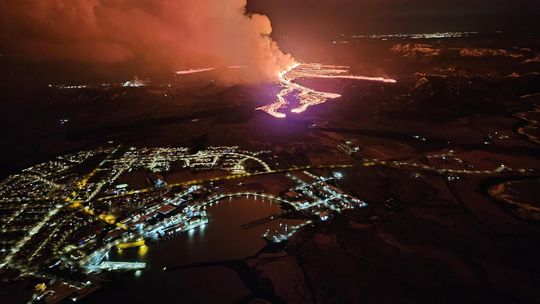


 Flight To Wonder