Note: Over at Vella, today’s episode is “Namesakes: Surtseyan.”
Ten years ago this month, a volcanic serial killer struck again. Thousands of its human neighbors had gotten out of Kelud’s way in time, thanks to careful monitoring and emergency planning, but the volcano still claimed some victims.
Let’s first visit Gunung (Mount) Kelud for its 2007-2008 eruption — VEI 2 in intensity — so you can get an idea of what the place looked like.
It’s quite pretty, and the emphasis in this Kelud Volcano Observatory (KVO) video is on mitigation, coexistence, and gratitude for the many benefits the volcano provides to people living in the area:
Cool! A gorgeous lava dome in the background for selfies, tourism income soaring, and state-of-the-art monitoring in place.
What more could anyone want?
Six years later, everyone wanted to put as much distance as possible between Kelud and themselves.
Using the Global Volcanism Program’s report on that VEI 4 eruption as a guide, here is what happened:
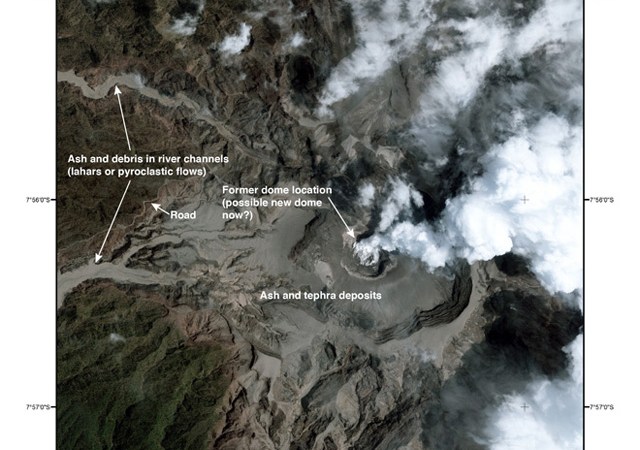
On 13 February 2014, the Indonesian National Board for Disaster Management (Badan Nasional Penanggulangan Bencana-BNPB) reported that a major eruption occurred at Kelut (also known as Kelud) volcano in East Java, Indonesia. Ground-based observers had little insight about the ash plume height, but a number of satellite observations helped to constrain the height and other eruption parameters such the direction of plume movement. CALIPSO satellite data revealed that a rapidly rising portion of the plume ejected material up to an altitude exceeding ~26 km, well into the tropical stratosphere. Most of the less rapidly rising portions of the plume remained lower, at 19-20 km altitude. The 2014 eruption destroyed a dome emplaced in the volcano’s caldera during the previous eruption in 2007 (BGVN 33:03 and 33:07). According to BNPB in a report issued on 18 February 2014, ~7 people were killed and ~100,000 evacuated. At least one commercial aircraft flew into the plume, later landing successfully but incurring costly engine damage.
There is a lot more detail in this report, including the good news that volcanologists saw it coming and everyone within 10 km of the crater evacuated a few days before Kelud exploded.
Video of the early moments of this eruption is impressive, even though it happened at night:
Kelud is very close to Surabaya, Indonesia’s second-largest city, and of course everyone there was affected by the ash:
There was a crater lake present at the vent. Water interactions with lava pulverized the ash so that it traveled quite far and got into everything.
Reportedly, at least some of the deaths, as well as most of the seventy hospital cases, were due to respiratory problems.
In addition, the lake water was responsible for huge mudflows, known as lahars.
The following KVO video doesn’t have English subtitles (here is a technical report in English), but it shows lahars and other visuals that give us some idea of the massive changes this 2014 eruption wrought:
More information:
- Global Volcanism Program page.
- Kelud’s catastrophic lahars in 1919 (remember: “serial killer”).
- GVP report on the deadly 1990 eruption (“serial killer”).
A little lagniappe:
Yes, this place is in East Java, too!
 Flight To Wonder