It wasn’t the scientists’ fault.
In 2015, they went to Reunion Island to study birds, and a storm drove away the birds and forced the boffins to spend Christmas in their tent.
It didn’t dampen their spirits:
On Réunion Island
Some people do live on this volcanic Indian Ocean island that’s located a little more than 400 miles east of Madagascar, but much of Réunion is just lava, hardened or still in motion.
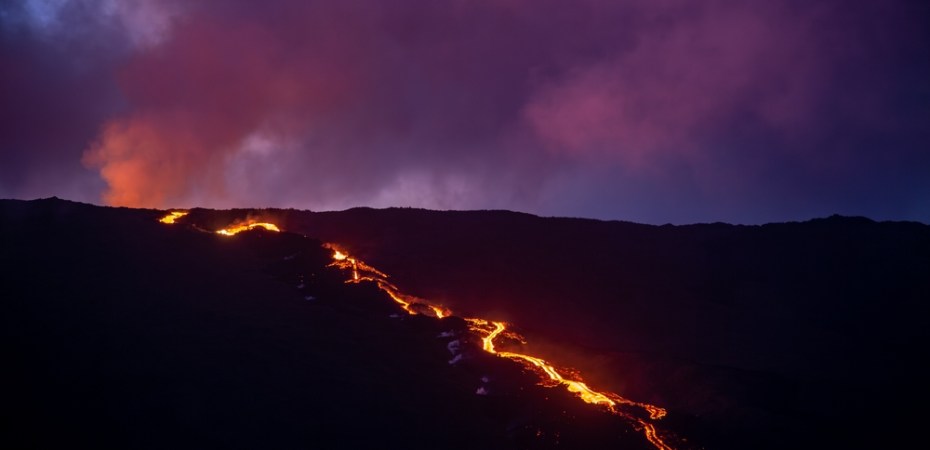
Locals (who are citizens of France) call the volcano Furnace Peak (Piton de la Fournais) — a furnace that’s usually open for business.
The soggy ornithologists presumably weren’t too close to this site on the island, filmed from August through October 2015:
Even if it wasn’t still erupting at Christmas, it probably would have made a terrible camping ground!
Here is Furnace Peak in July 2023 —
— and there is much more to see online from various Hawaiian-style flows here down through the years.
Like Hawaii, Réunion Island is a hot spot. This sort of thing goes on:
In fact, it has been going on for 65 to 66 million years, under seafloor and through whatever continental crust — say, India — that plate tectonics takes over the hot spot.
On the following animation that spans the last 200 million years of such movements, the Réunion hot spot’s location is that central red spot, though the 65 to 66-million-year-old plume itself actually broke through the crust around the time that southwestern India was passing over it (an eruption that appears in black in the video):
Plate tectonics moves crustal plates around, but hot spots have deep roots and tend to stay fixed in one location.
As you can see, that eruption went on for a while, even after India moved on.
It was a biggie, with some complex interactions.
Where Dinosaurs Come Into It
In fact, this is the huge eruption that everyone refers to when discussing the disappearance of nonavian dinosaurs and many other plants and animals in the end-Cretaceous major mass extinction.
We looked at it most recently in 2020.
The debate goes on over the contributions of the Deccan Traps flood basalts to that extinction event versus the immense effects of the Chicxulub impact just off what is now Mexico’s Yucatan Peninsula. (Here is just a little of the discussion from one paleontologist’s viewpoint.)
But testing, including the recent RHUM-RUM (“completely alcohol free“), suggests that today’s abundant Réunion Island volcanism comes from the tail end of that disastrous 65 to 66-million-year-old plume.
Not to worry — the really bad effects were from impact and eruption of the enormous head of that rather mushroom-shaped plume, long ago. All we have now, from the much smaller tail, is “regular” volcanism.
I wonder if those soggy scientists celebrating Christmas 2015 in a tent realized the connection, and if so, whether they saw the irony of their position: studying living “avian dinosaurs” while working on the remains of the very material that helped extinguish all the others.
Lagniappe:
Geonerds! Here’s an in-depth look at the RHUM-RUM expedition:
Featured image: Aymeric Bein/Shutterstock: First 2023 eruption of Piton de la Fournaise
 Flight To Wonder