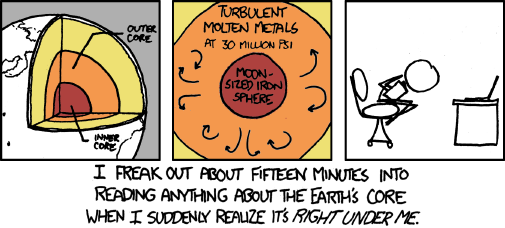
The Earth’s fiery, high-pressure core is about as far away from us as Sante Fe, New Mexico, is from New York City.
Fortunately for all life at the surface, that intervening 1,800 miles of mantle material is very good insulation.
Core heat, though, does sometimes rise up toward us in the form of a mantle plume.
The plume impacts one small area at the base of North America’s continental crust and starts going through tens of miles of granitic rock like a hot knife through butter.
The continent resists. Its surface starts to crack open. Glowing lava surges up into these huge cracks, over and over again, widening them, pooling as a mini-magma ocean in the broadest cracks.
Things will be bad when these lava floods are completely free to roll out across the land — much worse than even a superuption!
But then Nature saves the day.
In an unrelated geologic event, some big thing or things hit the edge of North America, not once but several times, applying enough force to hold the hapless continent together until that mantle plume finally weakens and the crustal cracking stops.
All the molten rock that is at or near the surface slowly hardens over time, and then it is buried by other geologic events.
You see, this isn’t science fiction.
It really happened to North America — back in the days when this land mass was part of a growing supercontinent called Rodinia (derived from a Russian word meaning “beget” and applied because, many decades ago, experts in ancient life thought animals first evolved in Rodinia).
As you can guess, the mantle plume catastrophe isn’t recent.
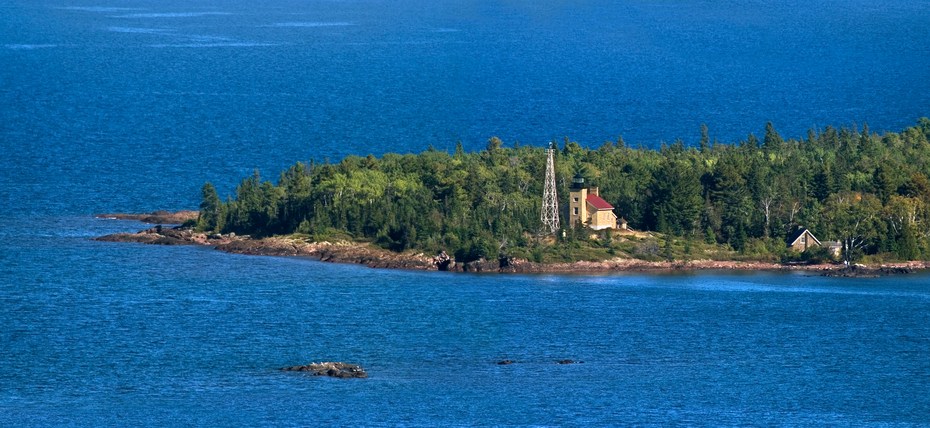
Here is how a small part of that former site of continental devastation is still weathering down after more than billion years:
But wait. There’s more!
The plume material contained valuable minerals (jargon alert) that H. sapiens would eventually exploit in many ways.
But first H. sapiens had to find this buried treasure.
Some lagniappe:
What happened to North America after Rodinia? Here is one hypothesis, out of several that I’ve come across while reading up on the Precambrian (be sure to fact-check their Yellowstone information with the boffins!):
There was basalt flooding from the Yellowstone plume impact, but it was nowhere near the scale that would have occurred if the Midcontinental Rift hadn’t failed — we’re talking seafloor spreading here!
Featured image: Doug Lemke/Shutterstock
 Flight To Wonder