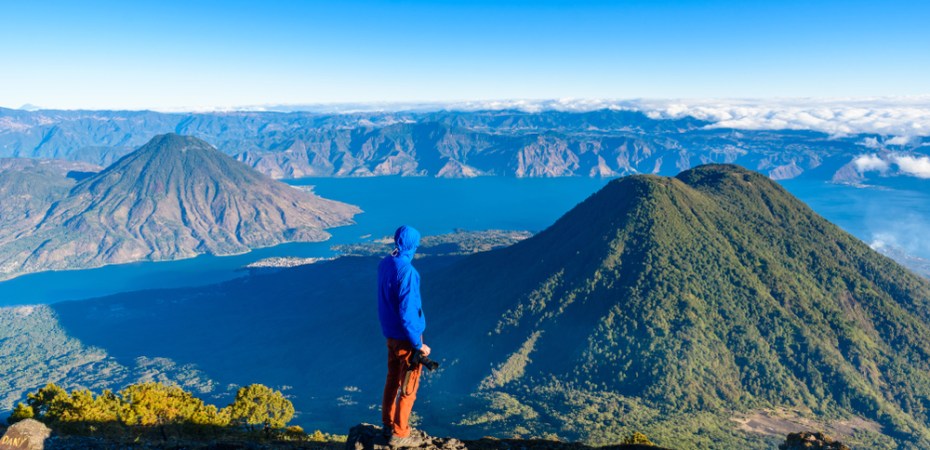
Remember how last week’s “aftermath of a supereruption” showed the beautiful Flagg ranch area as it is today, near Yellowstone?
That video was too short. Here is another gorgeous aftermath, the video taken some 75,000 to 85,000 years after what was more or less Ground Zero during the Los Chocoyos supereruption (jargon alert) at Guatemala’s Atitlán Caldera:
If these researchers are right, that eruption might have been part of a rare “superuption doublet” with Toba, over in Indonesia.
That is to say, the supereruptions were separate events — Guatemala is across the Pacific Ocean from Sumatra — but they might have happened within a thousand years of each other, a short enough interval for enabling such massive volcanic events to hit earth’s climate with a double whammy.
Today, Atitlán is the name of one of the three post-caldera volcanoes that you can see in the video (the other two are San Pedro and Tolimán).
These have formed on the caldera's rim, and the Global Volcanism Program reports that Atitlán has had several eruptions over the previous thousand years, last in the 1850s.
These were “normal” in size, not more than VEI 3 (which is problematical enough when people live nearby).
There was a deadly landslide from Tolimán in 2003, but the GVP notes finding no evidence of an eruption at either San Pedro or Tolimán since the Pleistocene ended.
What about Atitlán Caldera? Will it host another supereruption?
Nothing like that seems imminent right now.
Howver, according to this study, there is still magma down there, as well as some hydrothermal activity, and eventually Atitlán Caldera possibly could erupt again.
I like these videos of recovered beauty after volcanic devastation — is a series possible?
Let’s see next week.
A little lagniappe:
It is less easy for people to recover from something like this:
Featured image: Simon Dannhauer/Shutterstock
<hr
 Flight To Wonder