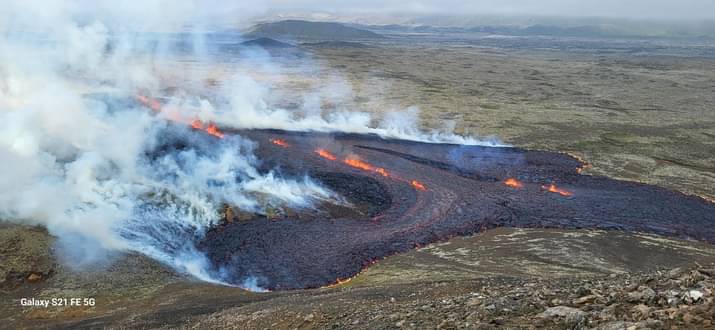
I had missed this eruption in the Fagradalsfjall Fires post and so went back in to this July blogging while developing an entry for that post. I was amazed at the similarities to what is happening now, right down to strongish quakes at Eldey and Kleifarvatn. Check it out for yourself (runs through mid-July 2023)!
- Icelandic Met Office, (autotranslated).
- IMO geoscientist notes, (autotranslated).
- Layperson Jón Frímann’s blog.
- IMO data and link to Norwegian Meteorological Office data (autotranslated).
- Icelandic Volcanoes Twitter feed.
Update, July 12, 9:27 a.m., Pacific: The eruption continues.
Per RUV, while it has decreased significantly from its start, the eruption’s power is still greater than that of previous ones recently.
34/ The clear weather over Iceland at the moment means that we've got a couple of clear passes from Sentinel, giving us a very good before/after shot of the first day of the Fagradalsfyall eruption. You can see just how extensive the lava flows are already. pic.twitter.com/SHQ7wTPXIU
— Alistair Hamill (@lcgeography) July 12, 2023
https://platform.twitter.com/widgets.js
Also, RUV reports, smoke from the burning vegetation is in itself hazardous, not least because it stays close to the ground, whereas the volcanic emissions tend to rise.
Keep the wind at your back, officials advise visitors (and already some 3,000 hardy people have made the 18-km round-trip foot trek to the eruption site, which is in a more remote place, fortunately).
Update, July 11, 9:13 a.m., Pacific: Here are the latest updates from IMO (autotranslated) and RUV English.
The good news is, the initial eruption intensity has decreased a lot. The gas levels are less, too, though I don’t know if the still-air weather conditions at the site are still a problem.
The less-good news is that the magma dike is moving, and at last report, was under Keilir (that triangular hill in the middle distance on some webcams). IMO notes that any new venting could occur there, though it’s more likely to happen near the currently open ones.
Update, July 10, 5:12 p.m., Pacific: Embedded a second RUV cam, and here is the latest geoscientist note from IMO:
An eruption began at Litla Hrút in Reykjanes at 16:40 today, July 10. It is believed that the fissure is now about 900 meters long, and the first assessment of the lava flow shows that it is much greater now at the beginning of an eruption than in previous eruptions in the area. Gas pollution is high in the vicinity of the eruption centers and can be dangerous. Gas pollution is likely in many places in Reykjanes and the capital area. People are advised not to enter the area until first responders have had a chance to assess the situation.
Some tweets — and this video — indicate that flow volume is high and gas is quite intense.
The area has been closed off. As I understand it, air traffic internationally and elsewhere in Iceland isn’t affected, other than a small no-go zone in Iceland air space over the active site.
One of the last images from tonight's drone livestream #Iceland #volcano pic.twitter.com/waovfPkKYF
— Duncan (@shaksper) July 10, 2023
https://platform.twitter.com/widgets.js
Update, July 10, 2023, 10:04 a.m., Pacific: It’s on!
Video of the smoke rising from the Reykjanes eruption – taken by my daughter Katla. pic.twitter.com/HkgD44keu0
— Gisli Olafsson (@gislio) July 10, 2023
https://platform.twitter.com/widgets.js
RUV reports on this initial news, with updates (autotranslated). Nice video close-up in this Visir article, too (autotranslated).
Update, July 10, 8:38 a.m. and 9:51 a.m., Pacific:
Where's the lava?
The Southern Volcanoes and Natural Hazards Group says that because the magma consists of relatively heavy primitive basalt, gas pressure is required to crack the final layer of crust. "It is impossible to predict exactly when it will happen".#Iceland #volcano pic.twitter.com/0gzm1z7qaz— Duncan (@shaksper) July 10, 2023
https://platform.twitter.com/widgets.js
Something neat I’ve rediscovered about Iceland: it never gets dark, this time of year.
And if you happen to be watching the cam at the right time of “night” you get to see the Sun apparently erupting from Keilir!

Quick update, 9:51 a.m.: Another tweet (per replies, it means that the magma is building up):
Icelandic news are now reporting an aseismic zone between Keilir and Fagradalsfjall. That zone appeared on Saturday according to the news report. #Iceland #earthquake #volcano
— Jón Frímann (@jonfr500) July 10, 2023
https://platform.twitter.com/widgets.js
Update, July 9, 2023, 5:13 p.m., Pacific: Ever see an earthquake?
Caught on camera: 5.3 earthquake at around 22:23 local time, potentially the most powerful earthquake yet measured in this sequence #Iceland #volcano pic.twitter.com/aGJFXzjeer
— Duncan (@shaksper) July 9, 2023
https://platform.twitter.com/widgets.js
Apparently, its intensity has been adjusted to 5.2, but that’s still the strongest one thus far, I think. Another “door opener”?
Update, July 9, 1:58 p.m., Pacific: Here’s the latest IMO update — lots of magma is about 1,640 feet below the surface:
Today marks 5 days since the onset of the seismic sequence between Fagradalsfjall and Keilir caused by a magmatic intrusion just north-east of the location of the 2022 dike intrusion that resulted in an eruption 5 days later.
Deformation in the area continues to slow down and seismicity is relatively quiet around the dike location.
Triggered seismicity northeast of Keilir and in the region between Keilir and Kleifarvatn continued with earthquakes at Kleifarvatn last night (8 July) the largest being magtnitude 4.6. It was widely felt in the Southwest region, in particular due to its closer proximity to the capital region than the dike location. Rockfall was reported in mountains by Kleifarvatn and Trölladyngja, including some rockfall on nearby roads.
A one-day ICEYE interferogram, spanning the 7-8 July 2023, constrains the location of the dike related deformation as of yesterday afternoon. The interferogram shows deformation related to continued inflow of magma into the dike as well as significant surface deformation related to movements on NE-SW trending faults and possible graben formation.
Geodetic modeling results based on the new ICEYE interferogram show that the magma continues to reach shallower depths, now estimated to be at half a kilometer below the surface. The modeling indicates that as of yesterday afternoon, the dike was not propagating further to the north or south, but remained at a relatively stationary location between Litli Keilir and Litli Hrútur, with a length of approximately 3 km. However, the dike continues to inflate and migrate upwards.
These measurements and modeling results indicate that magma is moving closer to the surface, with an eruption being a highly likely scenario, although the timing is still uncertain (hours to days).
This scientist sums up the accompanying map nicely and also provides a link to the IMO post:
The blue line on this map shows the modelled position of the magma-filled dike that is probably c.500 m below the surface.
If an eruption happens, it is most likely to happen somewhere along this blue line. #Iceland #eruption #Reykjanes https://t.co/a6qW1c98FV pic.twitter.com/NECbGFs13v
— Dave McGarvie (@subglacial) July 9, 2023
https://platform.twitter.com/widgets.js
Update, July 9, 9:03 a.m., Pacific: There is despair among some eruption-anticipators on Twitter, but per the IMO geoscientist notes today:
Earthquake series at Fagradalsfjall
Two earthquakes over M4 in magnitude were measured today. The larger one measured M4.3 at 08:28 at Keili. Yesterday at At 17:57 (July 8) an earthquake of magnitude 4.5 was recorded at Kleifarvatn. The tremor is believed to be due to voltage changes.
Since July 4, around 9300 earthquakes have been recorded between Fagradalsfjall and Keilis. The collapse is due to magma intrusion in the area. The biggest earthquake occurred on July 5 at 8:21, 4.6 in size. A total of 25 earthquakes over M4 in magnitude have been recorded. The biggest earthquakes are found in many parts of the SW country.
The seismic activity at Eldey has decreased considerably. Since July 4, almost 500 earthquakes have been recorded near Eldey.
Rockfalls can occur following strong earthquakes, so be careful on steep slopes. Residents in the vicinity of the area are encouraged to pay attention to loose and in-stock items.
Icelandic is tough even for Google Translate, but I think “voltage changes” means a quake indirectly triggered by the magma, which causes stress-field changes as it moves, forcing other faults in the area to adjust.
Not sure what “in-stock items” refers to, but the general meaning is clear.
Quick update, 9:55 a.m.: This was posted about 15 minutes ago:
Earthquakes continue as scientists try to determine how long until it reaches the surface. Currently believed to be at around 500m depth. The influx of magma into the dyke/chamber is estimated to be around 54m/s. The map below from @RUVfrettir shows locations used in tweets. pic.twitter.com/8WDgIpAod7
— Gisli Olafsson (@gislio) July 9, 2023
https://platform.twitter.com/widgets.js
July 8, 1:26 p.m., Pacific: This gentleman is an elected official in national government — for the Pirate Party, grant you, but serious and knowledgeable nonetheless.
Scientists say this quake is due to magma pushing it toward the surface. They believe the magma is at a depth of less than a kilometer and expect an eruption to occur within the next 24 hours.
— Gisli Olafsson (@gislio) July 8, 2023
https://platform.twitter.com/widgets.js
Of note, one of the Icelandic geoscientists I follow calls the quake a possible “door opener” and notes that it actually was only indirectly triggered by the rising magma but could still serve that pathway-to-surface function.
The IMO website thus far just has a note that the M4.5 happened, no updates otherwise since yesterday.
Quick edit, 1:39 p.m.: Just came across this:
Recent 4.5 triggered earthquake at Kleifarvatn heralds eruption, says professor Benedikt Halldórsson.
"Before the eruption began in August 2022, there were three earthquakes with a magnitude of 4.5 to 5 in Kleifarvatn, all triggered earthquakes." #Iceland #earthquake— Duncan (@shaksper) July 8, 2023
https://platform.twitter.com/widgets.js
Link to more information is in the reply.
Update, July 8, 10:35 a.m., Pacific: Still waiting:
Lovísa Mjöll Guðmundsdóttir told RÚV radio news that the lava is now so close to the surface that its depth cannot be measured – "we just have to wait and see if it manages to break through the last part or not"#Iceland #volcano https://t.co/ggTSrqgYZv
— Duncan (@shaksper) July 8, 2023
https://platform.twitter.com/widgets.js
July 7, 10:58 a.m., Pacific: I don’t know enough geography to say if and/or how this could be related to the ongoing dike activity, but IMO put the news in that post (autotranslated) as an update:
Updated July 7, 2023 at 4:15 p.m.
Just before midnight on July 6, an earthquake began at Eldey on the Reykjanes Peninsula. Around 3 pm on July 7, over 480 earthquakes have been recorded in the series. Of these, 38 have been reviewed. About 10 earthquakes above M3 and six above M4 have been recorded there, the largest one measuring 4.5, today at 05:06. Earthquakes in this area occur regularly, but the activity now is unusually high. In light of this, it has been decided to move the flight color code for Eldey to yellow.
Update, July 7, 7:10 a.m., Pacific: Per the IMO (autotranslated), seismicity has decreased a bit but their deformation monitors show that the magma is still moving upwards:
…Since the storm began, on July 4, around 7,000 earthquakes have been recorded in the area between Fagradalsfjall and Keilis. More than 300 earthquakes have been reviewed. The collapse is due to a new magma intrusion in the area, specifically between Fagradalsfjall and Keilis, and the middle of the corridor is believed to be between Litla Hrút and Litla Keilis. A total of 17 earthquakes over magnitude 4 have been recorded and over 50 over magnitude 3. The biggest earthquake occurred in the morning of July 5 at 8:21 and measured 4.8 in size. The largest earthquakes are found in many parts of SWland, east of Hella and north of Snæfellsnes. Continued seismic activity can be expected, but it has decreased slightly at the intrusion as time has passed. However, seismic activity in the area between Keilis and Kleifarvatn has continued and it is a trigger earthquake.
Despite decreasing seismic activity, deformation measured by GPS and InSAR strongly suggests that magma is moving closer to the surface. An InSAR image based on radar satellite data showing deformation between 28 June and 6 July corroborates the findings from the Met Office’s GPS and seismometer system regarding the magma intrusion. Model calculations based on the wave interpolation and GPS data indicate that the upper level of the magma intrusion reached a depth of 1 km in the first half of yesterday (July 6). Gliðnun is along a 2.8 km line between Fagradalsfjall and Keilis, centered just north of little Hrút, which is in very good agreement with what seismic activity has shown. They also show that magma inflow is almost twice as fast as in the run-up to the August 2022 eruption, but the total volume of magma that has arisen in the upper part of the crust is similar or about 12 million cubic meters. GPS measurements since then indicate that the magma is still moving closer to the surface…
This is my favorite part of these recent “runny red lava” eruptions in the Reykjanes area: that boffins can “see” so well what is happening underground and communicate it so clearly to the public.
Conditions here — social as well as physical — make that very in-depth knowledge and sharing possible, I suppose.
Update, July 6, 4:17 p.m., Pacific: This is happening very quickly.
Tweeted about an hour ago:
8/ Translated from Icelandic: New data shows magma is less than 1 km deep & even shallower than that. Flow of magma considerable. These are strong signs that an eruption may be imminent, according to Icelandic Met Office 6/7/23 https://t.co/Bp0llyomVi
— Alistair Hamill (@lcgeography) July 6, 2023
https://platform.twitter.com/widgets.js
Update, July 6, 1:17 p.m., Pacific: In the IMO’s 6 p.m. (local) post (autotranslated), there is a nice INSAR image of the ground deformation, which they explain in clear lay terms.
They also note (via Google Translate):
Based on current estimates, two scenarios are most likely. The seismicity may decrease steadily without magma rising to the surface. Alternatively, the magma could continue towards the surface, which would lead to an eruption at the current location of the earthquake. It cannot be ruled out that magma reaches the surface anywhere in the area between Fagradalsfjall and Keilis. Of the two, it seems more likely to erupt within days or weeks.
During the earthquake sequence, the greatest risk is due to seismic activity and the surface movements caused by larger earthquakes in the sequence, away from the main activity, together with trigger earthquakes on other cracks on the Reykjanes Peninsula. The largest earthquakes can cause local rock falls, so people are advised not to walk near rocky cliffs or steep slopes in the area around Keili, Fagradalsfjall and Kleifarvatn.
Meanwhile, on the webcam front:
The tremors are clearly visible on webcams. Here you can see a 3.2 earthquake that occurred after 11:00 this morning. pic.twitter.com/s2GVrdlyR7
— RÚV English (@RuvEnglish) July 6, 2023
https://platform.twitter.com/widgets.js
Update, July 6, 10:29 a.m., Pacific: Still waiting. Per the Iceland Review, this intrusion seems more energetic and broader than the previous two. Also, if it comes up and the lava heads north, there could be impacts on human “stuff.”
July 5, 10:23 p.m., Pacific: No eruption yet, but saw this:
Yes, is a new dyke intrusion! The fourth one into our @naspmon seismic network 😁🙏 you can see the time evolution on the zoomed pic of the refined events. The dyke is propagating aprox. from 2022 eruption site to Mt. Keilir.
Images from: @Vedurstofan pic.twitter.com/cPrYdplatd
— Dr. Thorbjorg Agustsdottir (@fencingtobba) July 6, 2023
https://platform.twitter.com/widgets.js
Original post:
We’ve looked at this densely populated (for Iceland) peninsula before, when seismicity there intensified in 2020 and, for the first time in several centuries, the area hosted eruptions in 2021 and 2022, which the USGS summarizes quite nicely here.
Well, there is more seismicity now, enough apparently to suggest that the entire peninsula might be a single volcanic system.
Of course, it is part of the Mid-Atlantic Ridge, which in theory can erupt anywhere, but those who subscribe to the idea might be referring to a single connected magma source, perhaps?
Anyway, I saw news of this in a couple places over the weekend but held off mentioning it in order to see if the story stands up or was just the product of some overexcitement.
It has legs.
A few online media sources have it. Per Reykjavik Grapevine:
The return of constant rumbling has geologists and volcanologists watching the area closely, with RÚV reporting that an eruption could be imminent at Fagradalsfjall.
The area last erupted at Geldingadalir in 2021 and Meradalir in 2022.
Volcanologist Þorvaldur Þórðarson told the radio station Bylgjan on Monday the land has been inflating under the entirety of the Reykjanes peninsula in recent weeks, signalling rising lava under the surface.
The rising land throughout the entirety of the peninsula – not just under the previous eruptions sites – also signals that the entire peninsula could be one giant active volcano rather than a chain of smaller volcanoes, as previously believed. In theory, that means that lava could begin erupting from any place on the Reykjanes peninsula.
UPDATE, July 5, 13:00 — The man of the hour, Þorvaldur further told Morgunblaðið Wednesday morning the seismic activity indicates another eruption on the Reykjanes peninsula appears imminent. He said there are signs – including the shallow depth of the the earthquakes – that a considerable amount of lava is pooling below the surface, with the estimated location of an eruption being just north of Meradalir, which last erupted from August 3 to August 22, 2022.
Based on the degree of land rise in the area, Þorvaldur notes that the eruption could be larger than those that occurred in 2021 and 2022.
Most important of all is that the Icelandic Met Office reports (autotranslated) the possibility of an eruption in hours to a few days, though they note also that it’s possible that things will quiet down again.
More as this develops.
Featured image: RUV Enish
 Flight To Wonder