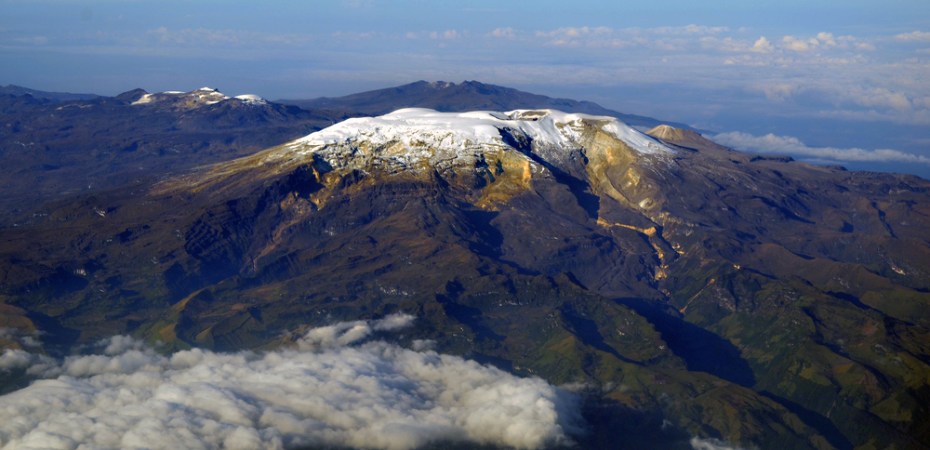
- Status: Yellow.
- Live stream (Telecafe):
-
Links to still-image webcams, public data, and other information.
- Interactive official hazard map (autotranslated), via Relief Web; En español
- Update archive.
December 26, 2023,9:47 p.m., Pacific: Ruiz has been cranking up again but is still at Yellow alert. However, in their weekly update today (PDF, Spanish), SGC notes that it could go to Orange or Red with little warning.
Per Google Translate:
Manizales, December 26, 2023 07:50 p.m.
Weekly newsletter on Nevado del Ruiz volcano activity
From the monitoring of the activity of the NEVADO DEL RUIZ VOLCANO, the MINISTRY OF MINES AND ENERGY through the COLOMBIAN GEOLOGICAL SERVICE (SGC) informs that:
In the week between December 19 and 25, 2023, the volcano continued to present a
unstable behavior, characterized by a slight increase in activity levels. Compared to the previous week, the main variations in the monitored parameters were:– Seismic activity associated with rock fracturing inside the volcanic building increased in the number of earthquakes recorded and in the seismic energy released. The earthquakes were located
mainly on the eastern flank of the volcano and, to a lesser extent, on the different flanks of the volcanic building, at distances of up to approximately 11 km from the Arenas crater. The depths of the events varied between less than 1 and 9 km from the top of the volcano. One stands out
increase in this type of seismicity on December 24 and 25, in the eastern sector, approximately 5 km away from the Arenas crater, with depths between 3 and 4 km. Some of them were reported as being felt by inhabitants of the sectors of La Cabaña and the canyon of the
Lagunilla River, in the department of Tolima, as reported in the extraordinary bulletin published yesterday, December 25. The earthquakes reported as felt occurred on December 24 at 2:02 p.m., 2:03 p.m. and 5:15 p.m., and on December 25 at 8:13 a.m. and 11:35 a.m., being the one at 8:13 a.m. December 25th the most energetic during the seismic increase and of the week, with a magnitude of 2.5. Additionally, between 11:01 p.m. on December 24 and 7:40 a.m. of the 25th December, seismicity was recorded associated with the activity of the dome (protuberance or mound) of
lava located at the bottom of the crater. The earthquakes were of low to moderate energy level and were related to both rock fracturing and fluid dynamics.– Seismicity related to pulsatile emissions of ash and gases into the atmosphere increased in the
number of earthquakes recorded and seismic energy released. The energy levels of these … Seismic events were low and occasionally moderate. Through the cameras used in monitoring of the volcano, it was possible to confirm some of the recorded ash emissions, as well as various changes in the relative temperature of the emitted material.– The volcano continued to emit water vapor and gases into the atmosphere. The degassing rates of sulfur dioxide (SO2) were variable. The maximum height of the gas and ash column was 1500 m vertically and 1900 m dispersion. These values were measured on the top of the volcano on December 21 and 22, respectively. The column dispersion direction was variable with preferential tendency towards the southeastern flank of the volcano the first days of the week and towards the
southwestern and northwestern sectors during the weekend, generating ash fall in areas close to the volcano and in the city of Manizales.– In monitoring the thermal anomalies detected at the bottom of the Arenas crater through the satellite monitoring platforms, like the previous week, persist within energy levels moderate.
It is not ruled out that gas and ash emissions continue to occur which, in accordance with the winds that prevail at the time of emission, disperse towards populated centers, generating
affectation due to falling of this material. On the other hand, in this state of volcanic alert, present some earthquakes that can be felt.From the SGC we make a recommendation to call people who visit the National Park
Natural Los Nevados so that they do not approach the areas closest to the Arenas crater, where access is restricted, since the persistence of the anomalies, the activity related to the lava dome and the Frequent ash emissions make this sector of the park risky for the life and integrity of people.It is important not to normalize the behavior of the volcano in a state of Yellow alert. Although this state indicates that the volcano presents less instability and, consequently, less probability of making a considerable eruption, at any time its activity could increase and go into a state to Orange alert (volcano with important changes in the monitored parameters) or even to Red
(Erupting volcano).For this reason, from the SGC we recommend carefully monitoring its evolution through the bulletins, weekly and other information published through our official channels, as well as the instructions for local and departmental authorities, and the National Unit for Disaster Risk Management(UNGRD).
October 12, 5:23 p.m., Pacific: This just in from the SGC:
🗣️ Les informamos que este jueves, 12 de octubre, en el seguimiento desde las plataformas de monitoreo satelital, se observaron cambios en la anomalía térmica que existe en el fondo del cráter Arenas del volcán Nevado del Ruiz.
Abrimos 🧵 para contarles más… pic.twitter.com/eAYP1FOFWT
— Servicio Geológico Colombiano (@sgcol) October 12, 2023
https://platform.twitter.com/widgets.js
Twitter will translate it; do read the whole thread.
Basically, they have noted a change in the summit crater thermal anomaly. That’s all for now, and they are keeping it at Yellow alert. They just wanted to give everyone in harm’s way a heads-up.
It has been a long time since the last update, and for now, pinning and daily blog updates here aren’t called for.
We’ll just have to wait on the volcano.
Featured image: Ric Photography/Shutterstock
 Flight To Wonder