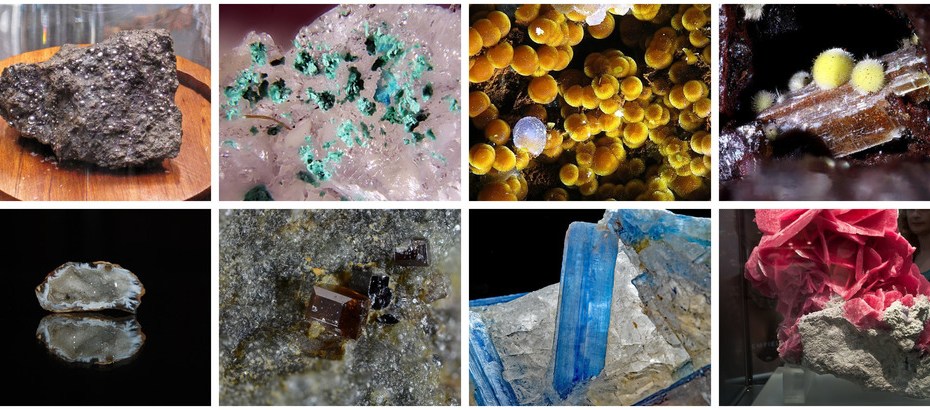
It’s good to have a history — some recent winners have moved forward, but I’ll try to find new pictures and links for them.
They need all the help they can get because the competition is tough to beat.
Which ones would you choose?
Match #5: Quicksilver and calcite
No, not that — mindboggling as the scene’s effects and videography are.
This:

Granted, it doesn’t seem very quick here, but that’s what it looks like in its natural environment underground; it is liquid at Earth’s surface. Mindat page. (Image by James St. John, CC BY 2.0
Actually, this makes a better movie clip because those terrifying coalescing T-1000 droplets, in real life, are made out of this.
Well, with such an A-list filmography under its belt, this is the all-time mineral winner, right?
“Hold on!” The creaky old voice sounds old enough to be Father Time.
And hundreds of millions of years do separate us from trilobites — perhaps the first fossils to leave evidence of natural eye lenses.

“I lost a lens — don’t anybody move till I find it!” (Image source)
While reading up on Precambrian and Cambrian times for my cat evolution project, I learned that there is quite an ongoing debate about trilobite eyes by experts who want to understand how today’s insects developed their compound eyes.
For today’s post, I didn’t want to go into all that and arbitrarily chose the most authoritative source on page 1 of the search results and moved on. (That’s a doozy of an abstract, but it does confirm the mineral’s usage).
Eyes and movies can connect, and this mineral might very well be Nature’s original version of the hard lens.

Here, the mineral fills a geode. Mindat page. (Image by bvick390 from Pixabay)
Match #6 (Guano is involved)
Isn’t that cheating? Aren’t minerals supposed to be formed by nonbiological processes?
Only sometimes, per Dr. Wikipedia.
In terms of our contest, though, this competitor fits the traditional definition — it forms when rock containing copper reacts with bird/bat poop guano.
That rarely happens, and I can only find one Creative Commons image of it:

That’s okay: it’s sparkly and a very pretty copper blue! Mindat has more; for contrast, remember the origin of all that shiny stuff. (Image by David Hospital via Wikimedia, CC BY-SA 4.0).
What on Earth could compete with that?
How about something that’s found in stars? Can’t get much farther from a bat cave than that!
The fact that this mineral also erupts from Mount Vesuvius, frankly, seems like overkill.

These dark crystals are in Japan. Mindat page. (Image by D. Nishio, CC BY-NC 2.0.
Match #7: “Orange puffballs vs. blue sceptres!”
Yep. That’s a direct quote.
This —

Mindat page. (Image by Cristian Rewitzer via Wikimedia, CC BY-SA 3.0.)
Versus one of our old friends.
This:

IGS page. (Image by Géry Parent, CC BY-ND 2.0.)
Match #8: Beauty and the beast
That’s my description of two minerals that we have already met:
A rocky rose —

Jake Slagle, CC BY-NC 2.0.
And the “Jenga rock” —
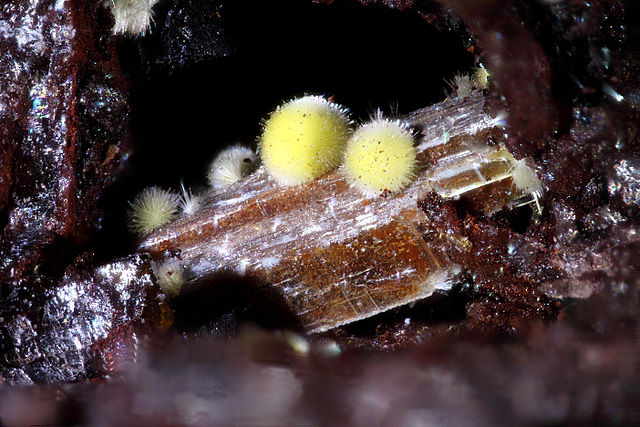
These stone puffballs, unlike those up above, contain uranium, as does the Mineral Cup contestant they’re growing on — just so much radioactivity! (Image by BLFrank via Wikimedia, CC BY-SA 4.0.)
Brrr! Whoever dreamed there could be so much drama in rocks.
Now then — a surprise announcement.
Match #8 voting closed yesterday.
Today, at the time of posting, the Match #1 Quarterfinals page is live.
And that deserves a post of its own.
Some lagniappe:
Speaking of overkill…
Of note, the cave has been flooded since 2015, and the crystals can grow again in that mineral-rich water. (Source)
 Flight To Wonder