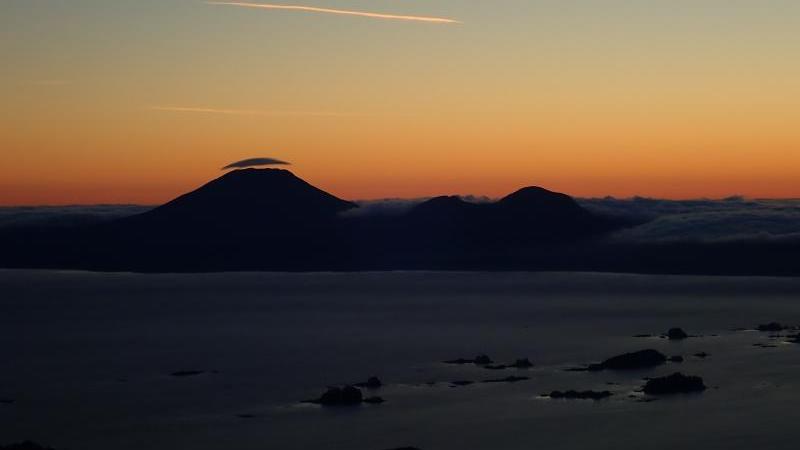
This image was taken on August 26, 2023. As you can see, Edgecumbe (left, wearing a small cloud for a hat) is waaay out there, but it’s still in daytripper range for —
Scientists:
August 30, 2023.
Hikers:
July 14, 2023.
and prankers:
What a great place to relax and enjoy Nature!
Yet despite that 4,000-year-long slumber, the Alaska Volcano Observatory spent most of this year building a monitoring network on Mount Edgecumbe — they have just completed it.
Why did they go to all that work and expense before an Alaskan winter comes to make field trips much, much harder?
(Hint: It’s not because they’re concerned that next year’s April Fooler might not give authorities a heads-up for fear of getting busted by the EPA.)
Magma is moving below Mount Edgecumbe
Frequently erupting volcanoes are hard on the neighbors, but they give geoscientists lots of data to work with.
The boffins have few clues about what to expect when a long-dormant volcano like Mount Edgecumbe stirs — the geologic record is very helpful, of course, but even if perfectly preserved (never the case), it contains little to no evidence of the processes associated with those ancient eruptions; processes that might be starting up again.
Understanding processes like these (jargon alert) is key to providing warnings and emergency management decisions as early as possible before the eruption.
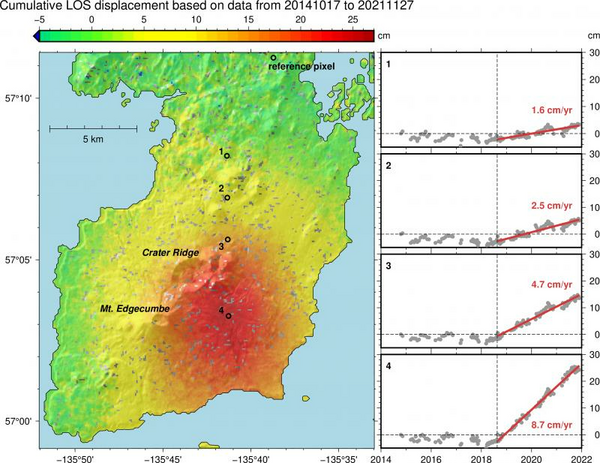
This satellite image graphic from an article, also linked in post text, isn’t as pretty as the above videos but it’s much more helpful to researchers, showing how the rise of underlying magma makes Mount Edgecumbe expand. Yes, all of that massive mountain is inflating like a balloon!
At Edgecumbe,the USGS explains in this June 2023 article:
…On April 11, 2022, Alaska Volcano Observatory (AVO) scientists observed seismic activity at Mount Edgecumbe on Kruzof Island near the town of Sitka, Alaska. Except for an elaborate April fool’s day prank in 1974, this volcano has remained quiet for around 4,000 years based on its geologic record…[satellite studies] successfully identified deformation that started long before the recent earthquake swarm. Retrospective analysis of seismicity at the nearest seismograph in Sitka showed an increase in low-magnitude seismic activity in mid-2019…An influx of magma into a volcanic edifice such as this does not indicate the potential of an eruption. This merely is the indication that there is some magmatic activity at depth. Scientists expect more changes in deformation, higher rates of seismicity, and detection of volcanic gases prior to any eruption at Mount Edgecumbe. This summer, AVO will install further instrumentation and conduct gas and geologic studies at Mount Edgecumbe, in addition to continued InSAR and seismic analyses, allowing scientists at the Alaska Volcano Observatory to better monitor this volcano for such changes…
And they just finished that network setup.
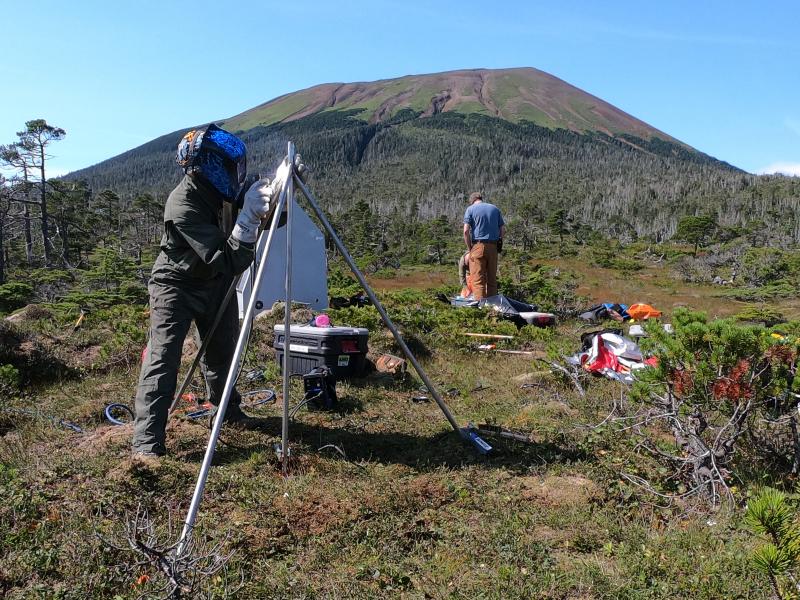
Mount Edgecumbe is on the AVO’s list of monitored volcanoes now. When enough data has been collected and analyzed, you’ll find the results — and lots of other interesting stuff — on the Observatory’s Edgecumbe page.
What if Mount Edgecumb erupts?
It isn’t on the USGS hazard assessment list, but that came out in 2018 before scientists learned of Edgecumbe’s seismic swarm.
There are air traffic lanes overhead — see the contrail (I think) in this post’s title image?
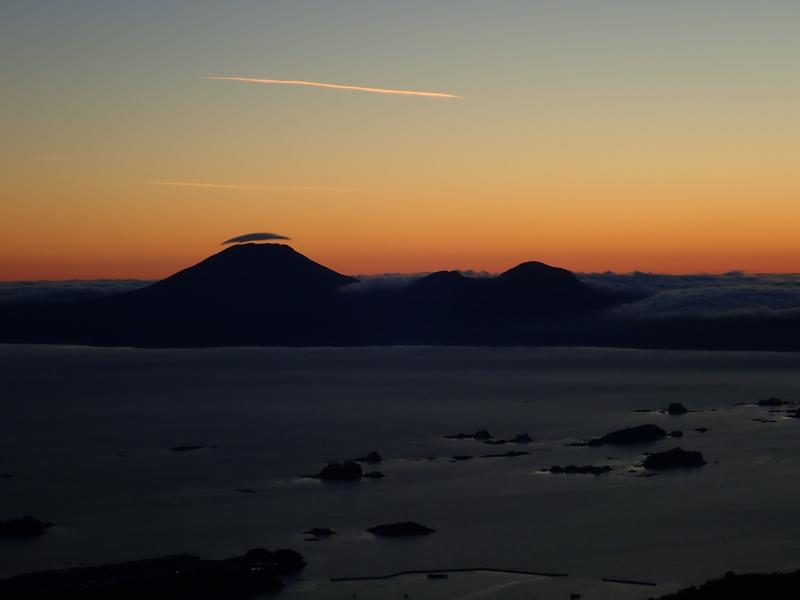
Here it is again (credit at end of post).
International air traffic might need to be redirected if Mount Edgecumbe erupts explosively.
Also, per the Global Volcanism Program, more than 7,000 people nearby are at risk.
A lot depends on the eruption intensity, as well as weather and other factors. For general information, here is AVO’s page on volcanic hazards.
Volcano monitoring doesn’t guarantee safety or 100% prediction accuracy, but everyone within reach of Mount Edgecumbe is better off now that Alaska’s volcanologists put in a hard summer’s work.
May they enjoy a long and quiet winter’s nap!
But be careful while laying in supplies.

Featured image: M. Kaufman/Alaska Volcano Observatory / University of Alaska Fairbanks, Geophysical Institute, public domain.
 Flight To Wonder