The longstanding eruption at Hunga Tonga-Hunga Ha’apai looked very impressive on January 14, 2022:
But that was just the pregame warmup.
You might have seen parts of this Tonga Geological Services (TGS) video online and thought it was the Big One — no, that occurred the following day, when apparently no one at ground level was filming.
Describing the video above, TGS notes:
This was an aerial capture from an unmanned aircraft viewing northeastward with Hunga Ha’apai Island in the forefront and Hunga Tonga Island in the left background. This was possible by a voluntary assistance of the His Majesty’s Armed Forces Naval Vessel Ngahau Koula, taking the Tonga Geological Survey Team to observe the sudden explosive eruption observed on Himawari satellite with volcanic ash rising to over 25km into the atmosphere. This occurred suddenly after the volcano had appeared silent for almost 7 days prior.
This huge display of gigantic release of energy was expected to be the end of the eruption. However, it was not to be.
Let’s look at how events that culminated in the massive January 15th blast unfolded.
The new island

Source, Figure 1
In late 2014, eruptive products from the submarine volcano Hunga connected the uninhabited Tongan islands of Hunga Tonga and Hunga Ha’apai together, forming a new island.
No one was particularly surprised, since Hunga also had shown surface activity in 2009.
According to reports on the Global Volcanism Program page, by 2015 the new island was “about 120 m high, 1.5 km wide (N-S), and 2 km long (W-E). The island was an estimated 1 km in diameter with a crater that was 400-500 m in diameter.”
The eruptions then quieted down and it now appeared to be a good place to study how life colonizes new land.
On December 20, 2021, Hunga erupted again:
The big blast
While we tend to think of the Hunga Tonga eruption as a mushroom cloud, it actually went on at a fairly low level for a while after the December renewal of activity.
In December 2021, authorities set up a 5-km exclusion zone. Surtseyan-style eruptions made the new island several hundred meters bigger. Ash fell up to 10 km away, and a few air flights were affected. (GVP)

Tanya Harrison, Planet Labs, via GVP
Then things calmed down around January 3 and stayed that way until the big eruption on January 14th (shown in the video at the top of the page) took out the middle third of the new island. (GVP)
Eruptions continued through the next day and then, around 5 p.m., this happened:
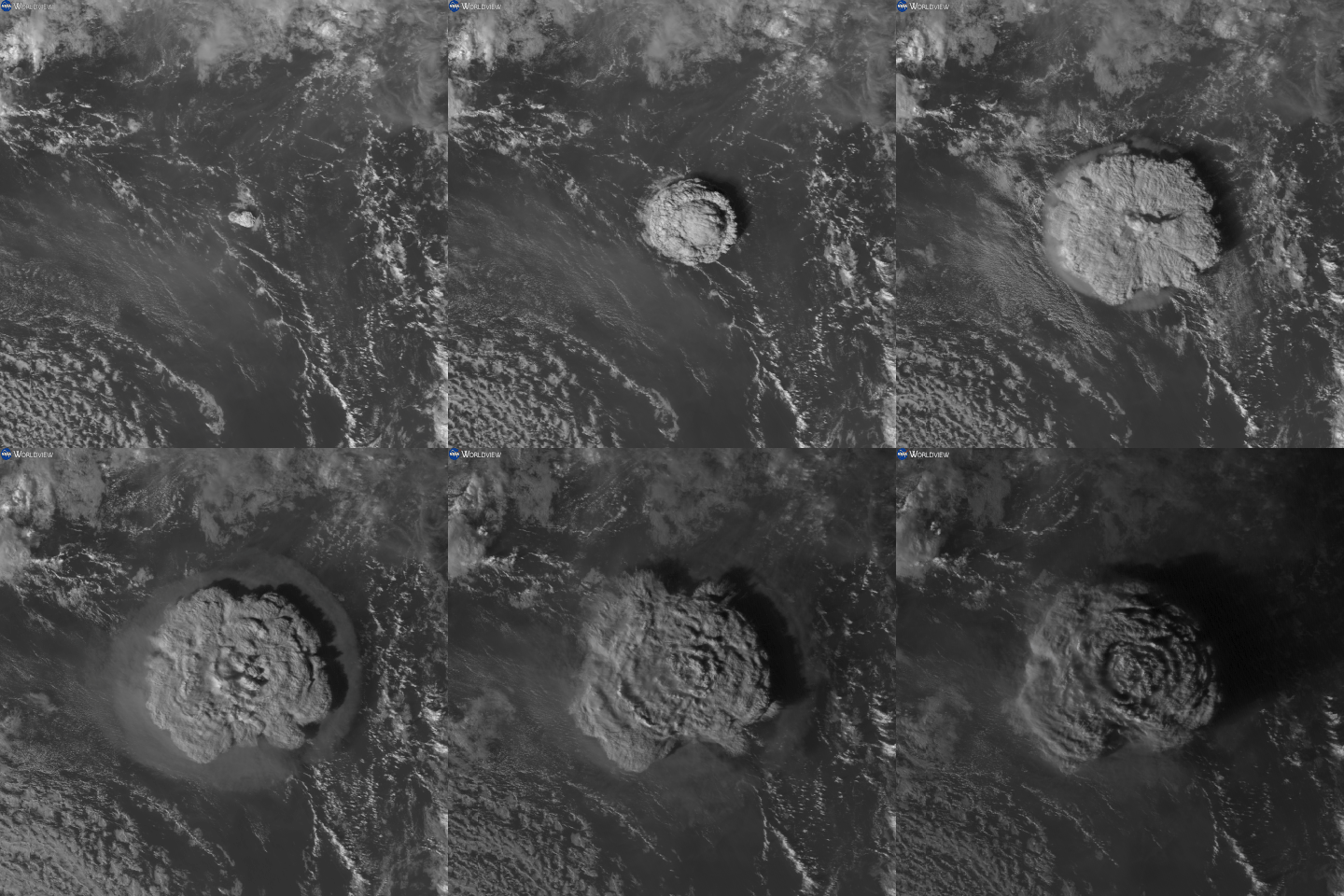
Japan Meteorological Agency/NASA SPoRT via Wikimedia, CC BY-SA 4.0.
But how?
I can’t find any videos about it, and geoscientists are apparently still discussing this.
Per an article by Dr. Shane Cronin, who is familiar with the region and was part of the team that first studied the new (and very short-lived) island in 2014-2015:
…at least three different magma sources were involved. Radium isotope analysis shows two magma bodies were older and resident in the middle of the Earth’s crust, before being joined by a new, younger one shortly before the eruption.
The mingling of magmas caused a strong reaction, driving water and other so-called “volatile elements” out of solution and into gas. This creates bubbles and an expanding magma foam, pushing the magma out vigorously at the onset of eruption.
This intermediate or “andesite” composition has low viscosity. It means magma can be rapidly forced out through narrow cracks in the rock. Hence, there was an extremely rapid tapping of magma from 5-10km below the volcano, leading to sudden step-wise collapses of the caldera.
The caldera collapse led to a chain reaction because seawater suddenly drained through cracks and faults and encountered magma rising from depth in the volcano. The resulting high-pressure direct contact of water with magma at more than 1150℃ caused two high-intensity explosions around 30 and 45 minutes into the eruption. Each explosion further decompressed the magma below, continuing the chain reaction by amplifying bubble growth and magma rise.
After about an hour, the central eruption plume lost energy and the eruption moved to a lower-elevation ejection of particles in a concentric curtain-like pattern around the volcano.
This less focused phase of eruption led to widespread pyroclastic flows – hot and fast-flowing clouds of gas, ash and fragments of rock – that collapsed into the ocean and caused submarine density currents. These damaged vast lengths of the international and domestic data cables, cutting Tonga off from the rest of the world.
A 24-minute compilation of videos taken 40-some miles from these events.
And in an earlier article, Dr. Cronin noted that “the eruption on January 15 seems to be right on schedule for a ‘big one'” at Hunga, which apparently does this every 1,000 years or so.
He suggests that the submarine volcano’s smaller eruptions — like the one that began in 2014, connecting Hunga Tonga and Hunga Ha’apai islands — happen on its rim. Big caldera-forming blasts like that of January 15, 2022, are millennial.
During the eruption, Hunga’s caldera floor went from a depth of 150 m to 850 meters below sea level. (BBC)
What about the two original islands?
Each was broken but neither was destroyed. And both were tall enough to keep their heads above water when the Hunga rimrock they are built on sank into the abyss:
The island remnants at the edge of the Hunga caldera – Hunga Tonga first with <10% of the island left (collapse to a deep abyss to the left in this view. Then turns to Hunga Haapai <25% of its former size – collapsed toward us and to the caldera (left in this view) pic.twitter.com/17KD2nkfMC
— Shane Cronin (@scronin70) April 10, 2022
https://platform.twitter.com/widgets.js
Reaching the mesosphere
So how did Hunga Tonga’s plume get to the heights we described last week?
As I understand it, this happened through overshoot of the plume’s gas content (ash is too heavy to make it that far).
I think the basic physics involves something like what’s shown in this model of Pinatubo’s 1991 column movement.
I found no simple videos describing the process. Dr. Clive Oppenheimer put it most clearly for me, in his book Eruptions That Shook The World, by pointing out that high-rising eruption columns result from a combination of heat and a rapid discharge rate at the vent.
That beautifully incandescent stuff in lava fountains doesn’t heat up the air the way tephra in a plinian column does.
The column entrains that heated air, and (per Dr. Oppenheimer):
Once sufficient air is sucked in and heated up, the plume becomes less dense than the ambient air and convects upwards. Its buoyancy will loft it to the height where it has the same density as the surrounding air. It may even overshoot this point thanks to its momentum but it will then sink back under gravity to its ‘neutral density level’, flowing downwards and outwards to form a mushroom or umbrella-like cloud…
But Pinatubo and other plinian-tempered fire mountains weren’t hit with a massive “magma hammer” within the first five minutes of their main event.
If you don’t mind another lengthy quote, Hunga Tonga’s blast was on a whole ‘nother level (video added):
The eruption of Tonga’s underwater Hunga Volcano culminated on 15 January 2022 with a giant volcanic plume that rose out of the ocean and into the mesosphere. This plume created record-breaking amounts of volcanic lightning observed both from space and by radio antennas on the ground thousands of kilometers away. We show that the eruption created more lightning than any storm yet documented on Earth, including supercells and tropical cyclones. The volcanic plume rose to its maximum height and expanded outward as an umbrella cloud, creating fast-moving concentric ripples known as gravity waves, analogous to a rock dropped in a pond. Point locations of lightning flashes also expanded outward in a pattern of donut-shaped rings, following the movement of these ripples.
Optically bright lightning was detected at unusually high altitudes, in regions of the volcanic cloud 20–30 km above sea level. Our findings show that a sufficiently powerful volcanic plume can create its own weather system, sustaining the conditions for electrical activity at heights and rates not previously observed. Overall, remote detection of lightning contributed to a detailed timeline of this historic eruption and, more broadly, provides a valuable tool for monitoring and nowcasting hazards of explosive volcanism worldwide.
— Source
I’m keeping an open mind on it and will close this post for now. Next time, maybe, we can take a brief look at how volcanoes influence climate.
That’s generally speaking, of course. We’ll have to wait for the AGU meeting workshop this December to hear some of the ideas about Hunga Tonga’s effects.
Got room for some lagniappe from 2019?
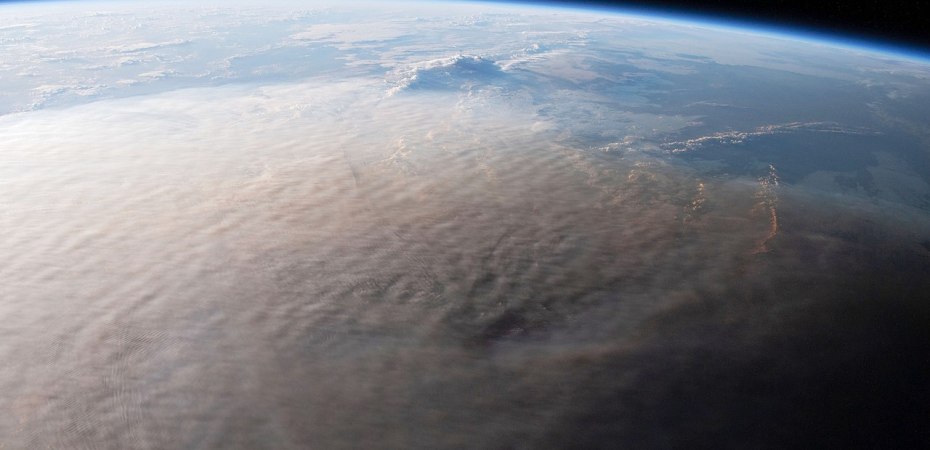
Featured image: NASA Earth Observatory via Wikimedia, public domain.
 Flight To Wonder