- Global Volcanism Program page.
- Darwin VAAC.
- Google Scholar
The last two Sunday Morning Volcano posts have taken us to the Near Oceania part of eastern Melanesia.
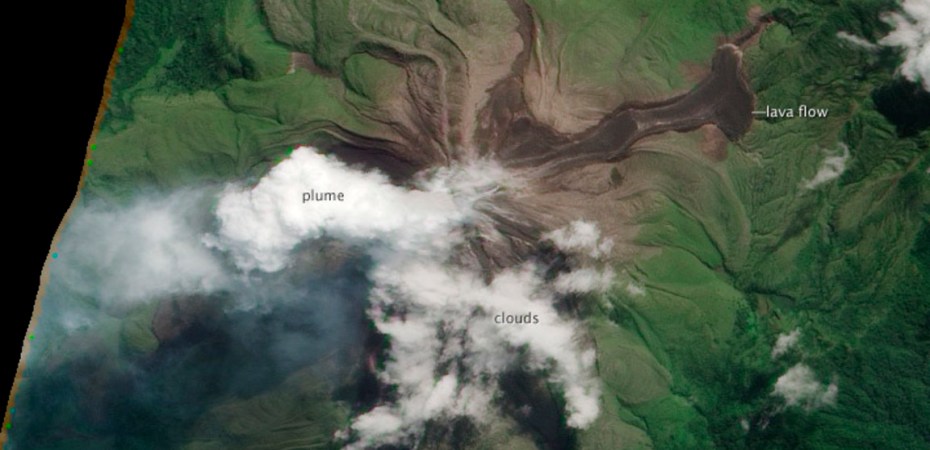
Well, Ulawun and Ritter are quiet, but Bagana Volcano on the island of Bougainville erupted recently (the image above is from 2012) and it’s still causing so much trouble that Bougainville leaders have actually asked for military humanitarian aid from Papua New Guinea, whose soldiers were banned from the island twenty years ago as part of the peace accords ending years of bloody strife.
That is a very big deal.
Here is more context.
In strictly geological and humanitarian terms, Bagana is very remote but is reportedly affecting some 8,000 people.
This was posted five days ago:
More information:
- Global Volcanism Program (GVP) page.
- Darwin VAAC.
- Google Scholar
Update
December 17, 2025, 7:03 a.m., Pacific: I am updating all these posts, and Bahama seems to be stirring again.
Per the GVP:
Most Recent Weekly Report: 27 August-2 September 2025
The Darwin Volcanic Ash Advisory Centre (VAAC) reported that ash plumes from Bagana were identified in satellite images rising to 2.1 km (7,000 ft) a.s.l. and drifting NW during 27-28 August.
August 23, 2023, 5:51 p.m., Pacific: Just saw this. Things are bad there.
Per the GVP:
Most Recent Weekly Report: 16 August-22 August 2023
RVO received no reports about volcanic activity at Bagana during 31 July-16 August due to the lack of information coming from the Torokina area. Photos of summit activity taken during 17-19 showed ash emissions rising no higher than 1 km above the summit and drifting SE; a small explosion produced an ash plume during the morning of 19 August. Deposits from small pyroclastic flows were also evident in the photos; lava flows and the pyroclastic-flow deposits were also identified in satellite data. Two temporary seismic stations were installed near Bagana on 17 August at distances of 7 km WSW (Vakovi station) and 11 km SW (Kepox station). The Kepox station immediately began recording continuous, low-frequency background seismicity. The Alert Level remained at Stage 2 (on a four-level scale).
August 22, 9:06 a.m., Pacific: Other nations, and finally, the UN have been helping, but I noticed this volcano-related goal in a Relief Web update: “Urgent need to establish monitoring systems at both Mt Mount Bagana and Mt Balbi to determine if eruptions are continuing and will lead to a major eruption or receding to safe levels.”
August 10, 2023, 6:47 a.m., Pacific: There is some ash emission reported, plus a strong thermal anomaly at the summit, per the GVP update through August 8th, but the main news is that US Marines are going in with humanitarian aid.
The cynic in me whispers “Geopolitics,” but common sense suggests that, given the recent lengthy war and the fragility of ongoing autonomy talks, the sight of Papua New Guinea military ships in Bougainville waters might have inflamed people, despite the humanitarian reasons for their presence.
Just a guess, but there we are, apparently. Hope things stay calm, locally and geopolitically, as well as geologically.
July
2827, 12:28 p.m., Pacific: Per the GVP through July 25:According to new articles, more than 7,000 people needed temporary accommodations due to the eruption at Bagana, with about 1,000 of those in evacuation shelters. Ashfall was deposited over a broad area, contaminating water supplies, affecting crops, and collapsing some roofs and houses in rural areas. Schools were temporarily shut down. The Alert Level was lowered to Stage 2 (on a four-level scale).
But per the provincial news station’s Facebook page, July 28th:
Bougainville’s Regional MP and Internal Security Minister, Peter Tsiamalili is concerned with the limited capacity and lack of urgency in responding to the Mount Bagana Volcano disaster.
Tsiamalili says even more concerning is the lack of speed from scientists, in communicating to authorities the risk level of the emergency, a week after conducted aerial and physical assessment on the system, and three weeks after the initial mild eruption.
…
He says while authorities are currently focused in receiving, settling and caring for the displaced population on either sides of the Crown Prince Range, it is critical they are also informed of the state of the disaster and possible projections of future activities of the volcano to continue ongoing and future planning into the emergency…
Effectively managing volcanic hazards involves SO much more than just putting some technology on the fire mountain and having trained personnel monitor it.
For best results, there must also be all-around communication, and everyone must get involved.
In particular, public officials must try to understand that scientists are information specialists, not wizards or policy decisionmakers; scientists must try to pass along complex information in simple lay terms, in a geopolitical/social setting that might not be ready for the sort of hard truths and uncertainties that volcanism often throws at H. sapiens; and we laypeople need to work with authorities but take responsibility for our own safety and wellbeing.
That’s a tall order anywhere in the world, but especially in areas whose history includes so much grief and complex upheavals.
Anyway, the station also reports that kids are in class again, so I’ll unpin this for now.
Space-station view of Bagana’s plume in 2021.
Featured image: Bagana erupting in 2012, by NASA.
 Flight To Wonder