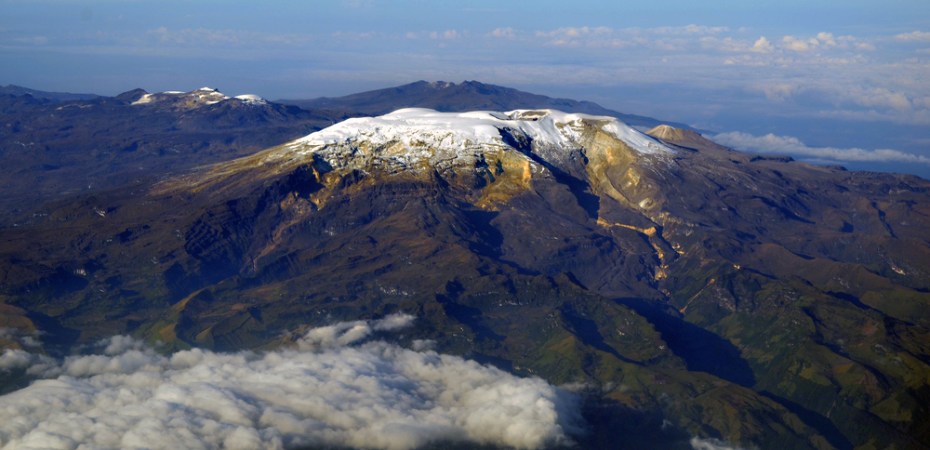
- Status: Yellow.
-
Live stream via Telecafe:
Weather permitting. Also, here are links to still-image webcams, public data, and other information.
- Interactive official hazard map (autotranslated), via Relief Web; En español
- Update archive.
Update, June 27, 12:06 p.m., Pacific: They’ve lowered the level back to yellow!
The bulletin just came out. Here it is via Google Translate (emphasis original):
Manizales, June 27, 2023 02:00 p.m.
From the monitoring of the activity of the NEVADO DEL RUIZ VOLCANO, the MINISTRY OF MINES AND ENERGY through the COLOMBIAN GEOLOGICAL SERVICE (SGC) informs that:
The activity level of the volcano changes to YELLOW LEVEL of activity or (III): CHANGES IN THE BEHAVIOR OF VOLCANIC ACTIVITY
During the last weeks, the activity of the volcano has presented a gradual decrease in several of the parameters monitored, after the registered increase that led to the change of level from Yellow to Orange on March 30. Since the behavior of the volcano has returned to a level of less instability and that the probability of occurrence of an eruption of considerable magnitude in terms of days or weeks, the SGC determines that the Nevado del Ruiz volcano changes its level of activity from Orange (II) to Yellow (III).
This activity level change is based on the results of observation, analysis and evaluation, integral of the parameters monitored in the volcano permanently, which indicate the following changes:
● A gradual decrease in seismicity related to rock fracturing inside the volcanic structure. After reaching the highest daily rates (on March 29 and 30, 2023) since instrumental monitoring of the volcano began in 1985, this type of seismicity returned to the levels that were before March 24, the date on which it began to increase considerably.
● The location of the seismic events is variable and scattered around the crater without showing no pattern in depth, as has been reported in recent weeks. This differs markedly from the time the seismicity migrated along the La Palestina fault from the southwestern sector of the volcano towards the Arenas crater with a pattern from higher to lower depth.
● The energy levels of rock fracture earthquakes are lower than those registered during the last week of March and the first weeks of April.
● Currently, the record of low energy earthquakes in the Arenas crater — related to the seismic activity associated with the bulge or dome of lava existing at the bottom of the crater — is occasional (on April 13, the largest number of earthquakes of this type occurred since 2015, the year in which first observed).
● The seismicity associated with the movement of fluids inside the volcanic conduits registers variations in the number of earthquakes and in the levels of energy released, but does not show significant changes that suggest the movement of magma towards more superficial levels.
● Degassing processes related to the discharge of gases such as sulfur dioxide (SO2) and water vapor to the atmosphere have not had significant variations in the last weeks, which indicate processes of pressurization of the volcanic system and/or ascent of magma to the surface.
● The deformation of the volcanic surface is less and there are no evidence of important processes of this type in the volcano.
● Pulsatile and continuous ash emissions have decreased.
● The energy level of the thermal anomalies detected at the bottom of the crater has decreased compared to those reported between April 7 and 26, which reached values similar to those presented in 2015, when the extrusion process and emplacement of the lava dome occurred in Arenas crater.
It is important to clarify that, although the level of activity changes to Yellow (III), the volcano Nevado del Ruiz is still unstable, it is still possible that some phenomena will be registered contemplated at this level of activity as the increase in seismic activity, felt earthquakes, ash emissions, lahars, morphological changes, noise, odors of volcanic gases, among others, that could even alter the quality of life of the populations in the zone of volcanic influence. As we have mentioned, the volcano can quickly destabilize, which would lead to return to the Orange level or, even, to go to the Red level, and it is necessary that the community in general keep an eye on the evolution of volcanic activity.
The COLOMBIAN GEOLOGICAL SERVICE will continue to monitor the evolution of the volcanic phenomenon and will inform in a timely manner about the changes that may occur.
For more information visit the following link:
https://www2.sgc.gov.co/Noticias/boletinesDocumentos/Forms/AllItems.aspx
I’ll keep this pinned for a while and only update it for a major change.
Edit, 1:30 p.m., Pacific: I just noticed this live (at the moment) interview with Dr. Makario Londoño:
Featured image: Ric Photography/Shutterstock
 Flight To Wonder