
A US national park filled with what look (in this image) like pointy striped balloons is very nice, but it’s Friday — where’s the cat?
Right here:
The lab itself start[ed] in 2012 when a young girl discovered a fossil outside the visitor center. The lab works on anything that has been found in the Badlands Nation[al] Park by paleontologists, or even sometimes park visitors.
“Fossil Preparation Lab actually started in 2012 when visitors were really interested in a saber tooth cat-like animal that had been found outside the visitor center. The park realized that they were really interested in what was going on with the excavation. And so, the preparator then started preparing at a small table in front of some visitors and basically grew from a one-table working exhibit to an entire room where we can have over a thousand people a day visiting,” said Carpenter.
— Source
Technically, that was a cat-like predator — a nimravid:

Source, including more info on Badlands NP nimravids.
— but nimravids are certainly relevant for us.

The North American nimravid species, Pogonodon. Note the flat-footed stance: cats today walk on their toes. It’s unclear how nimravids got around. (Image: Nobu Tamura via Wikimedia, CC BY-SA 4.0)
All the papers I’ve read on the subject note that nimravids — which some experts suspect originated in Asia and migrated here over the Bering land bridge — were the very first known carnivores with a feline shape!
Other firsts
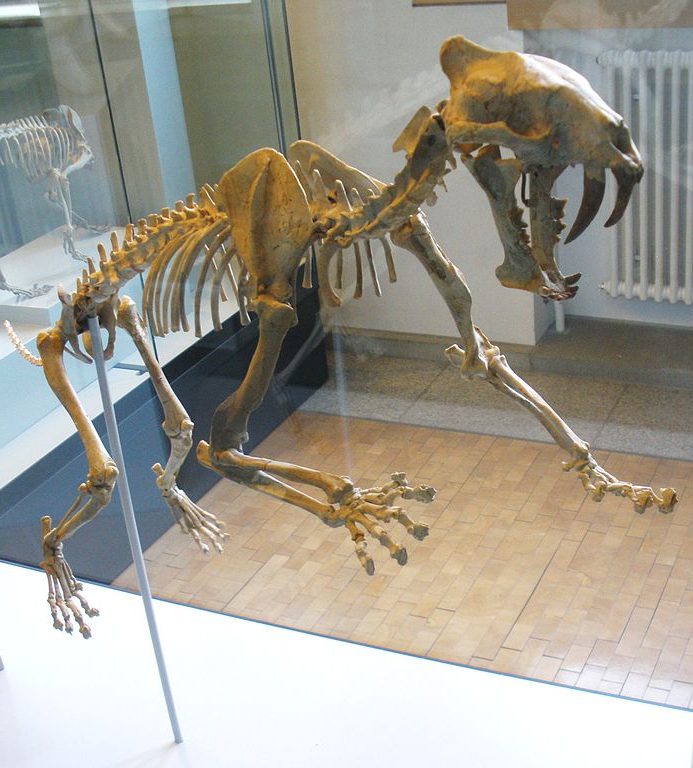
On those floodplains, you didn’t want to turn your back on the nimravid Hoplophoneus. (Image: ghedoghedo via Wikimedia, CC BY- SA 3.0)
I wanted to share that news story from earlier this week with you for two reasons:
- It shows that human fascination with cats and cat-like critters led to the creation of what the story describes as the only known fossil lab in the US national park system where visitors and scientists routinely mingle and chat during the boffins’ working hours.
This is cool — although field work to dig up the nimravid and other fossils is often done in hot and dry conditions.
- I first learned how Felidae-relevant this fossil-rich park is during my quest to find out how cats evolved; when those nimravids died out, North America’s famous “cat gap” began.
But there is much more history here than that!
Here’s a nice overview of the park’s natural history, in case you ever feel like dropping in there someday for a vacation visit.
When it gets to the Oligocene, you’ll hear about the floodplain ecosystem that left bands of color in Badlands Park and see sketches of some of the prey that nimravids hunted. (In case you’re interested, I looked but didn’t find the video about clastic dikes that she mentions.)
H. sapiens is only a few hundred thousand years old, as far as I’ve read. If we had been around when what’s now Badlands NP looked sort of like the nature in this video, we probably would have tried to manage it, too:
Lagniappe:
Yes, there were true dogs on the floodplains, too.
The Brule Formation, where this fossil dog (found on a South Dakota ranch) comes from, is mentioned in the natural history video above.
Edited June 23, 2023.
Featured image: Wick Smith/Shutterstock
 Flight To Wonder