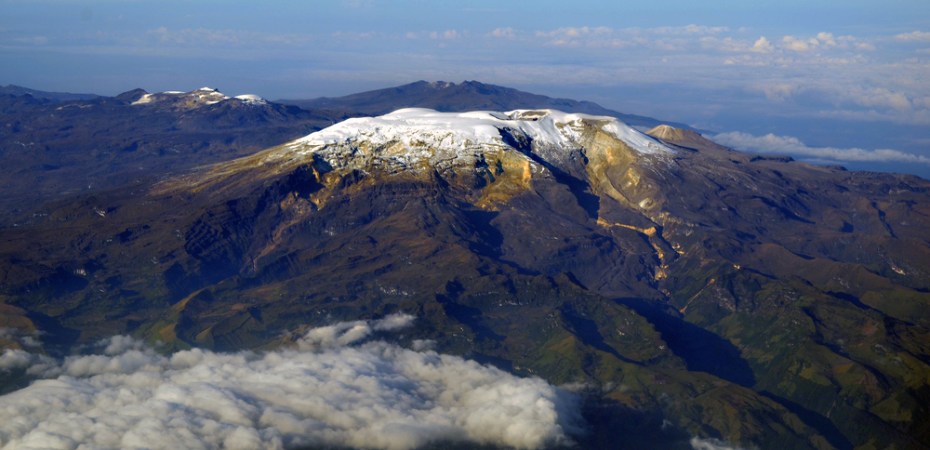
- Status: Orange.
-
Live stream via Telecafe:
Weather permitting. Also, here are links to still-image webcams, public data, and other information.
- Interactive official hazard map (autotranslated), via Relief Web; En español
- Update archive.
Update, June 22, 12:50 p.m., Pacific: Got a late start today, but fortunately, Ruiz has calmed down a little bit.
Lullaby and good night… — I wish!
While hunting up news, I found a new streaming webcam (above), operated by Telecafe, which I think is the region’s public television organization. (That link is in Spanish because Google Translate doesn’t translate it, for some reason.)
Through it, reportedly (autotranslated), people saw incandescence on the night of June 20th, and some expressed concern about it.
The SGC tweeted a response, with information plus the factual statement that such activity is within what is expected at ORANGE alert level, (which Twitter will translate, if you’re signed in there):
🌋Esta incandescencia de ayer 20 de junio a las 09:41 p.m., asociada a una emisión de ceniza y observada a través de una cámara de @canaltelecafe es un fenómeno que está contemplado dentro de los parámetros de un volcán en nivel Naranja y con un comportamiento inestable como el… pic.twitter.com/tRARGYVSg7
— Servicio Geológico Colombiano (@sgcol) June 21, 2023
https://platform.twitter.com/widgets.js
Here is today’s bulletin (emphasis) in the original:
Manizales, June 22, 2023 11:05 a.m.
From the monitoring of the activity of the NEVADO DEL RUIZ VOLCANO, the MINISTRY OF MINES AND ENERGY through the COLOMBIAN GEOLOGICAL SERVICE (SGC) informs that:
From 9:00 a.m. from yesterday (June 21) until the time of publication of this bulletin, the activity of the volcano continues to show variations, observing during the last 24 hours a decrease in seismicity and related surface activity.
The seismic activity associated with the movement of fluids inside the volcanic conduits was mainly characterized by the persistence of continuous signals of low energy, associated with the release of gases and water vapor into the atmosphere. Regarding June 20, there were fewer signals related to pulsating emissions of ash and/or incandescence, which presented lower seismic energy values than those registered the previous day.
Regarding the seismicity associated with the fracturing of the rock inside the volcanic edifice, it was notable decrease in the number of earthquakes and seismic energy, compared to the June 20 record. The earthquakes were located predominantly in the Arenas crater and in the eastern sector, up to a maximum distance of 5 km from the crater. Also some scattered earthquakes were located in other sectors of the volcano. The earthquakes were of low energy with depths ranging from 1 to 5 km.
Regarding the surface activity in the volcano, the column of gases, steam and/or ash reached a maximum height in the vertical of 600 m and in dispersion of 700 m, both values measured from the top of the volcano. The preferential dispersion direction of the column was maintained between the northwest and west-northwest of the volcanic structure. For yesterday (June 21) there was no continuous emission of ash and there were no reports of ash fall.
On the other hand, the variations in the degassing of sulfur dioxide and the output of water vapor from the crater into the atmosphere continued.
Additionally, from the platforms of satellite monitoring, at dawn today, a report of a low-energy thermal anomaly was obtained at the bottom of the crater. The other monitored parameters presented minor variations.
Although in recent weeks the activity of the Nevado del Ruiz volcano had begun to show signs of decrease, in the last six days there has been an increase compared to weeks and it therefore remains unstable. The volcano has not returned to its normal levels of activity and, despite the decrease in his activity in previous weeks, it still could make a major eruption in days or weeks. As we have mentioned, in previous occasions, after presenting important changes in its activity, the volcano Nevado del Ruiz has shown a decrease in its activity before a major eruption. That is to say, first it registers a strong increase in its activity, then a considerable decrease and, subsequently, it makes a major eruption.
Therefore, we reiterate that the activity of the Nevado del Ruiz volcano continues at ORANGE LEVEL, which
indicates that there is a probability that in days or weeks there will be a larger eruption than it has made in the last 11 years (May 29, 2012 was the first minor eruption of this volcano did in its most recent eruptive process). To change level and return to Yellow, a prudential time is required where trends and patterns can be observed that allow inferring the possible decrease in activity, aspects that cannot yet be confirmed. For this reason, following the precautionary principle, the level of activity of the Nevado del Ruiz volcano will remainin ORANGE LEVEL. During this time, in the event of an acceleration of the processes that suggest an imminent eruption or that the eruption itself occurs, the level of activity will be changed to Red.We recommend that the community remain calm, follow all the instructions of the Unit National for Disaster Risk Management (UNGRD) and local authorities, and be attentive to the information provided by the Colombian Geological Service on the evolution of the state of the volcano.
The COLOMBIAN GEOLOGICAL SERVICE will continue to monitor the evolution of the volcanic phenomenon and will inform in a timely manner about the changes that may occur.
For more information visit the following link:
https://www2.sgc.gov.co/Noticias/boletinesDocumentos/Forms/AllItems.aspx
Featured image: Ric Photography/Shutterstock
 Flight To Wonder