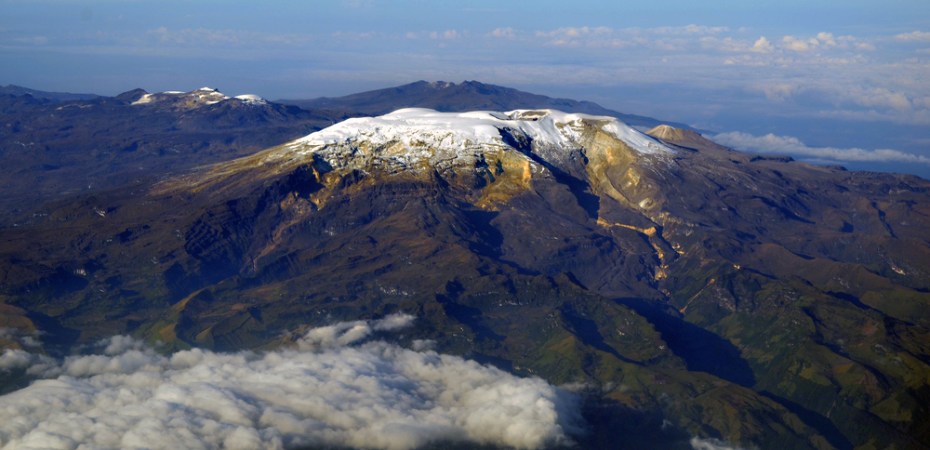
- Status: Orange.
- Interactive official hazard map (autotranslated), via Relief Web; En español
- USAID April 4th map (autotranslated) posted on May 18 at Relief Web.
- Links to webcams, public data, and other information.
- Update archive.
Update, June 21, 10:59 a.m., Pacific: Ruiz kept requiring ash advisories overnight, and one is in effect now, despite their noting that the plume seen on webcam at that point appeared to be mostly steam and gas.
The ash previously erupted still is in the air — even just a little bit like this, I understand, can mess up aircraft.
More recently, one of the online webcams was clear enough to see most of the volcano’s summit area; it’s difficult to tell which is plume and which is weather cloud:

This high up, I see, it can get frosty in the Andes whenever moisture is there.
While looking for news to post, I found an El Tiempo article (autotranslated), based on an interview with Dr. Makario Londoño and perhaps others at the SGC, as well as on unattributed information that was in yesterday’s SGC bulletin.
Some excerpts:
…[S]eismic activity in the Nevado del Ruiz has decreased, according to the SGC, because the magma that was seeking to rise to the surface remained still under a lava dome that is currently at the bottom of the Arenas crater and that was formed after a lava outlet in 2015.
“It is estimated that the magma that generated those earthquakes at the end of March is under the dome, very close to the surface,” says the SGC.
For this reason, the entity warns, thermal anomalies are detected from satellites and it is one of the main reasons why the threat of eruption of the Nevado del Ruiz volcano remains latent .
…
On previous occasions, after presenting important changes in its activity, the Nevado del Ruiz volcano has shown a decrease in its activity before a major eruption. That is to say, first it registers a strong increase in its activity, then a considerable decrease and, later, it makes an important eruption.
“This does not necessarily have to happen always, but the fact that it has happened on previous occasions makes it necessary to pay more attention to the evolution of the volcano’s activity during these days,” Londoño added.
What does it take for it to erupt?
The SGC explained to this newspaper the events that would be needed for the Nevado del Ruiz to erupt.
“If the magma reaches certain levels of superficiality and the thermodynamic and physicochemical conditions are met, it is likely that there will be an eruption of this type. Otherwise, the magma can stay there for a long time, as has happened with the lava dome. which has been at the bottom of the crater for eight years. Everything depends on an unpredictable evolution,” says the entity.
[LAYPERSON SPECULATION]If the magma gets any more superficial, it will dome up as lava.
I don’t know and don’t dare guess what those “thermodynamic and physicochemical conditions” might be — well, okay, I’ll try a guess. “Physicochemical” might refer to gas exsolution and buildup if, say, a sintering process (extreme jargon alert) completely seals the vent. They can’t go down to see if this is happening, but it’s interesting that SO2 isn’t pouring out of the volcano, with lots of magma that close to the surface.
Perhaps the magma is mostly degassed, thanks to the partially open vent and ongoing ten-year eruption.
There might be intermittent blockage.
It also has a lot to do with the magma’s geochemistry and, as noted at that sintering link, temperature. Of course, temperature (“thermodynamics”) plays so many roles in an active volcano — all this layperson can intelligently say after reading many papers and Oppenheimer’s Eruptions That Shook The World. [/LAYPERSON SPECULATION]
Very, very complex: “the entity’s” explanation in that news story has an elegant simplicity.
Here is today’s SGC bulletin via Google Translate (emphasis in the original); it was long enough to trigger GT’s 5,000-character limit for the first time since I’ve been doing this:
Manizales, June 21, 2023 12:05 p.m.
From the monitoring of the activity of the NEVADO DEL RUIZ VOLCANO, the MINISTRY OF MINES AND ENERGY through the COLOMBIAN GEOLOGICAL SERVICE (SGC) informs that:
From 9:00 a.m. from yesterday (June 20) until the time of publication of this bulletin, the activity of the volcano continues to show variations, especially in the seismicity parameter. The seismic activity associated with the movement of fluids inside the volcanic conduits continued predominating, and compared to June 19, it maintained similar levels. some of the seismic signs were associated with pulsatile ash emissions confirmed through the website cameras used for volcanic monitoring. Also, the continuous emission of ash was confirmed recorded from noon to early evening yesterday (June 20).
Regarding the seismicity associated with the fracturing of rock inside the volcanic edifice, this increased in the number of earthquakes and seismic energy, in relation to June 19. The earthquakes were located mainly between 1 and 2 km away to the east-northeast of the Arenas crater, depths between 3 and 4 km from the top of the volcano. In this sector the earthquake was of greater magnitude than this volcano has registered since last May 21: yesterday at 09:51 p.m., of magnitude 2.2 and 4 km deep. To a lesser extent, other registered earthquakes were located in the Arenas crater and in various sectors of the volcano up to a distance of about 8 km from the crater, at depths ranging from 1 to 5 km.
Regarding the superficial activity in the volcano, the column of gases, steam and/or ash reached a maximum vertical height of 1300 m measured from the top of the volcano and presented a preferential direction of ash dispersion towards the west-northwest of the volcanic structure, reaching heights close to 4000 m above the top of the volcano, like the one that could be observe this morning from several places far from it. As in days gone by, yesterday there was ash fall in Manizales (Caldas). Since the wind forecast remains towards the northwest, it is not ruled out that this phenomenon continues to affect the city today, if ash emissions persist. On the other hand, incandescence periods also continue to be observed on nights associated with pulsatile ash emissions (such as the one registered yesterday at 09:41 p.m), a phenomenon that is contemplated within the parameters of a volcano at Orange level and with a very unstable behavior such as that of this volcano today.
Additionally, the variations in the degassing of sulfur dioxide and the output of water vapor from the crater into the atmosphere continue. The variations of the other parameters monitored are still minor.
Although in recent weeks the activity of the Nevado del Ruiz volcano had begun to show signs of decrease, in the last five days there has been an increase compared to weeks and therefore remains unstable. The volcano has not returned to its normal levels of activity and, despite the decrease in its activity in previous weeks, it still could make a major eruption in days or weeks. As we have mentioned, on previous occasions, after presenting important changes in its activity, Nevado del Ruiz volcano has shown a decrease in its activity before a major eruption. That is to say, first it registers a strong increase in its activity, then a considerable decrease and, subsequently, it makes a major eruption.
Therefore, we reiterate that the activity of the Nevado del Ruiz volcano continues at ORANGE LEVEL, which indicates that there is a probability that in days or weeks there will be a larger eruption than it has made in the last 11 years (May 29, 2012 was the first minor eruption of this volcano in its most recent eruptive process). To change level and return to Yellow, it is required a prudential time where trends and patterns can be observed that allow inferring the possible decrease in activity, aspects that cannot yet be confirmed. For this reason, following the precautionary principle, the level of activity of the Nevado del Ruiz volcano will remain in ORANGE LEVEL. During this time, in the event of an acceleration of the processes that suggest an imminent eruption or that the eruption itself occurs, the level of activity will be changed to Red.
We recommend that the community remain calm, follow all the instructions of the Unit National for Disaster Risk Management (UNGRD) and local authorities, and be attentive to the information provided by the Colombian Geological Service on the evolution of the state of the volcano.
The COLOMBIAN GEOLOGICAL SERVICE will continue to monitor the evolution of the volcanic phenomenon and will inform in a timely manner about the changes that may occur.
For more information visit the following link:
https://www2.sgc.gov.co/Noticias/boletinesDocumentos/Forms/AllItems.aspx
Featured image: Ric Photography/Shutterstock
 Flight To Wonder