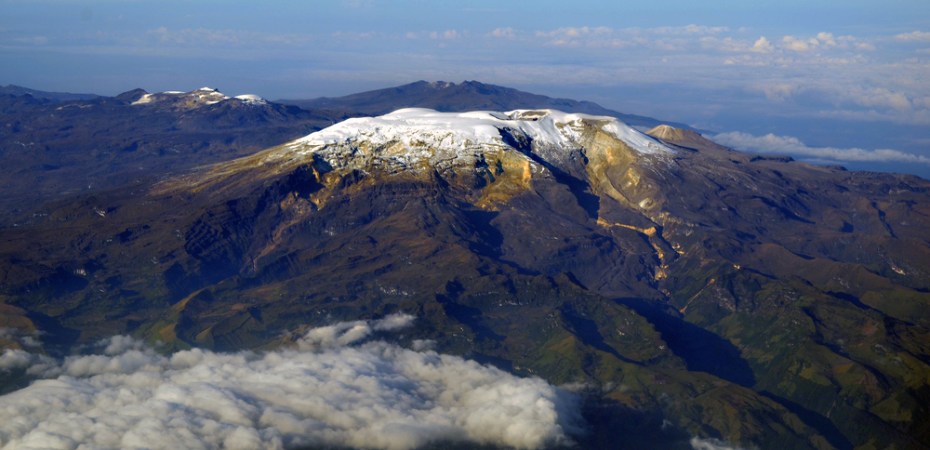
- Status: Orange.
- Interactive official hazard map (autotranslated), via Relief Web; En español
- USAID April 4th map (autotranslated) posted on May 18 at Relief Web.
- Links to webcams, public data, and other information.
- Update archive.
Update, June 20, 12:06 p.m., Pacific: Per SGC, the constant low-level ash emission that began a few days ago has stopped, but Ruiz continues to be impulsive, so to speak.
The current ash advisory describes an ash cloud extending 15 nautical miles from the summit and up to 20,000 feet.
However, this is not at all the massive darkness of a major eruption column that so terrified Pliny the Younger and his mother in AD 79 near Vesuvius.
Yet.
Hopefully, there never will be a plinian-style eruption episode, but one is not impossible, and everybody near Ruiz needs to stay on their guard (as SGC keeps telling us in their bulletins).
In fact, per this source (autotranslated), the UNGRD is calling for some evacuations:
…Taking into account the high threat perimeter of the volcano, the UNGRD explained that there are 40 villages in the municipalities of Herveo, Casabianca, Villahermosa, Líbano and Murillo in Tolima, in addition to nine in the municipality of Villamaría, Caldas. Taking into account that if the volcano goes into red alert these jurisdictions could be affected, they were asked to evacuate preventively.
It is important to take into account that the volcanic flow is dangerous, but one of the great concerns of relief agencies are lahars; avalanches caused by the eruption that end up increasing the flow of rivers and causing high-impact overflows, as happened with the municipality of Armero in 1985.
To take into account: The lahars could even reach Cundinamarca, since there are several rivers that are in the area of influence of the snow-capped mountain and end up flowing into the Magdalena River.
“The populations that are in high threat, located at distances greater than 15 kilometers from the Arenas crater, should take into account that the flow of lahars could move along the Gualí River, from its source to the mouth of the Magdalena River. It would involve the municipalities of Herveo, Fresno, Mariquita, Honda, Falan, Palocabildo and Casabianca, in Tolima, and Guaduas, in Cundinamarca”, said the UNGRD.
Municipalities such as Casabianca, Villahermosa, Murillo, Líbano, Lérida, Ambalema, Armero and Honda , in Tolima, would be at latent risk due to the Azufrado and Lagunilla rivers, meanwhile, the Recio river could affect the jurisdictions of Murillo, Líbano, Lérida, Venadillo and Ambalema , in Tolima. Similarly, in Caldas there is also concern about the Claro and Chinchiná tributaries, which could hit Manizales, Anserma, Neira, Palestina, Chinchiná and Villamaría .
Keep in mind and apply the following recommendations from the UNGRD in the context of the emergency caused by Nevado Ruiz [in November 1985].
They are serious. In that field guide linked on Washington VAAC’s Ruiz page, the volcanologists note that:
The 1985 eruption lasted only 20 to 90 minutes but reduced the area of the ice cap by 16% from 25 km2 to 20.8 km2 (Thouret, 1990). The corresponding volume of snow and ice loss was estimated to be 6 x 10⁷ m3,or about 9% of the pre-eruption total. An additional 25% of the ice cap area was fractured and/or destabilized (Thouret et al., 2007). The catastrophic lahars triggered by the 13 November, 1985, eruption of the ice-clad NRV demonstrate that the interaction of hot pyroclastic deposits with snowand ice could release 30-50 million m3 of meltwater in 30-90 minutes. The 1985 eruption caused a 16% loss in area and a 9% loss in volume of snow, firn and ice. Turbulent pyroclastic density currents mechanically mixed with snow and produced meltwater at a rate of 0.5-1.6mms-1 (Thouret et al., 2007).
Trailer from the movie streamed on Amazon. See lagniappe at end of post.
When it happens, it happens fast — and nobody wants to see casualties, especially not the more than 23,000 who died in what’s now called Antiguo Armero and in other communities in 1985.
Well.
On that cheerless note, here is SGC’s morning bulletin, via Google Translate (emphasis in the original):
Manizales, June 20, 2023 10:30 a.m.
From the monitoring of the activity of the NEVADO DEL RUIZ VOLCANO, the MINISTRY OF MINES AND ENERGY through the COLOMBIAN GEOLOGICAL SERVICE (SGC) informs that:
From 9:00 a.m. from yesterday (June 19) until the time of publication of this bulletin, the seismic activity related to the movement of fluids inside the volcanic conduits continues predominating. Yesterday morning and early afternoon, this type of seismicity showed an increase in the number of earthquakes and in seismic energy. Then, in the course of the afternoon it gradually decreased, until it reached lower seismic energy levels at night, which are maintained until the time of publication of this bulletin. In parallel, at night the continuous emission of ash that began on June 17 in the morning ceased. Also, since last night, pulsatile ash emissions have been associated with these seismic signals. Both types of emissions were confirmed through web cameras used for volcanic monitoring.
Regarding the seismicity associated with the fracturing of rock inside the volcanic structure, this increased in the number of earthquakes and seismic energy, compared to June 18. The earthquakes were of low energy and were located in the Arenas crater and the western sectors, southwestern and southeastern parts of the volcano at distances no greater than 8 km from the crater, at depths that ranged between 1 and 6 km measured from the top of the volcano.
On the other hand, in what has to do with the surface activity in the volcano, the column of gases, steam and/or ash reached a maximum height of 1000 m measured from the top of the volcano and a preferential direction towards the northwest of the volcanic edifice. Yesterday there were reports of falling ash in Manizales and Palestina (Caldas). Also, occasionally, incandescence was associated with one of the pulsatile ash emissions recorded in the evening.
Additionally, the variations in the degassing of sulfur dioxide and the output of water vapor from the crater into the atmosphere continued. In the early hours of today, through the satellite monitoring platforms, new reports of low-energy thermal anomalies were obtained at the bottom of the crater.
Finally, it is important to mention that the variations of the other monitored parameters are still minor.
Although in recent days the activity of the Nevado del Ruiz volcano has begun to show signs of decrease, it also registers some moments of increase with respect to previous days and, therefore, it is still unstable. The volcano has not returned to its normal levels of activity and, despite the decline in its activity, it could still erupt in a major way in days or weeks. As we have mentioned, on previous occasions, after presenting important changes in its activity, the Nevado del Ruiz volcano has shown a decrease in its activity before a major eruption. That is to say, first it registers a strong increase in its activity, then a considerable decrease and, subsequently, makes a major eruption.
Therefore, we reiterate that the activity of the Nevado del Ruiz volcano continues at ORANGE LEVEL, which indicates that there is a probability that in days or weeks there will be a larger eruption than the volcano has made in the last 11 years (May 29, 2012 was the first minor eruption than this
volcano did in its most recent eruptive process). To change level and return to Yellow, requires a prudential time where trends and patterns can be observed that allow infer the possible decrease in activity, aspects that it is not yet possible to confirm. For this, following the precautionary principle, the level of activity of the Nevado del Ruiz volcano will remain in ORANGE LEVEL. During this time, in the event of an acceleration of the processes that suggest an imminent eruption or that the eruption itself occurs, the level of activity will be changed to Red.We recommend that the community remain calm, follow all the instructions of the Unit National for Disaster Risk Management (UNGRD) and local authorities, and be attentive to the information provided by the Colombian Geological Service on the evolution of the state of the volcano.
The COLOMBIAN GEOLOGICAL SERVICE will continue to monitor the evolution of the volcanic phenomenon and will inform in a timely manner about the changes that may occur.
For more information visit the following link:
https://www2.sgc.gov.co/Noticias/boletinesDocumentos/Forms/AllItems.aspx
Lagniappe:
Very necessary after that 1985 reminder:
By the way, I keep forgetting to mention that Google Translate is not perfect, and I know enough Spanish to clean up some of its mistakes on a purely grammatical level — things like “volcanic structure” for “structure volcanic.”
I also must add back in the SGC’s bolding of emphasized text and hope I have done that correctly each day.
Featured image: Ric Photography/Shutterstock
 Flight To Wonder