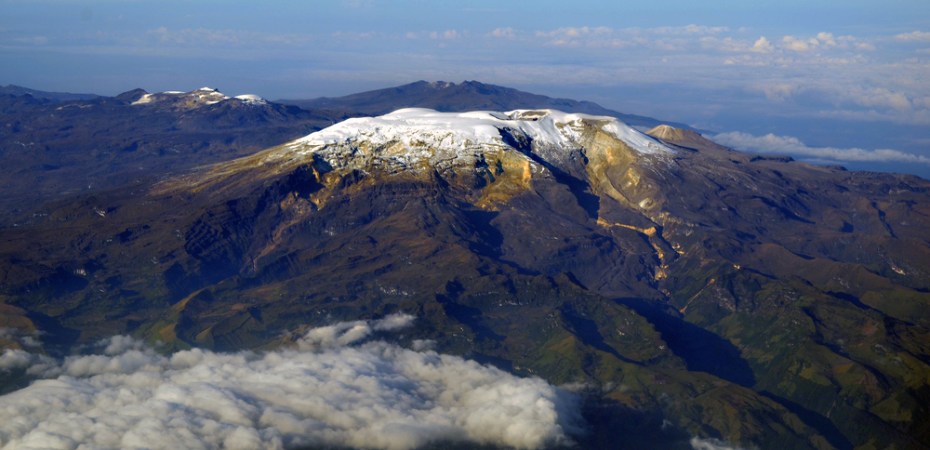
- Status: Orange.
- Interactive official hazard map (autotranslated), via Relief Web; En español
- USAID April 4th map (autotranslated) posted on May 18 at Relief Web.
- Links to webcams, public data, and other information.
- Update archive.
Update, June 18, 9:38 a.m., Pacific: This morning the summit was clear, and I saved two webcam images that show how unstable the volcano can be.
Early (check image UTC time stamp), I saw this through the Cerro Guali cam:

Less than an hour later, that plume had changed to this:

I think the military sometimes censors images of their Cerro Guali base.
Yes, it’s disconcerting when a huge mountain behaves somewhat like a curtain blowing in the wind.
[LAYPERSON SPECULATION]At least Ruiz is somewhat open at the moment, so more explosive pressure might not be building up; however, with magma so close to the surface, I wish more SO2 was coming out.[/LAYPERSON SPECULATION]
A series of ash advisories has been issued over the last 24 hours, with the most recent one still in effect.
As the SGC notes in today’s bulletin (emphasis in the original), Manizales has had some ashfall, and they’ll probably get it again today:
Manizales, June 18, 2023 10:30 a.m.
From the monitoring of the activity of the NEVADO DEL RUIZ VOLCANO, the MINISTRY OF MINES AND ENERGY through the COLOMBIAN GEOLOGICAL SERVICE (SGC) informs that:
From 9:00 a.m. yesterday (June 17) until the time of publication of this bulletin, it has been observed an increase in seismicity related to the movement of fluids within the volcanic conduits. Compared to June 16, this seismic activity has shown levels similar in the number of earthquakes and increase in the level of seismic energy released, although, in general terms, the maximum values of seismic energy registered in the second week of May, it is observed that the signs of low energy have been sustained for more time.
Regarding the seismicity associated with the fracturing of rock within the volcanic structure, this continued with low levels in the number of earthquakes and increased seismic energy, compared to June 16. The earthquakes were located mainly to the west of the volcano, at a distance approximately 8 km from the Arenas crater, with depths between 4 and 6 km. The maximum magnitude registered was 1.1, corresponding to the earthquake registered yesterday at 05:34 p.m. Prior to publication of this bulletin, some small earthquakes have been registered in the northeastern sectors and southeast of the volcano.
On the other hand, the superficial activity in the volcano has been characterized by the continuous emission and several confirmed pulsatile ash emissions via the webcams used for the
volcanic monitoring and other external sources. Some of these were associated with small incandescence in the Arenas crater – generated by the heat of the material emitted at high temperatures – as observed last night at 09:21 p.m. and 09:56 p.m. The column of gases, steam and/or ash presented a maximum height of 1500 m measured from the top of the volcano and a direction preferential to the northwest of the volcanic edifice. Yesterday, in the afternoon, and this morning, a report of ash fall in Manizales (Caldas) was received. According to the forecast of the wind, it is not ruled out that this phenomenon continues to affect the city today.Additionally, the variations in the degassing of sulfur dioxide and the output of water vapor from the crater to the atmosphere continued. There were no reports of thermal anomalies on the bottom of the Arenas crater, given the high cloudiness conditions at the time of capturing the image from the satellites, which does not indicate that they are not still present.
Finally, it is worth mentioning that the variations of the other monitored parameters continue being minor.
The activity of the Nevado del Ruiz volcano, although still unstable, has begun to show signs of decrease with some moments of increase compared to previous days. It is important to remember that this does not imply that the volcano has returned to its normal levels of activity. Despite the decline in its activity, it could still make a major eruption in days or weeks. As we have mentioned, on previous occasions, after presenting important changes in its activity, the Nevado del Ruiz volcano has shown a decrease in its activity before a major eruption. That is, it first registers a strong increase in its activity, then a considerable decrease, and then a major eruption.
Therefore, we reiterate that the activity of the Nevado del Ruiz volcano continues at ORANGE LEVEL, which indicates that there is a probability that in days or weeks there will be a larger eruption than the volcano has done in the last 10 years. To change level and return to Yellow, a period of time is required where trends and patterns can be observed that allow inferring the possible decrease in activity, aspects that cannot yet be confirmed. For this reason, following the precautionary principle, the level of activity of the Nevado del Ruiz volcano will remain at LEVEL ORANGE. During this time, in the event of an acceleration of the processes that suggests an imminent eruption or the eruption itself, the level of activity will change to Red.
We recommend that the community remain calm, follow all the instructions of the Unit National for Disaster Risk Management (UNGRD) and local authorities, and be attentive to the information provided by the Colombian Geological Service on the evolution of the state of the volcano.
The COLOMBIAN GEOLOGICAL SERVICE will continue to monitor the evolution of the volcanic phenomenon and will inform in a timely manner about the changes that may occur.
For more information visit the following link:
https://www2.sgc.gov.co/Noticias/boletinesDocumentos/Forms/AllItems.aspx
Featured image: Ric Photography/Shutterstock
 Flight To Wonder