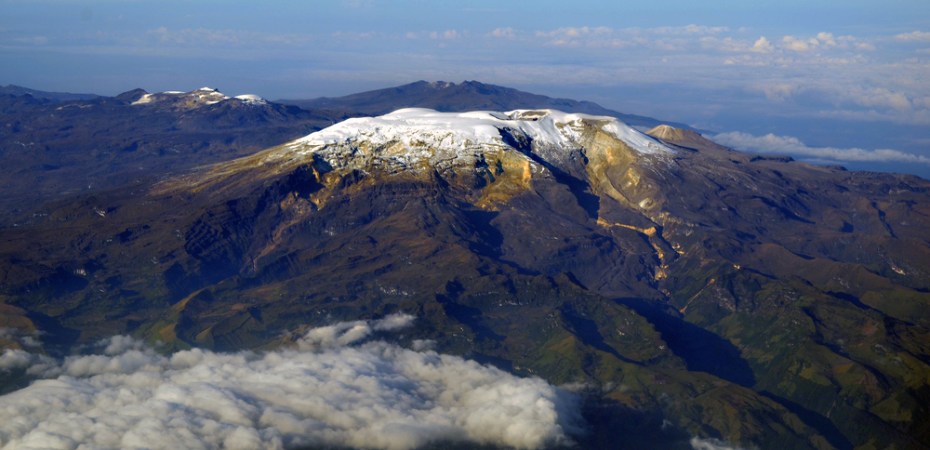
- Status: Orange.
- Interactive official hazard map (autotranslated), via Relief Web; En español
- USAID April 4th map (autotranslated) posted on May 18 at Relief Web.
- Links to webcams, public data, and other information.
- Update archive.
Update, June 17, 10:51 a.m., Pacific: It’s a mixed bag today. The SGC still reports that activity is in decline BUT there is significant increase in the movement of fluids in the conduit and a continuous ash emission that probably began yesterday.
Indeed, a VAAC advisory is in effect:
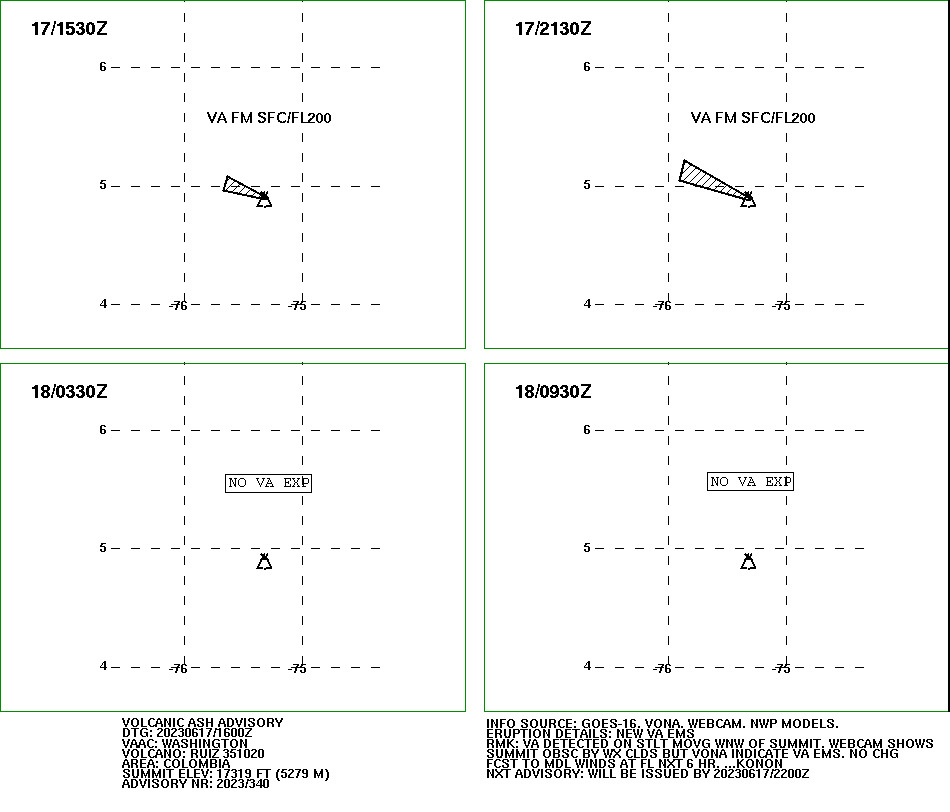
This seemingly contradictory information makes sense to me this way:
- [LAYPERSON SPECULATION]Ruiz has been erupting at a relatively low level for ten years now. So, continuous ash emission is not unusual behavior right now.
- The main concern is that this relatively stable eruption process could suddenly go nonlinear without warning:
Pressure cookers on hot burners go nonlinear without warning, too.
- The probability of such an event destabilizing the current eruption might be dropping now. [/LAYPERSON SPECULATION]
As Dr. Makario Londoño said in interviews earlier this week, the ash emissions show that the Ruiz system has not yet completely stabilized but all other parameters appear to be settling down.
However, note what the SGC continues to say about this volcano’s past behavior before a major eruption (emphasis in the original June 17th bulletin):
Manizales, June 17, 2023 10:00 a.m.
From the monitoring of the activity of the NEVADO DEL RUIZ VOLCANO, the MINISTRY OF MINES AND ENERGY through the COLOMBIAN GEOLOGICAL SERVICE (SGC) informs that:
From 9:00 a.m. yesterday (June 16) until the time of publication of this bulletin, the activity of this volcano continues to show, in general terms, low levels. Variations in most of the monitored parameters continue to be lower, although a slight increase compared to previous days.
In the last 24 hours, there has been a notable increase in the seismicity related to the movement of fluids inside the volcanic conduits that has been recorded since June 15. This type of increase has not been observed since the second week of May; however, the energy of seismic signals so far has been minor. Some of the demonstrations in surface of this increase in seismicity, there have been several pulsatile emissions of ash confirmed through the web cameras used for volcanic monitoring. One of these emissions, registered last night at 11:04 p.m., was associated with a small incandescence in the Arenas crater, generated by the heat of the material emitted at high temperatures. Also, from 08:27 a.m. today, it was possible to confirm the continuous emission of ash that has been registered probably since yesterday morning.
On the other hand, the record of the seismicity associated with the fracturing of rock within the volcanic structure was occasional and decreased, in the number of earthquakes and in seismic energy, in comparison with June 15. The earthquakes were of very low energy.
Regarding the monitoring of surface activity, the column of gases, steam and/or ash presented a maximum height of about 800 m measured from the top of the volcano. The address of dispersion was variable between the northwest and southwest of the volcanic edifice. Additionally, the variations in the degassing of sulfur dioxide and the output of water vapor from the crater to the atmosphere continued.
The activity of the Nevado del Ruiz volcano, although still unstable, has begun to show signs of decline. It is important to remember that this does not imply that the volcano has returned to its normal activity levels. Despite the decrease in activity, it could still have a major eruption in days or weeks. As we have mentioned on previous occasions, after presenting important changes in its activity, the Nevado del Ruiz volcano has shown decreased activity before a major eruption. That is, first it records a sharp increase in his activity, then a considerable decrease, and then it has a major eruption.
Therefore, we reiterate that the activity of the Nevado del Ruiz volcano continues at ORANGE LEVEL, which indicates that there is a probability that in days or weeks there will be a larger eruption than the volcano has done in the last 10 years. To change level and return to Yellow, a period of time is required where trends and patterns can be observed that allow inferring the possible decrease in activity, aspects that cannot yet be confirmed. For this reason, following the precautionary principle, the level of activity of the Nevado del Ruiz volcano will remain at LEVEL ORANGE. During this time, in the event of an acceleration of the processes that suggest an imminent eruption or the eruption itself, the level of activity will change to Red.
We recommend that the community remain calm, follow all the instructions of the Unit National for Disaster Risk Management (UNGRD) and local authorities, and be attentive to the information provided by the Colombian Geological Service on the evolution of the state of the volcano.
The COLOMBIAN GEOLOGICAL SERVICE will continue to monitor the evolution of the volcanic phenomenon and will inform in a timely manner about the changes that may occur.
For more information visit the following link:
https://www2.sgc.gov.co/Noticias/boletinesDocumentos/Forms/AllItems.aspx
Featured image: Ric Photography/Shutterstock
 Flight To Wonder